Burg Veldenstein: A Medieval Hilltop Castle in Bavaria


Site at a Glance
- Rating
- 4
- Popularity
- Low
- Country
- Germany
- Primary era
- Medieval
- External website
- Open
- Eras represented
- Medieval, Modern
- Civilizations
- German, Holy Roman Empire
- Site type
- Military
- Remains
- Castle
On this page14 sections
History
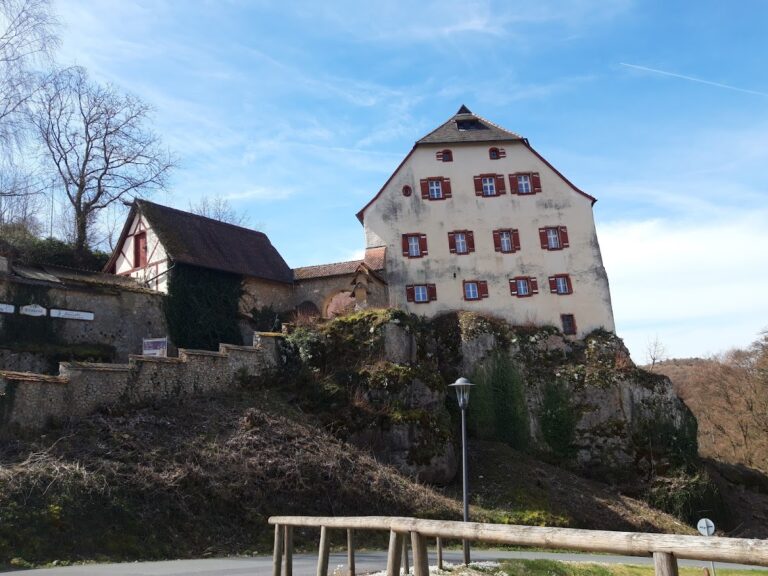
Burg Veldenstein is a medieval hilltop castle in Germany above Neuhaus an der Pegnitz, in Bavaria. Its construction date and founder remain uncertain, although tradition connects it with border defenses ordered in 1008 by the bishop of Eichstätt on behalf of Emperor Conrad II. The castle occupies a defensible position at the southern end of the Veldensteiner Forest and later became an administrative and residential center of the Bamberg bishopric.
Origins and Bamberg administration
The castle first appears in written evidence in 1269 under the name novum castrum, meaning “new castle.” It then belonged to the Bamberg bishopric, the ecclesiastical territory governed by the bishops of Bamberg, and functioned as an administrative seat for the surrounding lands. The name Veldenstein was first recorded in 1323.
In its early phase, the castle offered refuge to nearby peasants during periods of danger. Local officials administered it, and from the fourteenth century noble representatives of the Bamberg bishops held office there. The families von Stor, von Egloffstein, and von Wiesenthau received the castle and its administrative district as fiefs.
Expansion into a residential fortress
Hans von Egloffstein carried out a substantial rebuilding campaign in the early fifteenth century, including work on the inner castle. Bishop Georg I von Schaumberg later recovered Veldenstein from the Egloffstein family. During the tenure of his successor, Philipp von Henneberg, from 1475 to 1487, the complex underwent major expansion.
Veldenstein then became a residential castle of the Bamberg bishops. Later bishops visited it to receive the hereditary homage of their subjects. The fortress also played a military role. It was regarded as one of the strongest fortresses in its region and endured repeated attacks, although Brandenburg and Nuremberg forces damaged it during conflicts in the sixteenth and seventeenth centuries.
War, destruction, and decline
During the Thirty Years’ War, the European conflict fought mainly between 1618 and 1648 amid religious, dynastic, and territorial struggles, Swedish troops occupied Veldenstein in 1632. Bavarian forces took control in 1635. The Bamberg bishops restored the castle by the end of the seventeenth century and resumed using it as a residence.
In 1708, lightning struck the powder tower. The resulting explosion and fire destroyed much of the complex. The bishops subsequently abandoned residential use, and the ruins gradually deteriorated. Following the secularization associated with the 1801 Treaty of Lunéville and Napoleonic policy, Bavarian authorities sold the castle. During the nineteenth century it passed repeatedly between private owners, with different sections temporarily held by different people.
Private restoration and twentieth-century changes
Wolfgang Brunnhuber sold his portion to the retired district court official Carl Heinrich Friedrich August May in 1861. May acquired the tower, the former senior administrative residence, the main portal, and the walls from Anna Sturm in 1863, bringing the property back under one owner. He began restoring the residential areas that year and died at the castle in 1873.
May’s widow, Anna Regina May, and their five children inherited the property. She continued the reconstruction, including restoration of the main tower in 1875 and renovation of the building ring during the 1890s. In 1897 the castle was sold to Hermann von Epenstein, a Berlin landowner and military physician. Before 1914, he spent approximately one million marks on restoration. The Nuremberg stonemason Johann Groschel directed work lasting nearly a decade, repairing walls, towers, and gates while seeking to recover the castle’s former appearance.
After von Epenstein’s death, his widow Elisabeth inherited Veldenstein and sold it in 1939 to Hermann Göring, then a Reich Minister in Nazi Germany. Göring visited the castle regularly for hunting, renovated parts of it, and had a bombproof bunker built beneath the manor house in 1942.
Capture, public ownership, and conservation
American forces captured the castle after a brief engagement in 1945. Searching for rumored art treasures associated with Göring, they broke into parts of the buildings with pneumatic hammers. The search found a box containing 36 old table lamps, as well as wine, champagne, and cognac.
After the American withdrawal, the castle housed up to approximately 100 refugees, and some rooms were divided into separate living quarters. The Free State of Bavaria became the owner in 1950 and placed the castle under monument protection. From 1968 the complex was used by a falconry enterprise. In 1972 the local Kaiser Brau company leased it, converting the former manor house into a hotel and restaurant. The complex opened to the public in 1974, while several private apartments remained on the grounds.
The lease ended on 31 December 2012, after which the hotel and apartments were cleared and the castle stood vacant. In May 2013, about 300 tonnes of rock and sections of the castle wall collapsed, damaging a house below the hill and leading to the evacuation of 16 residents. The castle remained closed for approximately 14 months and later faced renewed closure because of safety concerns. Investigations attributed the rockfall to inadequate rainwater drainage. Extensive structural repairs followed, and the major renovation was completed in 2023. Burg Veldenstein is protected in Bavaria as both a listed architectural monument and an archaeological monument, and it is also listed as restored and having museum status.
Remains
Castle layout and defensive structures
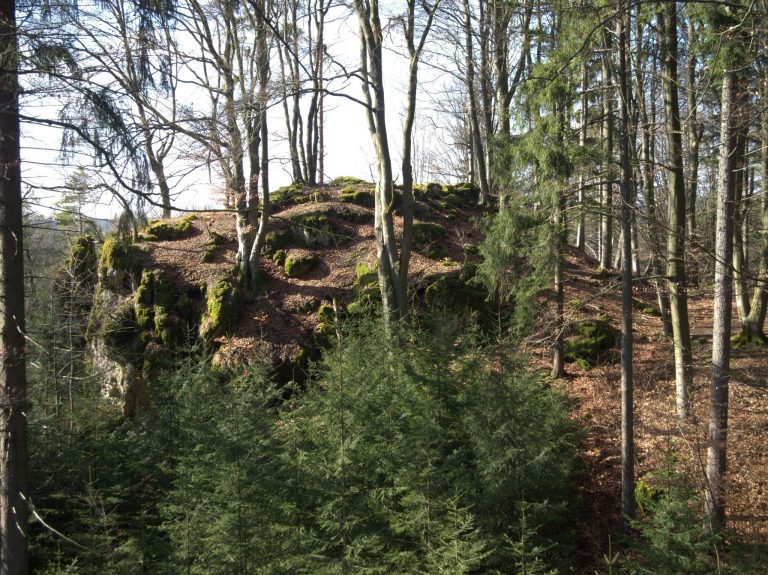
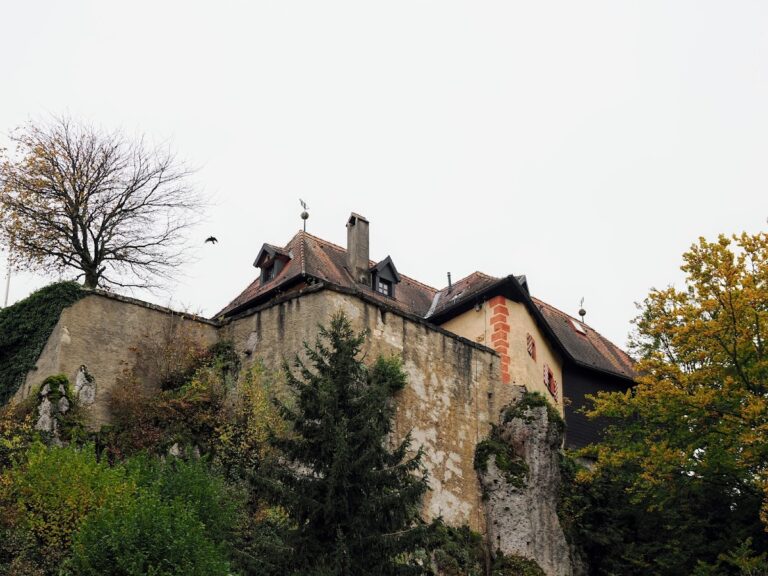
Burg Veldenstein occupies a spur at approximately 419 metres above sea level above Neuhaus an der Pegnitz, within a predominantly wooded landscape at the southern end of the Veldensteiner Forest. The earliest castle was reportedly little larger than the area occupied by its keep. Later building phases created an inner castle and an outer castle, linked by defensive walls, a protected wall-walk, and an outer defensive enclosure.
Principal tower and inner castle
The inner castle contains the principal tower, or keep, the main fortified tower of a medieval castle. Its restoration was completed in 1875. The surviving complex also includes additional towers, defensive walls, gates, and the former senior administrative residence, which is incorporated into one of the towers. Together these elements preserve the division between the central fortified area and the expanded outer defenses.
Outer defenses and collapse area
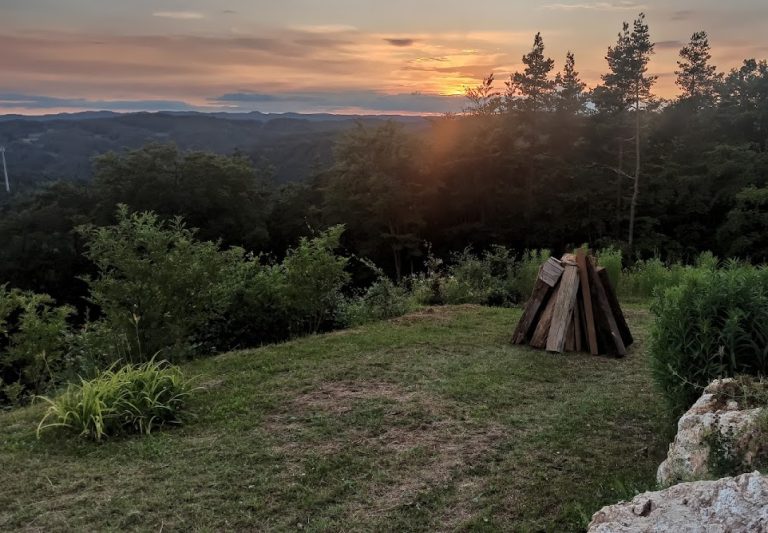
The outer castle retains its defensive walls, gates, wall-walk, and outer enclosure. In 2013, a major section of the fortification wall and adjacent rock fell into the valley. A viewing platform was created at the collapse site, while the surviving structures underwent extensive stabilization and renovation.
Manor house and underground bunker
Manor house
A nineteenth-century manor house replaced a grain store in 1863. The building was later converted into a hotel and restaurant. It forms part of the castle’s surviving group of residential structures and remains physically associated with the underground bunker built beneath it.
Underground bunker
A bombproof bunker was constructed beneath the manor house in 1942. It had independent electricity, air purification, and water supply. Its position beneath the residential building reflects the twentieth-century alteration of the medieval complex during Göring’s ownership.
Evidence of postwar reuse
The northeast tower preserves a visible trace in its parquet flooring. The mark shows where a partition wall divided the building into separate rooms when the castle provided housing for refugees after the Second World War.