Burg Schärding: A Medieval Castle and Urban Fortification in Austria


Site at a Glance
- Rating
- 4.7
- Popularity
- Low
- Country
- Austria
- Primary era
- Medieval
- Eras represented
- Medieval, Early Modern
- Civilizations
- Duchy of Bavaria, Holy Roman Empire
- Site type
- Military
- Remains
- Castle
On this page11 sections
History
Burg Schärding is a medieval castle in Austria that probably originated in the twelfth century above the Inn on a granite rock. The Counts of Formbach are considered its likely builders, and the castle is first mentioned in 1150. It later became part of the possessions of the Andechs and then the Babenbergs, while Duke Leopold VI of Austria commissioned the first masonry castle to replace earlier wooden defensive works.
Medieval lordship and fortification
The castle passed by inheritance to the Andechs in 1160 and to the Babenbergs in 1230. The Babenbergs were a medieval dynasty that ruled Austria first as margraves and later as dukes. From 1248 to 1357, the dukes of Bavaria controlled both Schärding and its castle.
In 1357, Duke Albrecht I of Bavaria-Straubing pledged Schärding, its surrounding territory, and its toll rights to the dukes of Austria for 20,000 gold gulden. The pledge helped him raise an army against incursions from Bohemia. The Peace of Schärding, concluded on 29 September 1369, transferred Tyrol to Austria while returning Schärding to Bavaria. The castle and town then remained Bavarian until 1705.
During the expansion of the fortifications, Duke Ludwig the Bearded ordered the construction of the town moat, the outer castle gate, and Schärding’s major gates between 1429 and 1436. These works strengthened the castle’s place within the wider defensive system of the town.
War, fire, and destruction
Austrian troops captured and occupied Schärding and its castle in early 1705 during the War of the Spanish Succession, a European conflict over the inheritance of the Spanish monarchy. After the Peace of Rastatt, Bavarian regiments returned to the castle in early 1715.
On 18 June 1724, cannon fire during a Corpus Christi procession, a Christian feast honoring the Eucharist and traditionally marked by a public procession, caused a fire in the town. Thirty-two houses and the castle burned. The administrative buildings were repaired, while the principal residential and representational building, known as the palas, remained in ruins. Arson caused another fire on 9 November 1775, further damaging the affected buildings. The Peace of Teschen returned Schärding to Austria in 1779.
The castle was finally destroyed during the French Wars in 1809 and was not rebuilt. Fire debris was used to fill the castle moats. Since 1895, the grounds have been laid out as a park, and the City of Schärding owns them.
Remains
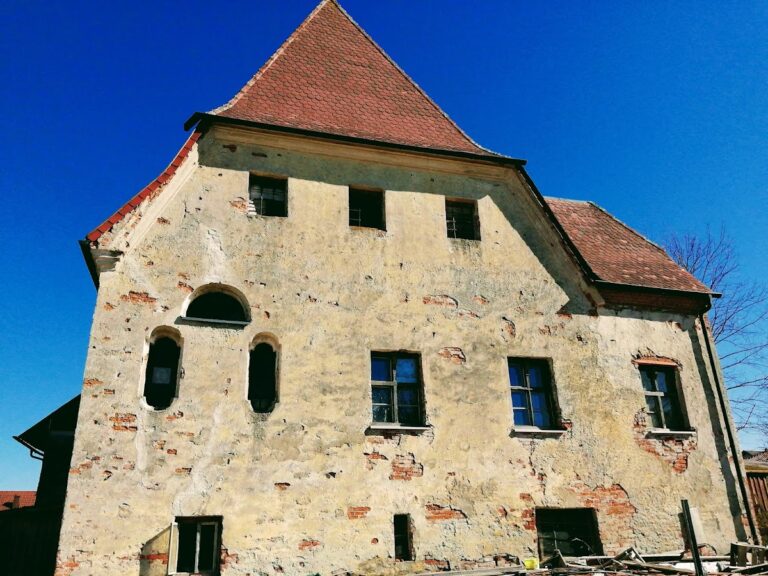
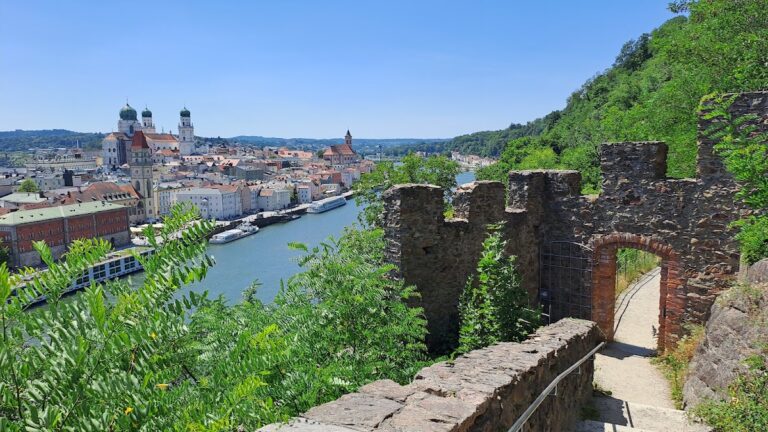
The surviving castle occupies part of the former urban fortification on the granite rock above the Inn, within Schärding’s city park. The remains include stretches of defensive wall, the castle moat with its fortified Zwinger wall, the outer gate tower, former courtyard buildings, a reconstructed well, and elements of a medieval water system.
Walls, moat, and entrance
Outer gate tower
The Schlosstor, or outer gate tower, was built in phases in 1430 and 1570. It formed the outermost castle tower and originally had four storeys. The building served as the residence of the ducal castle warden and could be reached only by a bridge across the castle moat until 1809. It now houses a local-history museum.
Defensive walls and moat
Several stretches of the castle wall survive together with the moat and its Zwinger wall. A Zwinger is a fortified space between defensive walls, designed to expose attackers as they approached the inner defenses. The moat belongs to the castle’s defensive layout and was later filled with fire debris after the destruction of 1809.
Courtyard buildings and water system
Former granary
Buildings within the castle courtyard formed part of the former castle complex. The former granary survives in reused form as the home of the music school, preserving one element of the courtyard’s building group.
Castle well and medieval pipes
A castle well reaches 26 metres below the grounds. It was rediscovered and reconstructed in 2003. The site also preserves wooden water pipes from a medieval fountain system, adding evidence of how water was supplied within the castle complex.
Cannon from the French Wars
A cannon commemorating the French Wars of 1809 is associated with the castle grounds. It recalls the conflict during which the castle was destroyed and its remains were not rebuilt.