Burg Beeskow: A Moated Castle and Cultural Center in Germany



Site at a Glance
- Rating
- 4.3
- Popularity
- Low
- Country
- Germany
- Primary era
- Medieval
- External website
- Open
- Eras represented
- Medieval, Early Modern
- Civilizations
- Holy Roman Empire
- Site type
- Military
- Remains
- Castle
On this page9 sections
History
Burg Beeskow is a moated castle in Beeskow, Germany, whose buildings reflect successive phases from the thirteenth through the sixteenth century. Its origins are dated to around 1272, and the castle first appears in written records in 1316. It stood within the Middle March, a historical region of the central eastern German borderlands, and formed part of a defensive network of water castles.
The Lords of Strehle and Bieberstein
The castle belonged to the Lords of Strehle and was associated with the Strehle lordship of Beeskow–Storkow. Together with Burg Storkow and the castles of Lieberose and Friedland, it belonged to a wider group of strongholds connected with the region’s medieval rule and defense.
Between 1377 and 1382, ownership passed through inheritance to the Lords of Bieberstein. In 1518, Ulrich von Bieberstein pledged the castle to Dietrich von Bülow, Bishop of Lebus. The bishop expanded Burg Beeskow into an episcopal residence, giving the complex a new institutional role.
Brandenburg and Hohenzollern rule
In 1556, the castle and its lordship passed to Margrave Johann I of Brandenburg-Küstrin. After his death, they came permanently into the possession of the Brandenburg electors in 1575. They thereafter belonged to the Hohenzollern dynasty, a German ruling family that supplied Brandenburg’s electors and later Prussia’s kings and Germany’s emperors.
Gebhard XXIII von Alvensleben held the Beeskow lordship as a pledge from 1625 to 1627, jointly with the Storkow lordship, and lived in Burg Beeskow. The Hohenzollerns later used the castle as an administrative building until 1915. Beeskow then acquired the complex and continued to use it for administrative and economic purposes.
War, adaptation, and cultural use
Fighting at the end of the Second World War caused the east wing to burn out in 1945. After the war, the castle provided accommodation for refugees from East Prussia and Silesia.
In 1991, the district parliament decided to convert the complex into a cultural and educational center. The conversion into an exhibition center was completed in 2017. Burg Beeskow now houses the Beeskow Art Archive, whose collection contains about 23,000 objects, chiefly paintings, prints, drawings, and watercolors, alongside photographs, sculptures, applied art, and medals. Until 1990, these works belonged to parties, mass organizations, and state institutions of the German Democratic Republic, the East German state that existed from 1949 to 1990.
A regional museum devoted to the historical, ethnographic, and ecological themes of the Beeskow–Storkow region was established in the complex, together with a medieval collection and a torture cellar. Temporary exhibitions focus mainly on art of the German Democratic Republic. A music museum opened at the castle in May 2018, and the Oder-Spree Museum opened in the gallery rooms in June 2021.
Burg Beeskow belongs with the castles of Storkow and Friedland to the Strele Castles association, a regional heritage network linking strongholds connected with the historical Strehle or Strele lordship. The association emphasizes cultural activity in the Oder-Spree district and remembrance of their shared history of rule. The courtyard and the ramparts behind the castle were renovated in 2022, and the complex is protected as a listed monument.
Remains
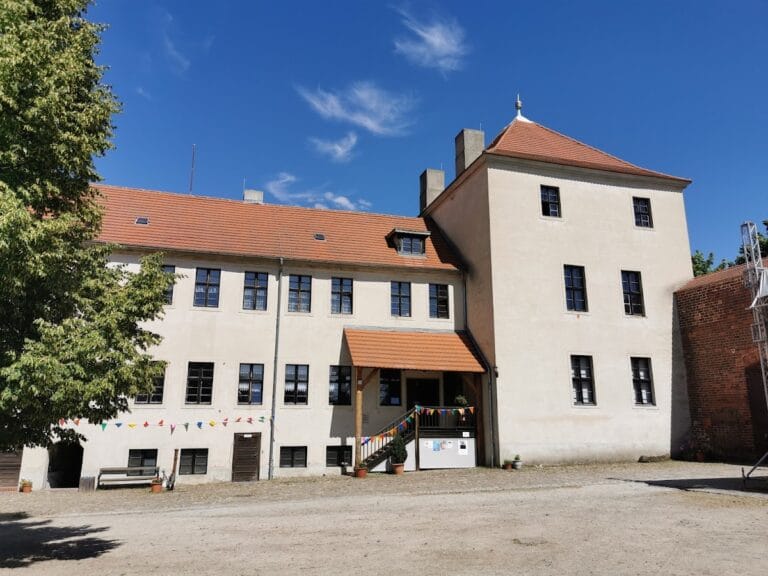
Burg Beeskow is a lowland water castle, meaning that it stands in relatively flat terrain and is surrounded or partly protected by water. The complex occupies an island in the Spree within the town of Beeskow. Its surviving buildings represent successive construction phases extending broadly from the thirteenth to the sixteenth century, while galleries, museum rooms, and archive spaces now occupy parts of the historic complex.
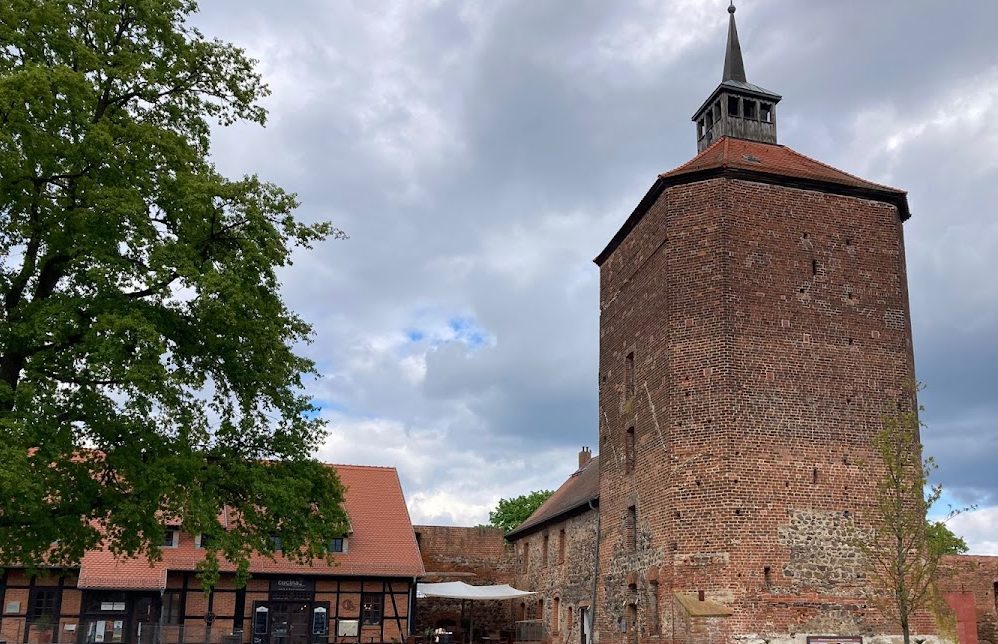
Castle tower
A tower approximately 30 metres high forms part of the castle complex and serves as a viewing point. It remains one of the principal vertical elements of the lowland castle.
Administrative building
The administrative building was renovated in 2018. It contains a concert hall, a musical-instrument museum, and the Oder-Spree Museum, which opened in the castle’s gallery rooms in 2021.
Residential and exhibition buildings
The Vorsteherhaus is a residential building within the complex. Its name refers to a house for an administrator or official. Other rooms and gallery spaces accommodate exhibitions and the Beeskow Art Archive, allowing the historic buildings to support cultural and educational functions.
East wing and grounds
The east wing was burned out during the wartime fighting of 1945. The castle courtyard and the ramparts behind the castle were renovated in 2022, preserving the surviving grounds as part of the complex’s present form.
Nearby sites