Ruine Falkenberg: A Medieval Hilltop Castle in Germany


Site at a Glance
- Rating
- 5
- Popularity
- Very Low
- Country
- Germany
- Primary era
- Medieval
- Eras represented
- Medieval
- Civilizations
- Holy Roman Empire
- Site type
- Military
- Remains
- Castle
On this page9 sections
History
Ruine Falkenberg is a medieval castle ruin in Germany, located in the Falkenberg district of Wabern. It was probably built around the middle of the thirteenth century by Konrad von Hebel on a strategically important route toward Fritzlar, Gudensberg, and Kassel. The castle first appears in a record from 1250 under the name “Valkenberc,” where Konrad was the first witness in a document issued by Count Gottfried I of Ziegenhain.
The Falkenberg family and its fiefs
From around 1270, Konrad von Hebel’s descendants began using the family name von Falkenberg. His son Otto I was among the first to adopt it, while Konrad’s brother Heinrich remained at Hebel and continued to use the name von Hebel. In the fourteenth century, Otto I’s three sons divided the family into the Falkenberg, Densberg, and Herzberg lines.
In 1309, Johann and Konrad von Falkenberg transferred their allodial castle, meaning property held as their own rather than as a fief, to Landgrave Johann of Lower Hesse. They immediately received the castle and the villages of Falkenberg, Uttershausen, Hebel, and Mardorf back as feudal holdings. The Lower Castle followed a different legal arrangement, since it was a fief of Hersfeld held by the lords of Hebel.
Between Mainz and Hesse
Falkenberg became entangled in the long political and military rivalry between the Archbishopric of Mainz and the Landgraviate of Hesse. Mainz was both an ecclesiastical territory ruled by an archbishop and a major secular power, while Hesse was governed by a landgrave, a high-ranking territorial ruler. The Falkenberg and Hebel families shifted their alliances as both powers sought control of castles and routes in the region.
In 1321, several members of the families entered a hereditary military and administrative relationship with the nearby Mainz city of Fritzlar. They included Hermann von Gruna, the Fritzlar canon Hermann von Falkenberg, the knight Johann von Falkenberg, and the squires Konrad Hebel and Thilo Hebel. Falkenberg Castle was made an open house for the archbishop, placing it at Mainz’s disposal for military use or refuge. This arrangement was renewed in 1322 with Archbishop Matthias, in 1336 by Johann Gruszing von Falkenberg for Baldwin of Luxembourg, administrator of the Mainz archbishopric, and in 1338 by Thilo and Hermann von Falkenberg.
In 1338, the Falkenbergs also received Rockshausen, Wolfershausen, Beisheim, and Kleinbeisheim from the landgrave of Hesse. In return, they were required to keep Falkenberg open to the landgrave against all enemies except Mainz. Landgrave Heinrich II of Hesse asserted feudal overlordship over the castle in 1347. Seven years later, Archbishop Gerlach formally ceded Falkenberg to Hesse and acknowledged that it could not be used militarily against the landgraviate.
Conflict and changing control
The settlement did not end the rivalry. In 1354, Johann Gruszing von Falkenberg pledged half of Jesberg Castle, which he held from Mainz, to his relative Thile von Falkenberg. Gerlach then summoned Johann Gruszing to Densberg, where Johann partly rebuilt Densberg Castle in 1355 against Heinrich of Hesse’s wishes. In 1356, Gerlach accepted that Thile and Hermann von Falkenberg could no longer support Mainz because they had lost Falkenberg while serving the archbishop.
A dispute between Otto, Johann Gruszing, and Thile von Falkenberg was mediated by Gerlach in 1358, but fighting later took place around Falkenberg. In 1359, Johann Gruszing was commissioned to complete a castle at Densberg for the archbishop. Complaints concerning Falkenberg, Löwenstein, and Kogelberg castles reached the archbishop and the landgrave in 1362.
In June 1364, Heinrich von Hanstein occupied Falkenberg for Mainz, acting independently and expelling the Mainz castle-man Konrad IV of Falkenberg and his household. The castle therefore did not remain under Mainz control. Negotiations in August produced no settlement, and in May 1365 Gerlach again demanded that Johann Gruszing restore Falkenberg under the agreement of 1354.
Late medieval decline
The Falkenbergs joined the anti-Hessian Sterner League in 1372–1374, one of the aristocratic leagues formed by regional nobles for political and military purposes. Their influence also grew through further Mainz appointments and grants. In 1374, Werner II von Falkenberg became Mainz’s chief official for Hesse, Thuringia, and the Eichsfeld. On September 29, 1391, four Falkenbergs became founding members of the Bengler League, another regional noble alliance.
Werner’s son Konrad von Falkenberg, also known as Kunzmann, took part on June 5, 1400, in the killing of Duke Friedrich of Brunswick-Lüneburg. Friedrich was a candidate for the German kingship and was ambushed near present-day Kleinenglis while returning from Frankfurt to Brunswick. The attackers were Count Heinrich VII of Waldeck, Konrad von Falkenberg, Friedrich III of Hertingshausen, and a knight of Löwenstein.
By this period, Falkenberg Castle was jointly held by members of the Falkenberg, Hebel, Holzsadel, Riedesel, and Urff families. Feuds and wars caused substantial damage, followed by repairs and strengthening carried out between 1437 and 1454.
Abandonment and later identity
The castle declined after the Falkenbergs inherited Schloss Falkenberg in 1521, following the extinction of the von Hebel family. They moved to this newer residence, which the von Hebels had built around 1510 approximately 500 metres farther south in Falkenberg. The old castle was demolished after 1621, while the village of Falkenberg developed below it.
Ruine Falkenberg is also known as the Old Castle or Upper Castle, names that distinguish it from the Lower Castle and the later Schloss Falkenberg. Its history reflects the changing position of a noble family whose residence became involved in the competing claims of Mainz and Hesse before its eventual replacement by a newer seat.
Remains
Hilltop fortification
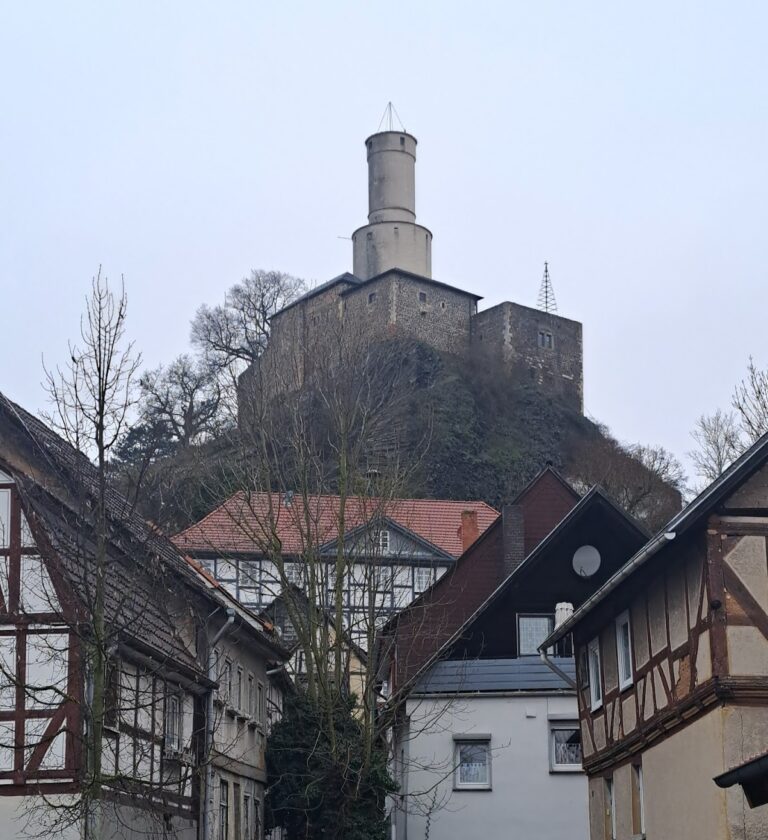
The castle occupied a steep, cone-shaped basalt knoll at an elevation of 255 metres above sea level. As a hilltop fortification, it used elevated ground for defense and for control of surrounding routes. The summit stood within a protected elm forest, and the castle’s central enclosed area formed the inner castle of the complex.
Surviving structures
The surviving fabric consists of the square lower section of a keep resembling a residential tower, together with overgrown sections of the enclosing defensive wall on the northeastern side of the inner castle. These remains preserve part of the principal fortified tower and a fragment of the enceinte, the wall surrounding the castle complex. The ruin is an archaeological and historical remnant of the medieval Falkenberg stronghold.