Burg Neugutenstein: A Medieval Ministerial Castle Ruin in Germany


Site at a Glance
- Rating
- 4.7
- Popularity
- Very Low
- Country
- Germany
- Primary era
- Medieval
- Eras represented
- Medieval
- Civilizations
- Habsburg, Holy Roman Empire
- Site type
- Military
- Remains
- Castle
On this page8 sections
History
Origins and Austrian feudal connections
Burg Neugutenstein is a medieval castle ruin in Germany, near Gutenstein, now a district of Sigmaringen in Baden-Württemberg. Its builders and exact construction date remain uncertain. A date reaching back to around 1100 has been recorded, while the castle is generally thought to have been built at the beginning of the fourteenth century by the lords of Gutenstein. It was a ministerial hilltop castle, a fortified residence associated with the medieval service nobility.
The castle first appears in written evidence in 1354, when Burkhard von Reischach held it as a fief of Duke Albert of Austria. Albert belonged to the Habsburg ruling house, whose ducal authority connected the castle to Austrian feudal administration. In 1377, Duke Leopold III of Austria pledged the property to Ulrich von Stüben. The lords of Stüben redeemed the pledged holding in 1410 by paying Stefan von Gundelfingen 1,500 florins. By then, the castle was already described as a Burgstall, a former castle surviving mainly as a ruin.
Aristocratic and ecclesiastical ownership
In 1509, the ruin passed by purchase to the counts of Sonneberg. Around 1530, it entered the possession of the hereditary imperial stewards of Waldburg zu Scheer through marriage. The Waldburg family held the office of hereditary imperial steward, a high-ranking court and administrative position in the Holy Roman Empire.
In 1659, the Waldburg family exchanged the area known as the Gundelfinger Gut and the ruin with Laiz Abbey for the Faulbronn Forest. During this transaction, the site was called Prochen Guettebstein, while the name Gebrochen Gutenstein also appeared in a document and became an alternative designation for the ruin. It later belonged to Gebhard Xaver, Eberhard Ernst, and Josef Alois, all stewards of Sigmaringen. In 1783, ownership passed to Prince Karl Friedrich of Hohenzollern-Sigmaringen, a princely branch of the Hohenzollern dynasty that ruled territories in southwestern Germany.
Later survival of the ruin
A Gothic window or gate arch remained visible from the Danube road for decades. It probably collapsed during a storm in mid-January 2008, altering one of the features through which the ruin had long been recognized from the road.
Remains
Rock pinnacle and castle layout
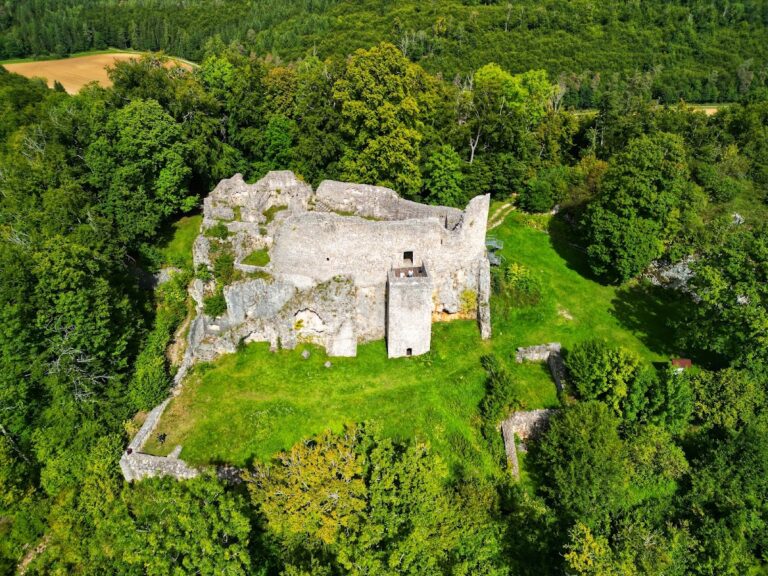
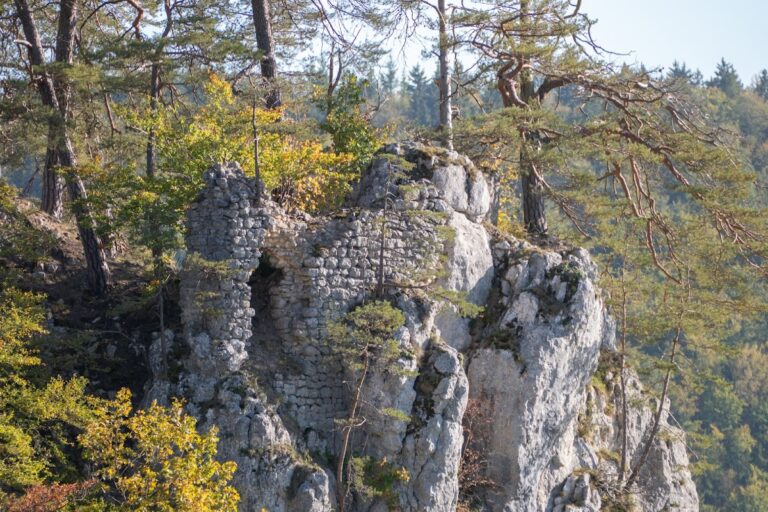
Burg Neugutenstein occupies an isolated rock pinnacle on the left side of the Danube valley, above the road between Sigmaringen and Beuron. The site lies on a valley slope in the Upper Danube Nature Park, near the confluence of the Schmeie and the Danube. The castle stands at approximately 660 metres above sea level, while the Danube is at about 577 metres. Its naturally defensible rock setting shaped a complex formed by two principal areas: a main castle on the rock and an economic courtyard on the adjoining plateau.
Principal castle
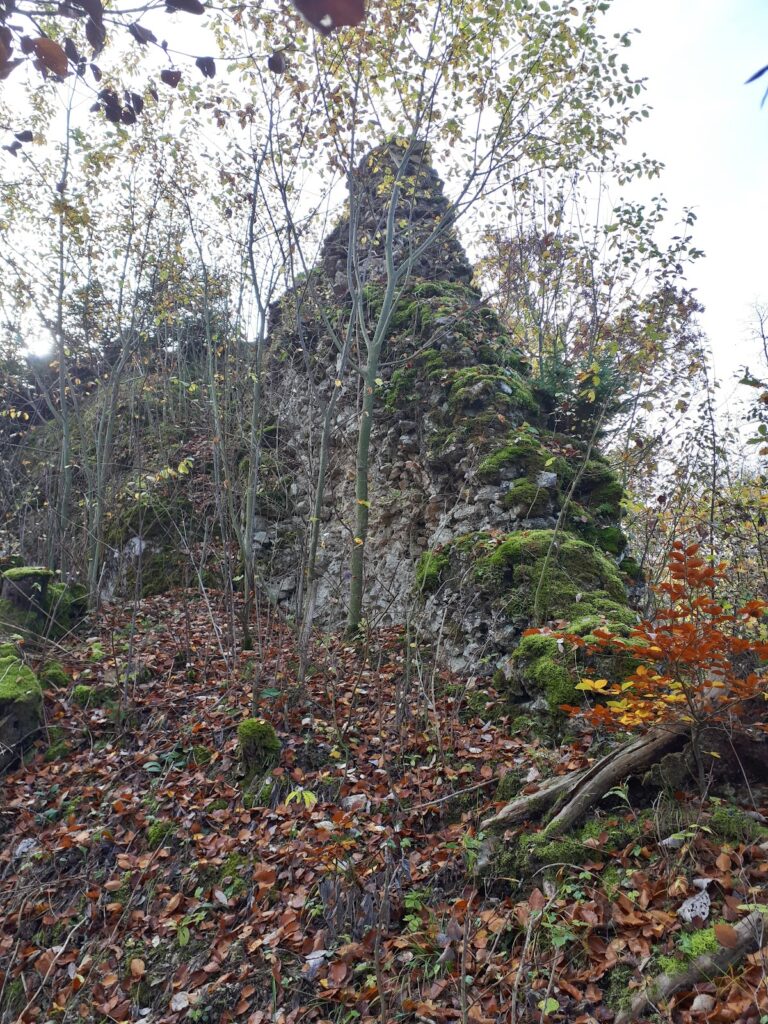
The main castle was divided into a residential tower and a lower castle. The most substantial surviving remains belong to the residential tower on the rock pinnacle. A remaining wall is approximately 8 metres high and 12 metres long. Construction used bossed ashlar, masonry whose outer stone faces project in deliberately rough or raised bosses, together with ashlar blocks made from regularly cut stone. A Gothic window or gate arch associated with the ruin stood visible from the Danube road until its probable collapse in the storm of January 2008.
Cave and associated remains
A cave with building remains is also associated with the castle complex, adding another surviving element to the physical evidence of the hilltop settlement.