Ruine Dietfurt: A Medieval Hilltop Castle Ruin in Germany

Site at a Glance
- Rating
- 4.5
- Popularity
- Very Low
- Country
- Germany
- Primary era
- Medieval
- Eras represented
- Medieval
- Civilizations
- Holy Roman Empire
- Site type
- Military
- Remains
- Castle
On this page13 sections
History
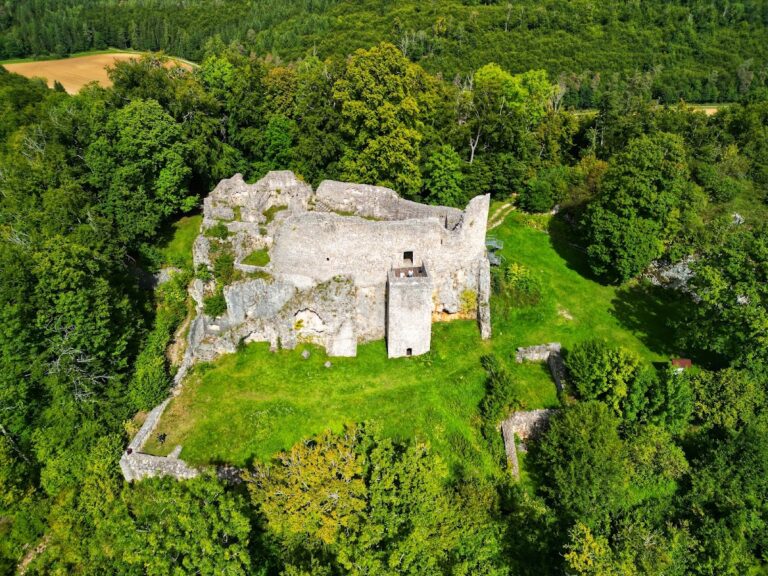
Ruine Dietfurt is the ruin of a medieval hilltop castle in Germany, in the hamlet of Dietfurt within the municipality of Inzigkofen, Baden-Württemberg. Built by medieval German nobles around 1095 or in the late eleventh century, it occupied a limestone summit above the Danube and probably helped protect a river ford. Its importance extends beyond the castle itself, since the cave beneath the rock preserves a long sequence of human use from the Late Paleolithic to the sixteenth century.
Early occupation and medieval lords
People used the rock long before the castle was erected. Finds from the Burghohle Dietfurt belong to the Late Paleolithic, Neolithic, Middle Bronze Age, later Urnfield period, Middle and Late Hallstatt periods, the Roman era, and the Middle Ages. The name Dietfurt, interpreted from Old High German as a reference to “the people,” has been taken as an indication of early settlement.
Dietfurt first appears in written records in 1095, when Heinrich, Eberhard, and Hermann of Dietfurt witnessed the foundation of Alpirsbach Monastery. The three brothers were named again in a document concerning the monastery in 1125. In 1132, Berthold, a steward of Waldburg, surrendered Dietfurt as an imperial fief, a territory held from the Holy Roman Emperor in return for service or loyalty, to Count Mangold II of Nellenburg in the king’s presence. By then, the nobles of Dietfurt had died out.
The estate belonged to the Waldburg stewards in 1253 and became the imperial fief of Hugo of Montfort in 1257. The castle itself appears in the written record for the first time in 1274. In 1421, Egg and Heinrich of Reischach sold Dietfurt, held as a Nellenburg fief, to Anna, Countess of Werdenberg, daughter of Baron Johann of Zimmern. Anna died on 1 March 1445 and was buried at Inzigkofen Monastery.
Fortification and decline
Dietfurt was described as a fortified castle in a protective and defensive alliance of the high nobility in 1468. After the Werdenberg counts died out, ownership passed to the House of Fürstenberg in 1534 and to Hohenzollern-Sigmaringen in 1806. The castle was already described as a ruin in 1593, indicating that its decline had begun by the late sixteenth century.
New Templar occupation
From 1850, farmers from Dietfurt owned the ruin. The New Templar Order acquired the parcels known as “Ruin” and “Castle Ditch” in 1924, and in 1927 two farming families sold the order most of the castle hill, including the ruin. The organization, also called the Ordo Novi Templi, established its German headquarters, the Staufen Archpriorate, at Dietfurt. An archpriorate was an administrative center headed by an archprior.
The Ordo Novi Templi was a modern esoteric and racist association founded by Adolf Joseph Lanz, also known as Lanz von Liebenfels. It adopted the name and imagery of the medieval Knights Templar but was a separate modern organization. During the 1920s and 1930s, the area around the ruin served as a meeting place for the order, which is regarded as one of the precursors of Nazi ideology.
Between 1928 and 1929, the New Templars built a hut in the former castle ditch and transformed the Burghohle into a ritual sacred space. The order was dissolved at the beginning of the Second World War. During and after the war, the hut accommodated a bombed-out New Templar family and later refugees from Bessarabia.
Archaeology and conservation
After the Second World War, treasure seekers dug a pit about 1 meter wide, 4 meters long, and 5 meters deep while searching for a legendary golden ball. The excavation destroyed prehistoric layers. In 1970, employees of the Sigmaringen branch of the German Red Cross Mountain Rescue Service found Urnfield-period and early and high medieval fragments in the disturbed area. The State Monument Conservation Office and the University of Cologne then carried out extensive excavations between 1972 and 1995, including campaigns in 1974, 1984, and 1987 to 1988.
The cave’s archaeological sequence includes Late Upper Paleolithic, Early Mesolithic, and Late Mesolithic to Neolithic horizons. The Mesolithic was the transitional period between the Paleolithic and Neolithic, while the Pleistocene was the Ice Age epoch followed by the Holocene. The site is especially important for evidence of the transition from Pleistocene hunter-gatherer societies to later settlement phases.
The Sigmaringen mountain rescue service leased the ruin from 1959 and took over the entire area in 1964. It acquired the property, including the hut, ruin, and cave, in 2004. Restoration began in 2005, followed by continuing maintenance and structural conservation from 2007. This work also addressed the loss of original stone caused by centuries of reuse in nearby buildings. In 2011, mountain rescue volunteers contributed 597 hours of labor.
Remains
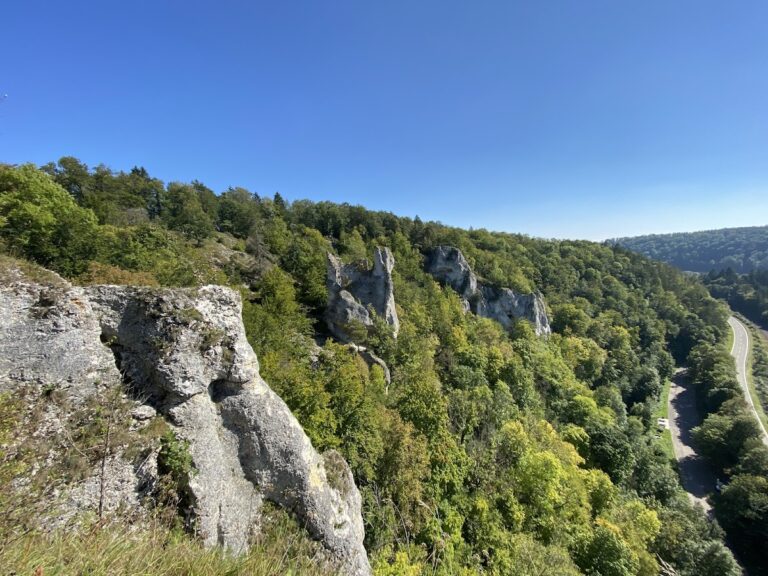
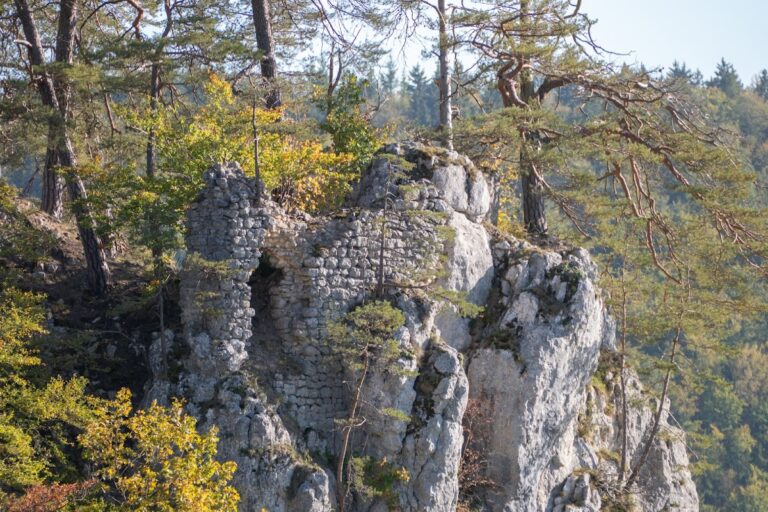
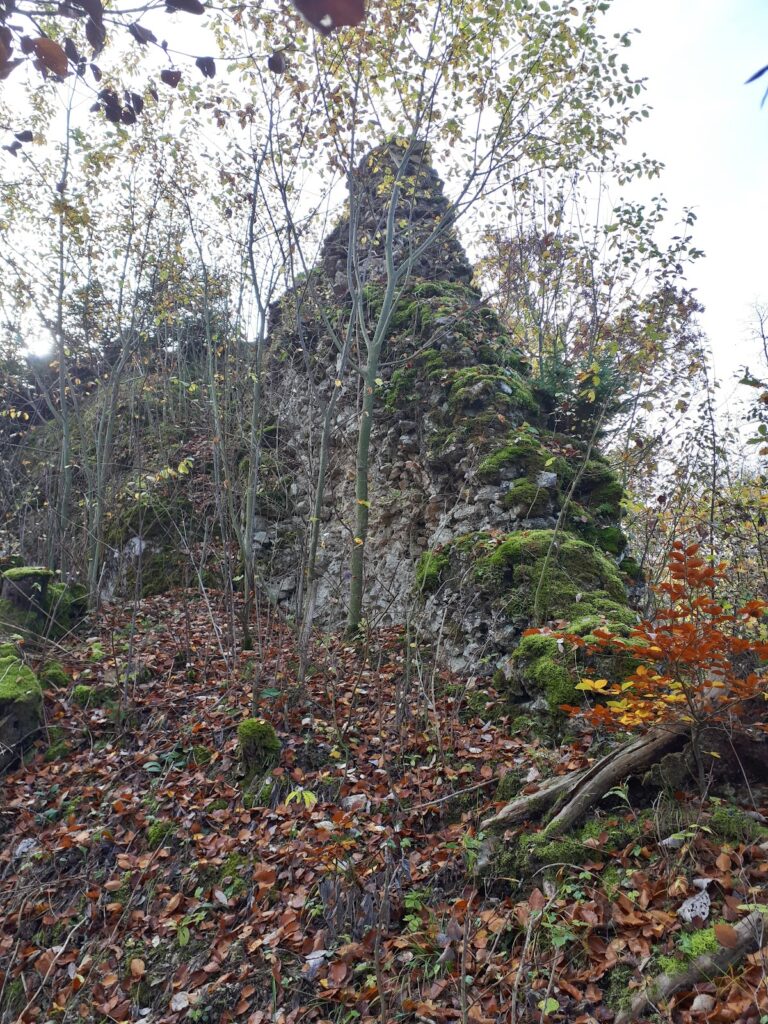
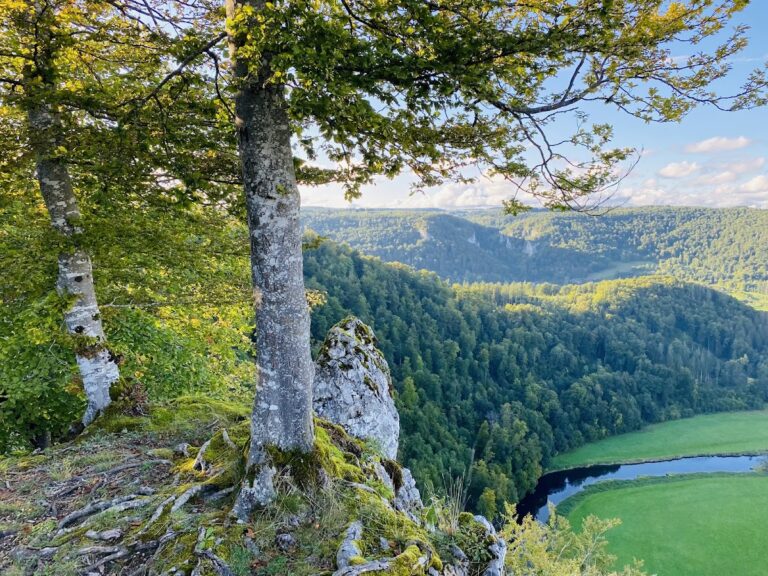
Ruine Dietfurt occupies an exposed limestone rock at about 620 meters above sea level, with the Danube surrounding the strategic summit. The castle was constructed from humpback ashlar and rubble stone. Its surviving masonry includes a protective outer shell of large rocks around an inner core made from smaller stones. The castle’s former ford remains visible approximately 110 meters below the bridge.
Castle remains
Keep
The surviving bergfried, or principal tower of a medieval German castle, is the most conspicuous remnant of the fortress. Its oak-plank floor was secured so that the tower could be entered safely. Enlargement of the entrance area was planned as a later conservation measure.
Shell wall
During conservation work in 2010, a longer section of the shell wall near the cave entrance was secured with trass mortar. The remaining 13 meters of inner masonry were not to receive a new outer shell. Since 2007, conservation has used limestone from rockfalls and freshly broken material from other parts of the Danube valley and the Heuberg, avoiding worked stones taken from other castles. In 2011, the work had used 73.41 tons of lime mortar, 64.32 tons of limestone, and 5 tons of wall gravel.
Burghohle Dietfurt
Cave passage and chambers
The Burghohle lies beneath the castle within the limestone rock. It is a passage cave with an entrance at each end. The main passage extends about 40 meters between the entrances and links three larger chambers, some reaching 8 meters in height. The passage descends about 10 meters from one entrance to the other, so several stairways are required.
Archaeological sequence
Excavations in the cave produced material from the Late Paleolithic, Neolithic, Middle Bronze Age, later Urnfield period, Middle and Late Hallstatt periods, the Roman era, and the Middle Ages. The Magdalenian, a later Upper Paleolithic culture, is also represented. A Late Bronze Age clay plaque from the Urnfield period, decorated with concentric circles and also called an altar plate, has been interpreted as evidence of cultic use. The Urnfield period was a later Bronze Age period associated in part with cremation burials in urns, while the Hallstatt period was an Iron Age cultural period in central Europe.
Later alterations
The New Templar Order altered the cave for ritual use. A former outer exit was blocked by a wall, probably as part of the castle’s escape system, although the wall itself also dates from the New Templar period. A stained-glass image of Saint Michael was formerly installed in a window and held particular importance for the New Templars. The cave’s lower chamber has no demonstrated connection with the order. The entrance is secured by a heavy locked steel door.
Nearby sites