Burg Hartenstein: A Medieval Hilltop Castle in Austria


Site at a Glance
- Rating
- 3.9
- Popularity
- Very Low
- Country
- Austria
- Primary era
- Medieval
- Eras represented
- Medieval, Modern
- Civilizations
- Holy Roman Empire
- Site type
- Military
- Remains
- Castle
On this page7 sections
History
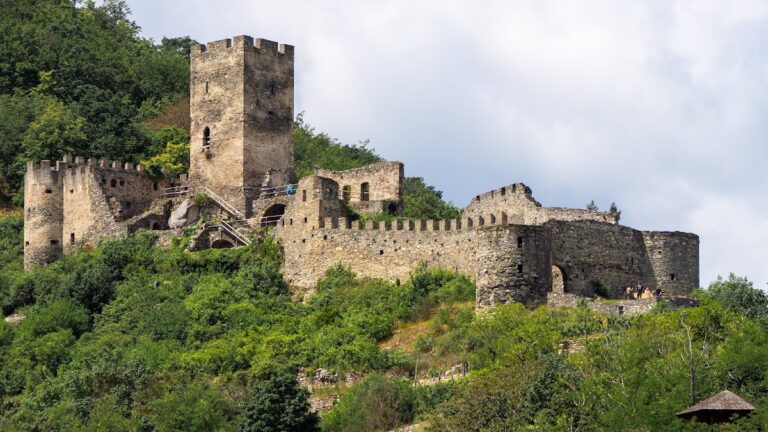
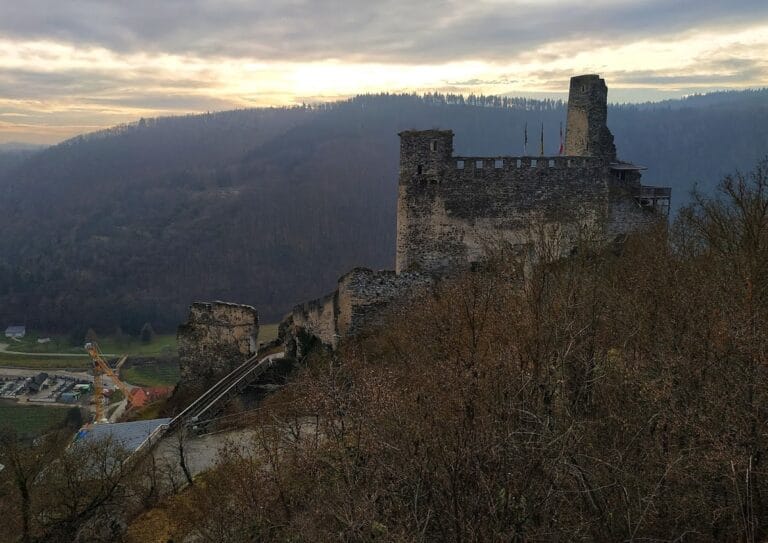
Burg Hartenstein is a hilltop castle in Austria, near Nöhagen in the municipality of Weinzierl am Walde, Lower Austria. It stands in the small Krems Valley, within the rugged granite landscape of the Waldviertel, about 15 kilometres west of Krems. The origins of the Hartenstein lordship and its associated residence remain uncertain. The castle was probably established by a possible descendant of the Kuenringer family, perhaps Heinricus de Hertinsteine, who appears in a document from 1187.
Medieval lordship
Until 1270, Hartenstein was held by the Lords of Kaja and Kamegg. In that year it passed to the brothers Hertnit and Leutold of Stadekke. Heinrich von Wallsee acquired the property in 1300, after which the Wallsee family administered the lordship through burgraves, officials responsible for managing and defending a castle or castle district for its lord.
Hartenstein changed hands repeatedly after the Wallsee family relinquished several lordships in the Waldviertel during the second half of the fourteenth century. The Lords of Maissau held it from 1380 to 1411. Christoph von Rappach acquired it in 1416, and from 1430 it belonged to Hans and Leopold von Neidegg. Jörg Scheck von Walde purchased Hartenstein in 1445, beginning another succession of ownership changes.
Decline and changing uses
During the second half of the seventeenth century, the lords and holders of the estate increasingly preferred more comfortable residences. The medieval castle was abandoned and began to decay. It nevertheless resisted a brief Swedish siege in 1645, although the attacking forces destroyed the outer work known as the “Nasn” with an explosion.
Georg Ludwig Count Sinzendorf bought the Hartenstein lordship, together with 117 subjects, in 1666. After his death in 1682, Prince Paul Esterházy acquired the castle. Emperor Charles VI enfeoffed, or granted as a fief, Baron Philipp Ferdinand von Gudenus with Hartenstein in 1726. The Gudenus family retained the property until 1927.
Between 1780 and 1799, Johann Heinrich von Gudenus removed usable materials from the castle, including doors and window frames, for construction at his hunting lodge in Els. In the early nineteenth century, the two towers were used as granaries. Otto Pospischil leased the increasingly ruined complex in 1892 and established a cold-water sanatorium in the outer bailey, the defended area outside the main stronghold. The outer bailey was remodelled between 1892 and 1896 in a historicist castle style, reviving forms associated with earlier architecture, while the main castle had already long been a ruin.
Twentieth-century history
During the Nazi period, the German Youth Hostel Association used the complex as a “youth castle.” After the Second World War, the physician Erich Buchmeier made an unsuccessful attempt to revive the sanatorium. Peter Kotauczek, or his company BEKO Hartenstein, took over the castle in 1993. The complex is currently used as a residence.
The Gudenus Cave below Burg Hartenstein places the site within a much earlier human history. The natural cavity yielded evidence of Neanderthal occupation almost 100,000 years ago, including hand axes and other tools. These finds represent the earliest settlement traces discovered in Lower Austria.
Remains
Fortified castle complex
Burg Hartenstein survives as a fortified hilltop complex consisting of a main castle, an outer bailey, and two towers. The main castle is now a ruin, while substantial parts of the wider complex remain. The outer bailey preserves the physical result of its late nineteenth-century conversion into a cold-water sanatorium, when it was remodelled in a historicist castle style between 1892 and 1896. Earlier changes also shaped the surviving fabric: doors and window frames were removed between 1780 and 1799 and reused at the hunting lodge in Els, while the two towers served as storage granaries from the beginning of the nineteenth century.
Gudenus Cave
Below the castle, the Gudenus Cave occupies a natural cavity eroded from the riverbank. Its Stone Age archaeological material includes hand axes and other tools associated with Neanderthal occupation. The finds, dating to almost 100,000 years ago, provide physical evidence for early human activity in the landscape beneath Hartenstein and help explain the cave’s place in the prehistory of Lower Austria.
Nearby sites