Břecštejn: A Medieval Hilltop Castle Ruin in Czechia
Site at a Glance
- Rating
- 4.5
- Popularity
- Low
- Country
- Czechia
- Primary era
- Medieval
- External website
- Open
- Eras represented
- Medieval
- Civilizations
- Holy Roman Empire, Kingdom of Bohemia
- Site type
- Military
- Remains
- Castle
On this page9 sections
History
Břecštejn is a medieval hilltop castle ruin above Hrádeček in Czechia, probably rebuilt in the first half of the fifteenth century as a compact castle of the Silesian type. It served as a Hussite stronghold during the occupation of Trutnov from 1421 and later became the seat of the Zilvár family’s power before falling into decline and ruin.
The predecessor castle and Hussite period
A predecessor known as Stein or Stejn probably occupied the summit in the fourteenth century. Its lord, Otto of Stein, also called Otto Lapide, donated three hides of land at Oblanov to the Crusaders of the Holy Sepulchre in 1336. The religious order was associated with the protection and commemoration of the Holy Sepulchre in Jerusalem, and the land supported its monastery at Trutnov. The earlier castle probably disappeared later in the fourteenth century.
The present castle was probably rebuilt in the 1420s by Jan I Zilvár, father of Mikuláš Zilvár, although its foundation is also broadly placed in the first half of the fifteenth century. From 1421, while Trutnov was occupied by Jan Žižka, Břecštejn served as a Hussite stronghold. The Hussites were a Bohemian religious and political movement that emerged from the teachings of Jan Hus, and their wars relied on fortified bases and local supporters. The Zilvár family supported their side.
The Zilvár lordship
The first documented reference to Břecštejn dates from 1455, when the castle was recorded in the Trutnov feudal registers as the property of Mikuláš Zilvár of Pilníkov. During the fifteenth century, the Zilvárs acquired extensive estates in the foothills of the Krkonoše and reached the height of their power around 1500.
On 30 June 1522, King Louis II released Adam I Zilvár’s estates at Břecštejn, Pilníkov, and Vlčice from their feudal obligations to the lordship of Trutnov. Louis II was the Jagiellonian ruler of Bohemia and Hungary. In 1532, Adam gave the castle the name Silberstein, while the Czech form Zilvarštejn was also used.
Adam I was succeeded by his son Jan, who held the lordship from 1550 to 1553. After Jan’s early death, control passed to his uncle Christoph Zilvár of Silberstein. Christoph made the Renaissance fortress at Vlčice his principal residence, allowing the smaller and less representative Břecštejn to fall into disrepair. His daughter Beatrix Eleonora of Lobkowitz later abandoned Pilníkov Castle as well, in 1581.
Confiscation, destruction, and abandonment
From 1609, most of the lordship belonged to Adam III Zilvár of Silberstein. His estates were confiscated after he took part in the Bohemian Estates’ uprising, a revolt by Bohemian nobles and other estates against Habsburg rule. Following the rebels’ decisive defeat at the Battle of White Mountain in 1620, the Bohemian Chamber sold the estates to Albrecht von Wallenstein in 1623. Wallenstein, a Bohemian nobleman and imperial military commander, sold the lordship in 1627 to the imperial colonel Daniel Hebron.
Swedish forces completely ruined Břecštejn during the Thirty Years’ War in the 1630s. The conflict was a major European war that affected the political and religious order of the continent. The castle was described as deserted by 1675. That year, Johann Adolf I, Prince of Schwarzenberg, acquired the Vlčice lordship and Pilníkov. Between 1677 and 1685, he founded the village of Silberstein and allowed its settlers to take building material from the castle ruins.
Later preservation and the castle’s name
After acquiring the Vlčice lordship in 1790, the flax-spinning mill owner Johann Franz Theer cleared and secured the ruin in 1794. He also created a paved sandstone path, opened a new entrance, and built a large wooden octagonal belvedere on the site of earlier wooden structures. His successors included Johann Baptist Theer and Josef Karl Theer. Adolf Karl Theer bequeathed his estates to the universities of Prague and Vienna in 1861. The estates were sold to the entrepreneur Hugo Wihard in 1868, and the ruin belonged to Friedrich Reimann from 1916.
The wooden belvedere was demolished in 1969. Břecštejn has been protected as a cultural monument since 1964, under monument-register number 18019/6-3720. An initiative to save the ruin failed in 2005 because the castle was not included among the 3,720 listed national cultural monuments, and its proposed inclusion had not taken place.
The castle’s name has several possible explanations. Břecštejn and the later form Brettstein may derive from a term meaning “board castle,” possibly referring to wooden superstructures. Another theory connects the name with ivy, which once heavily covered the ruin and still grows there. Silberstein is documented from 1532, while forms including Břečtejn, Bruštejn, Zilvarštejn, Stein, and Bröckstein were also used.
A tradition recorded by the chronicler Simon Hüttel in 1593 claimed that Wolf Ulstadt-Silber, regarded in that account as the ancestor of the Zilvár family, founded the castle in 1056. The claim is unsubstantiated and conflicts with the settlement of this part of the former border forest by the Moravian von Schwabenitz family only from the thirteenth century.
Remains
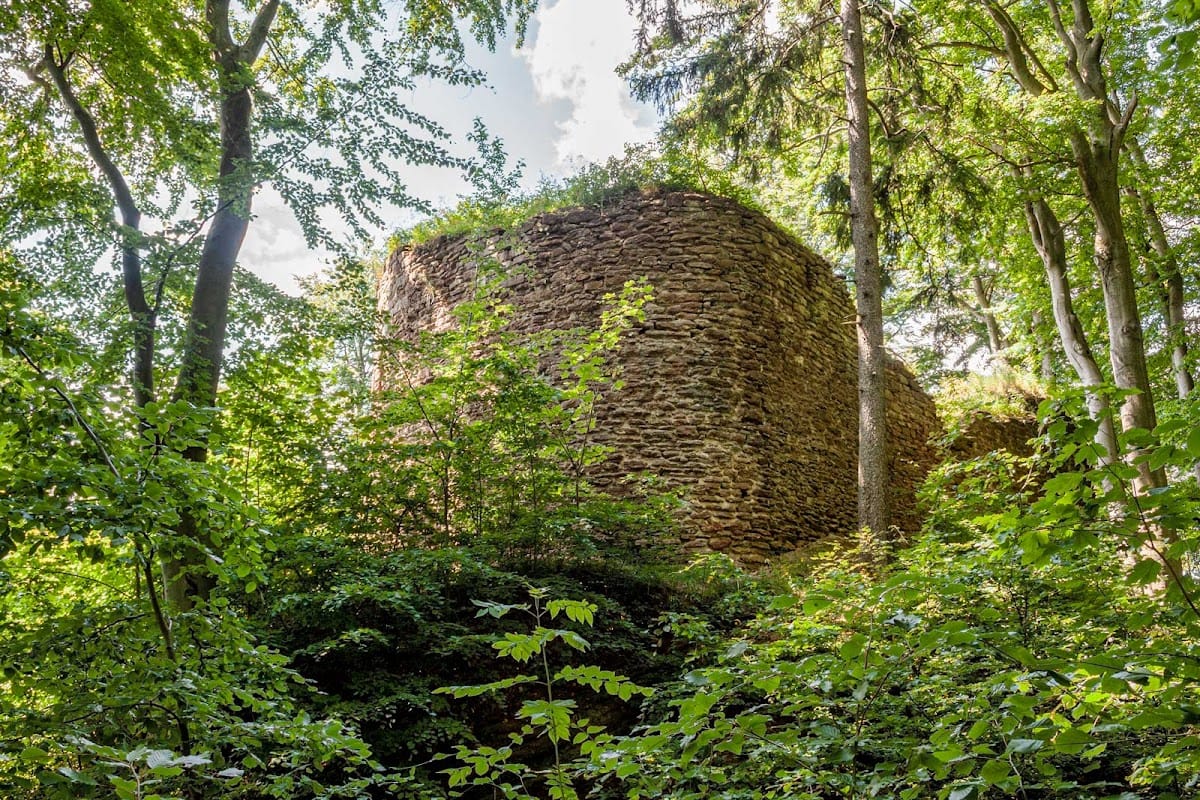
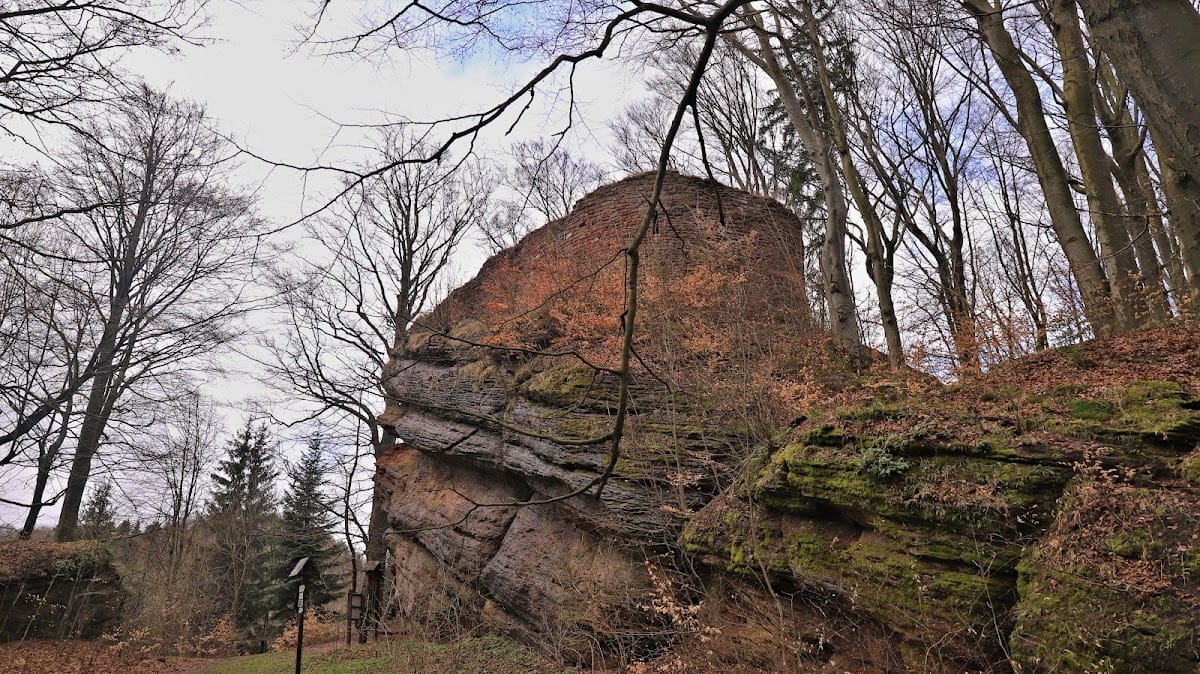
Břecštejn occupies a wooded rocky summit about 502 metres above sea level, east of and above Hrádeček. The rock drops almost vertically to the northwest, providing natural protection, while the castle overlooks the valley of the Silberstein Brook. On the eastern and southeastern approaches, two ramparts and ditches defended the site. The outer rampart consists of simply piled earth, while a stone wall about 80 centimetres thick stood along the crest of the inner rampart.
Castle core and defensive wall
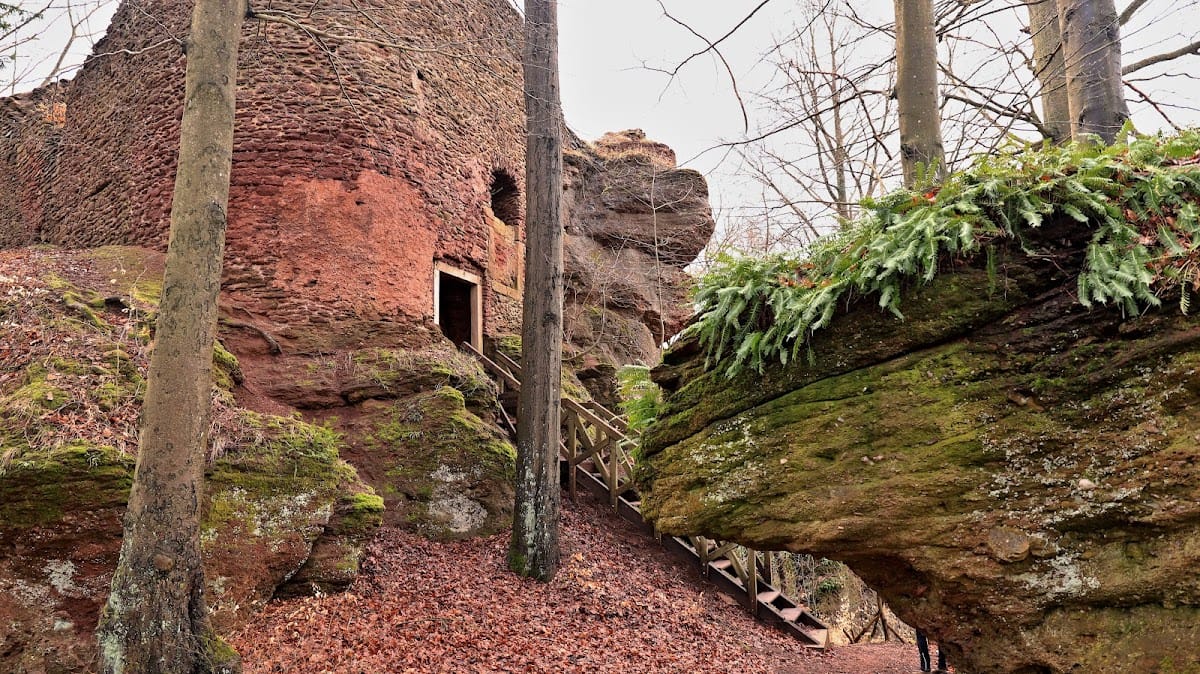
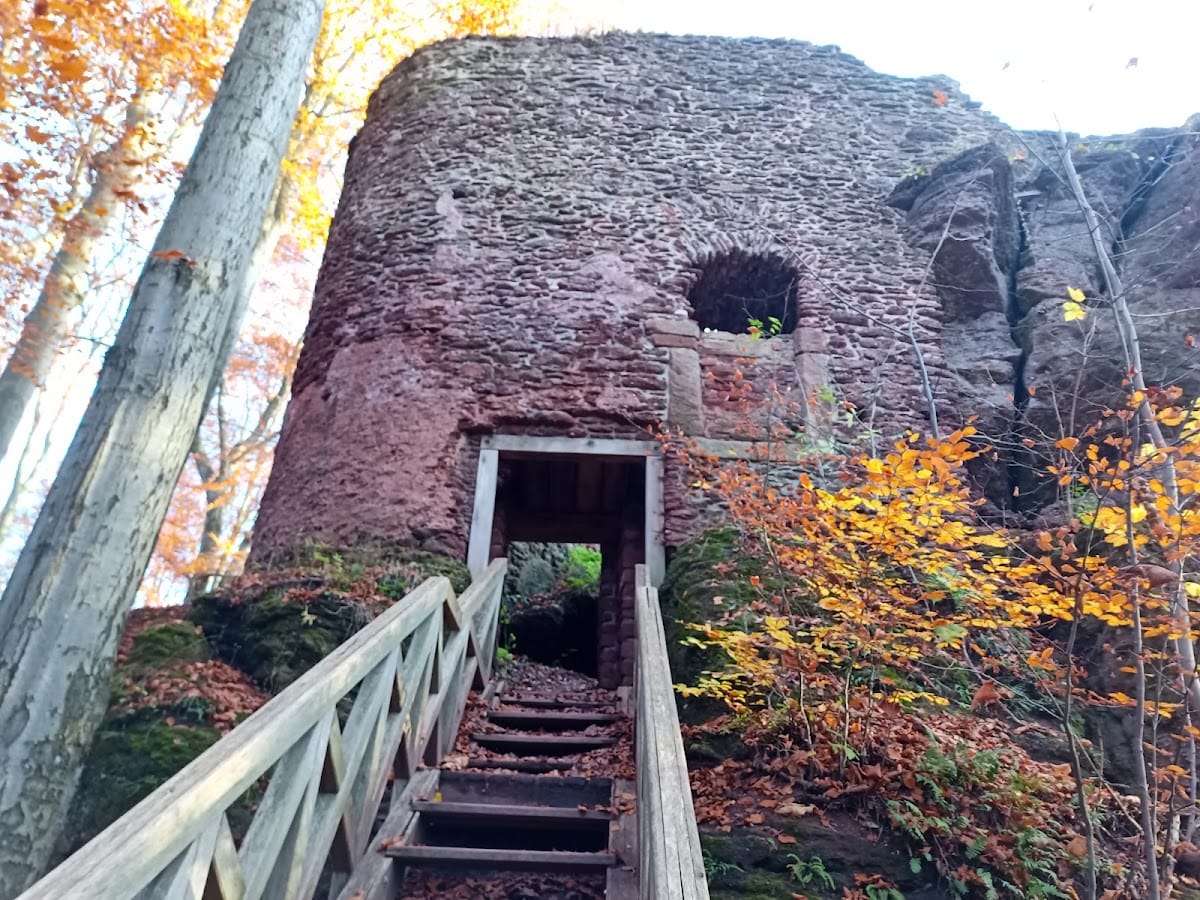
The castle was a compact residential fortress of the Silesian type. In this arrangement, the enclosing wall formed the main defensive framework, with the residential and military buildings contained within a single core. At Břecštejn, the continuous outer wall enclosed the castle core, while the tower and residential buildings formed one connected building complex. High sections of the enclosing wall survive, together with the cylindrical keep, palace, and cellars.
Palace and cellar
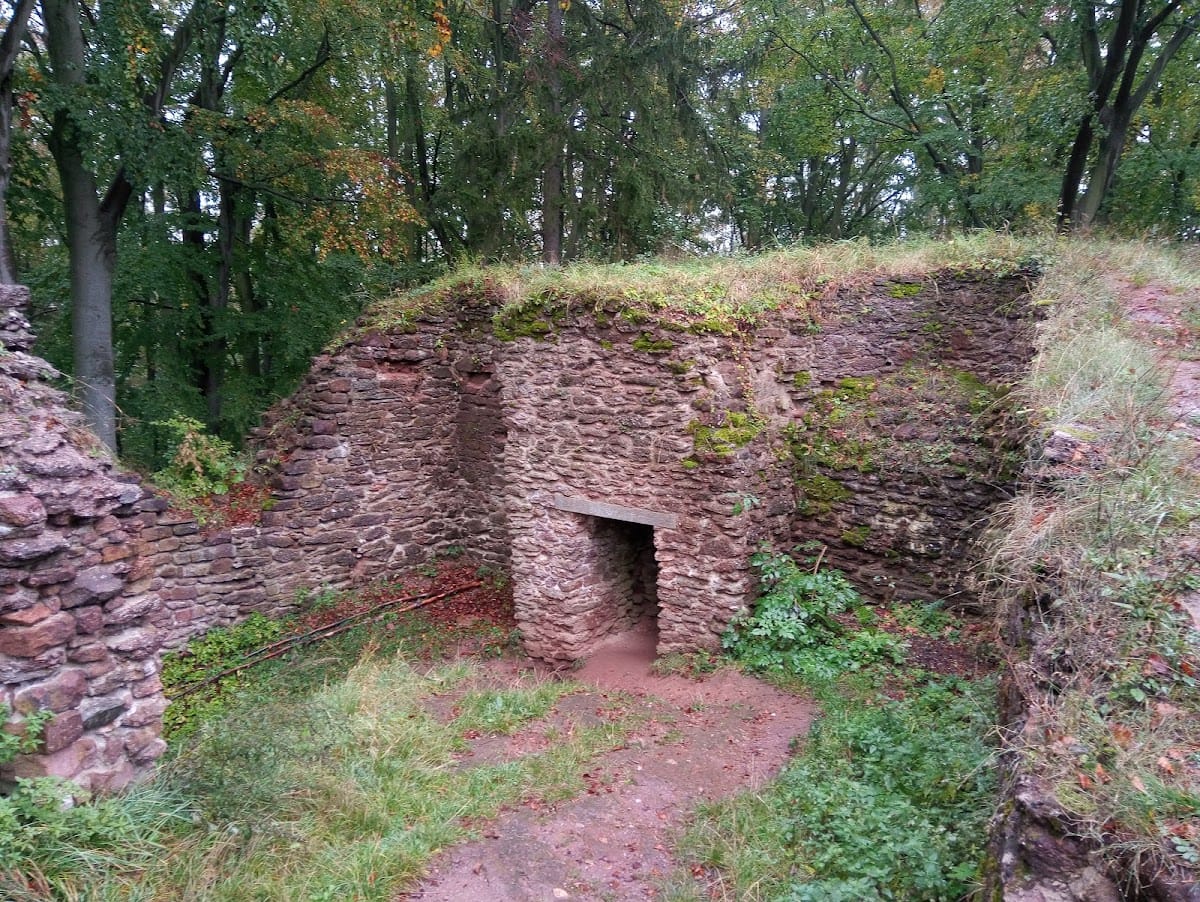
Only the ground level of the palace remains. It is covered by a barrel vault. A smaller building stood beside the gate, and the courtyard contains an entrance to a cellar cut directly into the rock. The former cellars now provide access to the ruin, while the present entrance to the castle core is not original. The form of the entrance to the outer bailey could not be established by archaeological investigation in 1992.
Belvedere and present condition
The large octagonal wooden belvedere erected in 1794 occupied the site of earlier wooden structures until its removal in 1969. The surviving masonry remains now require extensive structural securing.