Burg Coraidelstein: A Medieval Territorial Castle above the Moselle
Site at a Glance
- Rating
- 4.3
- Popularity
- Very Low
- Country
- Germany
- Primary era
- Medieval
- Eras represented
- Medieval, Early Modern
- Civilizations
- Holy Roman Empire
- Site type
- Military
- Remains
- Castle
On this page13 sections
History
Burg Coraidelstein, also known as Burg Klotten, is a medieval hill castle in Germany above Klotten on the Moselle. Its elevated position supported the control and defense of the surrounding area, and the castle later belonged to the Electorate of Trier, the territorial state ruled by the archbishop of Trier, who was also an elector of the Holy Roman Empire.
Roman and Early Medieval Background
Coins and pottery fragments indicate Roman activity at the site before the medieval castle was built. A Roman support post probably stood here during the third or fourth century and was likely connected with Trier, allowing river traffic on the Moselle to be monitored. After the imperial court moved to Milan in 395, Trier lost importance, and such Moselle posts were abandoned by no later than the fifth century. Franks and Alemanni later damaged them.
Local tradition places the foundation of the medieval castle in 960 and attributes it to Count Palatine Hermann I of Lorraine, a member of the Ezzonid dynasty, a powerful aristocratic family of the Rhineland. The date remains disputed. The site formed part of a Frankish royal estate, land held by the Frankish monarchy as part of its royal domain, associated with Hermann I.
Palatine Possession and Trier Rule
Palatine bailiffs occupied the castle until about 1140. Tradition associates the site with Richeza of Poland, daughter of Count Palatine Ehrenfried and later wife of King Mieszko II of Poland. After her husband died in 1036, she held family estates in the Holy Roman Empire, including Klotten, and the castle is linked with her as a summer residence.
The first secure written mention of the Reichsburg Klotten dates from 1294, when the castle passed to the Archbishop of Trier. A Reichsburg was held directly for the empire or its king. Its transfer to the Electorate of Trier was confirmed in 1346. King Adolf of Nassau, who ruled Germany from 1292 to 1298, was forced to pawn the castles of Cochem and Coraidelstein.
Archbishop Balduin of Luxembourg later permitted Heinrich of Klotten to build a house beside the castle. Balduin was Archbishop and Elector of Trier in the early fourteenth century. Heinrich’s daughter Jutta and her husband, Dietrich von Kesselstatt, subsequently took over the fief, a grant of land or property made in return for service or loyalty.
Noble Fiefs and Structural Changes
The Lords of Winneburg held Coraidelstein as a fief from 1410 to 1542. Disputes over the inheritance led to the construction of new sections between 1543 and 1547. In 1545, Heinrich von Hagen controlled part of the castle, while other shares belonged to the Winneburg heirs, the Haust family of Ulmen, the Höin family of Hartenfels, and Hugo and Gerlach Zandt of Merl.
Between 1575 and 1587, the entire castle was held by the Haust family of Ulmen. By 1654, the fief had been divided between an heir of that family and an heir of the Höin family of Hartenfels. It then passed to Johann Eberhard von Kesselstatt, a member of a prominent noble family of the Trier region. The von Kesselstatt family retained the castle until 1917.
Decline, Repair, and Later Use
Coraidelstein remained inhabited until 1830 and became a ruin at an uncertain date. Images from 1831, 1838, and 1841 trace its deterioration. In 1906, the district president of Koblenz called for the walls and towers to be secured against collapse. The von Kesselstatt family then commissioned masonry work on the keep.
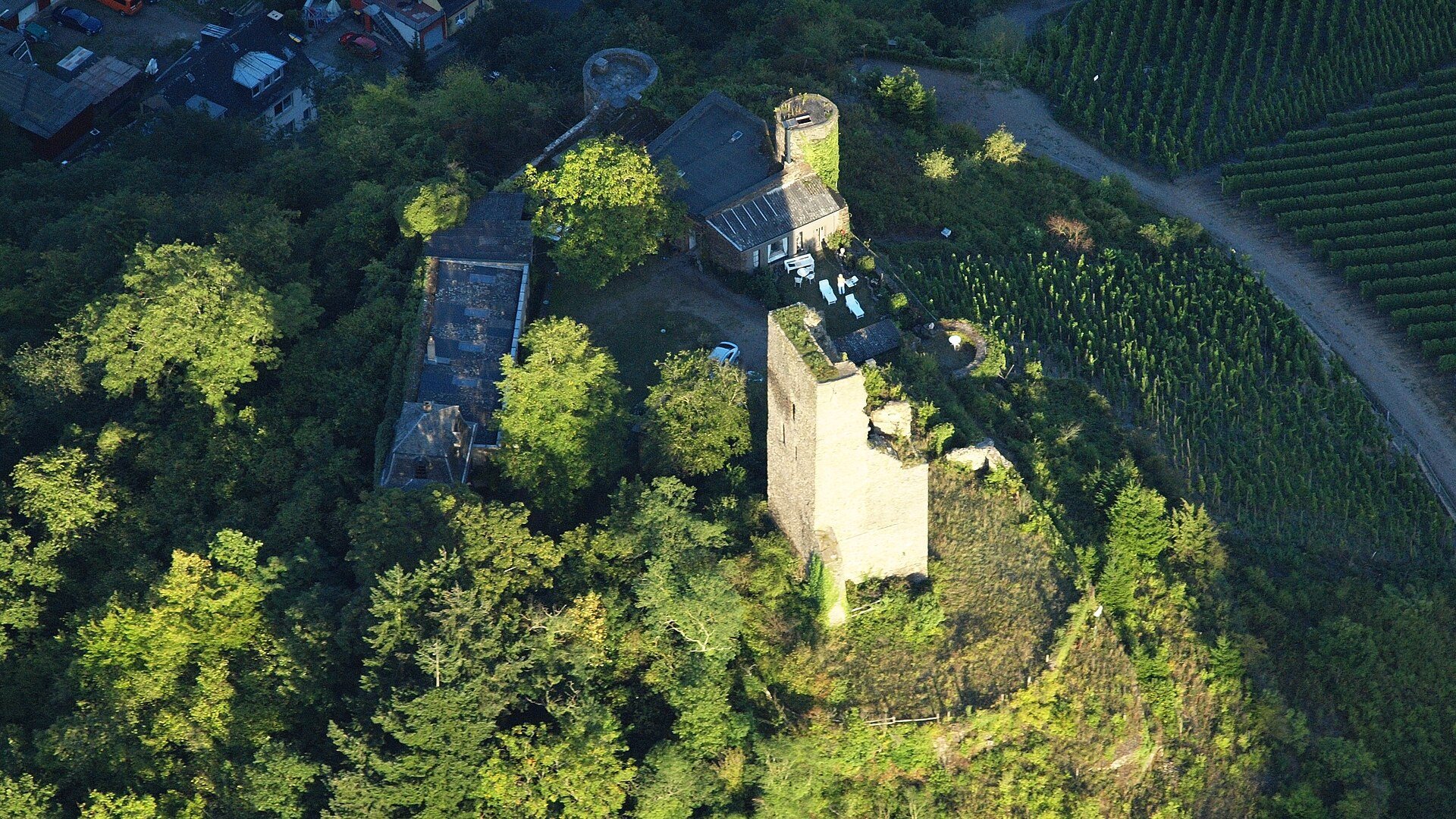
Hans Harney, a former consul and former director of Deutsche Bank in Düsseldorf, acquired the castle from the von Kesselstatt family in 1917 and had two residential buildings constructed there. In 1952, his daughter Else Harney and her partner Wendelin Stahl established a pottery workshop at the castle. After Harney’s death in 1984, Stahl continued the workshop with his former pupil Ayca Riedinger until his death in 2000.
The ruins are privately owned and recognized as a German cultural-heritage monument.
Remains
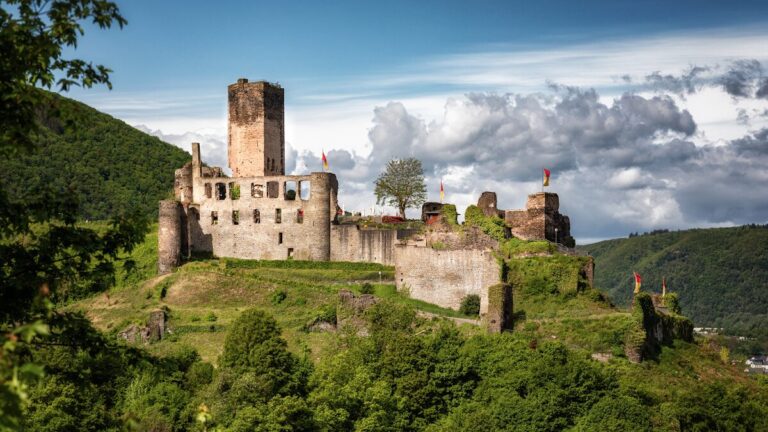
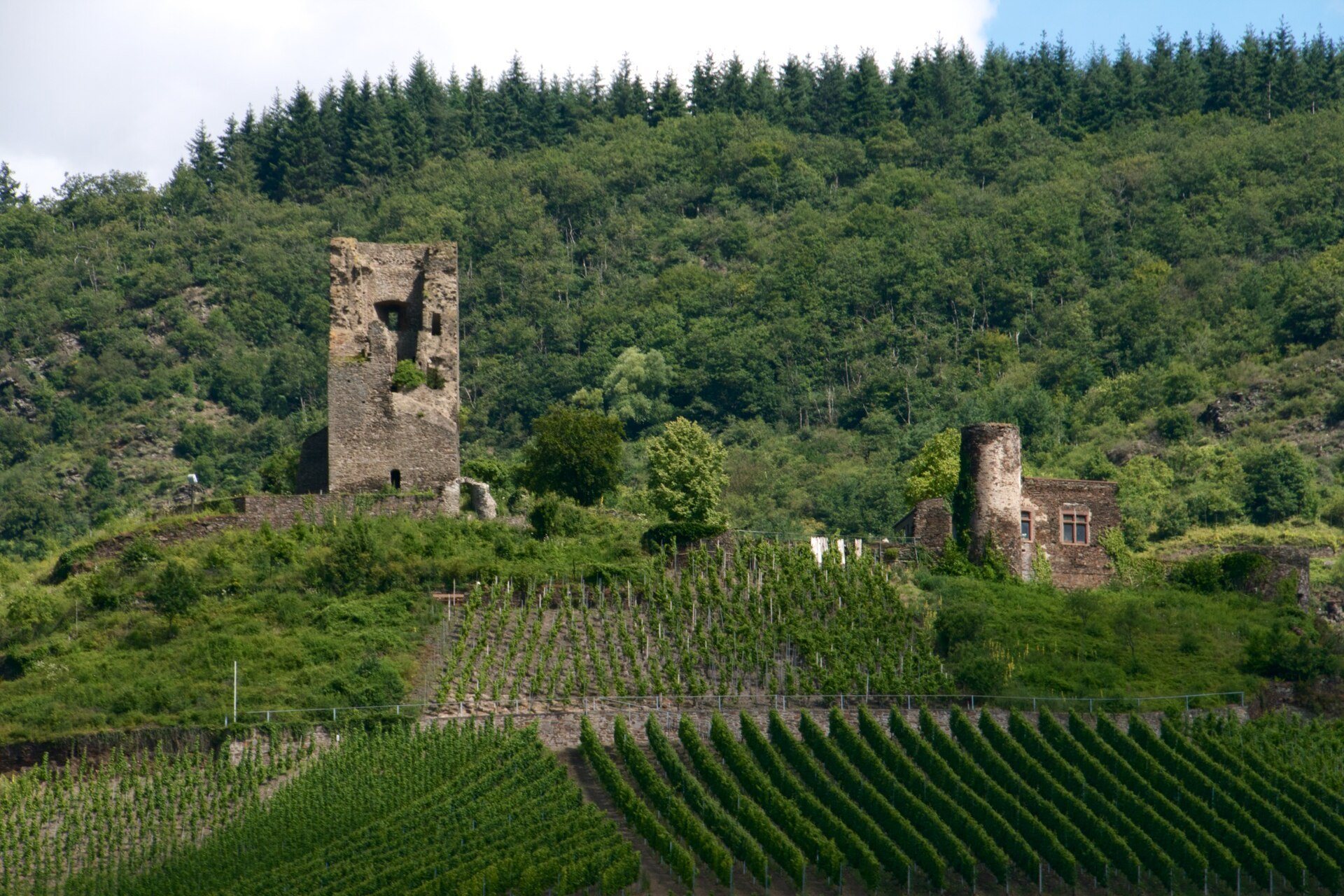
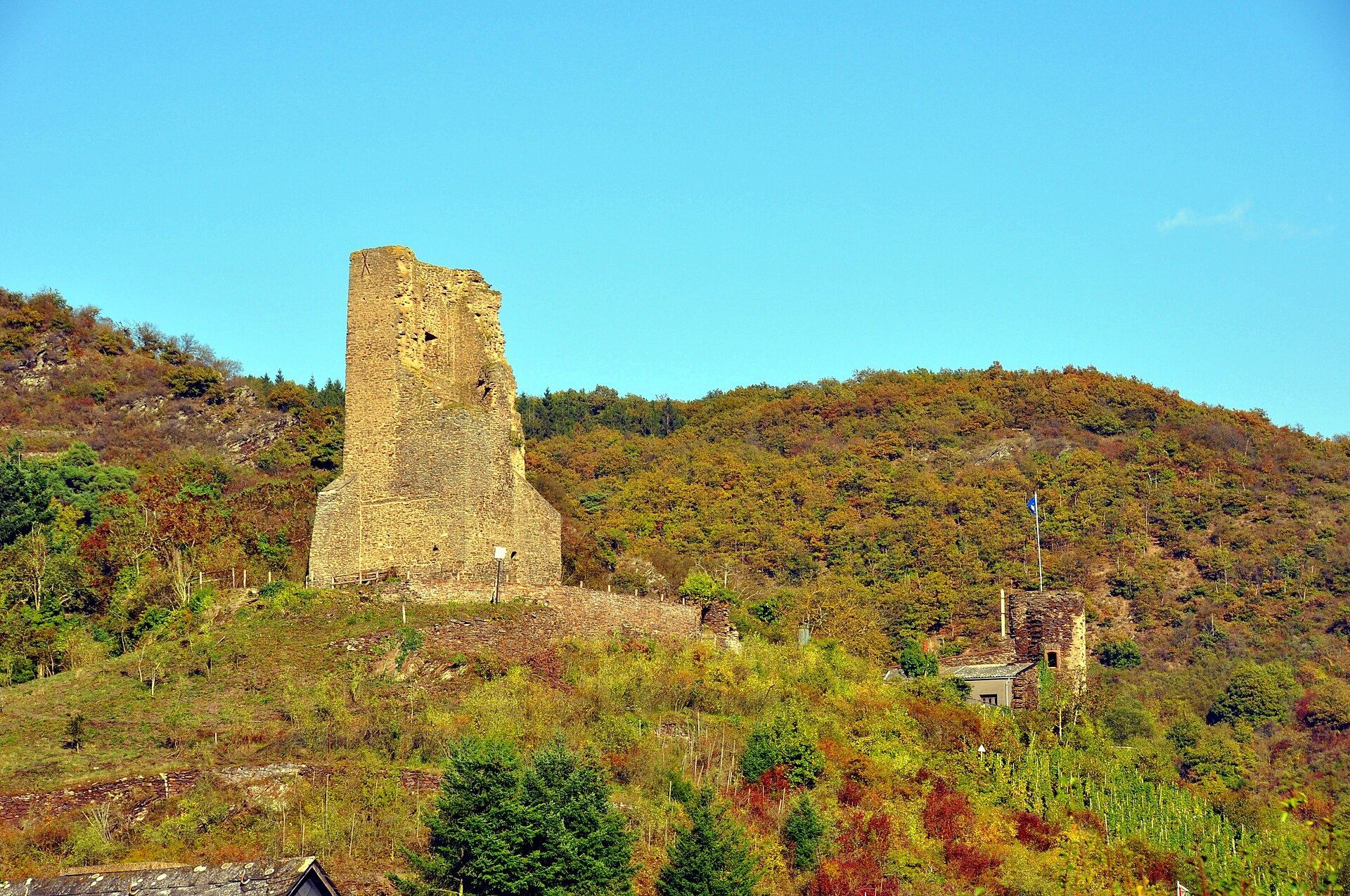
Burg Coraidelstein occupies a slope position on a hilltop above the Moselle, at approximately 177 metres above sea level. The site’s elevated setting provided a broad view over the river and suited the castle’s defensive purpose. Surviving elements include a Romanesque defensive tower, residential buildings, later castle sections, several towers, and remnants of the enclosing walls.
Defensive and Enclosing Structures
Romanesque Keep
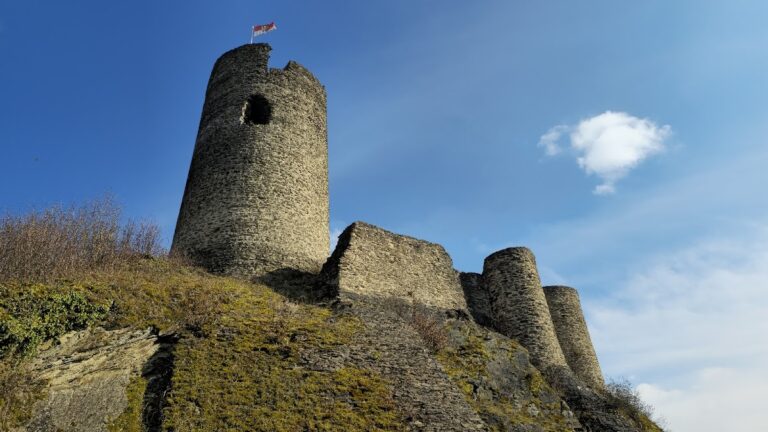
The oldest surviving part of the medieval castle is the ruin of a Romanesque bergfried, the principal defensive tower used chiefly for defense and refuge rather than as the lord’s ordinary residence. A substantial gap in its masonry prevents the tower from being climbed. Masonry repairs were commissioned in the early twentieth century to reduce the danger posed by unstable walls and towers.
Walls and Towers
Nineteenth-century views show the castle in a ruinous condition. By 1841, the surviving complex included the keep, several towers, and remnants of the enclosing walls. The masonry was considered structurally unsafe, forming the physical background to the later effort to secure the remains.
Residential and Later Castle Sections
Palas
The palas, the castle’s principal residential or representational building, was constructed in the sixteenth century and enlarged later. It belongs to the period when the castle’s internal ownership was divided among several noble families and new sections were added.
Sixteenth-Century Additions
Further sections were built between 1543 and 1547. The internal arrangement preserved a distinction between the older and newer parts: windows that once allowed people in the older section to look into the newer one were later walled up, blocking views between the two areas. The later residential buildings constructed after the 1917 acquisition added another phase of occupation to the surviving castle complex.
Roman Finds
Coins and pottery fragments recovered at the location provide material evidence for the Roman support post that preceded the medieval castle. These finds connect the hilltop with the Roman monitoring of Moselle river traffic during the third or fourth century.