Metternich Castle: Medieval Fortress Above Beilstein, Germany


Site at a Glance
- Rating
- 4.4
- Popularity
- Medium
- Country
- Germany
- Primary era
- Medieval
- External website
- Open
- Eras represented
- Medieval
- Civilizations
- Holy Roman Empire
- Site type
- Military
- Remains
- Castle
On this page8 sections
History
Metternich Castle is a medieval Gothic spur castle in Germany, above the town of Beilstein, whose first structures probably appeared around the middle of the thirteenth century. Originally called Beilstein Castle, it was first documented in 1268 as a possession of Johann von Braunshorn, a medieval nobleman who held the castle as a fief from the Archbishopric of Cologne.
Origins and changing ownership
Older interpretations placed the castle’s foundation around 1120 or even earlier, but archaeological investigation and detailed study by Alexander Thon and Stefan Ulrich indicate a later origin. No evidence of twelfth-century or earlier construction has been found. The Braunshorn family retained the castle until 1361, when Gerlach von Braunshorn died without a male heir. In 1363, ownership passed to his grandsons, Kuno and Gerlach von Winneburg, who adopted the name Winneburg und Beilstein. That same year, part of the castle was sold to the Archbishopric of Trier.
After the Winneburg and Beilstein line died out, the castle passed in 1637 to Wilhelm von Metternich-Winneburg und Beilstein. The Metternich family renamed the complex after themselves, and that name has remained in use. In 1652, the family received the castle as a permanent fief from the Archbishop of Trier.
War, destruction, and abandonment
During the Thirty Years’ War, the major European conflict fought from 1618 to 1648, Swedish troops and later a Spanish garrison occupied the castle. It survived these occupations largely undamaged. French troops destroyed it completely on 2 February 1689 during the War of the League of Augsburg, also called the Nine Years’ War, a major European conflict of the late seventeenth century. The castle was never rebuilt because the Metternich family did not have the resources to restore it.
The Metternich legacy
Klemens Wenzel von Metternich, the last owner from the Metternich line and later an Austrian statesman and diplomat, considered restoring the family property. The French occupation of the Rhineland during the 1790s led him to abandon the plan and eventually relinquish his claims to the castle. The ruins were later sold at auction and changed hands several times. Since 1962, they have belonged to the Sprenger-Herzer family.
Remains
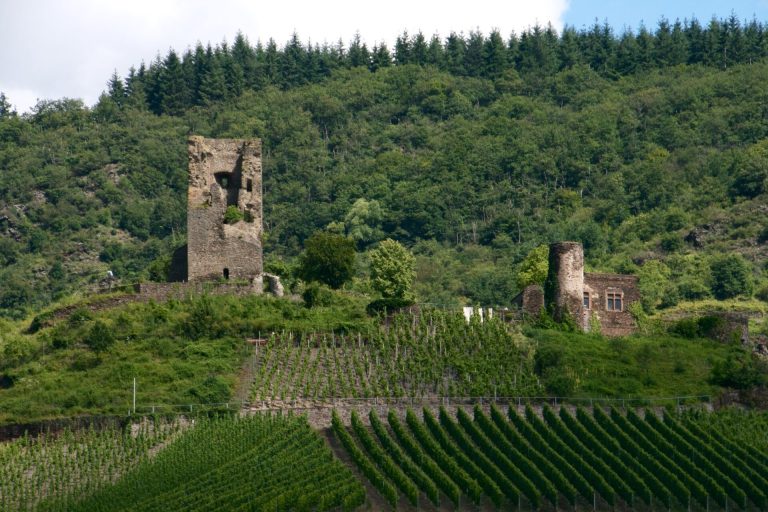
Metternich Castle occupies a rocky promontory above Beilstein in the Cochem-Zell district of Rhineland-Palatinate. The spur rises about 60 metres, falls steeply on three sides, and stands at approximately 150 metres above sea level. The complex covers roughly 80 by 50 metres and survives as a ruin whose defensive and residential elements remain identifiable.
Approach and outer defenses
Access to the castle was possible from the north, where the approach passed through several successive defensive enclosures. These included a substantial outer bailey and multiple zwingers, enclosed defensive areas positioned between or in front of walls so that attackers could be exposed to fire from the fortifications.
Citadel and bergfried
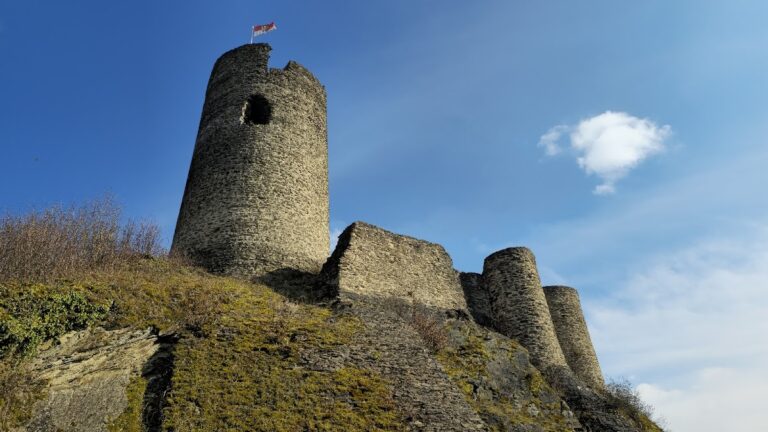
The main fortress was a stone, pentagonal citadel with high walls and a single gate. Its principal defenses faced the southern part of the spur, the side regarded as most vulnerable to attack. A pentagonal bergfried, the principal tower of a medieval German castle, projected toward this higher southern section. Approximately 25 metres high, it remains the dominant feature of the ruins and serves as a lookout tower over the Moselle valley.
Residential buildings
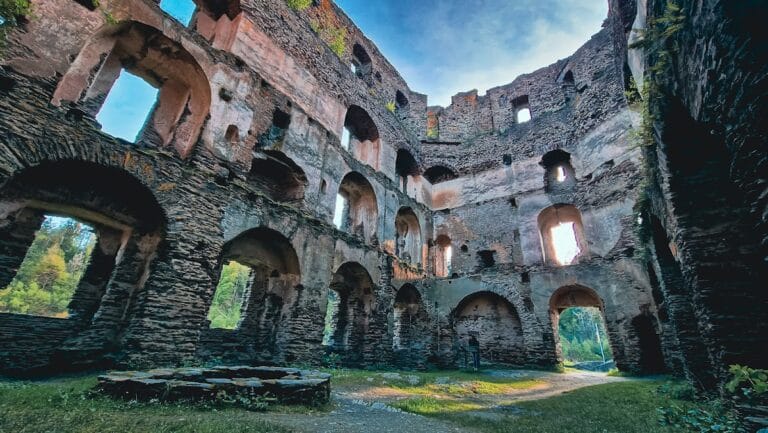
Partly preserved residential buildings show that the castle was a Ganerbenburg, a fortress occupied simultaneously by several noble families. The number of surviving residential structures suggests that several aristocratic families may have lived within the complex at the same time during the Middle Ages.