Palazzo delle Poste: Trento’s Futurist Post Office
Site at a Glance
- Popularity
- Medium
- Country
- Italy
- Primary era
- Modern
- Eras represented
- Early Modern, Modern
- Civilizations
- Holy Roman Empire, Italian
- Site type
- Civic
On this page12 sections
History
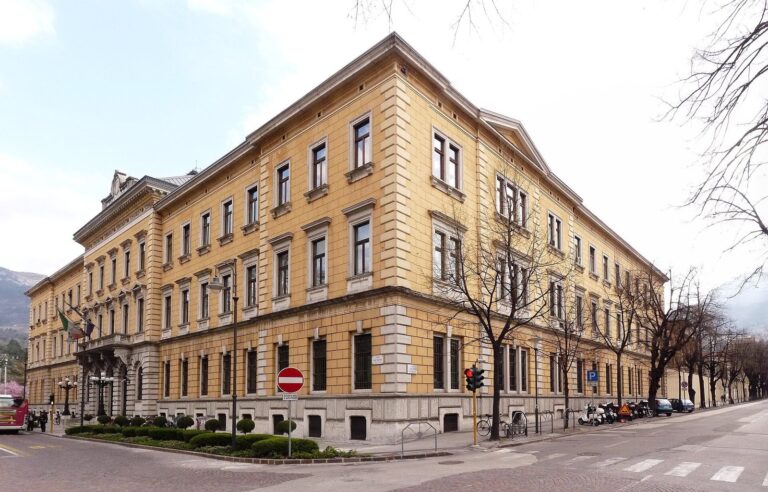
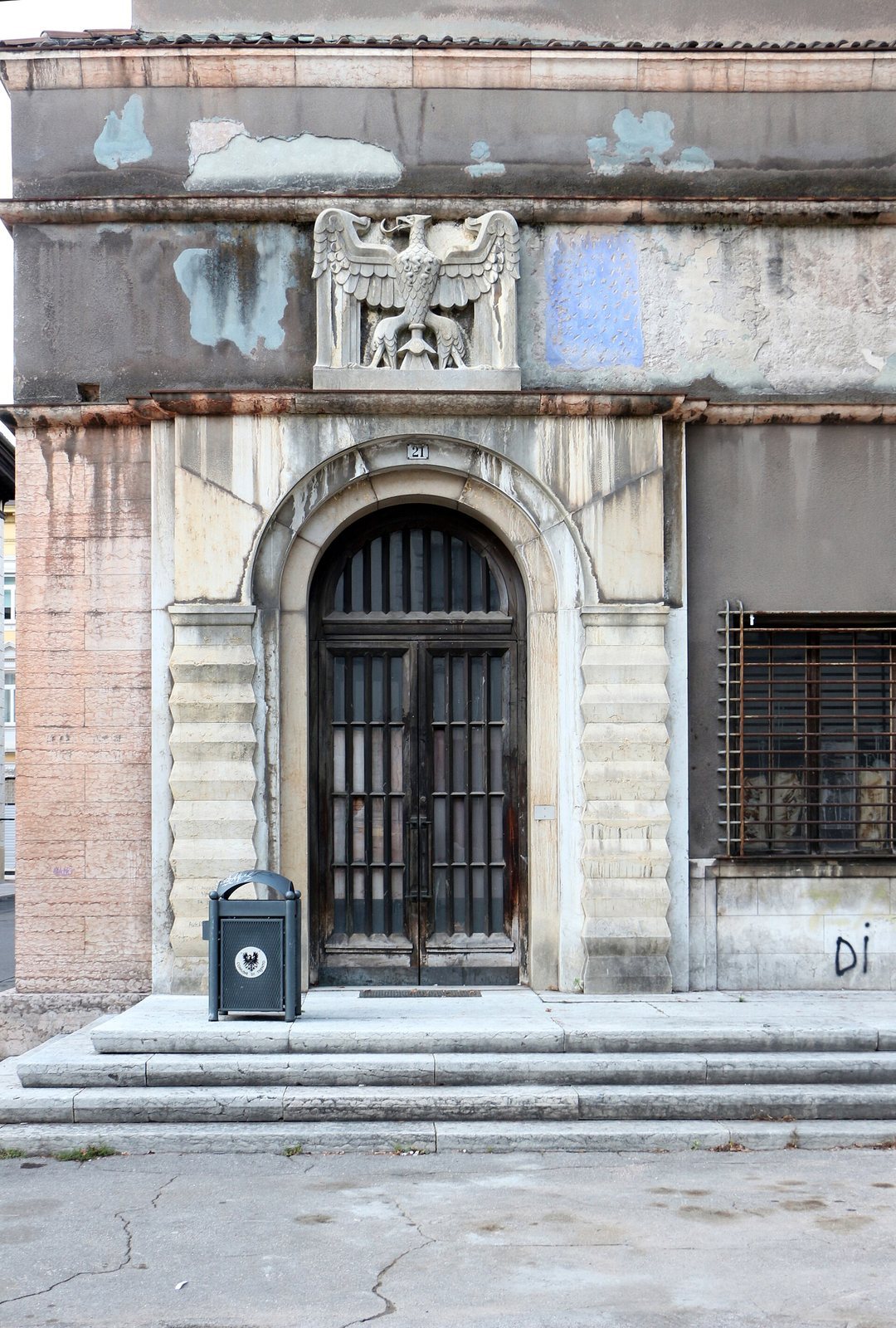
Palazzo delle Poste is the post-office complex in Trento, Italy, rebuilt in Futurist style between 1929 and 1934 as part of urban renewal under Italy’s Fascist regime, an authoritarian political movement. Futurism was an Italian avant-garde movement that celebrated modernity and dynamic forms. Architect Angiolo Mazzoni designed the complex, which was inaugurated in 1934.
The earlier post-office palace
The Renaissance Palazzo a Prato previously occupied the site and had been used as a sugar refinery. A fire destroyed it on 13 December 1845. A new post-office palace, designed by Austrian architect Friedrich Setz in the Empire style, a neoclassical style associated with the Napoleonic era, was subsequently built there.
Fascist-era reconstruction
During the Fascist-era renewal of Trento, the railway station, military barracks, and post office were regarded as conspicuously Austrian buildings. The post office was rebuilt as Mazzoni’s Futurist complex, constructed over the years from 1929 to 1934. Its design replaced the earlier palace as part of the city’s transformation.
Mazzoni and artist Fortunato Depero disagreed over the project. Depero was initially excluded, but secured a commission after consulting arts official and sculptor Maraini and prompting Futurist advocate Filippo Tommaso Marinetti to appeal to Minister Ciano. Mazzoni presented their aims as fully aligned, although their apparent agreement has also been attributed to pressure from Depero.
Reception and continuing use
The building’s design was considered out of step with local architectural traditions and nearby structures, including Palazzo Sardagna and buildings facing Piazza Vittoria. Two legends offered explanations for the mismatch: one said Rome had mistakenly sent Trento a design intended for Benghazi; another blamed a filing error between Trento and Tripoli. The post office remains in use.
Remains
Layout and surviving fabric
Rooms and services
Mazzoni described the design as a group of connected buildings rather than one palace. Its two floors had different functions. The ground floor accommodated financial and postal services, correspondence services, a writing room, and a recreation room for workers. The second floor held the vault, telegraph service, and administrative offices. In early plans, Mazzoni also designed furnishings and arranged objects such as tables and display cases.
Materials and reused elements
The complex used materials from the surrounding area: ochre porphyry, a hard stone, from Predazzo for the letterbox; yellow marble from Mori for the grand-staircase steps; and white limestone from Pila for the diamond-faceted pilasters, flat supports projecting slightly from the walls. The exterior was originally finished with cobalt-blue plaster. Elements from Palazzo a Prato were incorporated into the building, including a portal dated 1512, courtyard arches from a colonnaded portico, and a three-part window topped with Ionic capitals, carved column tops in a classical style. An ornamented fireplace from the earlier complex was later transferred to Castel Thun in Val di Non.
Artworks and sculpture
Paintings and family emblem
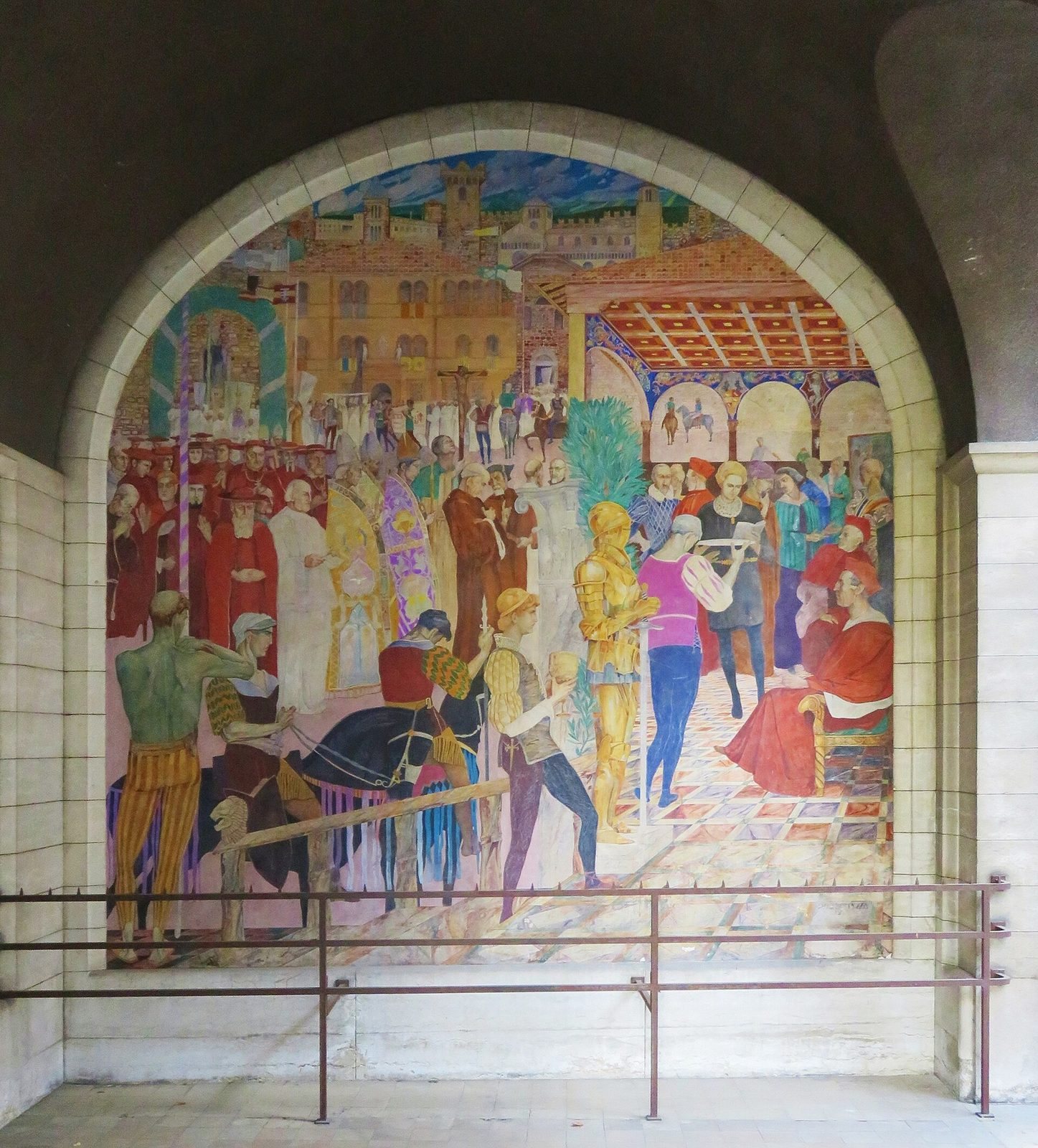
Luigi Bonazza painted a wall mural showing the reception of three cardinals at Palazzo a Prato during the Council of Trent, a major Catholic Church council held from 1545 to 1563. Gino Pancheri’s painting The Woodcutters and the Vine-Growers was placed on the second floor above the stairway. Alcide Ticò made the a Prato family coat of arms for the courtyard; it remains visible near the copy shop.
Stained glass
Depero and artist Tato made six multicolored stained-glass windows that separated the workers’ recreation room from the courtyard. Depero’s works were The Machines, The Arts, and The Fascist Era; Tato’s were The Youth March, Air Communications, and The Revolution. The windows were later lost. It is uncertain whether they were destroyed in the Anglo-American bombing of 1943, damaged in the 1966 flood and subsequently smashed with pickaxes, or affected by both events. During work on the building, a 19 January 1968 communication from superintendent Rasmo directed that the courtyard-arcade windows be replaced with clear, undecorated glass. Three smaller multicolored windows by Enrico Prampolini, titled Savings, The Telegraph, and Communications, remain visible along the corridor leading to the second-floor rooms.
Sculptures
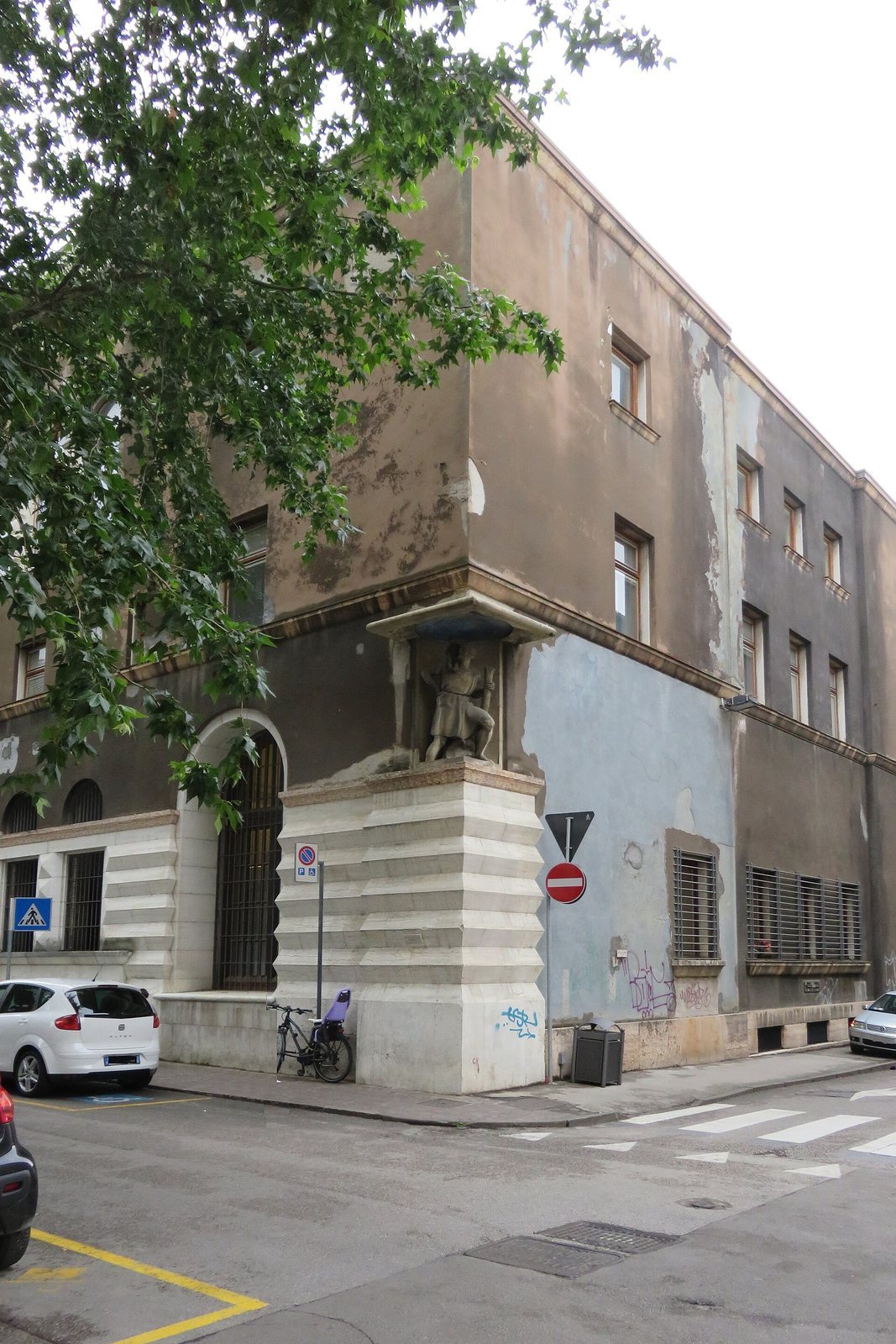
Stefano Zuech made a Saint Christopher, visible in a niche on the building’s south side. Saint Christopher is a Christian saint traditionally associated with travelers. Zuech also made a Saint Vigilius, a bishop of Trento venerated as a saint; that sculpture is now in Piazza D’Arogno near the cathedral.