Palazzo Thun: Historic Municipal Palace in Trento


Site at a Glance
- Rating
- 4.3
- Popularity
- Low
- Country
- Italy
- Primary era
- Early Modern
- External website
- Open
- Eras represented
- Medieval, Early Modern, Modern
- Civilizations
- Habsburg, Holy Roman Empire
- Site type
- Domestic
- Remains
- Elite Residence
On this page9 sections
History
Palazzo Thun is a historic palace in Trento, Italy, developed over four centuries as the urban residence of the prominent Thun-Hohenstein family. The complex took its present character through Renaissance rebuilding during the sixteenth-century reorganization of the city.
The Thun family residence
The family’s first recorded acquisition in the area occurred in 1454, when Sigismondo de Thono (1403–1467) purchased several buildings in Contrada Belenzani, in the central San Benedetto district. Later purchases enlarged the property, which stood alongside the family’s castle at Vigo di Ton in the Non Valley. A chapel dedicated to Saint Blaise was added to the residence and consecrated in 1489.
A younger relative, the second Sigismondo Thun (1487–1569), continued acquiring property and renewing the buildings. His work took place during the urban reorganization associated with Bernardo Clesio and later continued under Cristoforo Madruzzo, both prince-bishops, meaning bishops who also exercised territorial political authority in Trento.
Renaissance reorganization
In 1543, Sigismondo Thun completed the family’s acquisition of the area by purchasing a feudal house, a farmstead in Contrada delle Orne, and the tower known as the Mirani or Marcolina Tower. The consolidation of these holdings reshaped a plot that had previously retained a Gothic character.
Building-recovery works between 1550 and 1557 removed small portions of structures within the property, reorganized the building facing the street for use as a noble palace, and added four stone doorways. The entrance portal also belongs to this Renaissance phase, a period of renewed interest in classical forms that influenced European architecture and urban planning from roughly the fourteenth to the sixteenth centuries.
Division, damage, and changing uses
In 1596, the division of the family into separate branches split the palace into two areas known as the “lower” and “upper” sections. These were assigned to the Thun branch of Castel Bragher and the Thun branch of Castel Thunn. Seventeenth-century maps show that the overall arrangement of the property remained substantially unchanged.
French troops damaged the complex by bombardment during the siege of Trento in 1703. The altar of the Chapel of Saint Blaise was affected, and renovation preceded its reconsecration in 1732. Other parts of the property later accommodated commercial tenants, including the Bettola Thunnera, an inn and lodging house for soldiers of the Imperial army.
During the mid-eighteenth century, part of the garden was granted in usufruct to the recently founded Compagnia della Morte, a religious confraternity, or voluntary devotional and charitable association. The confraternity built the Church of Death there and used it for religious activities until the Napoleonic suppression of confraternities in 1811. After the property was sold, the church served as a library and archive.
Municipal ownership
Financial difficulties led the family to place the palace at auction in 1871. It then became municipal property. Reorganization works begun in 1873, including interventions by the architect Rodolfo Vantini, established the Municipality of Trento in the upper section. Most furniture, furnishings, and paintings remained with the family and were moved to other residences belonging to Count Matteo Thun.
Since the second half of the nineteenth century, Palazzo Thun has housed the Municipality of Trento and has continued in municipal use. Nineteenth-century alterations included changes to the entrance doors and further adaptation of the ground floor for commercial purposes.
Remains
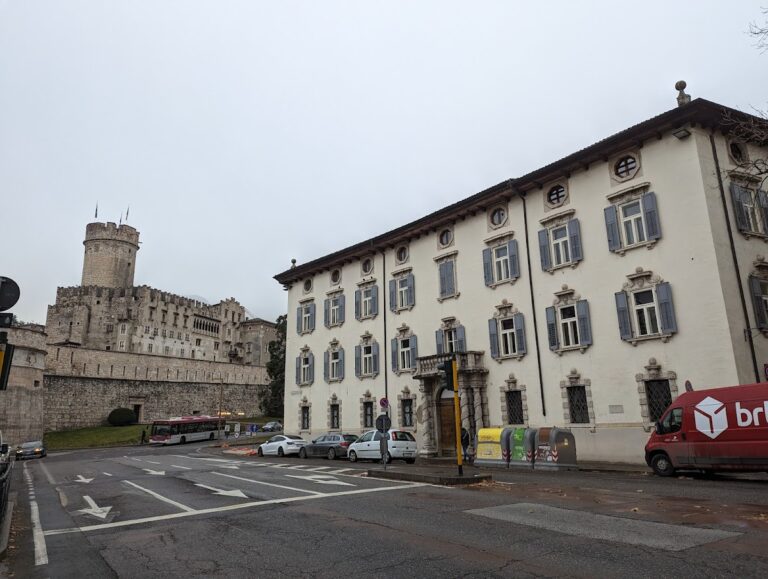
The complex consists of several building bodies arranged around courtyards, together with a tower, a chapel, and the former church in the garden area. Its principal street facade preserves the formal elements of the Renaissance palace created through the sixteenth-century reorganization.
Main facade and courtyards
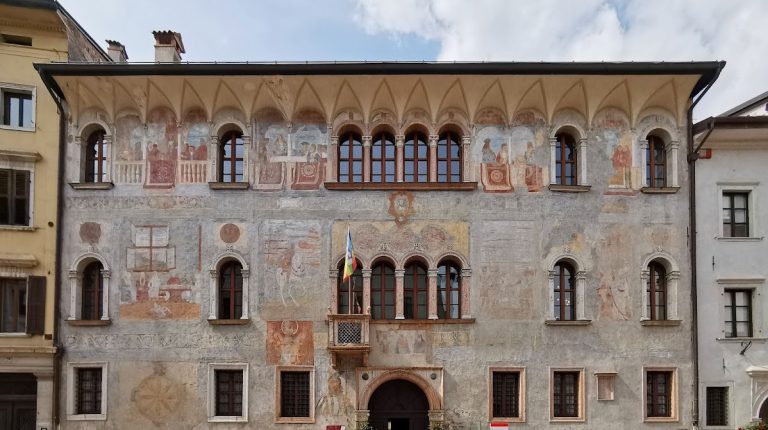
The main entrance is a Renaissance portal with a round arch and circular decorations carved from a stone resembling jasper. A stone balcony surmounts the portal. Above it, the facade is organized into three tiers of windows with architraves, followed by a further series of smaller openings beneath the crowning element. Two stone shields bearing the Thun emblem are placed at the corner of Via delle Orne and at the opposite corner. The name Thun is described as a Germanized form of de Tono.
Chapel and former Church of Death
The Chapel of Saint Blaise forms part of the palace complex. Consecrated in 1489, it retains its place within the residence’s architectural composition. Its altar was damaged during the 1703 bombardment, and renovation work led to the chapel’s reconsecration in 1732.
The garden area also contains the former Church of Death, built for the Compagnia della Morte according to a design by Camillo Vinoto. Following the alienation of the confraternity’s property in 1811, the building was adapted for use as a library and archive.
Paintings and memorials
Several interior rooms contain frescoes, paintings made on fresh plaster so that the pigments become integrated with the wall surface, along with numerous other paintings. Among the notable works are paintings donated to the city of Trento in 1902 from the facade of Casa Cloz-Salvetti-Zandroni-Garavaglia de Soresina in Via San Marco.
The secular sixteenth-century fresco cycle from that building is attributed to Domenico Ricci, known as Brusasorci. Brusasorci was the artistic nickname of the sixteenth-century Italian painter associated with the decoration, and the cycle is regarded as one of the most significant and valuable of its kind.
Memorial plaques beside the portal and in some interior rooms commemorate Trentino volunteers who died during the First World War. Other plaques remember people associated with service in the Austro-Hungarian army, the Second World War, and resistance to the Nazi regime.
Nearby sites