Château de Ham: A Medieval Fortress and State Prison in France


Site at a Glance
- Rating
- 4.2
- Popularity
- Low
- Country
- France
- Primary era
- Medieval
- Eras represented
- Medieval, Early Modern
- Civilizations
- French
- Site type
- Military
- Remains
- Castle
On this page13 sections
History
Château de Ham is a medieval fortress in France, first recorded in 1052 and generally associated with the early counts of Vermandois. Its construction date is unknown, but the castle developed through successive phases of medieval fortification, aristocratic ownership, royal service, imprisonment, and military destruction.
Medieval lords and reconstruction
Odon IV of Ham restored the castle during the thirteenth century. In the late fourteenth century, Enguerrand VII de Coucy acquired it after Jean de Ham died without a male heir. Enguerrand later passed the castle to his daughter Marie I de Coucy, who was married to Henri de Marle.
The seigneury was sold to Louis I of Orléans in 1400, but Robert de Marle, Marie’s son and heir, recovered it in 1409. Robert’s widow, Jeanne de Béthune, then transferred the property to her second husband, Jean II de Luxembourg-Ligny. He continued the process of restoration and rebuilding.
Louis de Luxembourg-Saint-Pol, Jean II’s nephew and heir, became count of Saint-Pol and constable of Louis XI from 1465. A constable was a senior military officer. In 1441, Louis commissioned the immense keep known as the Constable’s Tower and adapted the fortress to resist artillery fire.
Jacques of Savoy, the first husband of Marie of Luxembourg, died at the castle on 30 January 1486. Marie’s second marriage to François de Bourbon-Vendôme brought Château de Ham into the Bourbon-Vendôme family, from which King Henri IV later descended.
Sieges and royal transformation
The fortress endured several sieges, including an assault by Philip II of Spain in 1557. It returned to the French crown during the reign of Henri IV. At the end of the seventeenth century, the military engineer Vauban transformed the fortress. His designs influenced the modernization of many French fortifications under Louis XIV.
State prison and political history
Château de Ham was later converted into a state prison. During the Thermidorian repression, the measures that followed the fall of Maximilien Robespierre in July 1794, about ten Montagnards were imprisoned there in April 1795, including Chasles. Other notable prisoners included Louis I de Bourbon, prince of Condé; Jacques Cassard; the marquis de Sade; Mirabeau; Léonard Bourdon; Pierre Dezoteux de Cormatin; Marshal Moncey; Hugues Duroy de Chaumareys; General Hoche; Jules de Polignac; Martial de Guernon-Ranville; Jean de Chantelauze; Édouard Roger du Nord; General Adolphe Le Flô; Louis Juchault de Lamoricière; Ramón Cabrera; and Cheikh Boumaza.
Prince Louis-Napoléon Bonaparte, who later became Emperor Napoleon III, was imprisoned at Ham from 1840 to 1846. On 25 May 1846, he escaped disguised as a mason and using the name “Badinguet,” the alias associated with his flight from the fortress.
War, destruction, and preservation
During the Franco-Prussian War of 1870, the Second Army of the North encircled Ham, which was held by Prussian forces, and compelled the garrison to capitulate.
German forces dynamited the fortress on 19 March 1917 during the First World War. The ruins were later neglected, used as a stone quarry, and turned into a rubbish dump before preservation measures began. The surviving remains have been listed as a French monument historique since 1965. The association Les Amis du Château de Ham was founded in 1977 to preserve and interpret the ruins through maintenance, exhibitions, and performances.
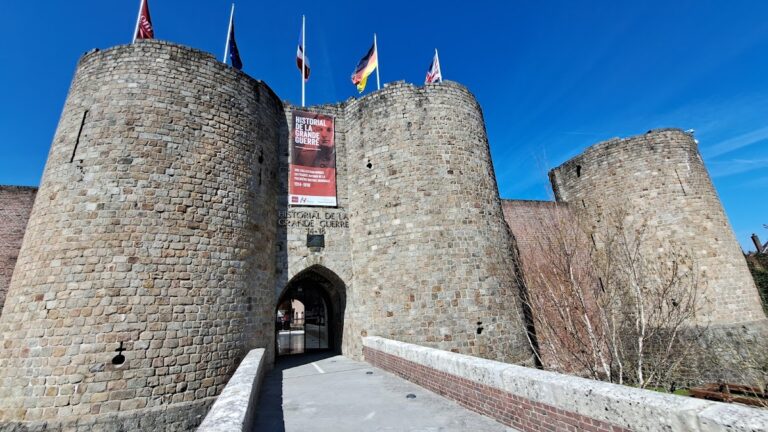
A plaque installed on the entrance tower on 11 October 1980 states that Louis-Napoléon Bonaparte, during his imprisonment from 1840 to 1846, developed policies of economic and social progress at the site.
Remains
Château de Ham occupied a roughly 120-metre-long by 80-metre-wide site. Its enclosure followed a polygonal arrangement associated with the Philippian plan, a medieval defensive system linked especially with fortifications developed under Philip II Augustus and characterized by a substantial stone enclosure, regularly placed towers, and strengthened curtain walls. Large cylindrical towers reinforced the perimeter, while the surviving ruins overlook the Canal de la Somme.
Fortifications and entrances
Enclosure and water defences
A round tower stood at each corner, and two square towers strengthened the curtain walls. The north-eastern square tower began as an entrance but was blocked during the fifteenth century. A deep ditch, with a channel along its bottom, carried water from the Beine, a tributary of the Somme. Construction of the Canal de la Somme in 1821 drained the ditch.
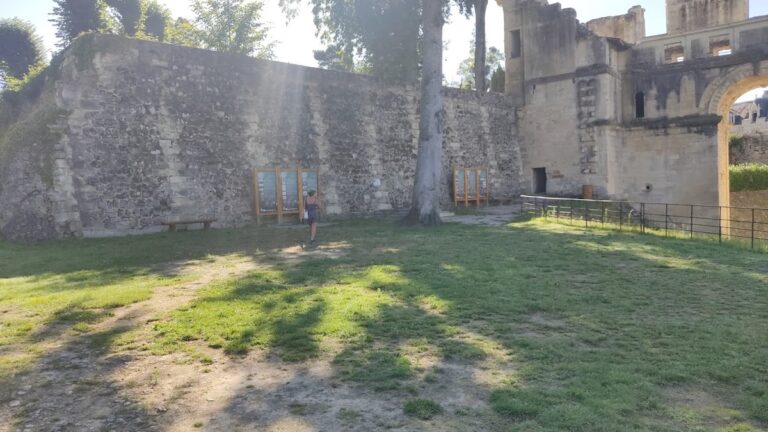
The enclosure wall rose about 16 metres. Sandstone formed its base, while blond limestone rubble made up the masonry above. Machicolations, projecting openings through which defenders could drop stones or other objects onto attackers below, and crenellations completed the defensive system.
Main entrance defences
The principal entrance was protected by a sixteenth-century demi-lune, a crescent-shaped outwork placed before a fortification, together with a drawbridge. A second demi-lune defended the south-eastern side before the canal was built. After the demolition of 1917, the square-plan entrance tower and sections of the enclosure remained.
Constable’s Tower
The Constable’s Tower, also called the Great Tower, defended the north-eastern corner. It measured approximately 33 metres in diameter and 33 metres in height, with walls about 11 metres thick. Two entrances were separated by an interior ditch, and the surrounding curtain walls joined the tower without direct communication.
Residential and living features
Residential building
A large residential building stood within the enclosure. Marie of Luxembourg lived there, and her children François I of Saint-Pol, Louis de Bourbon-Vendôme, and Antoinette de Bourbon were born at the castle.
Linden tree
A mutilated linden tree still stands within the castle site. It is sometimes called the Tree of Liberty, although that identification is probably incorrect. The tree may have been planted in 1793 by André Dumont, a representative of the Convention sent on mission, or by Léonard Bourdon, who was then imprisoned in the fortress.
On 26 October 1853, Napoleon III, Empress Eugénie, and their entourage took refreshments beneath the old linden during a visit to Ham. The tree was damaged when the fortress was destroyed in 1917. Its trunk burned, but surviving roots produced a new shoot.
Nearby sites