Brontochion Monastery: A Byzantine Monastic Complex in Mystras, Greece
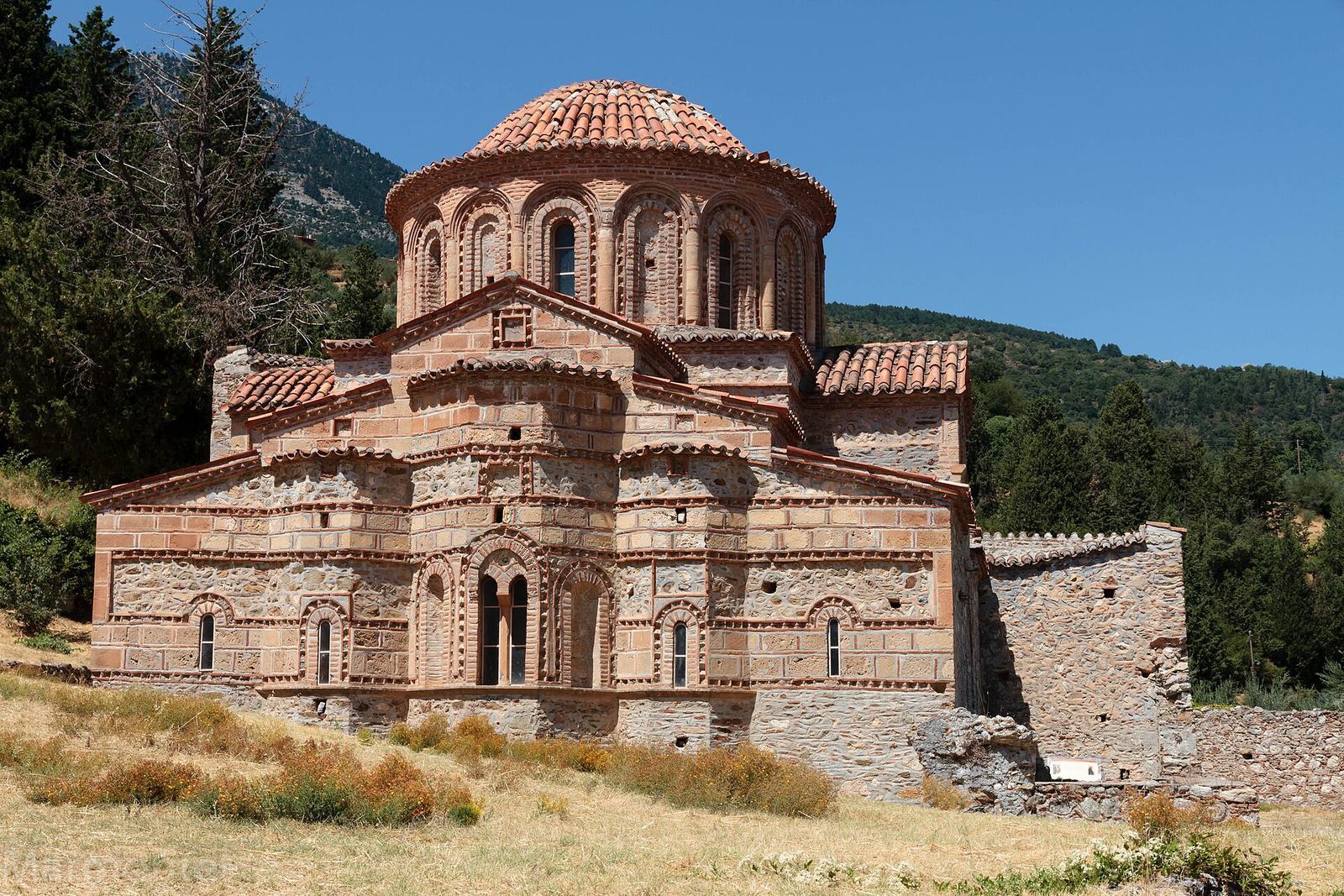
Site at a Glance
- Popularity
- Medium
- Country
- Greece
- Primary era
- Medieval
- Eras represented
- Medieval
- Civilizations
- Byzantine
- Site type
- Religious
- Remains
- Monastery
On this page11 sections
History
Brontochion Monastery was an Eastern Orthodox monastery in Mystras, Greece, whose two churches were built from the late 13th to the early 14th century during the Palaiologan era. The Palaiologan dynasty ruled the Byzantine Empire from 1261 to 1453, a period of cultural revival often called the Palaiologan Renaissance. Mystras was then the capital of the Despotate of Morea, a Byzantine successor state based in the Peloponnese.
Foundation and the two churches
The monk Pachomius, active in Mystras from 1290 to 1322, gathered donations and imperial land grants from Emperor Andronikos II Palaiologos and his son and co-emperor Michael IX. These resources supported the construction of the monastery’s two churches. Pachomius later became abbot, the head of the newly formed community.
The older church, Saints Theodores, was built between 1290 and 1295 and is mentioned in a record from 1296. Hodegetria, a title of the Virgin Mary meaning “She Who Guides,” was built or reconstructed in the early 14th century; proposed dates range from 1308 to 1322. A manuscript written by Metropolitan Nikephoros Moschopoulos, a senior bishop, and given to the monastery in 1311–1312 refers to Hodegetria and identifies the monastery with the dedication of the Most Holy Mother of God.
The churches’ original roles are uncertain. Saints Theodores may have been the first katholikon, or principal monastery church, before Hodegetria was built. Graves around Saints Theodores also support the possibility that it served as a cemetery church. Remains of monastic cells and a refectory around Hodegetria point to the community’s presence there. Hodegetria probably became the principal church, and the monastery later took its name.
Architectural influence
Hodegetria introduced the Mystras type, a mixed church design that became prominent among the city’s religious buildings and influenced churches including Hagia Sophia and Pantanassa. Its design also brought architectural forms associated with Constantinople into Mystras, then a provincial center. More broadly, church architecture of the period gave greater attention to exterior ornament and divided interiors into more distinct spaces.
Ottoman rule and modern recognition
During Ottoman rule, the monastery was converted into a mosque. It is no longer an active monastery. Since 1989, Brontochion has formed part of the UNESCO World Heritage Site of Mystras, inscribed under criteria ii, iii, and iv. Criterion iv recognizes the prevalence at Mystras of the mixed architectural type introduced by Hodegetria.
Remains
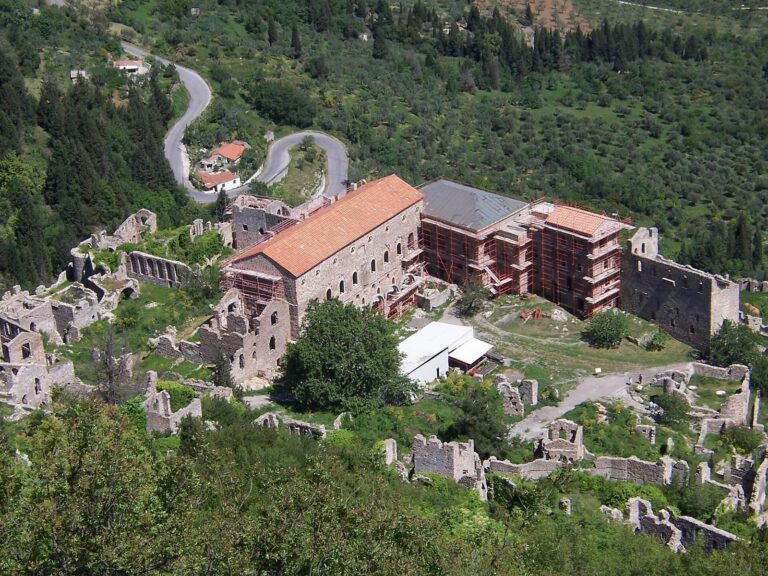
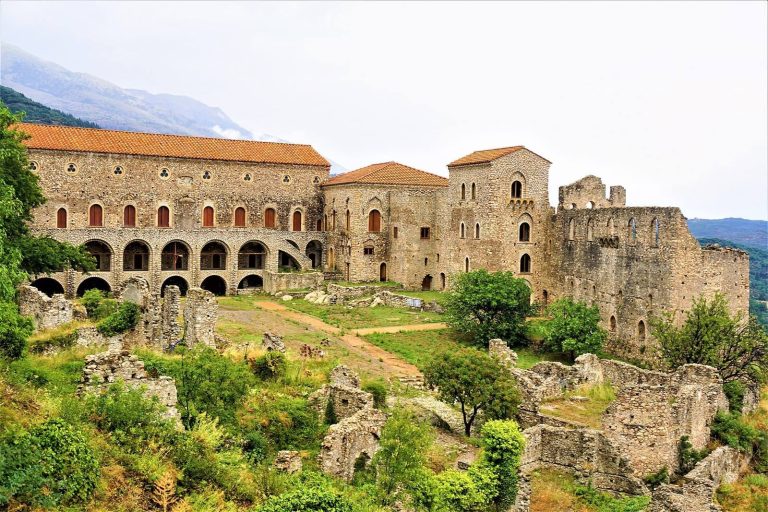
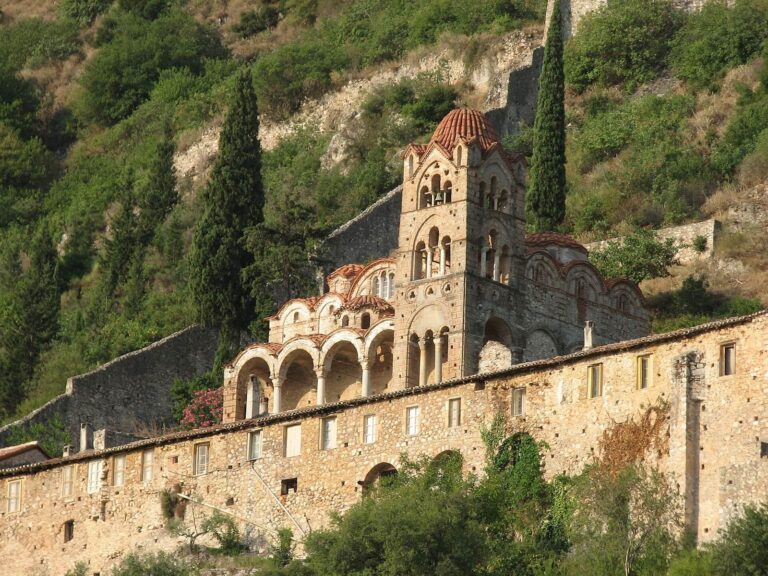
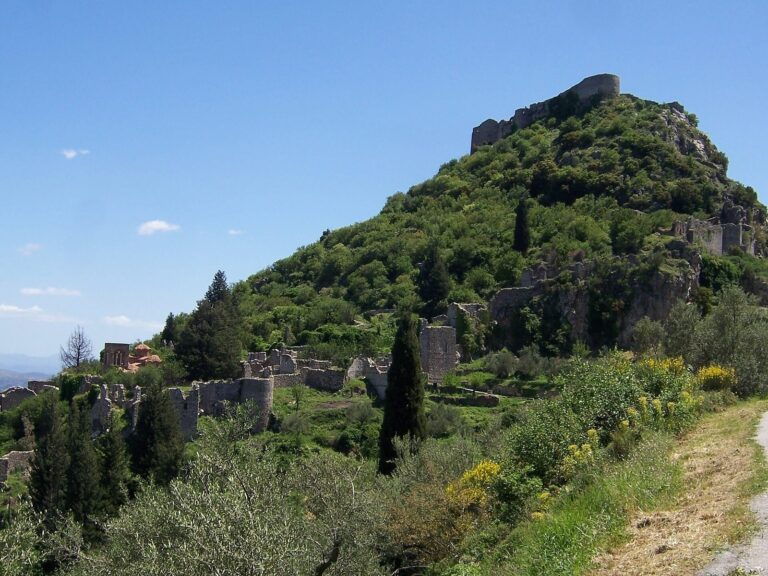
The surviving complex consists of Saints Theodores and Hodegetria in the Lower Town of medieval Mystras, at the foot of Mount Taygetus and about 6 km west of Sparta. It occupies the town’s northwest corner, beside the outer wall. The church of Evangelistria and the Metropolitan Cathedral of Saint Demetrios, which houses a museum, are to the east; the Palace of the Despots lies to the south.
Church of Saints Theodores
Plan and later additions
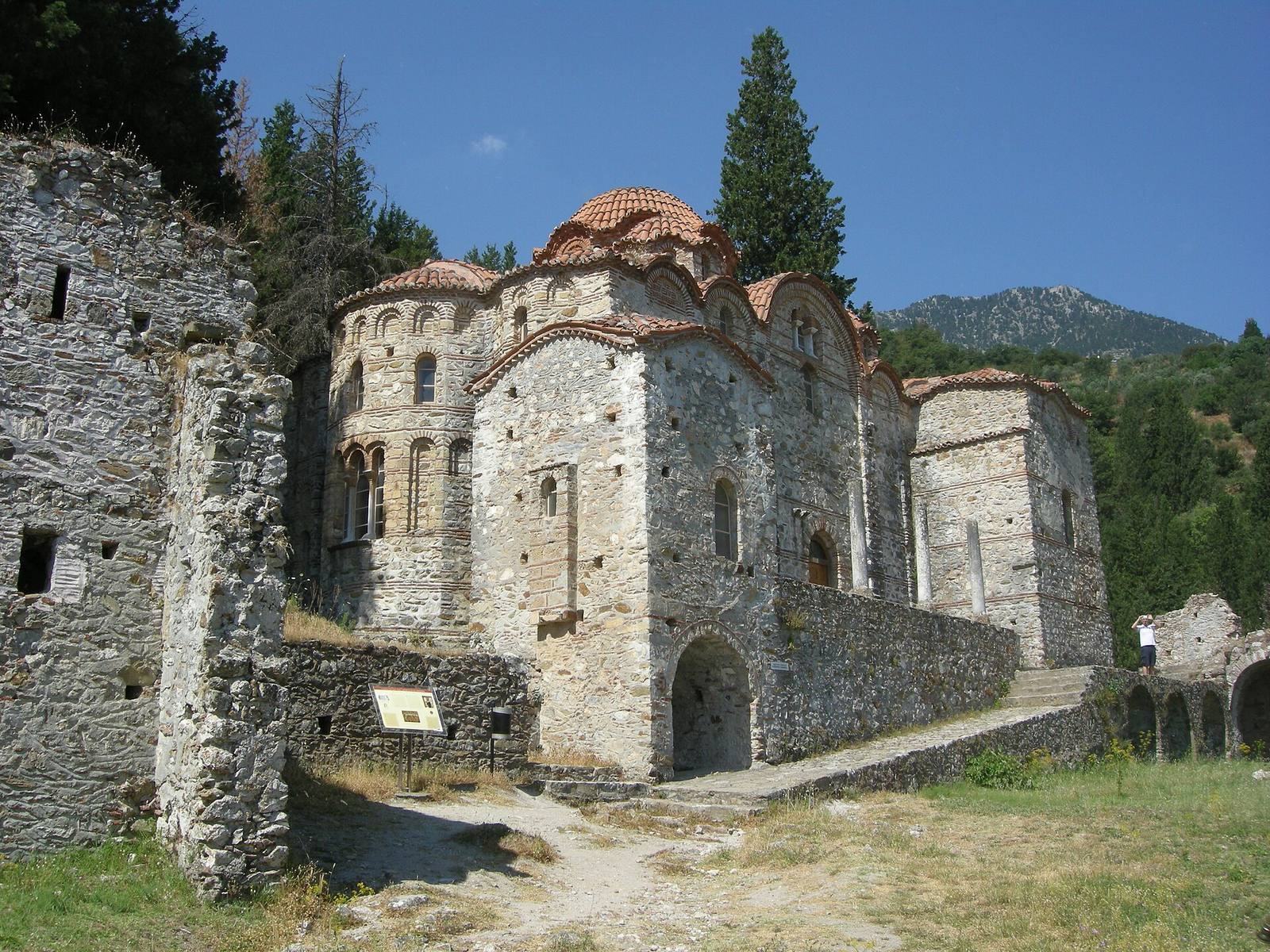
Dedicated to the military saints Theodore of Amasea and Theodore Stratelates, Saints Theodores has a simplified octagonal cross-in-square plan, with a central dome above a cross-shaped arrangement of interior spaces. Eight arches support the dome. Its two western supports are round columns rather than the square pillars used in earlier examples, and four chapels occupy the church’s corners. The corner chapels were added after the original building.
During the 14th century, a narthex (entrance vestibule) and two tower-shaped chapels were added on the west side. By the late 19th century the church was in ruins, and the upper part of its dome was reconstructed in 1930.
Interior remains
Fragments of late-13th-century frescoes survive inside, including a portrait identified as Emperor Manuel II Palaiologos. A tomb in the church is associated with Theodore I Palaiologos, despot of Morea, who died in 1407.
Church of Hodegetria
Plan and construction
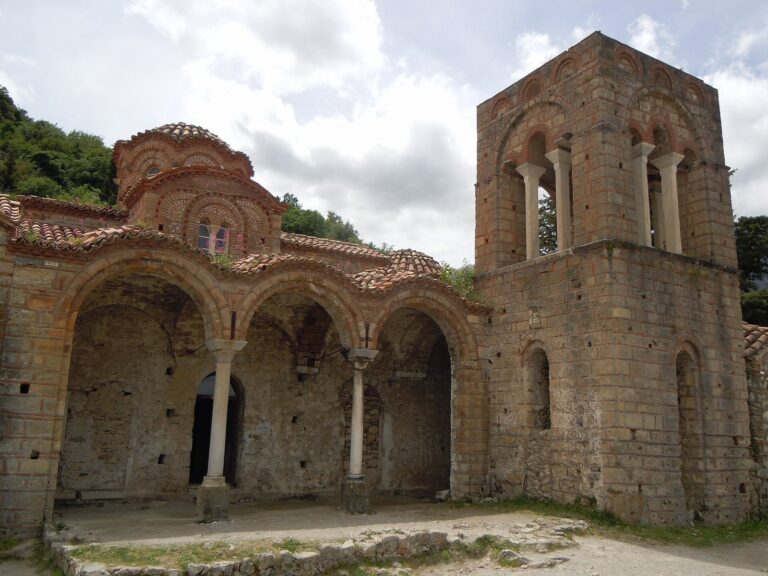
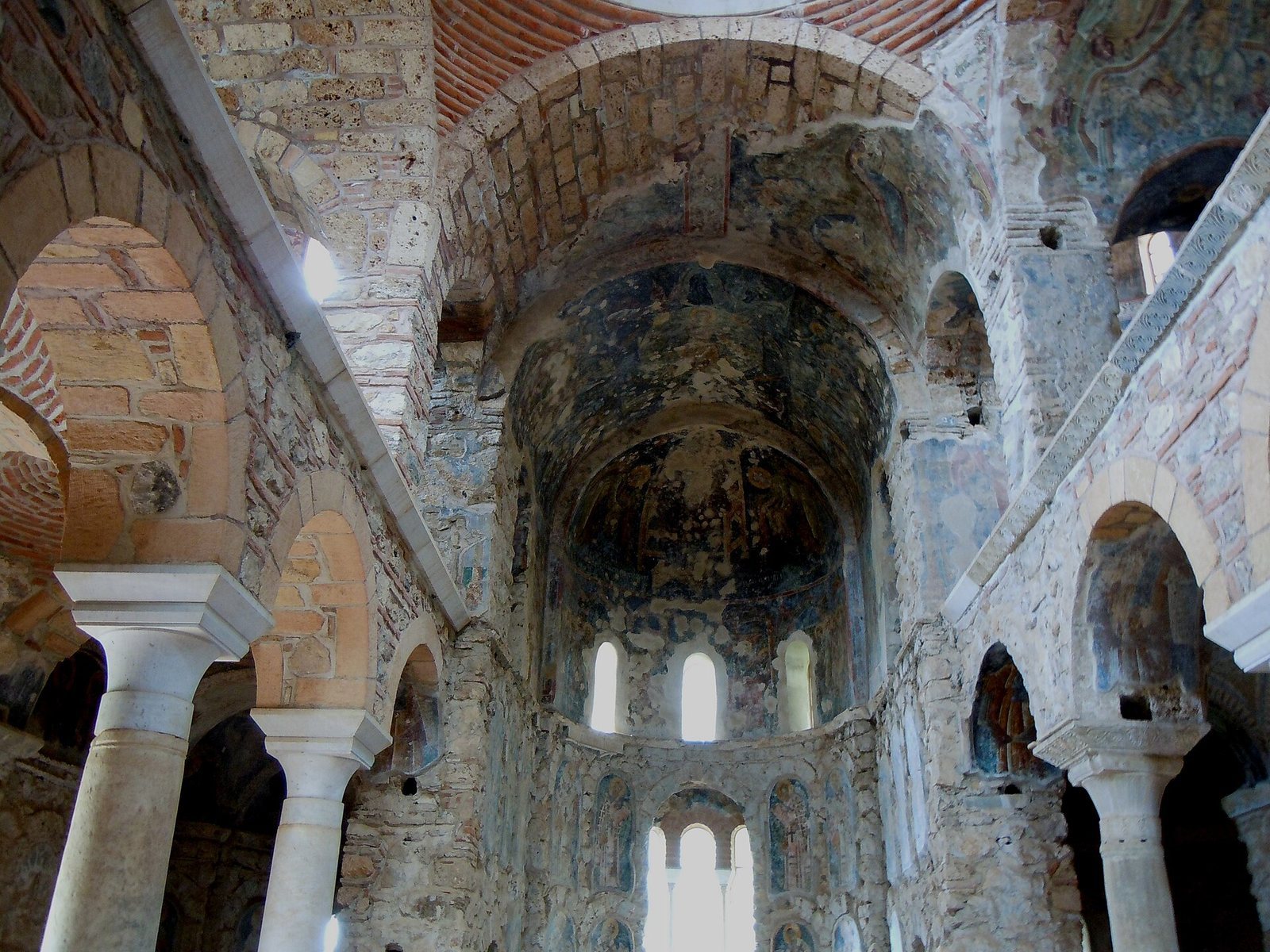
Also called Aphentiko, Hodegetria combines a three-aisled basilica, a church with a central nave and two side aisles, on its lower level with a cross-in-square church above. Two colonnades, each with three columns, divide the lower level into three aisles. Three apses, projecting ends of the sanctuary, face east. Arches between the columns and outer walls divide the side aisles into five covered sections. Above them, a gallery runs along the narthex and both side aisles.
The upper church has a four-column cross-in-square plan and five domes. Their drums, the structures supporting the domes, rest on the upper church’s framework and strongly reinforced outer walls rather than directly on the lower-level columns. This combination of a basilica below and a five-domed church above is uncommon beyond Mystras; comparable arrangements are noted at Saint Irene, the sixth-century chapel of Saint Nicholas at Katapoliani on Paros, and the eighth-century Hagia Sophia at Vize.
Two two-storey chapels stood at the ends of the narthex and were originally surrounded by porticoes, or roofed porches. Two more chapels were added in the second half of the 14th century, and the south portico was enclosed. Two further chapels border the north colonnade. A three-storey bell tower stands at the southwest end of the building, at the southern end of the western colonnade. Its cloisonné masonry sets squared stones within brick framing, unlike the alternating cut stone and horizontal brick courses used in other Mystras churches.
The main apse has three-lobed windows below two rows of blind arches, decorative arches set into the wall. The upper arches and the colonnades on the façade reflect forms from Constantinople. At Hodegetria, the colonnades brought this feature into provincial church architecture.
Interior decoration and paintings
Marble facing covers the lower-level interior walls alongside the wall paintings. A shallow-relief frieze and painted cornice crown the facing. The cornice imitates carved door-jamb ornament and includes a central cross with curling leafy branches. Some paintings were framed by arches inlaid with multicoloured pieces; three fragments survive on the eastern arch of the south colonnade, in black, white, and purple.
The paintings include scenes from the Dodecaorton, the twelve major feasts of the Orthodox Church, in and around the sanctuary. The main apse contains a cycle of sixteen senior church figures, while pairs of saints appear in the gallery. A cycle of eight feasts probably occupied the four cylindrical vaulted ceilings beneath the dome, and martyrs appear on the gable. Frescoes remain in two side-aisle vaults. Narthex paintings include scenes of Christ’s miracles and a depiction of Jesus among the teachers in the Temple. Fragments of 14th-century paintings with Old and New Testament subjects also survive, including a richly coloured procession of martyrs.
A fresco of the Virgin Mary as Zoodochos Pege, meaning “Life-giving Spring,” survives in the crescent-shaped wall panel above the royal door, the central entrance to the sanctuary. One group of paintings uses repeated, emphatic brushstrokes and a limited palette. In the Baptism, pale greens predominate with light-brown shading and occasional purple-brown tones. In the scene of the Myrrh-bearing Women at Christ’s tomb, a dark-red cave contrasts with a green mountain; the angel wears green and reddish brown, while the women’s garments combine dark brown with light blue or light yellow with green. Contrasting colours give the gallery’s scene of the Seventy Apostles a particularly lively effect.
Another group, including Christ’s miracles at the base of the narthex, scenes of the Passion, the Virgin and prophets, and saints in the west gallery, has more restrained brushwork and slender, nearly motionless figures. Its style has been compared with the mosaics of the Chora Monastery, a Byzantine monastic church in Constantinople known for its mosaics.