Higashinomiya Kofun: An Early Kofun-Period Burial Mound in Japan


Site at a Glance
- Rating
- 4.2
- Popularity
- Very Low
- Country
- Japan
- Primary era
- Classical
- External website
- Open
- Eras represented
- Classical
- Civilizations
- Yamato
- Site type
- Burial
- Remains
- Burial Mound
On this page7 sections
History
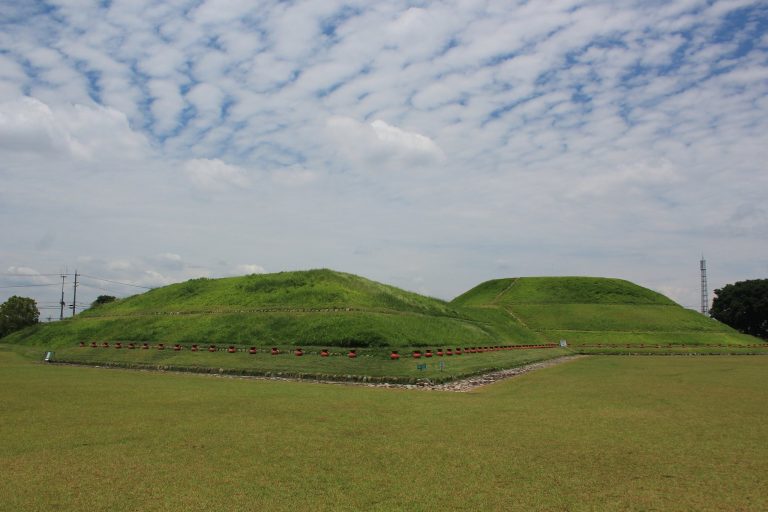
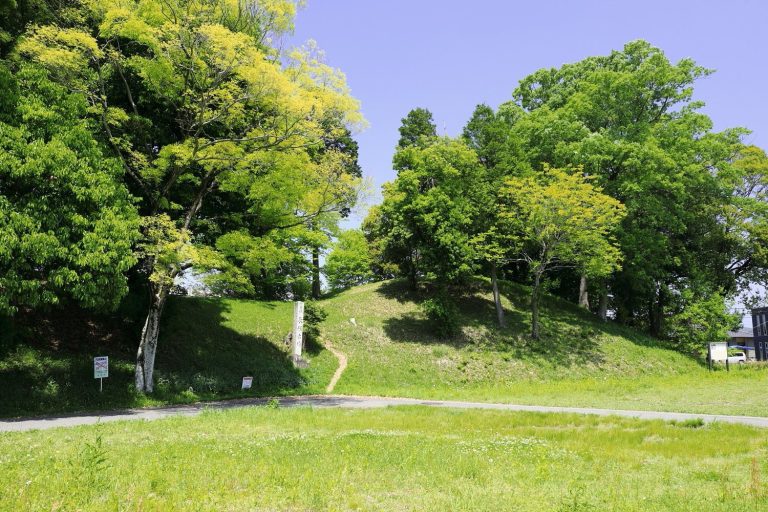
Higashinomiya Kofun is an Early Kofun-period burial mound in Inuyama, Japan, built by the ancient Japanese society of the period between the late third and fourth centuries. It stands on the left bank of the Kiso River at the western end of the long east-west ridge of Hakusanbirayama. The mound belongs to the square-rear and square-front type, known as a zenpo-koho-fun, rather than the more familiar keyhole-shaped form.
Dating and Early History
The construction date is conventionally placed in the fourth century because of the grave goods recovered from the mound. Archaeologist Jiro Akatsuka, one of the authors of the excavation report, proposed a date in the latter part of the third century after reconsidering the chronology of Tokai-region Haji pottery, an unglazed pottery tradition used to date ancient Japanese sites. Higashinomiya Kofun therefore remains dated broadly between the late third and fourth centuries.
Investigation and Protection
Grave robbing damaged the rear section in March 1973. Inuyama then commissioned Haruo Hisanaga and others to examine the damage, leading to excavation and surveying between August and September of that year. The investigation recovered the contents of a stone burial chamber and established the archaeological importance of the mound.
Further range-confirmation surveys during the 2000s, including historic-site maintenance work from 2005 to 2007, revised the recorded dimensions and clarified the mound’s construction. These surveys established that it was built in two tiers and originally covered with stone. Higashinomiya Kofun became a National Historic Site of Japan on July 19, 1975, and the designated area was enlarged on February 22, 2010. The excavated grave goods received designation as Important Cultural Properties in 1978 and are held by the Kyoto National Museum.
Remains
Mound Layout and Construction
Higashinomiya Kofun occupies a summit about 143 meters above sea level and overlooks the Owari Plain, the broad lowland around the lower Kiso, Nagara, and Ibi rivers. Its axis runs toward the northwest. The mound’s square rear section joins a square front section, creating the characteristic form of a zenpo-koho-fun. The overall form remains comparatively well preserved, although soil extraction damaged the western end of the front section.
Earlier measurements gave the mound a total length of 72 meters. The rear section was then recorded as 48 by 49 meters and 8 meters high, while the front section was described as 43 meters wide and 6 meters high. Later surveys, using the distribution of the stone facing, revised the overall length to 67 meters. They measured the rear section as 39 meters long and 36 meters wide, the front section as 35 meters wide, and the connecting neck as 19.5 meters wide. The rear section rises 9 meters and the front section 7 meters. The earth fill extends beyond the outer edges of the foundation stones beneath the stone covering.
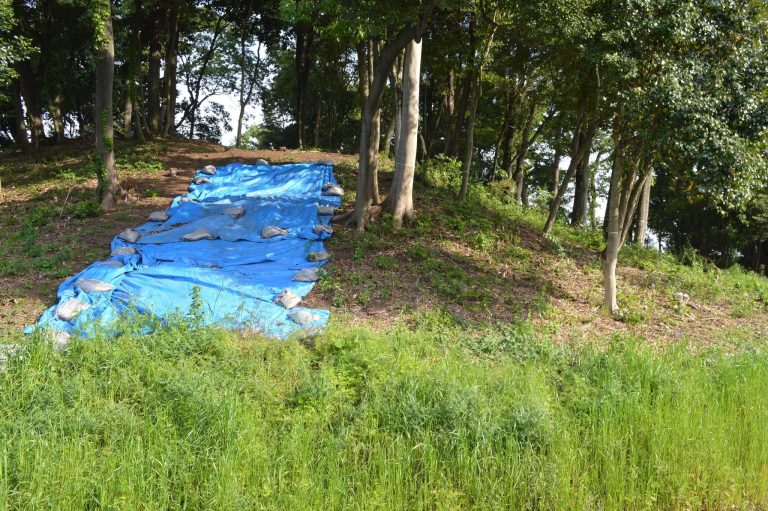
A terrace at approximately the midpoint of the rear section’s height shows that this part of the mound was built in two tiers. The upper portion of the front section has not been examined, while laser-survey contours suggest that the rear terrace may continue around it. Ground-penetrating radar indicates that added earth formed a considerable part of both sections. The summit is relatively narrow, with a level area measuring about 12 by 8 meters.
Burial Facilities
Three burial facilities are identified, two in the rear section and one in the front. The rear-section facility excavated in 1973 is a vertical stone burial chamber, meaning a below-ground grave with stone side walls and a stone roof. It measures 4.8 meters long and 0.8 meters wide.
Inside the chamber, a clay floor marked the position of a wooden coffin. The side walls were made by laying the narrow ends of mixed tuff and granite stones, while seven slab-like tuff capstones formed the roof. Tuff is rock made from compacted volcanic ash, and granite is a coarse-grained igneous rock. Together, these materials created the chamber that contained the principal group of grave goods.
Mirrors and Other Grave Goods
The chamber yielded eleven bronze mirrors. Four have triangular-profiled rims and designs of supernatural beings and animals. Another has an oblique rim and depicts two deities with two animals. The group also includes a Japanese square-patterned mirror, a four-animal mirror, and four mirrors decorated with human and animal figures.
The four mirrors with human and animal designs are considered Japanese-made, and their distinctive imagery is distributed only in the Nobi Plain. Each of the four triangular-rimmed divine-beast mirrors has a counterpart made from the same mold as an example excavated from another kofun in Japan. A same-mold mirror is produced from the original mold used for another example, making the relationship between these finds important for understanding the circulation of mirror designs.
Stone objects from the chamber comprised three stone bracelets, a wheel-shaped stone, a hoe-shaped stone, and two small containers with lids. The beads numbered 130, including three jade magatama, curved comma-shaped ornaments, and 127 tubular jasper beads.
Iron objects included four swords, nine swords of a distinct type, seventeen objects identified as swords or spears, six arrowheads, three strip-shaped axes, three socketed axes, an iron needle tube, two Y-shaped implements, and one additional iron implement whose precise identification remains uncertain. The complete group recovered from the stone chamber is held by the Kyoto National Museum.