Jaipur City Palace: Royal Residence and Seat of Government
Site at a Glance
- Country
- India
- Primary era
- Early Modern
- Eras represented
- Early Modern, Modern
- Civilizations
- British, Mughal, Rajput
- Site type
- Domestic
- Remains
- Palace
On this page21 sections
History
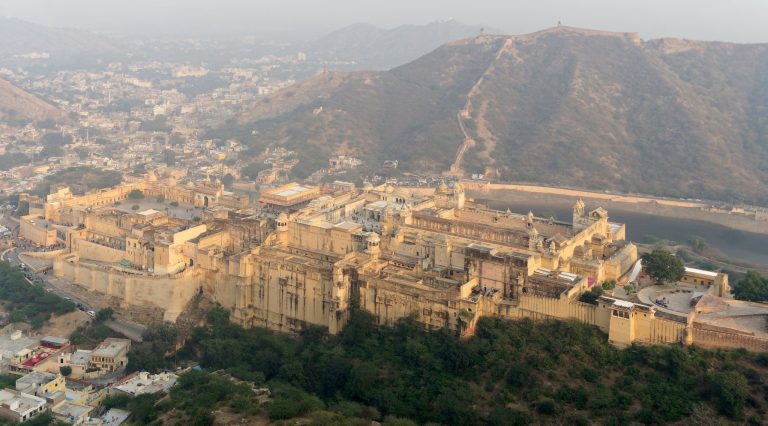
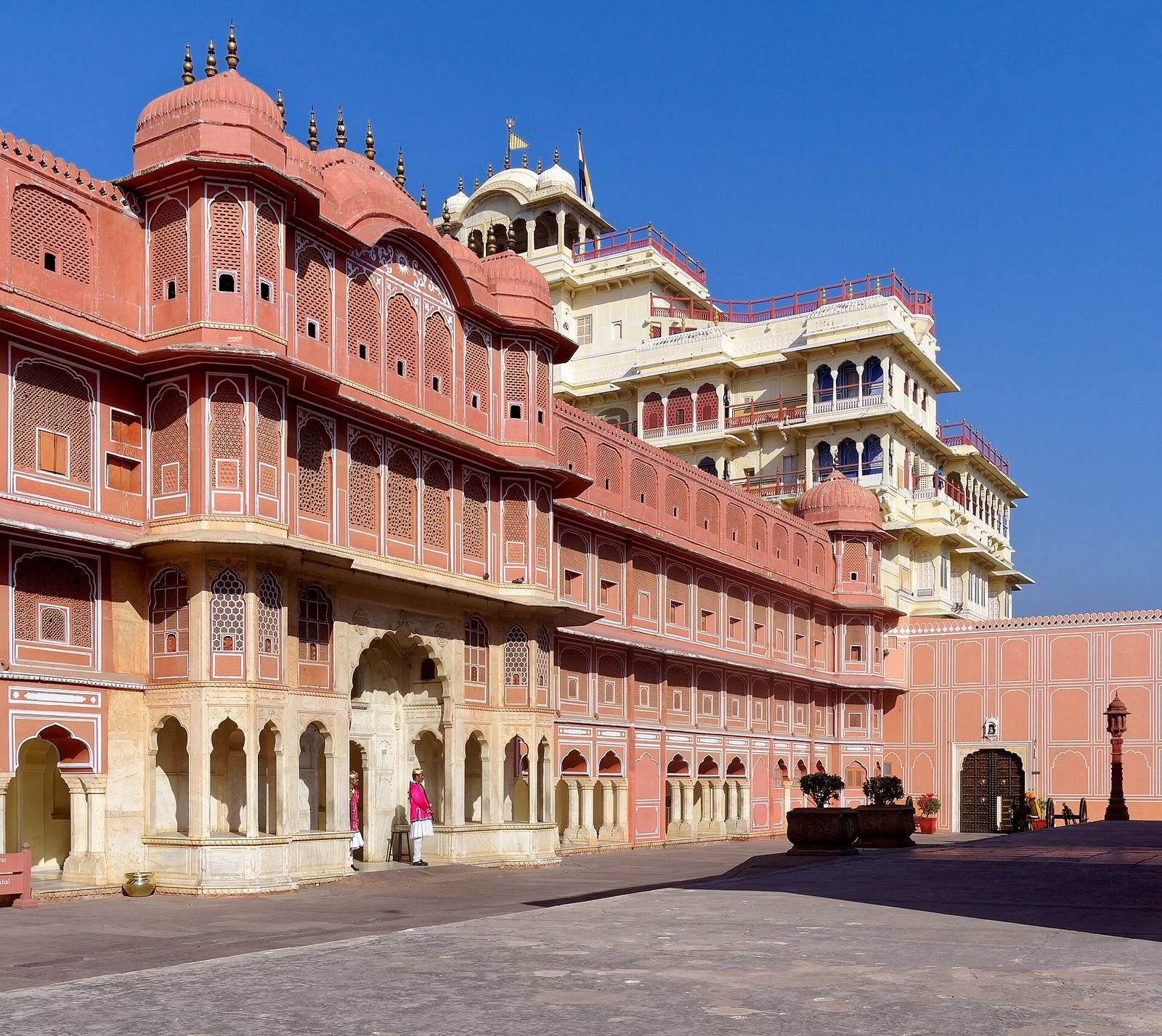
Jaipur City Palace is a royal complex in Jaipur, India, built for the Kachwaha Rajput rulers of Jaipur. Work began in 1729 under Maharaja Sawai Jai Singh II and was completed in 1732. Its architecture combines Rajput and Mughal elements, with European influence also noted. The palace served as the rulers’ residence and, while Jaipur was the state capital, the Maharaja’s ceremonial and administrative seat.
Founding Jaipur and the palace
Jai Singh moved his capital from Amber to Jaipur in 1727 as the population grew and Amber faced water shortages. The palace was part of the new capital’s development. Jai Singh planned Jaipur in six blocks separated by broad avenues, with Vidyadhar Bhattacharya guiding the city plan. Bhattacharya, who had worked as an accounts clerk in Amber’s treasury, later became the king’s chief architect. He drew on Vastushastra, a traditional Indian system of architectural planning, and a related classical treatise.
The palace was a royal residence, a center of administration and ceremony, and a setting for religious and cultural events. Jaipur’s rulers also supported the arts, commerce, and industry. Tradition links the title Sawai, meaning one and a quarter, to an exchange between Jai Singh and the Mughal emperor Aurangzeb at Jai Singh’s wedding. Jai Singh is said to have argued that their handshake made Aurangzeb responsible for protecting him and his kingdom. The story credits Aurangzeb with granting him the title, which later Jaipur rulers placed before their names. The associated flag became a royal insignia.
Political upheaval and changing rule
After Jai Singh’s death in 1744, rivalries and internal wars among Rajput rulers affected the region, while relations with the British remained cordial. Tradition says that Jai Singh’s son Ishwari Singh chose death by snakebite rather than face an advancing Maratha army. It also says that 21 of his wives and concubines died by sati, the self-immolation of a widow after her husband’s death.
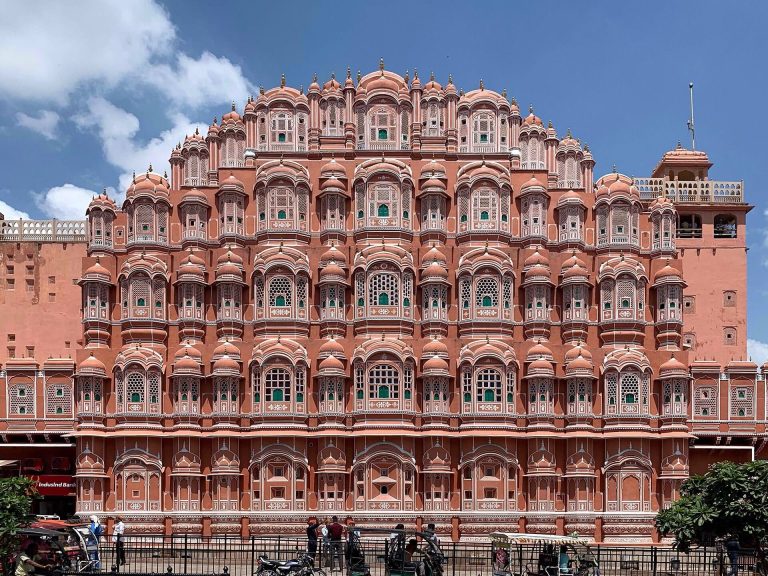
During the 1857 uprising, Maharaja Ram Singh II sided with the British. Jaipur’s monuments, including the City Palace, were painted pink to honor the hospitality shown to the Prince of Wales, later Edward VII. The color became an identifying feature of the city.
Expansion and the modern royal household
Later rulers continued to extend and alter the complex into the 20th century. Around 1900, the Mubarak Mahal courtyard was developed, with court architect Lala Chiman Lal building the palace at its center and Rajendra Pol constructed around the same time. Chiman Lal had worked with Samuel Swinton Jacob, the state’s executive engineer and architect.
Jaipur State joined the Indian Union in 1949, and Jaipur became the capital of Rajasthan. Maharaja Man Singh II, the adopted son of Maharaja Madho Singh II, was the last Jaipur Maharaja to rule from Chandra Mahal. He later served as Rajapramukh, the head of a state in post-independence India, and as India’s ambassador to Spain. The City Palace continued as the royal family’s residence and now houses the Maharaja Sawai Man Singh II Museum.
Remains
The complex occupies Jaipur’s central-northeastern area and brings together courtyards, buildings, pavilions, gardens, and temples. Red and pink sandstone are among its structural materials. The principal gateways connect public halls, inner courts, and the royal residence, while galleries in several palace buildings hold the museum’s collections.
Gates and audience spaces
Principal gateways
Three principal gates provide entry to the complex. Udai Pol stands near Jaleb Chowk, Virendra Pol near Jantar Mantar, and Tripolia means the three-gate entrance. Tripolia was reserved for the royal family. Udai Pol leads toward Sabha Niwas through a sequence of tight alternating turns. Virendra Pol opens onto the Mubarak Mahal courtyard, which connects through Rajendra Pol to Sarvato Bhadra. The gates were built at different times from the 18th through the 20th centuries, and their decoration reflects the styles of their respective periods.
Sabha Niwas
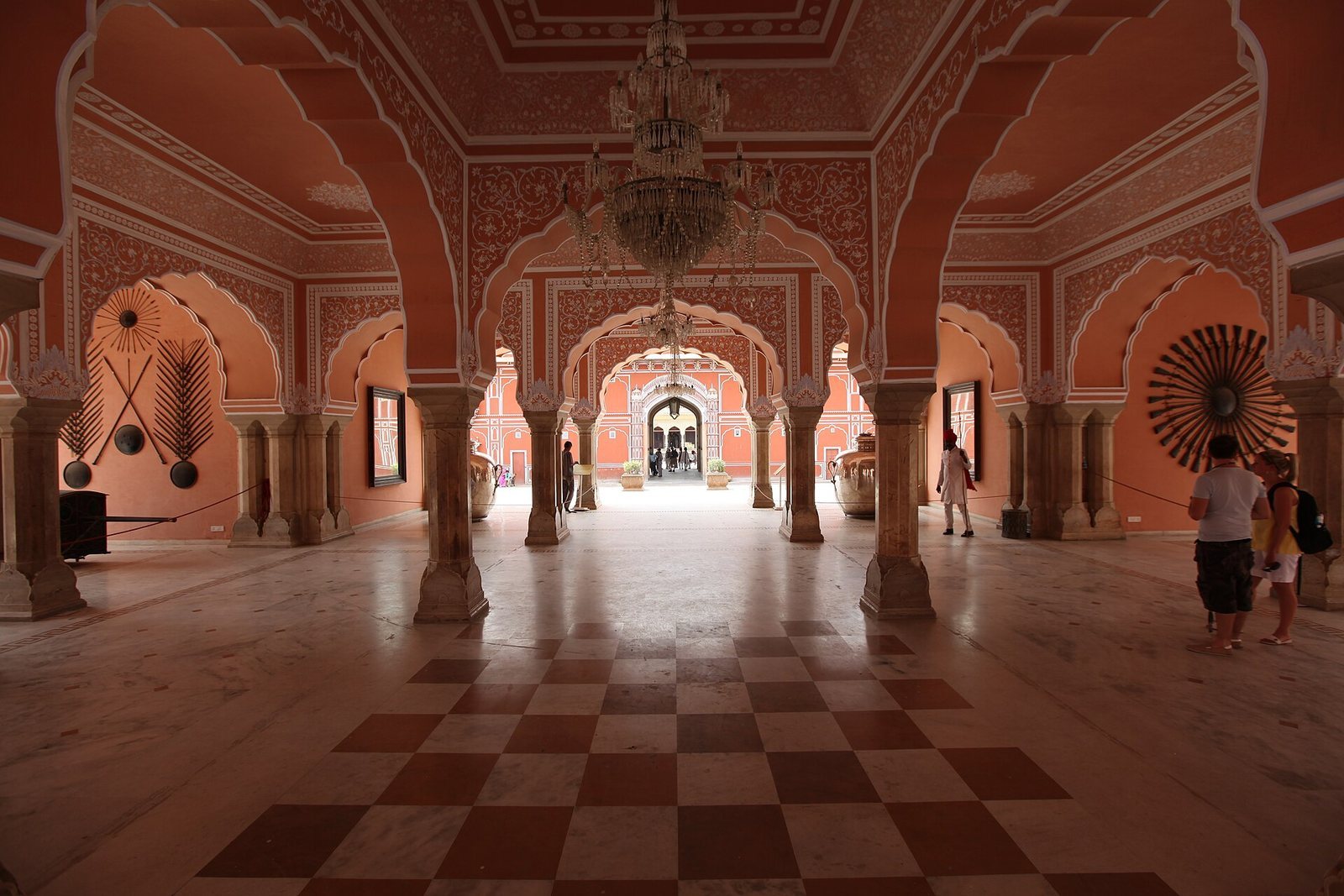
Sabha Niwas, the Diwan-e-Aam or public audience hall, follows the form of a Rajput audience hall. Marble columns support arches with scalloped edges, and painted plaster decorates the ceiling. Latticed screens at the southern end enabled women to watch proceedings while observing purdah, practices of seclusion for women. Two thrones stand at the center, with chairs arranged around them. The hall displays portraits of Jaipur Maharajas, a large devotional hanging called a pichhwai, and paintings of Holi and of spring and summer. The spring and summer works may have been made in the Deccan. Murals, chandeliers, military medals, and polo trophies are also displayed. The arches that once held the Holi paintings and the spring and summer portraits have since been closed. Photographs of the court during Man Singh II’s reign, along with images of Lord and Lady Mountbatten’s visit, line the corridor toward Sarvato Bhadra.
Clock tower
South of Sabha Niwas, a clock was installed in an existing tower in 1873. Purchased from Black and Murray & Co. of Calcutta, it was intended to improve punctuality in court proceedings.
Sarvato Bhadra
Sarvato Bhadra is a square, single-storey hall, open on its sides and enclosed by rooms at the four corners. Set between public areas and the private residence, it served as the Diwan-e-Khas, or private audience hall, and as a ritual space. Jaipur Maharajas traditionally held coronation rituals and other important private occasions there; the hall continues to host royal festivals. During Gangaur, associated with Gauri, and Teej, an image of a goddess is placed in a palanquin in the hall before being carried in procession through the city. At Makar Sankranti, kites belonging to Maharaja Sawai Ram Singh II are displayed there and flown from the roof.
Two large silver vessels displayed in the hall were commissioned by Maharaja Sawai Madho Singh II in 1902 for his journey to England for Edward VII’s coronation. He considered drinking English water religiously impermissible and intended to carry Ganges water. Known as Gangajalis, or Ganges-water urns, they were made from 14,000 melted silver coins without solder. Each stands 1.6 metres high, holds 4,000 litres, and weighs 340 kilograms. Guinness World Records recognizes them as the world’s largest sterling-silver vessels.
Palace courts, residence, and temple
Pritam Niwas Chowk
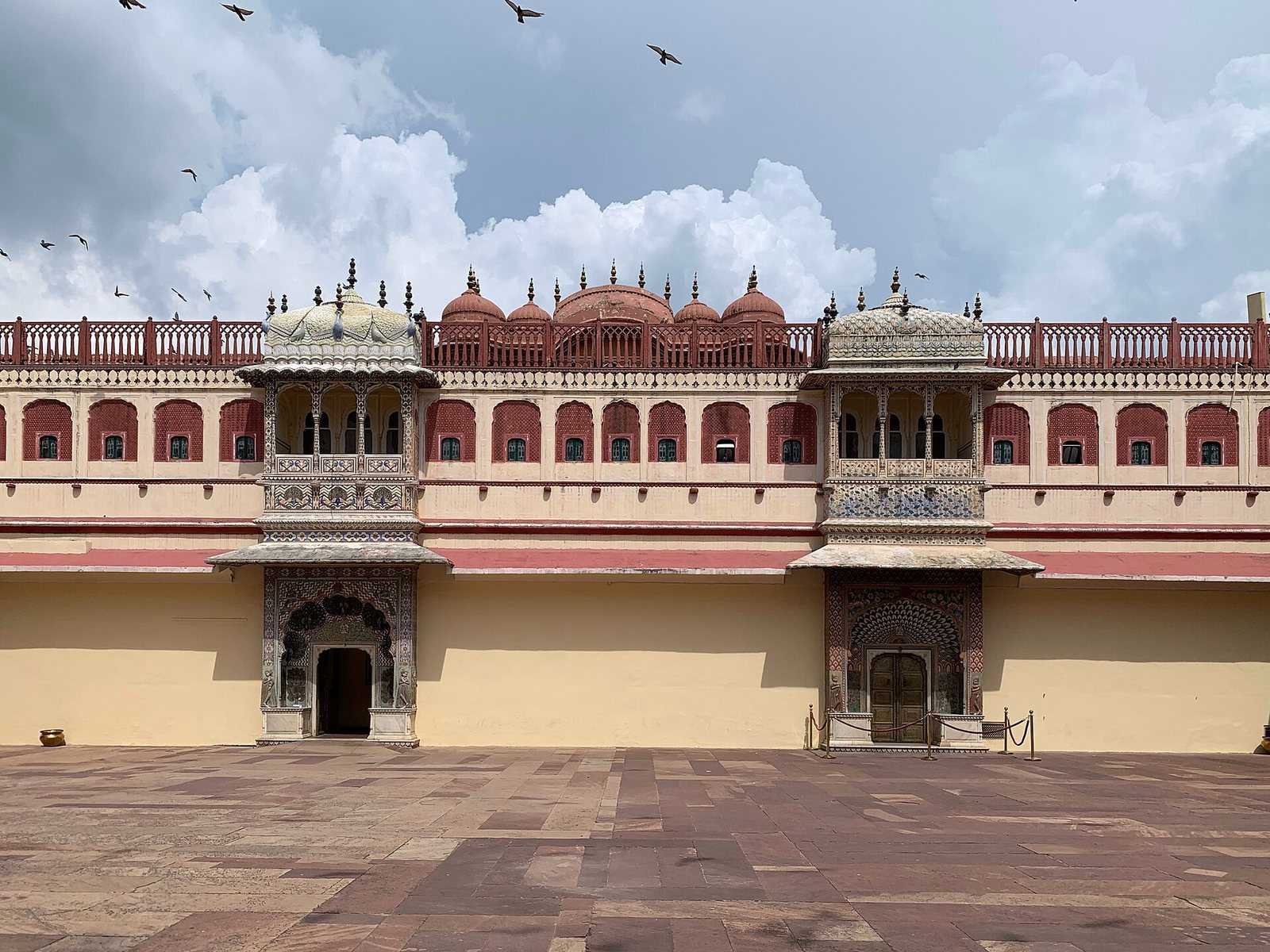
Pritam Niwas Chowk is the inner courtyard that gives access to Chandra Mahal. Its four small gates, collectively called Ridhi Sidhi Pol, carry seasonal and Hindu religious themes. The northeast Peacock Gate represents autumn and is dedicated to Vishnu. The southeast Lotus Gate represents summer and is dedicated to Shiva and Parvati. The northwest green Leheriya, or waves, Gate represents spring and is dedicated to Ganesha. The southwest Rose Gate represents winter and is dedicated to Devi.
Chandra Mahal
Among the complex’s oldest buildings, Chandra Mahal has seven floors, a number considered auspicious by Rajput rulers. Sukh Niwas occupies the first two floors. Above it are Shobha Niwas, decorated with colored glasswork, and Chhavi Niwas, finished in blue and white. The two uppermost floors are Shri Niwas and Mukut Mandir, the crowning pavilion. Paintings, mirrorwork, and floral ornament enrich the building, alongside its peacock doorway and latticed windows. Mukut Mandir has a bangaldar roof, a roof form associated with Bengal. The Jaipur royal standard flies there, with a quarter flag raised when the Maharaja is in residence. Gardens, fountains, and ornamental pools lie in front of the palace.
Mubarak Mahal
Built at the center of its courtyard to receive foreign guests, Mubarak Mahal has a hanging balcony and matching facades on all four sides. Intricate carving in white Andhi marble and beige stone gives its exterior a delicate, layered appearance. The building now contains museum offices and a library on the first floor, with the Textile Gallery on the ground floor.
Govind Dev Ji Temple
Dedicated to Govind Dev, a name for Krishna, the 18th-century temple stands in a garden outside the palace wall and forms part of the palace complex. Its position allowed the Maharaja to see it directly from Chandra Mahal. The temple’s ceiling has gold decoration, and the interior includes paintings and European chandeliers. Worship included seven daily aarti ceremonies, Hindu rites in which light is offered to a deity.
Museum galleries and collections
Textile Gallery
The Textile Gallery displays garments associated with several Jaipur rulers, including clothes linked to Maharaja Sawai Madho Singh I, the wedding jama, or long robe, of Maharaja Sawai Pratap Singh, and wrap-over tunics called angarkhas belonging to Maharaja Sawai Ram Singh II. A rare pashmina carpet, a fine wool carpet made around 1650 in Lahore or Kashmir, is also displayed. The collection includes polo clothing and cups, as well as billiards clothing associated with Maharaja Sawai Man Singh II.
A garment linked to Sawai Madho Singh I measures 1.2 metres across. He was said to have weighed 250 kilograms and to have had 108 wives.
Maharani Mahal
Formerly a residence for the queens, Maharani Mahal is now a museum gallery for weapons, some dating to the 15th century. Its ceiling has distinctive paintings made with ash from semiprecious stones. The displayed arms include a dagger, a gem-inlaid sword presented by Queen Victoria to Maharaja Sawai Ram Singh II, a bent-stock gun, and a small cannon designed to be carried on a camel or another animal.
Sileh Khana
The Sileh Khana, or weapons and armor gallery, contains arms used by the Kachwaha Rajputs of Jaipur and Amber. Its early-19th-century shamshir swords, curved South Asian swords, have hunting scenes and gold decoration showing people, buildings, animals, and birds. Two have shortened blades, a form that allowed more extensive decoration. Gold inlay also decorates their hilts and blades. These swords were made for display rather than use, and some hilts are attributed to a workshop established for Maharaja Sawai Madho Singh II.
A talwar, another type of curved South Asian sword, associated with Maharaja Ram Singh II bears his name on its 54-centimetre blade. The polished steel blade is unusually short and heavy, with a single cutting edge, an unsharpened section at its base, a shallow central groove, and a secondary edge near the tip. A trident is stamped near the blade’s strongest section. Other displayed swords are attributed to Maharaja Man Singh I and Maharaja Sawai Madho Singh II. One has a curved hilt and a steel pommel decorated with silver flowers.
The collection also includes a shield belonging to Maharaja Sawai Pratap Singh, painted with the clan goddess Shila Mata and hunting scenes, and a small metal child’s turban shaped like a cloth one. Armor includes a silver-colored helmet and armor from the 16th century, as well as a rare helmet and armor set made of pure gold. A decorative band imitating metal inlay was added to the gold helmet during the final years of Sawai Ram Singh II’s reign. The expensive silver and gold sets were used only rarely.
Buggikhana transport gallery
The Buggikhana contains non-motorized transport, including carriages, palanquins, camel saddles, and a miyana, or covered palanquin. The Prince of Wales presented its Victoria carriage to the Maharaja in 1876. Other objects include a mahadol palanquin carried by a single bamboo handle and a chariot used in festival processions of Hindu deities.
Painting and Photography Gallery
The Painting and Photography Gallery displays Jaipur paintings and photographs dating from the 18th and 19th centuries. The museum’s painting collection contains about 3,000 works, apart from paintings and manuscripts in the royal family’s private collection. It includes Mughal and Deccani paintings, Jaipur copies of Mughal works, paintings from other Rajput states, religious and secular subjects, illustrated manuscripts, miniature and large-format works, studies of nature, and paper-cut collages. A large Raslila composition, a devotional performance tradition depicting Krishna’s divine play, is by Sahib Ram. It portrays a court performance in which women alone performed, including the role of Krishna.
The photography collection spans the 1860s to the 1950s and includes about 6,050 prints, 1,941 glass-plate negatives, and photographic equipment. The prints include Indian-subcontinent landscapes and architectural views by photographers and studios such as Lala Deen Dayal, Johnston & Hoffman, and Bourne & Shepherd. Most negatives are portraits; others show Jaipur and Amber landscapes, paintings, and art objects. Some negatives associated with Maharaja Sawai Ram Singh II or his studio were made using wet-plate collodion, an early process that exposed coated glass plates while wet. They include images of women in the zenana, the women’s quarters of a royal household. Cameras and accessories apparently dating to the 1860s are also displayed.