Birnie Kirk: A Medieval Church and Former Cathedral in Scotland
Site at a Glance
- Rating
- 4.7
- Popularity
- Low
- Country
- United Kingdom
- Primary era
- Medieval
- Eras represented
- Medieval, Early Modern, Modern
- Civilizations
- British, Kingdom of Scotland
- Site type
- Religious
- Remains
- Cathedral
On this page14 sections
History
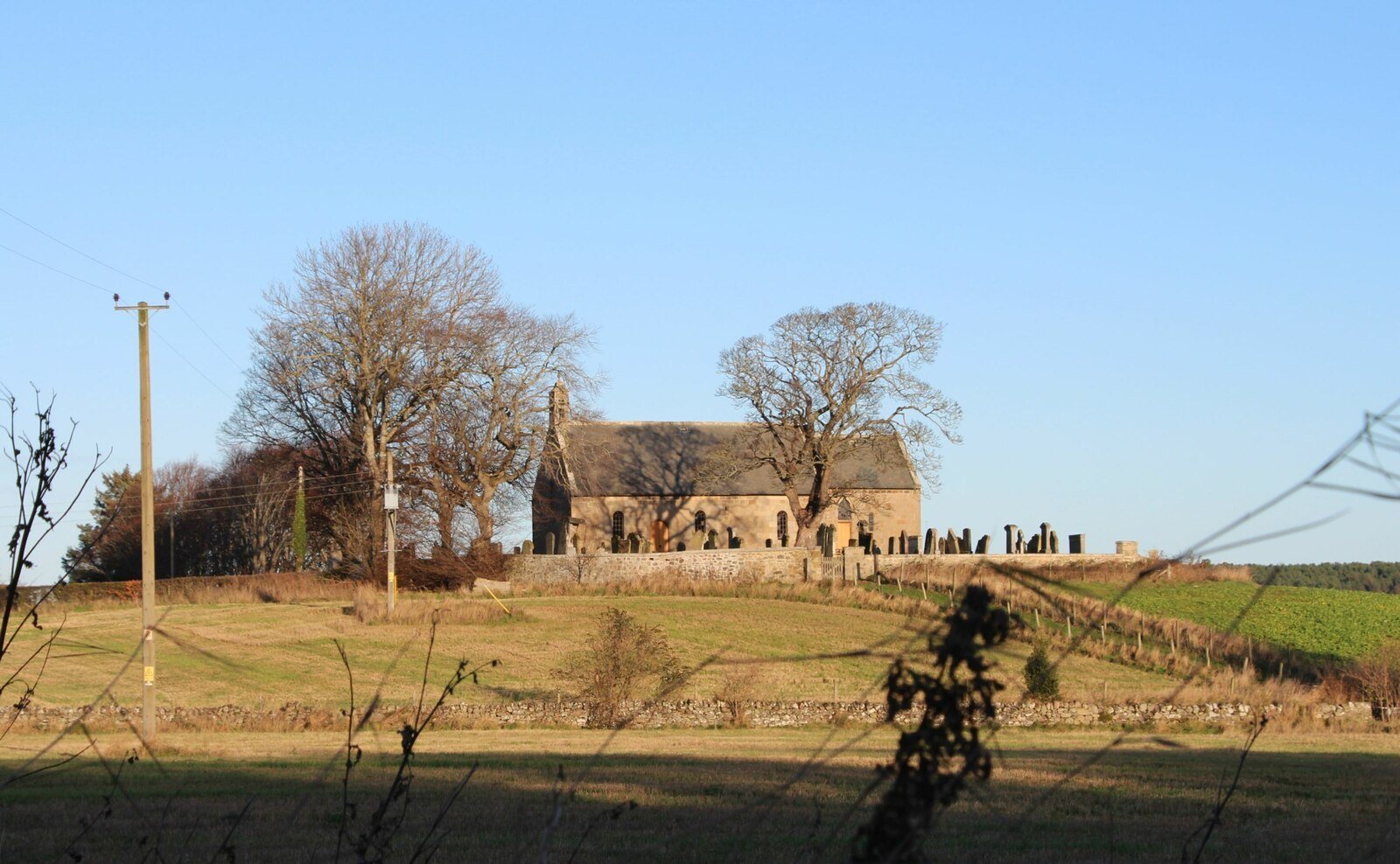
Birnie Kirk is a twelfth-century Norman church in the Lossie valley, about 4 km south of Elgin in Scotland, United Kingdom. Its Norman, or Romanesque, design belongs to a medieval tradition characterized by rounded arches. Birnie is among Scotland’s oldest churches in continuous use and is the oldest continuously used church site in its region.
Early Christian traditions and medieval origins
Tradition links the site to a sixth-century Christian church associated with St Brendan, an Irish missionary. The Norman church may have replaced that earlier building, and its former dedication to St Brendan points to an early Christian connection. The existence of a predecessor church remains uncertain, though early Christian traces may lie beneath later construction. The Pictish symbol stone at the site may instead indicate use before Christianity.
Episcopal seat and parish church
Birnie was an early seat of the Bishops of Moray and served as a cathedral. The episcopal seat was shared in turn with Kinneddar and Spynie before moving to Elgin. The establishment of Elgin Cathedral marked the end of Birnie’s possible role as a bishop’s seat, and the kirk later served as a parish church associated with the cathedral.
Simon de Tosny, the fourth Bishop of Moray, died in 1184 and was buried at Birnie.
Later changes and worship
In 1734, the west gable was rebuilt and the nave shortened. A substantial restoration followed in 1891, and the south-facing windows were overhauled in 1975. The kirk received Category A listing, Scotland’s highest listed-building category, in 1971. The graveyard became a scheduled monument, a legally protected archaeological site, in 1969; its protected area was extended in 1997 to include the symbol stone and remains beneath the church. In 1988, the associated manse and steading were downgraded from Category B to Category C.
Regular worship by the Church of Scotland, a Presbyterian church, ended after a thanksgiving service on 19 November 2023. Since January 2024, the Personal Ordinariate of Our Lady of Walsingham, a Catholic institution for communities retaining aspects of Anglican worship and heritage, has used the kirk for weekly Evening Prayer and monthly Mass by agreement with Elgin Kirk Session, the congregation’s local governing body.
Remains
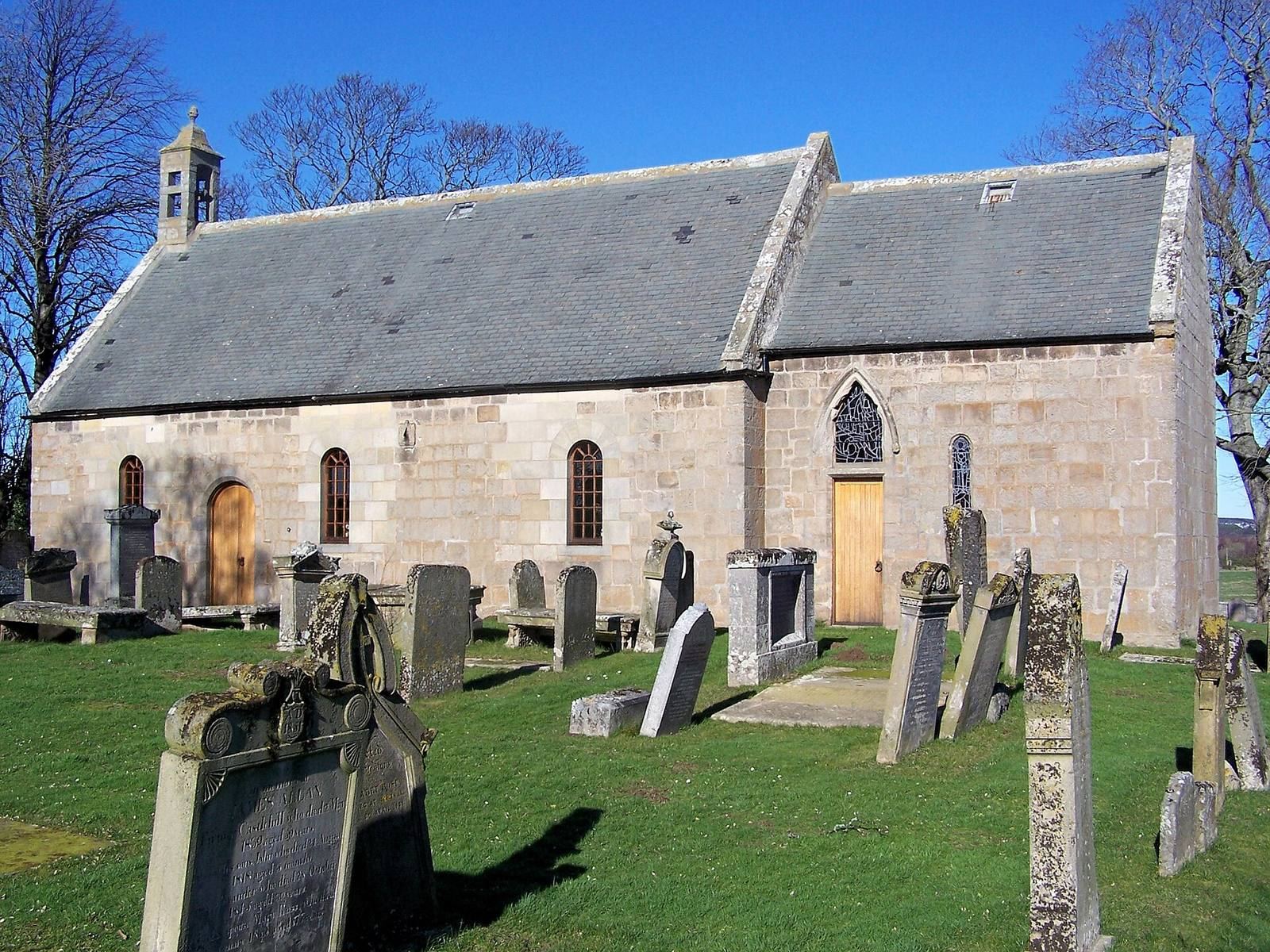
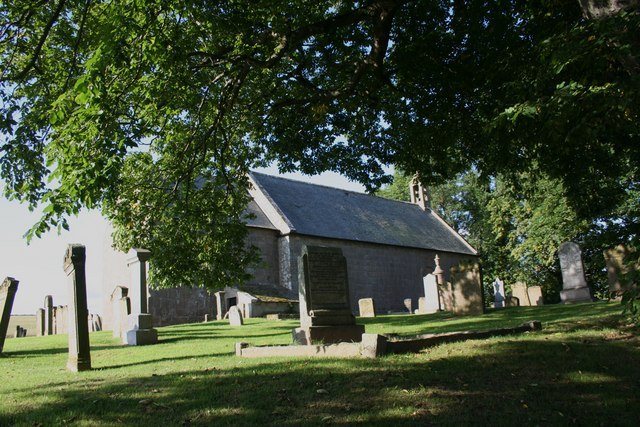
The isolated freestone church stands within an oval burial enclosure in the Lossie valley. The cemetery contains the Birnie Symbol Stone and a war memorial, while the associated manse and steading form part of the site’s surviving buildings.
The church
Plan and construction
Finely cut freestone forms the church’s simple rectangular plan. The nave, or main body, measures 14.45 m by 7.40 m. At its east end, a narrower, square chancel, the area around the altar, is 5.85 m long. A rounded arch connects the two spaces. Archaeological remains also lie beneath the building.
Entrances, windows, and roof
The principal entrance is a round-arched doorway on the south side, alongside three round-arched windows. A smaller doorway leads into the chancel, where medieval windows were repositioned during an alteration. On the north side, a pointed-arch doorway has been blocked, and a lancet window, a tall, narrow opening with a pointed arch, is set in the chancel. A small open belfry turret rises from the west gable, and the building has a pitched slate roof.
Interior furnishings
A bell in the chancel is believed to be an early Christian bell associated with the Celtic Christian tradition. Local tradition holds that it was made in Rome and blessed by the pope of the time. The church also contains a seventeenth-century Bible with a calfskin cover, known locally as the Hairy Bible, and a plain Romanesque baptismal font in a corner of the nave.
Enclosure, cemetery, and associated buildings
Burial enclosure
An oval, or slightly elliptical, enclosure about 50 m across surrounds the church. Its shape suggests an early medieval enclosure. The wall on the north side was removed to enlarge the cemetery.
Birnie Symbol Stone
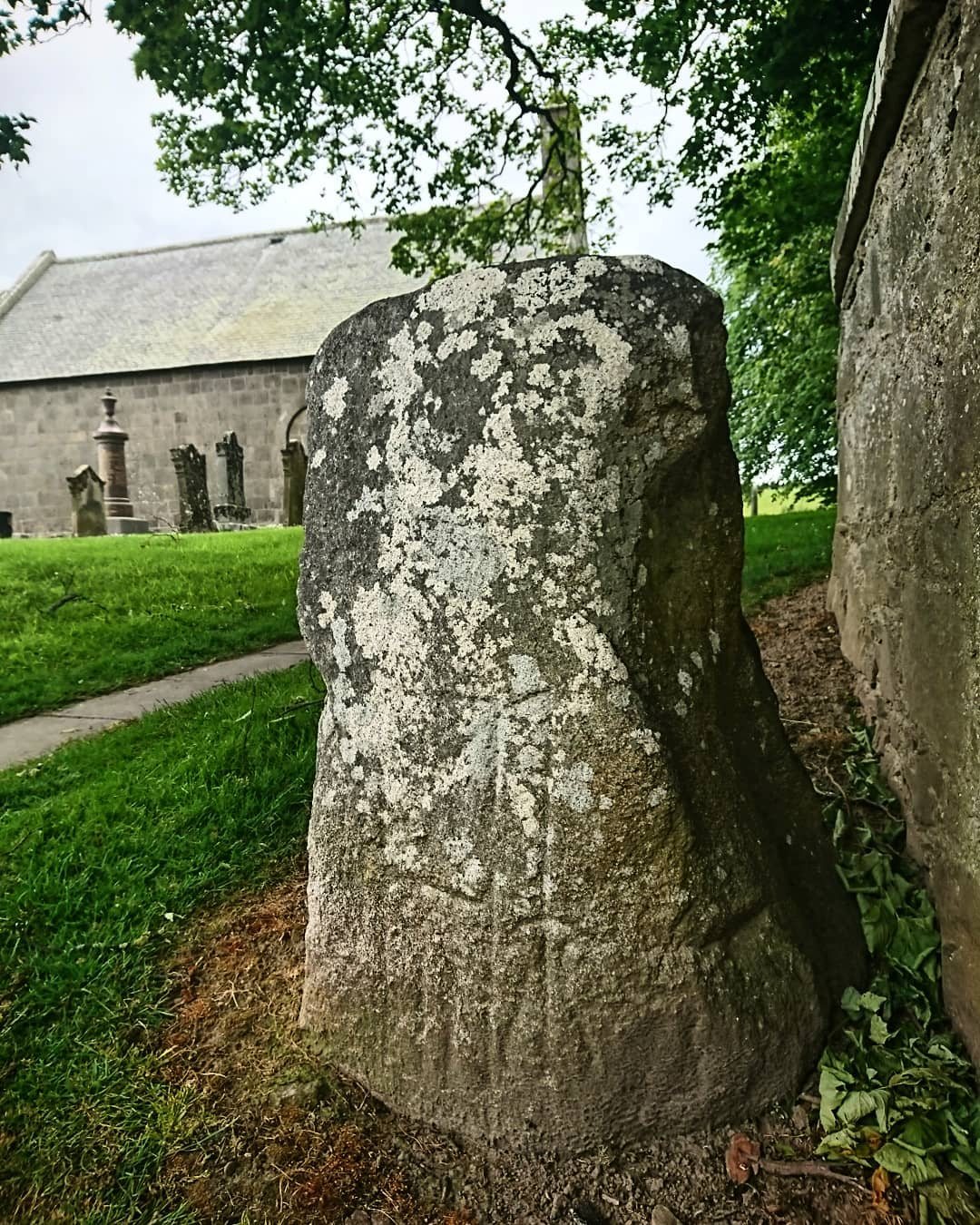
The Birnie Symbol Stone stands against the enclosure’s west wall. It is a granite Class I Pictish stone, a type bearing symbols without a Christian cross. The Picts were an early medieval people of northern Scotland. The stone measures 1.07 m high and about 0.6 m across and deep, tapering towards its top. Its north face carries a Z-rod, a Z-shaped design crossed by a rod, together with a rectangular device and an animal figure.
War memorial
A cemetery memorial commemorates local parishioners who died in the First and Second World Wars. Shaped like a chapel gable, it has two inset plaques beneath a Romanesque arch.
Manse and steading
The associated manse and steading include a two-storey house that dates substantially from the nineteenth century, with older fragments incorporated into its structure. Its front faces east and is arranged in five bays, or repeated window-and-door sections. The rubble-stone walls have a rough plaster finish and whitewash, with natural-stone surrounds contrasting with the wall surface. The windows are sash windows with either four or twelve panes, and the roof is slate.