Berat Old Town and Castle: A Fortified Historic Centre in Albania


Site at a Glance
- Rating
- 4.7
- Popularity
- Medium
- Country
- Albania
- Primary era
- Medieval
- Eras represented
- Iron Age, Classical, Medieval, Early Modern, Modern
- Civilizations
- Byzantine, Illyrian, Kingdom of Macedon, Ottoman
- Site type
- City
On this page18 sections
History
Berat Old Town and castle in Albania form a continuously inhabited fortified historic centre whose origins reach back to the 4th century BC. Ceramic finds from the 7th century BC show that an Illyrian settlement occupied the rocky hill, although its identification with the ancient city of Antipatrea remains probable rather than certain. The founder and exact foundation date are unknown. The centre developed through successive Illyrian, Macedonian, Roman, Byzantine, Bulgarian, Serbian, Ottoman, and Albanian phases, leaving a historic town shaped by long-term religious and cultural coexistence.
Ancient and Roman Berat
The settlement was associated with Dassaretia in southern Illyria and may have been founded by Cassander of Macedon after about 314 BC. Antipatrea became involved in the conflicts between Illyrian and Macedonian powers. In 217 BC, the Illyrian dynast Skerdilaidas and the Macedonian king Philip V contested control of the city. Rome later conquered it after Philip V’s rule. In 200 BC, the Roman legate Lucius Apustius captured the settlement, killed men of military age, demolished its walls, and burned the city.
During the Roman period the settlement belonged to Epirus Nova, an administrative region in the Roman province of Macedonia. It was known as Pulcheriopolis during the Roman and early Byzantine periods. After the fall of the Western Roman Empire, the town became part of an unstable Byzantine frontier and faced repeated Slavic invasions.
Bulgarian and Byzantine rule
The First Bulgarian Empire captured the settlement in the 9th century. At this time it acquired the Slavic name Belgrad or Beligrad, meaning “White City,” which preceded the name Berat. The town became an important centre in the Bulgarian region of Kutmichevitsa. In 1018, the Bulgarian governor Elemag surrendered it to Byzantine Emperor Basil II, restoring Byzantine rule.
Byzantine control continued until the Second Bulgarian Empire retook Berat in 1203 under Kaloyan. During the 13th century the town later came under Michael I Doukas, ruler of the Despotate of Epirus, a medieval Byzantine successor state in the western Balkans. In 1274, Byzantine Emperor Michael VIII Palaiologos recaptured Berat after it had been incorporated into the Kingdom of Albania under Charles I of Naples.
In 1280 and 1281, Sicilian forces commanded by Hugh the Red of Sully besieged the city. A relief army from Constantinople, led by Michael Tarchaneiotes, drove them away, and Berat subsequently returned to Byzantine control. In 1337, Albanian tribes from the regions around Mount Tomorr and Kanina rebelled and seized the fortress of Tomorr. Andronikos III Palaiologos defeated them with an army largely made up of Turkish mercenaries.
Serbian, Muzaka, and Ottoman periods
Berat passed to the Serbian Empire in 1345, or possibly in 1343. After the empire dissolved in 1355, the town successively came under John Komnenos Asen, Alexander Komnenos Asen, and Balsha II of Zeta. The Ottomans captured Berat in 1385, before the Battle of Savra, and may have intended to use it as a base for taking Valona. The Muzaka family regained control by 1396, when Berat became the capital of the Principality of Berat. Ottoman rule was established again in 1417.
In 1455, Skanderbeg attempted to capture Berat from an Ottoman force but failed. His army included about 14,000 Albanians and a small contingent of Catalan soldiers, while the defenders numbered about 40,000. The town underwent severe decline during the early Ottoman period, then recovered in the 17th century as a major craft centre, especially for wood carving.
By the 18th century, Berat was one of the most important Albanian cities under Ottoman rule. Its economy was closely tied to craft guilds, with twenty-two guilds recorded by 1750. They included tanners, cobblers, leather workers, metal workers, silversmiths, and silk makers. In the early modern period the town became the capital of the Pashalik of Berat, an Ottoman domain governed by a pasha, founded by Ahmet Kurt Pasha. Ibrahim Pasha of Berat was defeated by Ali Pasha in 1809, after which the town was incorporated into the Pashalik of Yanina.
Communities and national revival
Berat’s religious and social composition changed over the Ottoman centuries. In the early 16th century it was a Christian city without Muslim households. A Jewish community of twenty-five families lived there in 1519 and 1520 after the expulsion of Jews from Spain. Followers of Sabbatai Zevi were also present in the mid-17th century, and the Jewish community helped secure the release of war captives held in Durrës in 1596.
By the late 16th century, Berat contained 461 Muslim households and 187 households belonging to newcomers from surrounding villages. Conversion to Islam increased partly because Muslim urban craftsmen could receive tax exemptions in return for military service. From 1670 onward, Muslims formed the majority of the population, occupying nineteen of the town’s thirty neighbourhoods. Conversion pressure in some neighbourhoods and a shortage of Christian priests contributed to this change.
In 1867, Berat became a sanjak, an Ottoman administrative district within a larger province, in the Janina vilayet. During the 19th century it replaced a declining Vlorë as the centre of the sanjak, which was dominated by the Albanian Vrioni family. Late in the Ottoman period, the town had approximately 10,000 to 15,000 inhabitants. About 5,000 were Orthodox Christians, including approximately 3,000 Aromanian speakers and 2,000 Albanian speakers. The Jewish community of Yanina renewed Berat’s Jewish community during the 19th century.
Berat played an important part in the Albanian national revival, and Christian merchants supported the Albanian movement. The town was strongly affected by the revolts of 1833 to 1839. In October 1833, approximately 10,000 people surrounded the castle and forced the Ottoman mütesellim, Emin Aga, to leave. The rebels demanded that Berat stop supplying soldiers to the Ottoman government and that local administration be placed under Albanian officials. The government accepted these demands, appointed Albanian officials, and declared an amnesty.
A further uprising began in August 1839. Residents attacked Ottoman forces and besieged them in the castle as the rebellion spread through the Sanjak of Vlorë. Rebels captured the castle in September, but the Ottoman government again postponed the implementation of reforms in Albania. Berat later became a major centre of support for the League of Prizren, a late-19th-century Albanian nationalist alliance seeking greater political and administrative autonomy for Albanian-inhabited territories. It was represented in the formation of the league’s southern branch at Gjirokastra.
War, communism, and heritage protection
During the First World War, Austro-Hungarian occupation forces recorded 6,745 Orthodox Christians and 20,919 Muslims in the Berat region. During the Second World War, Muslim and Christian families concealed Jewish people in the homes and basements of sixty families. Muslims also allowed Jews to worship in the local mosque, whose walls still bear a Star of David.
From 23 to 30 October 1944, Berat hosted the second session of the Council of National Liberation of Albania. The Anti-Fascist National Liberation Committee, controlled by the National Liberation Movement, became Albania’s Provisional Democratic Government, with Enver Hoxha as prime minister and minister of defence.
During the Communist period, Berat served as a place of internal exile and political internment for people classified as public enemies and their families. From the 1950s, internees could not leave without permission and had to report daily to the Security Office or police. A 1963 report recorded thirty internees, including people considered at risk of escape and others convicted of ordinary offences. The writer Ismail Kadare was sent to Berat in 1967 and remained there for two years.
Enver Hoxha proclaimed Berat a “Museum City” in June 1961. The historic centres of Berat and Gjirokastra were inscribed together on the World Heritage List in 2005 under criteria (iii) and (iv), recognizing their well-preserved Ottoman-period architectural character and evidence of diverse urban societies and longstanding Balkan ways of life. The property’s boundaries were significantly modified in 2008. It covers 58.9 hectares with a 136.2-hectare buffer zone. Its integrity and authenticity were considered satisfactory, although illegal construction in the late 1990s and the need for stronger preservation management affected conservation of its outstanding universal value.
Remains
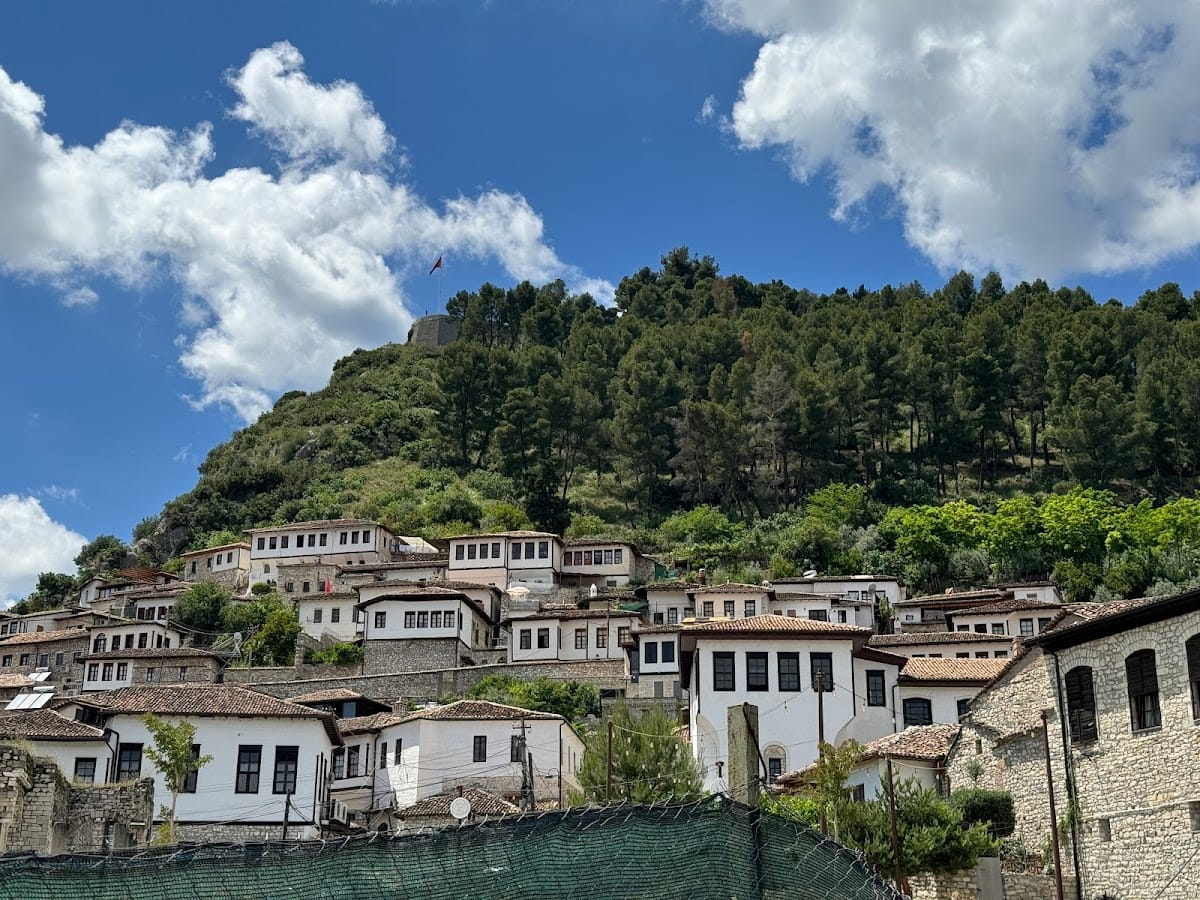
Berat’s historic centre occupies several river terraces around the Osum River and consists of three principal areas: Kalaja, the castle quarter on the hill; Mangalem, at its foot; and Gorica, on the left bank of the river. Tiered houses rise along the slopes, with predominantly horizontal layouts and numerous large windows. The town stands near the junction of the Osum and Molisht rivers. On the western side of the valley, the Osum has cut a 915-metre-deep gorge through limestone, creating the precipitous natural setting around which the settlement developed. Mount Tomorr forms the eastern backdrop, while Mount Shpirag rises above Gorica on the opposite side of the gorge.
Castle hill and fortifications
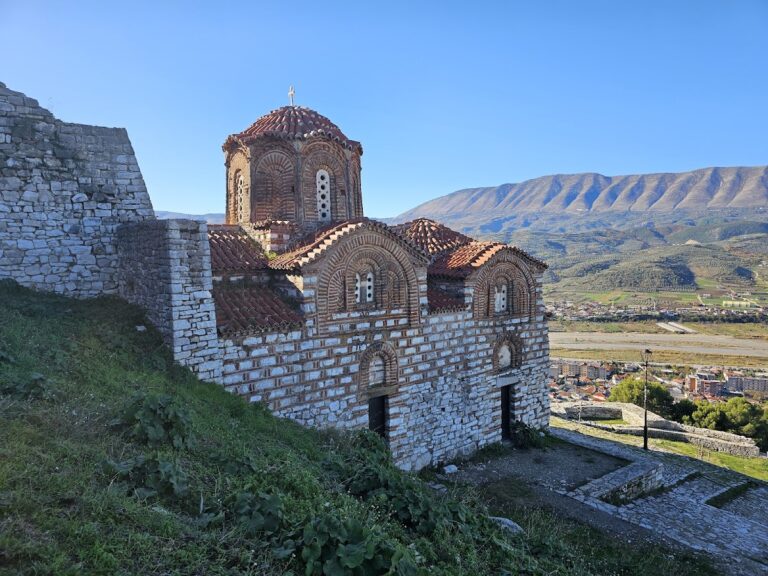
Berat Castle, also called the Kala or the Citadel of Berat, occupies a rocky hill on the right bank of the Osum at an elevation of about 214 metres. The approach is from the south, while the fortress overlooks the river, the modern city, and the old Christian quarter across the water. Its origins reach back to the 4th century BC, but most surviving fortifications date from the 13th century.
After the Roman destruction of 200 BC, the walls were strengthened in the 5th century under Emperor Theodosius II, rebuilt in the 6th century under Emperor Justinian I, and rebuilt again in the 13th century under Michael I Komnenos Doukas. A red-brick monogram in one of the walls represents the 13th-century rebuilding. The main entrance on the northern side is defended by a fortified courtyard and accompanied by three smaller entrances.
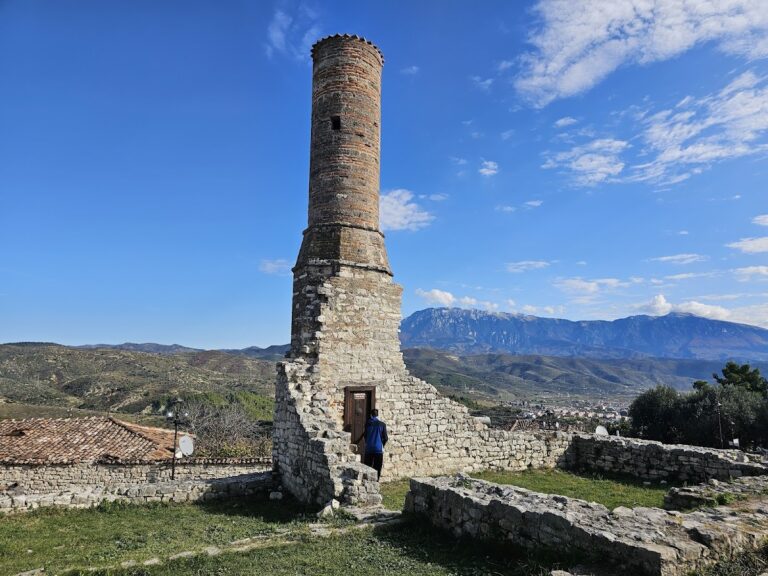
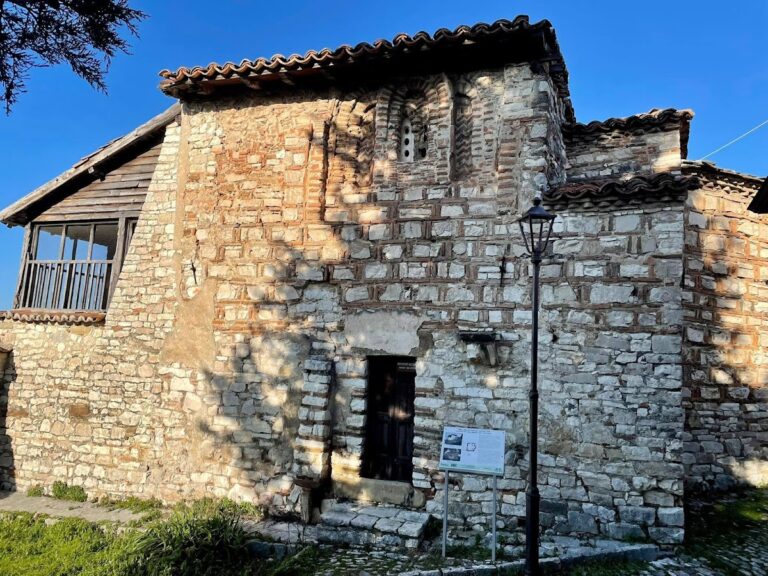
The enclosure was large enough to house a considerable part of the town’s inhabitants. Its narrow streets, Ottoman houses, Orthodox churches, and other buildings form the castle quarter. The fortress and many churches have suffered considerable damage, while some churches survive within the walls. The predominantly Christian population supported the construction of approximately twenty churches, most dating from the 13th century. A single mosque served the Muslim garrison, and its ruins include parts of the building and the base of its minaret.
Christian buildings and religious art
Church of St. Mary of Blachernae
The Church of St. Mary of Blachernae dates from the 13th century and contains mural paintings made by Nikollë Onufri in the 16th century. It forms part of the castle’s Byzantine and Orthodox architectural heritage.
Church of the Holy Trinity
The Church of the Holy Trinity was built in the 14th century inside the walls, within a small square planted with trees. Its cruciform plan and Byzantine murals remain important elements of the castle’s religious architecture.
Churches of St. Michael and St. Theodore
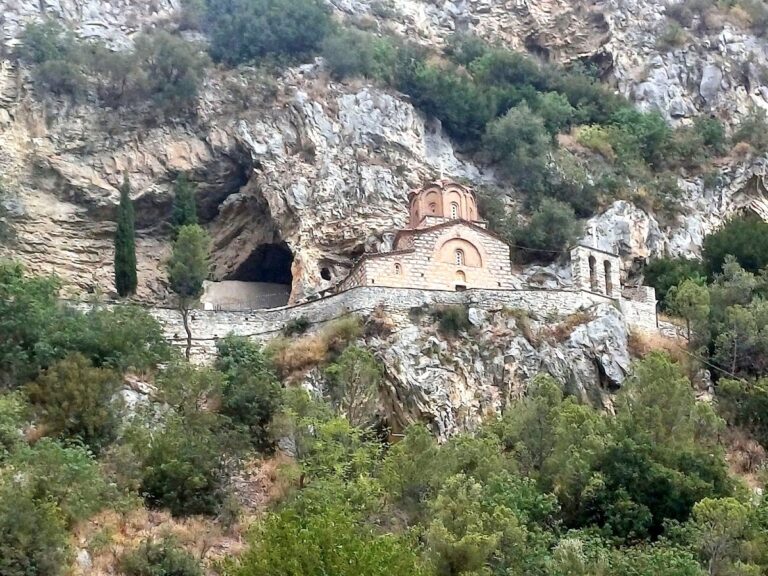
The Church of St. Michael was built outside the ramparts in the 13th century and is reached by a steep path. The small Church of St. Theodore stands near the entrance beyond a guardhouse and contains wall paintings by Onufri, a major 16th-century Albanian painter of frescoes and icons.
Cathedral of St. Nicholas
The Cathedral of St. Nicholas has been restored and functions as a museum dedicated to Onufri. Its interior contains a carved wooden iconostasis, a decorated screen separating the sanctuary from the nave, together with two icons of Christ and the Virgin Mary, a bishop’s throne, and a pulpit. The castle churches and the museum also preserve medieval frescoes and iconostases by Albanian painters including Onufri, Nikollë Onufri, Kostandin Shpataraku, and the Zografi brothers. Their collections include icons and religious silverwork such as sacred vessels, icon casings, and Gospel-book covers. The Berat Gospels date from the 4th century. Copies are held in the Onufri Museum, while the originals are preserved in the National Archives in Tirana.
Ottoman religious buildings
King Mosque and Leaden Mosque
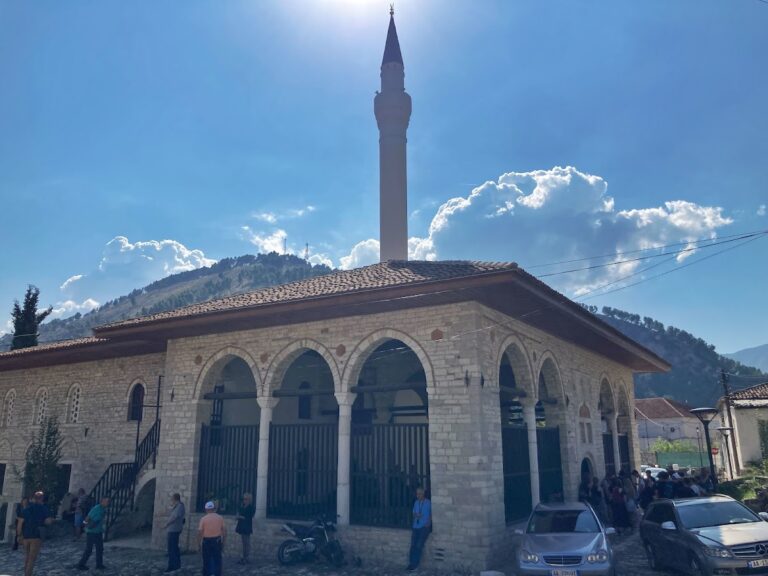
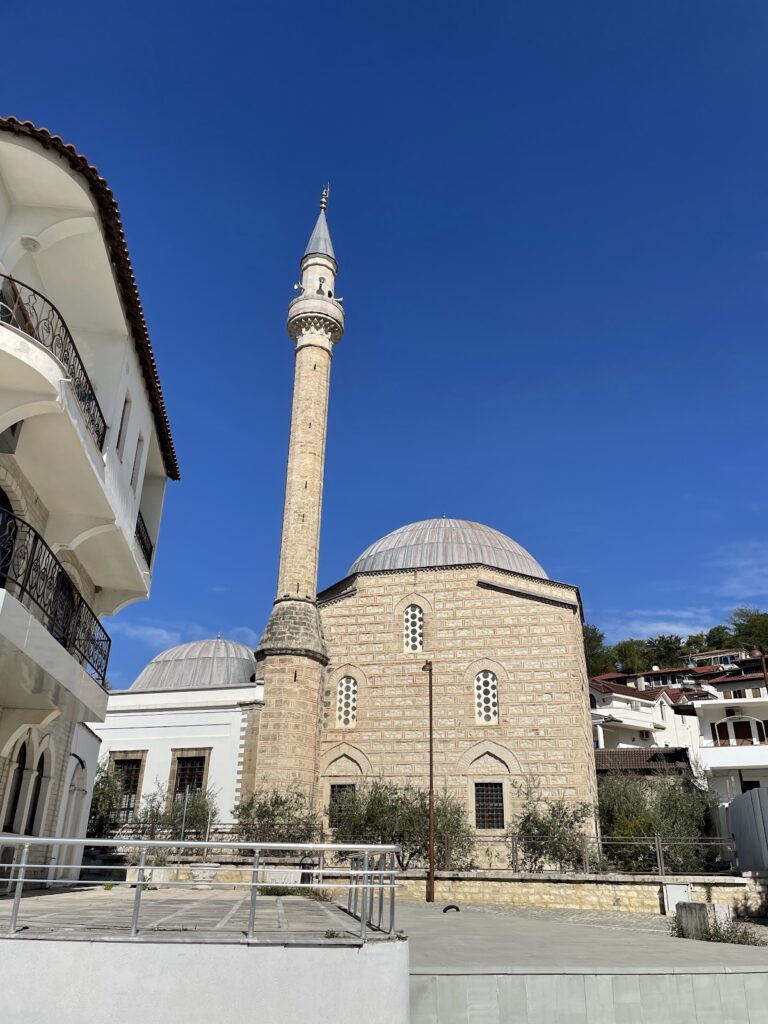
The King Mosque was built during the reign of Bayazid II, between 1481 and 1512. Its finely decorated ceiling survives as a notable interior feature, and the building functions as a museum in the modern period. The Leaden Mosque was built in 1555 and takes its name from the lead covering of its cupola, or domed roof. It stands in the centre of the town.
Bachelors’ Mosque
The Bachelors’ Mosque was built in 1827. Its portico and exterior decoration depict flowers, plants, and houses. The mosque’s name refers to young shop assistants, generally unmarried, whom Berat’s merchants used as a private militia.
Halveti Tekke
The Halveti Tekke is thought to have been built in the 15th century and was rebuilt by Ahmet Kurt Pasha in 1782. A tekke is a Sufi lodge used for religious practice and community life. This one belongs to the Khalwati, or Halveti, order, whose devotional tradition emphasizes spiritual discipline and retreat. A purported grave associated with Sabbatai Zevi lies nearby.
Historic houses, museums, and bridge
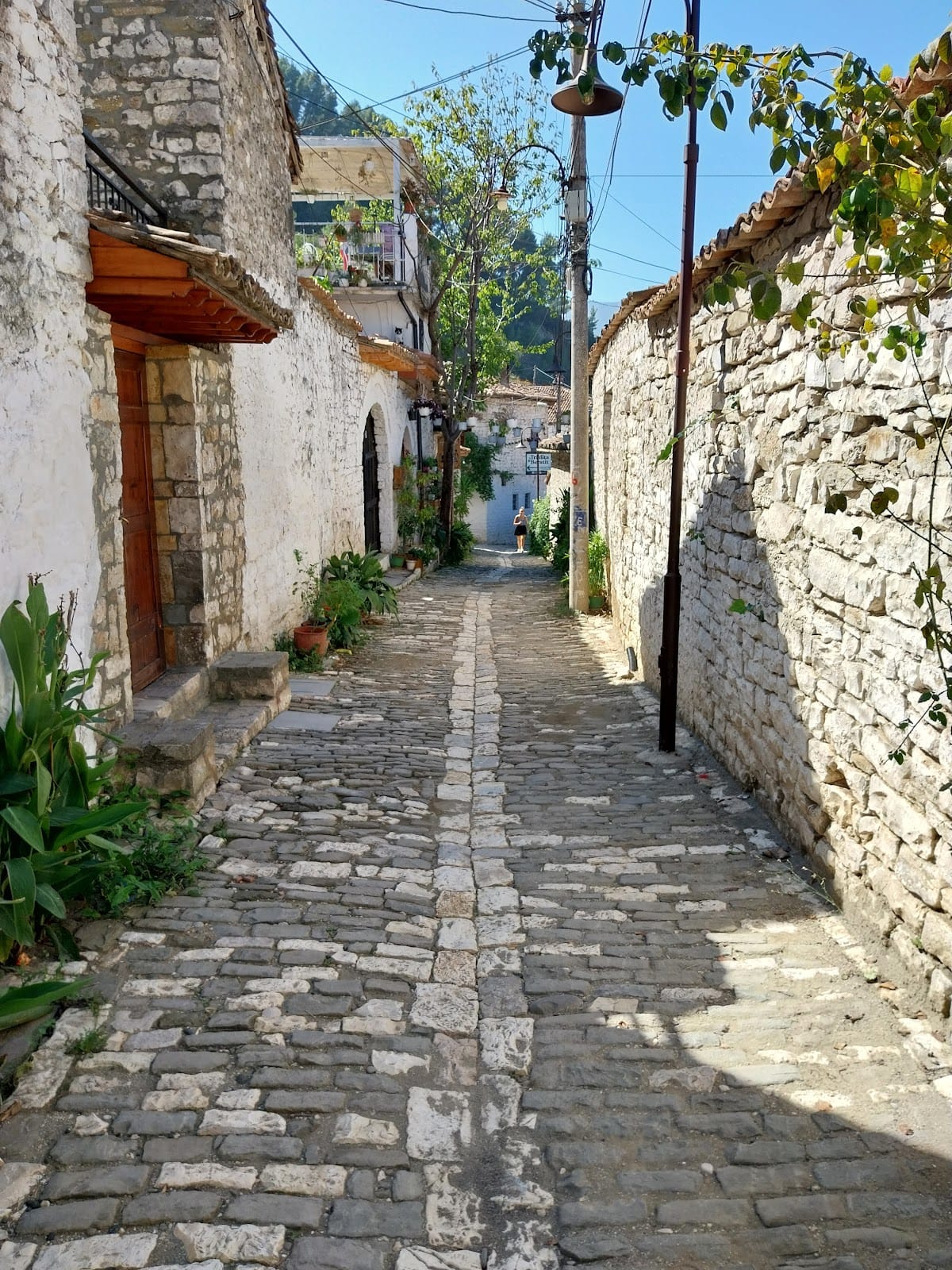
Berat’s traditional Balkan housing is represented mainly by late-18th- and 19th-century vernacular buildings arranged in tiers along the hillsides. Their numerous large windows gave rise to the epithet “City of One Window Above the Other.” The old town combines Ottoman-period houses and religious-community residences with Byzantine-era churches and Ottoman mosques. Some houses were rebuilt after the 1851 earthquake, retaining original stone lower storeys while using timber for their upper levels.
The National Ethnographic Museum, opened in 1979, contains domestic furnishings and household features including wooden cases, wall cupboards, chimneys, a well, an olive press, a wool press, large ceramic vessels, and a loom. Reconstructed spaces include a medieval street with traditional shops, an archive, a village sitting room, a kitchen, and another sitting room. In southern Berat, the Solomon Museum presents Jewish history, including the Holocaust in Albania and the survival of Jews during the Second World War.
Gorica Bridge connects the two parts of Berat. Originally built of wood in 1780, it was rebuilt in stone during the 1920s. The seven-arch bridge measures 129 metres in length and 5.3 metres in width, and stands about 10 metres above the average water level. Local tradition says that the original bridge contained a dungeon where a girl was imprisoned and starved to appease spirits believed to protect the bridge.
Together, the castle, churches, mosques, houses, museums, bridge, and terraced urban fabric represent a fortified but open town inhabited by craftsmen and merchants. Its surviving architecture combines Ottoman urban and housing traditions with earlier Byzantine, Christian, and medieval influences.
Nearby sites