Lead Mosque: A Sixteenth-Century Ottoman Mosque in Berat, Albania


Site at a Glance
- Rating
- 4.6
- Popularity
- Very Low
- Country
- Albania
- Primary era
- Early Modern
- Eras represented
- Early Modern
- Civilizations
- Ottoman
- Site type
- Religious
- Remains
- Mosque
On this page6 sections
History
Ottoman Foundation
Lead Mosque, also known as the Izgurli Mosque, is a sixteenth-century Ottoman mosque in Berat, Albania, completed in 1553–1554 during the reign of Sultan Suleiman the Magnificent. Affiliated with Sunni Islam, it was built when Berat had become one of Albania’s important Muslim centres and remains an active mosque.
Construction was commissioned by Ahmet Bej Uzgurliu, a local nobleman and vassal associated with the Skuraj family, after his conversion to Islam. The mosque belonged to a larger religious and charitable complex that included a bazaar, madrasa, an Islamic institution of religious learning, imaret, a charitable foundation commonly providing food, school, hammam, or public bathhouse, and shadirvan, a fountain installation associated with a mosque courtyard. The Ottoman traveller and writer Evliya Çelebi described carved stones beneath the lead covering in connection with the complex.
Protection and Restoration
Lead Mosque was placed on Albania’s list of religious cultural monuments in 1961. It survived the declaration of Albania as an atheist state in 1967 without being destroyed. The building was restored in 2014 by the Turkish Cooperation and Coordination Agency, with slight modernization of the minaret balcony. It is designated a Cultural Monument of Albania and forms part of the Historic Centres of Berat and Gjirokastra, inscribed as a UNESCO World Heritage Site in 2005.
Remains
Prayer Hall and Dome
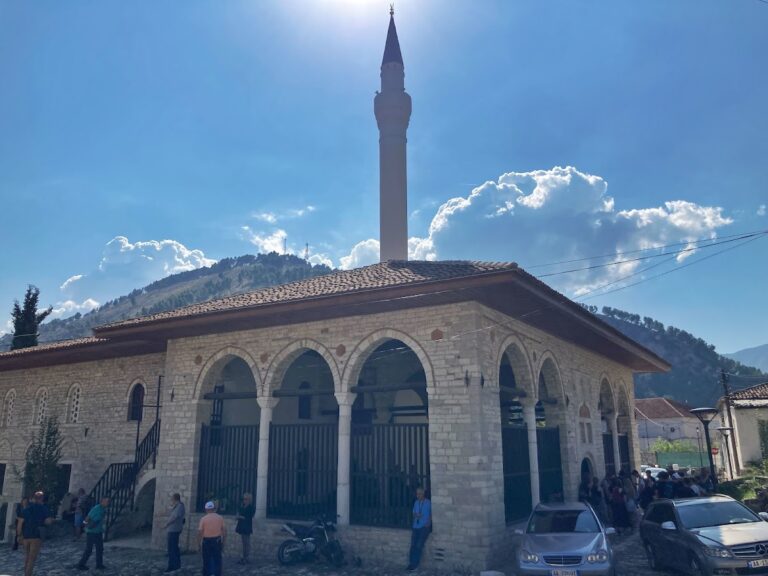
The mosque is built of masonry around a square prayer hall measuring approximately 10.1 metres on each side. A spherical dome covers the hall, and its lead covering gives the building its name. A northern portico extends from the prayer hall, while numerous windows illuminate the interior.
Minaret and Associated Complex
A tall, slender minaret rises beside the mosque. Cloisonné work, a decorative technique using compartments to contain contrasting materials or colours, decorates the point where the minaret meets the roof. The mosque was associated with a broader complex containing a bazaar, madrasa, imaret, school, hammam, and shadirvan, linking the prayer building with education, charity, commerce, bathing, and water provision.