King Mosque, Berat: An Ottoman Mosque in Albania


Site at a Glance
- Rating
- 4.4
- Popularity
- Low
- Country
- Albania
- Primary era
- Medieval
- Eras represented
- Medieval
- Civilizations
- Ottoman
- Site type
- Religious
- Remains
- Mosque
On this page9 sections
History
King Mosque, also known as the Sultan’s Mosque or Sultan Bayezid Mosque, is an Ottoman mosque in Berat, Albania, built during the reign of Sultan Bayezid II in the late fifteenth century. It is among Albania’s oldest mosques and originally stood at the centre of a wider religious complex.
The Ottoman religious complex
The mosque formed the central part of a complex that later included a sixteenth-century madrasa, an Islamic educational institution, as well as a caravanserai, a roadside lodging and service establishment for travellers and caravans. An eighteenth-century Bektashi khanqah, or Sufi religious lodge, and a library were also associated with the complex. The Bektashis are a Sufi order with a strong historical presence in the Balkans.
Destruction and rebuilding
The mosque was almost completely destroyed during the Ottoman campaign against the revolts of 1830–1831. Its artillery damage was caused by Commander Reshid Mehmed Pasha, who ordered the building to be reconstructed from the ground up in 1832–1833. The rebuilding followed older local architectural traditions.
Modern protection and use
Albania designated the King Mosque a Cultural Monument in 1948. During the Communist period, Enver Hoxha’s 1967 campaign against religious institutions brought religious buildings under state control throughout the country. The mosque survived, although its portico was altered and its minaret demolished. Both features were later restored according to the original plans. The mosque remains active and is affiliated with Sunni Islam. It forms part of the Historic Centres of Berat and Gjirokastër, inscribed as a UNESCO World Heritage Site in 2005.
Remains
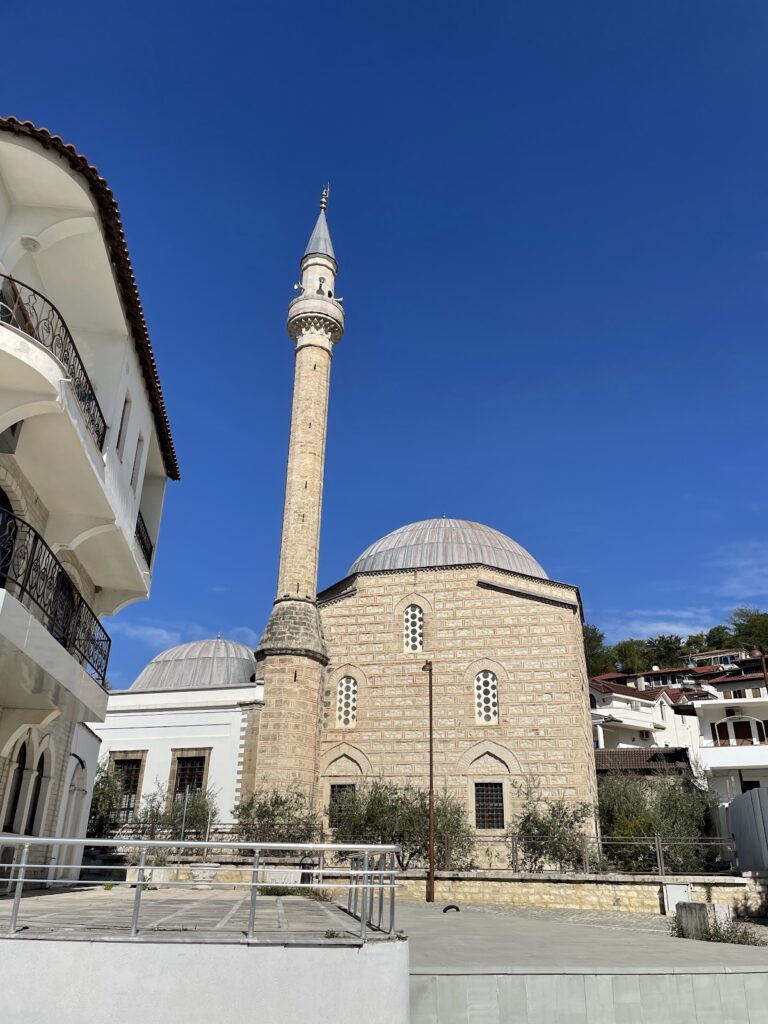
The rebuilt mosque is a masonry Ottoman-style structure and is described as one of Albania’s largest mosques. Its covered entrance and prayer hall form the principal elements of the building, while the interior is organized beneath a system of shallow domes and retains richly worked decoration.
Entrance and prayer spaces
Portico and women’s gallery
The portico is larger than the prayer hall, giving the entrance a substantial role in the building’s arrangement. Inside the hall, a women’s gallery occupies the northern side. The minaret, traditionally the tower associated with a mosque and the call to prayer, was demolished during the Communist period and later restored according to the original plans.
Ten shallow domes
The prayer space is covered by ten shallow domes arranged through an innovative structural system. Octagonal wooden inlays are incorporated into the domes, linking the ceiling’s construction with its ornamental treatment.
Interior decoration
Geometric and calligraphic designs enrich the domes and other interior surfaces. A frieze below the ceiling carries the 99 Names of God, traditional Islamic names and attributes referring to God. Rosettes at the centre of the ceiling contain Qur’anic verses. Eighteenth-century frescoes and other interior decorative elements survived the Communist period.