Rotaha Benedictine Nunnery (Ober-Roden): A Medieval Women’s Religious Community


Site at a Glance
- Rating
- 4.4
- Popularity
- Very Low
- Country
- Germany
- Primary era
- Unclassified
- External website
- Open
- Eras represented
- Unclassified
- Civilizations
- Unclassified
- Site type
- Religious
- Remains
- Monastery
On this page7 sections
History
Rotaha Benedictine Nunnery was a medieval Benedictine nunnery in Germany, associated with Ober-Roden in the present-day city of Rödermark. Dedicated to Saint Mary and other saints, it was probably founded around 700 in the early medieval Frankish realm, although this date remains cautious. In 786, Abbess Aba stated that women from her noble family had governed the institution for generations, indicating an established proprietary monastery in which a lay family retained substantial influence over leadership and administration.
Foundation and Carolingian Transfer
On 25 February 786, Aba transferred Rotaha and related properties in Hesse and the Rhineland to Lorsch Abbey. Lorsch was a major Carolingian imperial monastery. Under the agreement, Aba retained the use of the nunnery and its estates in return for an annual rent of ten solidi. The solidus was an early medieval monetary unit, and the agreement valued each solidus at twelve denarii. The arrangement also reserved leadership of Rotaha for suitable successors from Aba’s family. If no successor could be found, the nunnery and its properties were to be incorporated into Lorsch.
The reason for the transfer is uncertain. One possibility connects it with a suspected conspiracy against Charlemagne, the Frankish king and Carolingian ruler who became emperor in 800. Aba’s husband, Ado, and the East Frankish-Thuringian nobleman Hardrat may have been involved in events of 785–786. Another explanation follows the death of Aba’s father, Theodo, a Carolingian royal official who probably administered the Rodgau and possibly the Maingau. He exercised jurisdiction and may have acted as Rotaha’s lay proprietary-church lord, the patron responsible for a church’s administration, protection, legal affairs, and provision of clergy. His death may therefore have left the nunnery without its former administrative and protective support.
Through its connection with Lorsch, Rotaha came under an imperial abbey and received the advantages and royal military protection associated with that status. Lorsch became its proprietary-church lord and administrator, responsible for the nunnery’s continuing ecclesiastical provision. This relationship placed Rotaha within a larger Carolingian institutional framework while preserving a role for Aba’s family in its succession.
Later Medieval Records
On 21 November 903, Abbess Kunigunde transferred three further estates acquired by Rotaha to Lorsch. She then received the nunnery, its earlier lands, and the three additional properties back for continued use, under the same annual rent of ten solidi. Rotaha was described at this time as belonging to Saint Nazarius, the patron saint of Lorsch. The document does not describe this as a change of patronage.
A ninth- or tenth-century entry in the Seligenstadt Gospel Book probably refers to Rotaha and mentions a female institution associated with the place. The entry has been understood as referring to women’s rule, but its exact meaning remains uncertain. Ober-Roden church still carries the inherited dedication to Saint Nazarius. The date and circumstances of its adoption are unknown, although Lorsch may have maintained Rotaha’s religious provision through that church. During the medieval period, the church’s benefice could be exchanged, and it later provided pastoral care for Nieder-Roden until that settlement received its own parish.
A record from around 1250 mentions a bailiwick at “Rode near the blessed place.” A bailiwick was an administrative or jurisdictional office exercised by a bailiff on behalf of a superior lord or institution. The phrase has been interpreted as a memory of Rotaha after the nunnery had ceased to operate, but the identification is not certain. Lorsch’s subordination to the Archdiocese of Mainz in 1232 may have weakened the institutional privileges and protection on which Rotaha depended, possibly contributing to the end of its operation.
Possible Estates and Location
The proposed Niwenhof may have been the aristocratic or royal estate from which the proprietary monastery developed. Its possible foundation has been placed cautiously around 650, potentially in the Merovingian period, which preceded the Carolingian period. If Niwenhof was a royal estate, Rotaha may have been established on royal land rather than on the private property of Theodo’s family. Niwenhof later developed into a bailiwick and ultimately into the Nieder-Roden territorial court. Evidence places its decline after 1537.
Rotaha’s exact location remains unresolved. One possibility is the Ober-Roden church hill, while another lies in the Rollwald area of Nieder-Roden. Field names recorded there in 1856 refer to a blessed place, a royal meadow, a mill field, and a goose ditch. These names have been interpreted as traces of a former monastery complex with a water mill and bailiwick, but they do not conclusively establish that Rotaha stood there. Excavations in the Ober-Roden church hill material, including a 2023 doctoral study, likewise have not proved that the nunnery occupied that site.
Remains
Church on the Ober-Roden Hill
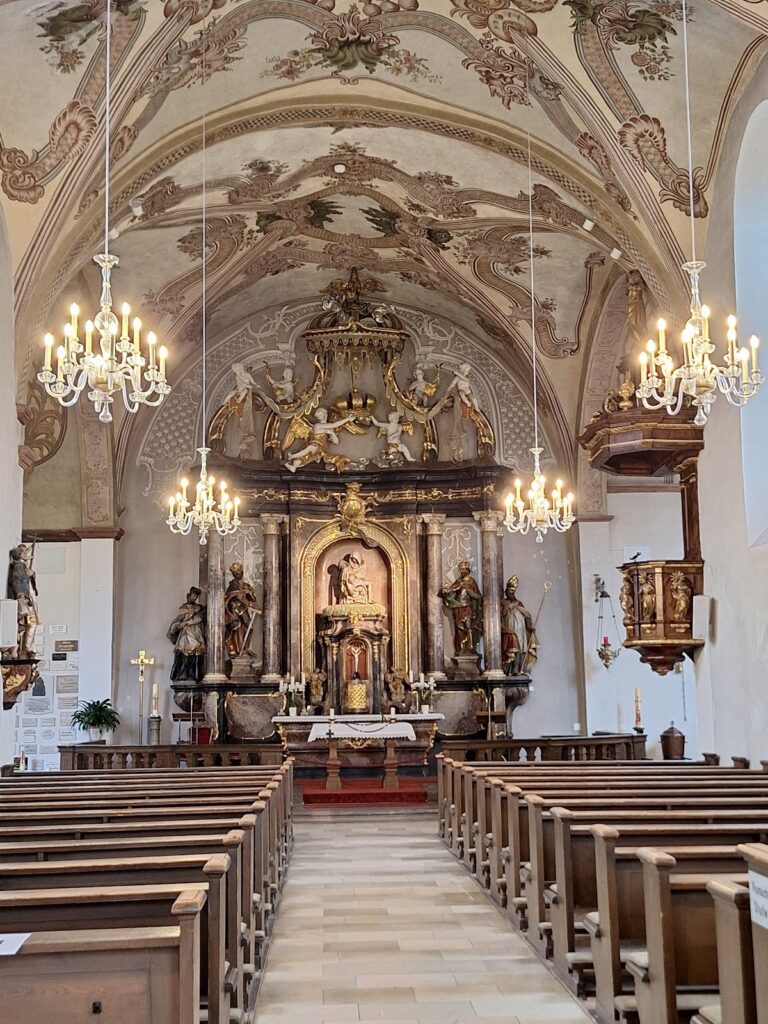
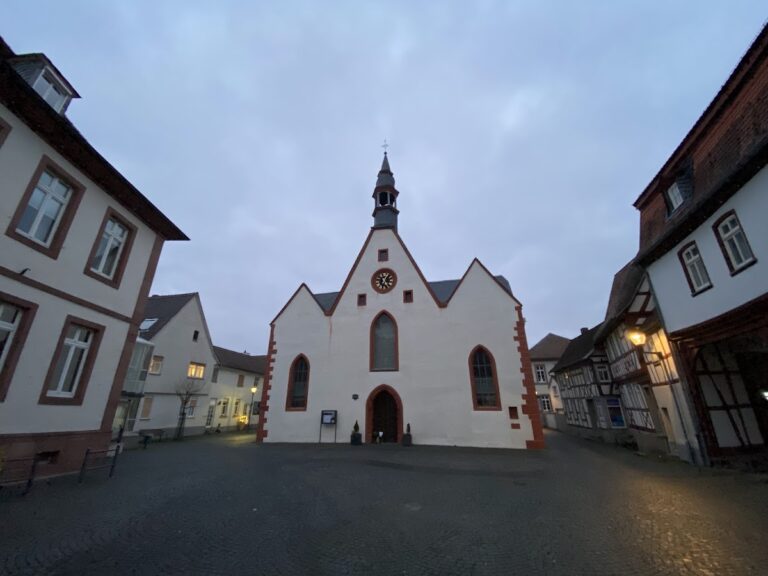
The church on the Ober-Roden church hill preserves evidence of at least four successive construction phases. The earliest was probably a wooden sacred building of Merovingian date. It was followed by a stone church from the Carolingian period and two thirteenth-century phases built after fires. The earliest church may have been a predecessor of Rotaha’s monastery church, but that identification remains an archaeological interpretation rather than an established fact.
The two latest phases may each have included a west gallery, an elevated platform at the western end of a church that could provide a distinct area for a women’s religious community. A coin beneath the latest floor covering supplies a date limit for the final remodeling: the work took place no earlier than the last quarter of the thirteenth century. This date may also indicate that the church continued to serve as Rotaha’s monastery church until that period. The surviving Saint Nazarius dedication links the church to the later religious history associated with Lorsch, but the dedication alone does not prove that Rotaha stood on the church hill.
Possible Rollwald-Nieder-Roden Complex
The possible complex in the Rollwald area has been associated with the Niwenhof bailiwick and a water mill. The field names connected with a blessed place, royal meadow, mill field, and goose ditch have encouraged the interpretation of an earlier institutional and administrative settlement. The existence and exact arrangement of these features as parts of Rotaha have not been conclusively established, so the proposed complex remains an alternative location rather than a confirmed layout of the nunnery.
Nearby sites