Abbey of St Maria del Monte: Benedictine Monastery and Basilica in Cesena


Site at a Glance
- Rating
- 4.7
- Popularity
- Low
- Country
- Italy
- Primary era
- Early Modern
- External website
- Open
- Eras represented
- Medieval, Early Modern, Modern
- Civilizations
- Italian, Papal States
- Site type
- Religious
- Remains
- Monastery
On this page17 sections
History
The Abbey of St Maria del Monte is a Benedictine monastery and minor basilica in Cesena, Italy, built around a ninth-century church on Spaziano Hill. Its origins are linked to a cell associated with Mauro, bishop of Cesena, who died in 946. According to tradition, Mauro withdrew to the wooded hill for prayer, and reports of miracles at his burial place encouraged local devotion and the enlargement of the original cell.
Foundation and Medieval Development
After the year 1000, a three-aisled basilica was built on the site. A Benedictine monastery was established between 1001 and 1026, and Pope Nicholas II confirmed the abbey by a papal bull in 1059. The complex was substantially enriched during the thirteenth century, as the monastery developed around the church and the growing cult of Saint Mauro.
In 1177, Frederick Barbarossa, the twelfth-century Holy Roman emperor, stayed at the abbey. He granted the community extensive land and placed it under his protection. Two columns that had once stood on the monastery grounds were given to the monastery of Santa Chiara in Naples in 1317. Local tradition held that Barbarossa had brought them from Jerusalem.
The abbey received a statue of the Madonna from the small church of Montereale in 1318. This event encouraged a popular devotional practice that became associated with the production of votive tablets, small painted offerings made in thanksgiving for answered prayers or protection. The tradition of making these objects for the Madonna del Monte was established by the fifteenth century and continues today.
Conflict and Reconstruction
Francesco II Ordelaffi, the medieval lord of Forlì, first profaned and later fortified the basilica. In 1356 and 1357 he seized the monastery and used it as a barracks. The monks fled for more than a year. When they returned, the complex lay in ruins, and reconstruction continued for more than a century.
During the period of Malatesta rule, the abbey became an important center of Cesena’s cultural and artistic life. The Malatesta were a ruling family with power in parts of Romagna, including Cesena, during the late medieval period. The monastery attracted prominent visitors and received visits from several popes.
Renaissance Transformation
Between 1536 and 1548, the church was reshaped in a project by Domenico Garavini of Brisighella, based on an original design attributed to Bramante, a leading Italian Renaissance architect. The complex’s artistic development also involved Scipione Sacco, Girolamo Longhi, Francesco Masini, Giuseppe della Valle di Scalve, Francesco Morandi, known as Terribilia, and Alessandro Corsi.
Earthquake, Suppression, and Restoration
A prolonged crisis affected the Benedictine complex during the eighteenth century. An earthquake in 1768 destroyed the basilica’s dome. Pietro Carlo Borboni rebuilt it, and Giuseppe Milani decorated it between 1773 and 1774.
After the French occupation in 1797, the abbey was abandoned or suppressed. The complex was confiscated and offered for sale in 1812, but Pietro Maria Semprini purchased it with his own funds and donated it to Pope Pius VII. Pius VII, whose papal name was Barnabas Chiaramonti, had been a Benedictine novice at the abbey. On 1 May 1814, he crowned the Madonna and Child and assigned the complex to the monks in his will.
In 1819, Pius VII re-established the abbey as part of the Congregation of Santa Giustina, a Benedictine reform congregation centered on the Abbey of Santa Giustina in Padua. The monastery was suppressed again in 1866, while the monks returned during the nineteenth century.
War Damage and Later Monastic Work
During the Second World War, the complex sheltered numerous evacuees and suffered severe bombing damage. The library wing collapsed, and the church’s counter-facade fresco was destroyed. The upper frieze by Girolamo Longhi survived the bombing of 1944.
In the second half of the twentieth century, the laboratory for restoring ancient books reopened, continuing the monastery’s work of conserving its library heritage. Pope John Paul II stayed at and visited the abbey in 1986 during his tour of Romagna, and an ex voto was painted to commemorate the visit. At the beginning of the twenty-first century, the Society of Friends of the Monte supported the creation of a group refectory with 80 seats and the Pio VII conference hall with 100 seats.
Remains
The abbey stands on Spaziano Hill at approximately 135 metres above sea level. From the forecourt, the panorama extends from Monte Titano and the first Apennine foothills across the Romagna plain to the Adriatic Sea. The complex combines the basilica, cloisters, monastic rooms, library spaces, and the surviving devotional collection within a long-developed hilltop setting.
The Basilica
Nave and High Altar
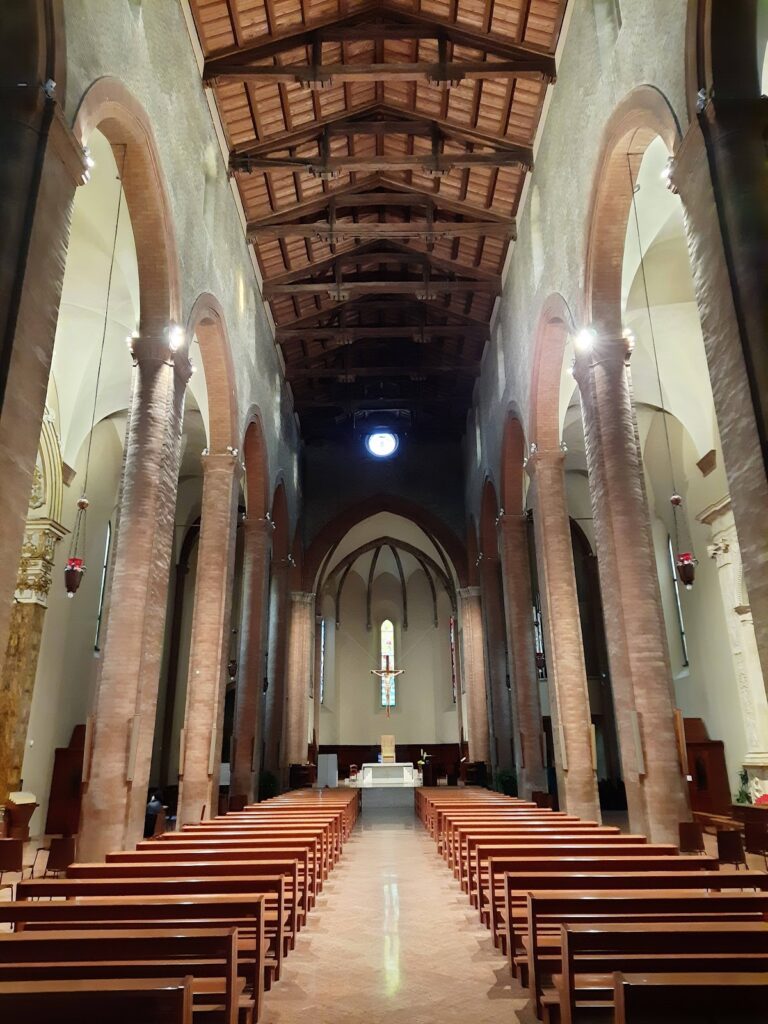
The church has an entrance on the right side of the building and a broad single nave with seven side chapels, three on the right and four on the left. A broad stone staircase rises to the presbytery, the area around the main altar, while the entrances to the crypt are placed beside it. The floor carries the symbol of the Benedictine Congregation of Montecassino.
Behind the high altar is a walnut monastic choir carved between 1560 and 1562 by Giuseppe della Valle di Scalve, also called Scalvini. The high altar area contains the Madonna Assunta, a thirteenth-century statue of stucco and painted wood. The Child held by the Madonna was added later, and Pius VII placed crowns on both figures on 1 May 1814.
Giuseppe Milani painted the high altar and dome decoration in 1773 and 1774. His design uses an upward-looking perspective associated with Melozzo da Forlì and was influenced by Carlo Cignani’s dome in the Chapel of the Madonna del Fuoco in Forlì Cathedral. The decoration includes the principal Christian virtues at the bases of the arches, the four Evangelists in the pendentives, eight Old Testament scenes in the drum, an Assumption of the Virgin in the dome, and the Coronation of the Virgin Mary in the apse semi-dome.
Chapels and Ambulatory
The first chapel on the right contains Bartolomeo Coda’s Annunciation, painted in 1543, together with a round painting of the head of Saint John. The second holds Francesco Mancini’s Saint Mauro Healing the Sick from 1704 and a round Deposition by Girolamo Marchesi from the sixteenth century. The third contains Francesco Francia’s Presentation of the Christ Child in the Temple and Purification of the Virgin, made in 1515, with another sixteenth-century Deposition by Marchesi in the lunette.
On the left, the first chapel contains a Saint Sebastian by Vincenzo Ansaloni. The next has a seventeenth-century Saint Lawrence, and the third contains G. B. Barbiani’s seventeenth-century Glory of Saints Benedict and Scholastica. The fourth chapel contains various relics and the body of Saint Agapo.
Paintings of old Cesena lead into the ambulatory. This area preserves part of the ex voto collection and includes three chapels. Their features include a fourteenth-century crucifix, an early twentieth-century terracotta statue of Saint Joseph, and a statue of Saint Benedict made by Leonardo Lucchi in 1987.
Friezes and Counter-Facade
A frieze by Girolamo Longhi runs along the upper part of three sides of the church. It contains fourteen scenes from the life of the Virgin. The frescoes date from 1559 and were uncovered in 1914. A sixteenth-century fresco on the counter-facade by Gavarini showed Moses removing his sandals before ascending Horeb. Bombing during the Second World War destroyed this work.
Crypt and Sacristy
A twentieth-century wrought-iron gate by Fra Pio Nobilione gives access to the crypt. The crypt contains a ninth-century stone cross and a Roman sarcophagus that served as the ancient burial place of Saint Mauro. The sarcophagus is now kept in Cesena Cathedral.
A large room leads to the fourteenth-century sacristy. Its furnishings date from the eighteenth century, while a cycle of frescoes by Giovanni Cappelli dates from 1946. The wall paintings include Saint John the Evangelist by Lorenzo Veneziano, made around 1370, Presentation at the Temple by Francesco Menzocchi from 1534, and The Holy Family by Gaspare Sacchi from 1536.
Cloisters and Monastic Rooms
Small Cloister
Traces of the first church remain visible on the basilica facade and can be seen from the Small Cloister. Dating from the fifteenth century, the cloister has a portico supported by small columns and an iron wellhead from the seventeenth century. It provides access to the library, the laboratory for restoring ancient books, and the monastic herbal shop beneath the portico.
Great Cloister
Of the three original cloisters, the sixteenth-century Great Cloister survives. It contains a monumental well made by Alessandro Corsi in 1588. The apparatus supplying the well has been attributed to Leonardo da Vinci, although that attribution remains uncertain.
Refectory
The twentieth-century refectory was created by restoring the convent’s cellars. It has a coffered ceiling and paintings showing scenes from the New Testament. The room forms part of the later monastic facilities that expanded the complex’s communal spaces.
Ex Voto Collection
The abbey preserves about 690 ex votos, making its collection one of the richest and oldest of its kind in Europe. These small painted tablets depict events in the lives of Cesena’s inhabitants and claimed interventions by the Blessed Virgin. Examples show the collapse of the old city theatre in 1820, a man narrowly avoiding execution at the end of the Second World War, a fifteenth-century illness, a rural disaster, a sixteenth-century shipwreck, and an accident involving a Vespa and an automobile.
Glass-plate reproductions of much of the collection are preserved in the Zangheri Photographic Archive. Together, the tablets connect the abbey’s Marian devotion with specific experiences of illness, danger, accidents, and disasters across several centuries.