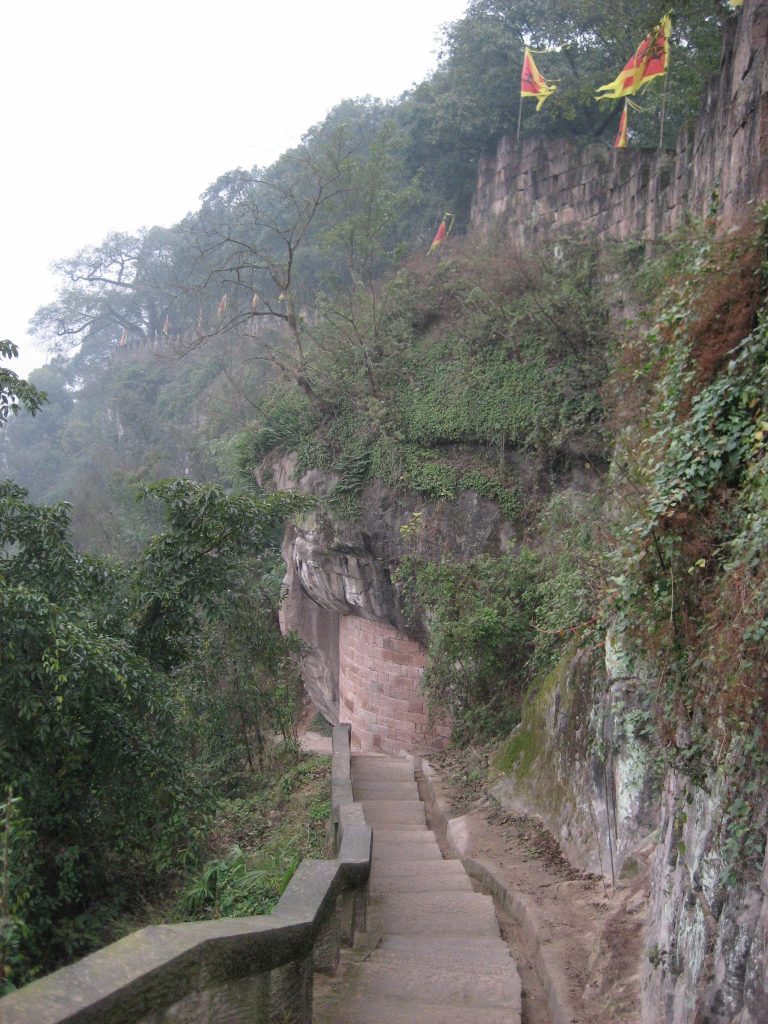
Beishan Cliffside Carvings: A Buddhist Rock-Carving Complex in China
Site at a Glance
- Popularity
- Medium
- Country
- China
- Primary era
- Medieval
- Eras represented
- Medieval, Early Modern
- Civilizations
- Ming, Qing, Song, Tang
- Site type
- Religious
- Remains
- Sanctuary
On this page14 sections
History
The Beishan Cliffside Carvings are a Chinese Buddhist rock-carving complex on Beishan in present-day Dazu District, Chongqing, China. Work began in 892 during the Late Tang and was substantially complete by 1146, more than 250 years later. Beishan is an important component of the Dazu Rock Carvings.
Carving from the Late Tang through the Song
The project began under Wei Junjing, a Late Tang regional military and administrative official, alongside the construction of the Yongchang stockade at Beishan. Work continued through successive regimes, including the Former Shu and Later Shu kingdoms of the Five Dynasties era, and the Song period. The carvings also include work from the Ming period. By the main phase of completion, the site comprised about 370 caves and niches and nearly 10,000 figures.
Later history and recognition
A tomb inscription for Xiang Yang’s wife, dating to the Shaoxing period of the Southern Song, identifies Buddha Ear Rock as the location of the Temple of Extending Grace. The North Tower Temple was rebuilt in 1677 and demolished during the Cultural Revolution, a political movement in China from 1966 to 1976.
Beishan was designated a Major Historical and Cultural Site Protected at the National Level in 1961. The protected property’s listed components were expanded in 1996 to include the Nanshan and Shizhuanshan carvings and Duobao Pagoda, and in 2019 to include the Miaogaoshan and Shuchengyan carvings. The Dazu Rock Carvings, of which Beishan is a part, became a UNESCO World Heritage Site in 1999.
Remains
The carvings occupy several areas on Beishan, historically called Longgang Mountain. The wider site extends for more than 300 m, while Buddha Bay, its principal carved area, follows a cliff face 460 m long. Rock faces and caves hold carved figures, scenes, inscriptions, and Buddhist text monuments; freestanding stone figures also survive in some areas.
Buddha Bay
Cliff face and carved program
Buddha Bay forms a west-facing crescent oriented east to west. Its rock face is 7 m high and divided into northern and southern sections. In 1952, the county cultural relics office numbered the carvings from 1 to 290, assigning numbers 1 to 100 to the southern section and 101 to 290 to the northern; 264 carved units are recorded. The area contains seven inscribed stone monuments, 45 inscriptions about the making of Tang- and Song-period images, eight Buddhist scripture pillars carved in shallow relief, a mural incised in lines, and more than 7,000 figures.
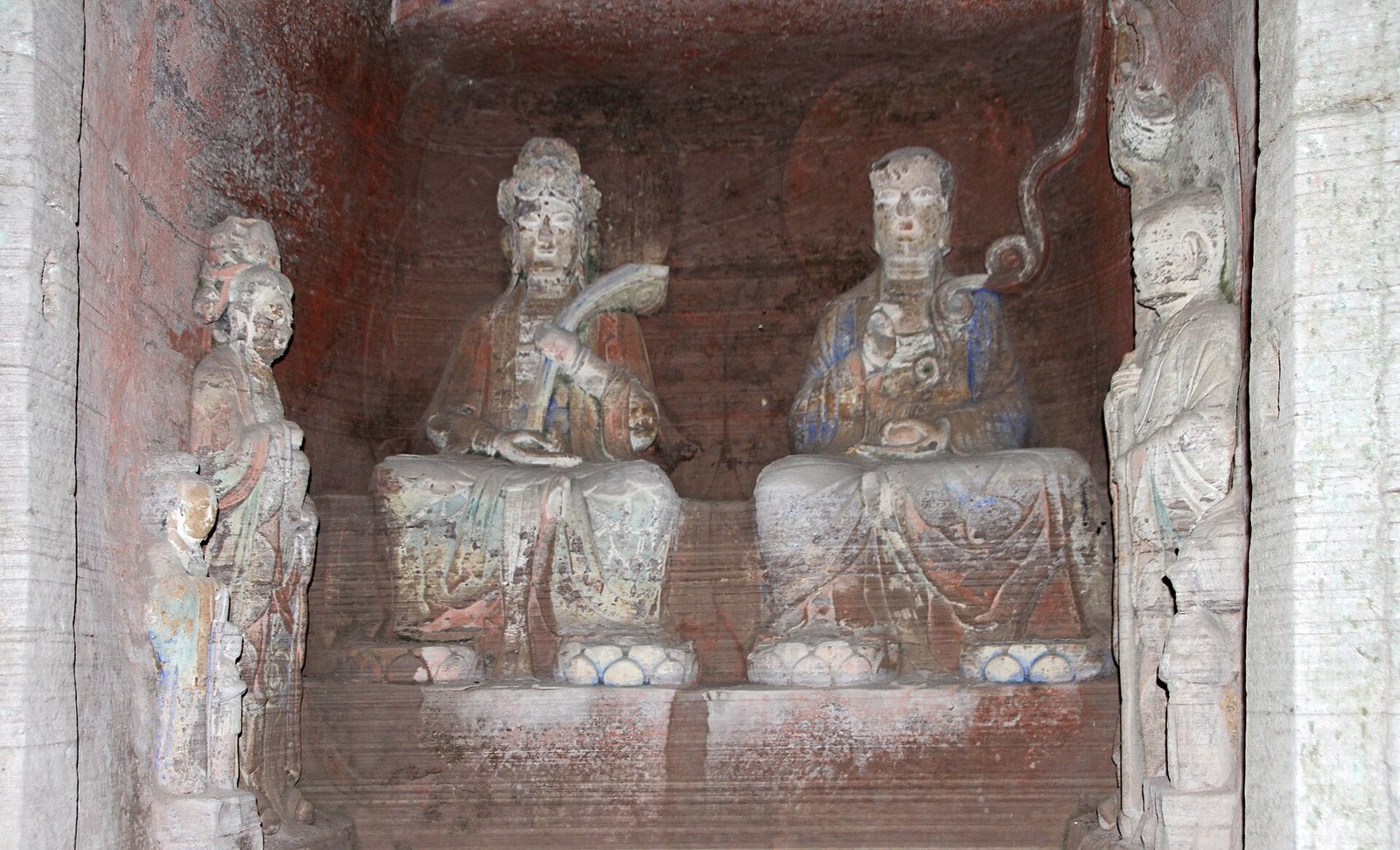
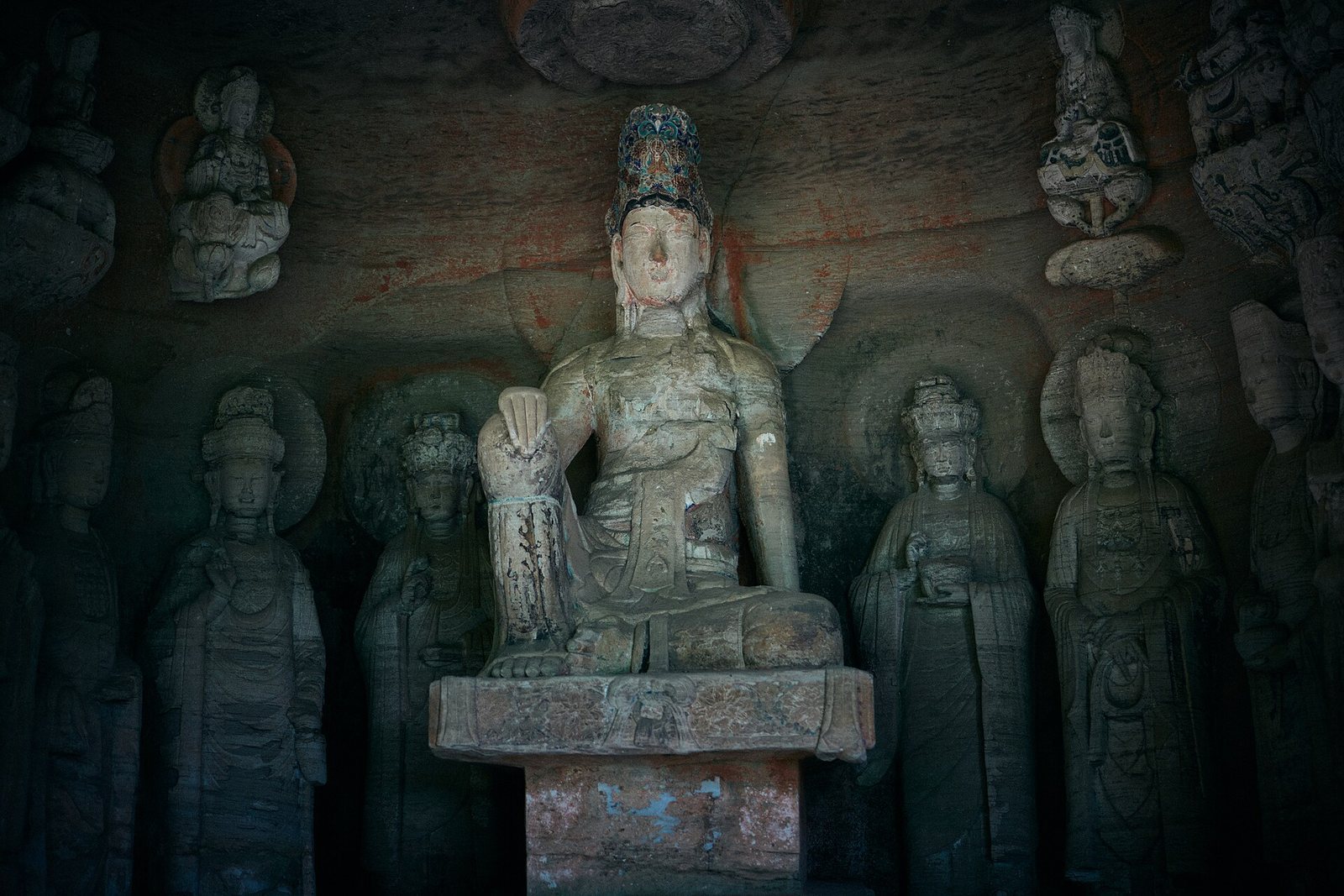
The carved subjects include Buddhas, bodhisattvas (beings who seek buddhahood while helping others toward liberation), arhats (practitioners who have attained liberation), and vajras (protective Buddhist figures), as well as narrative scenes and human figures. About one-third of the imagery is Esoteric Buddhist, associated with ritual and initiatory teachings. Pure Land Buddhism, which centers on rebirth in Amitabha’s Pure Land, the Three Stages movement, and Chan, a Chinese meditation tradition, are also represented. Guanyin, a bodhisattva associated with compassion, appears in more than half of the Song-period images.
Notable caves and niches
Among the named carvings are niche 5, a cave of Vaisravana, a Buddhist guardian king; cave 9, with Thousand-Armed Guanyin; and niche 125, the Rosary-Holding Guanyin, also called Charming Guanyin. Cave 136 depicts a revolving scripture repository, a rotating structure for storing Buddhist texts. Its design contrasts movement and stillness, strength and softness, mass and line, and different degrees of tonal density; it is regarded as a representative work of Song stone carving. Cave 155 shows the Peacock Wisdom King, a protective Buddhist figure, while niche 176 presents a transformation scene from the Maitreya Descent Sutra. A transformation scene conveys a teaching or scripture through images, and Maitreya is the Buddha expected in the future. Cave 245 depicts a scene from the Sutra on the Contemplation of Amitayus Buddha. Niches 279 and 281 show the Eastern Medicine Buddha of Pure Lapis Lazuli Light, associated with healing.
Other carved cliffs
Guanyin Slope
Guanyin Slope, also called Guanyin Rock, lies 1 km west of Buddha Bay. Its south-facing cliff is 34 m long and 6 m high, with 42 niches. The carvings, mainly from the Former Shu, Later Shu, and Song periods, include Ksitigarbha, a bodhisattva associated with rescuing beings from suffering, and the Bodhisattva King Who Guides the Way. They also depict Wish-Fulfilling-Wheel Guanyin and Thousand-Armed Guanyin.
Buddha Ear Rock
Buddha Ear Rock, also called Buddha Ear Peak, lies 1.5 km southwest of Buddha Bay. Its east-facing cliff is 33 m long and 17 m high. The carvings are arranged in 25 numbered units comprising 26 niches, and 233 figures survive. Most of the carvings date to the Five Dynasties period, with additions from the Song. Subjects include Guanyin, Ksitigarbha, Thousand-Armed Guanyin, Medicine Buddha scenes, single and paired Guanyin figures, Heavenly Kings, and Buddhas. Recent excavations have recovered freestanding stone carvings in the Song style.
Camp Slope
Camp Slope, also known as Bodhisattva Rock, is 2 km east of Buddha Bay. Its cliff face is 25 m long and 15 m high. Seventeen numbered units group the carvings and inscriptions, which include more than 180 figures. The works span the Late Tang, Five Dynasties, and Song periods and show Thousand-Armed Guanyin, Water-Moon Guanyin, the Three Sages of Huayan, Amitabha with Guanyin and Ksitigarbha, and an auspicious Buddha. Huayan is a Buddhist school associated with the Flower Garland Sutra. Major niches include no. 4, with Amitabha, Guanyin, and Ksitigarbha; no. 5, with Shakyamuni, the historical Buddha; and no. 10, with Thousand-Armed Guanyin. Tradition holds that Wei Junjing stationed troops here, a story said to explain the name Camp Slope.
North Tower Slope
Duobao Pagoda and temple precinct
North Tower Slope lies 500 m southwest of Buddha Bay. Duobao Pagoda stands on its summit and is commonly called the North Tower because it is north of the former county seat; the slope takes its name from the pagoda. North Tower Temple stood 20 m north of it. Three freestanding stone figures remain in the temple precinct, and an octagonal pool behind the temple contains a carved stone dragon.
Buddha images, niches, and inscription
Three metres south of the pagoda, two Song-period Buddha images face south with their backs against the cliff. They were later repaired and measure 9.64 m in seated height, with shoulders 3.98 m wide. A Guanyin niche in the Ming style lies 40 m south of the pagoda. Another Ming-era Guanyin niche, which was recut, is at a place called One Bowl of Water, 100 m south. A carved Buddhist dharani pillar stands on a cliff 150 m southeast of the pagoda. A dharani is a Buddhist sacred formula, and the pillar bears a four-character inscription meaning “Land of Begonia Fragrance.” Qing-dynasty calligrapher Zeng Zhimin wrote the inscription in regular script; each character is 1.8 m high.