Beata Vergine della Molinà: A Catholic Church in Domegge di Cadore
Site at a Glance
- Popularity
- Very Low
- Country
- Italy
- Primary era
- Early Modern
- Eras represented
- Medieval, Early Modern
- Civilizations
- Holy Roman Empire, Venetian
- Site type
- Religious
- Remains
- Church
On this page10 sections
History
Foundation and enlargement
Beata Vergine della Molinà is a Catholic church in Domegge di Cadore, Italy, near the boundary with Calalzo and within the Diocese of Belluno-Feltre. Residents of Domegge began building it in 1510 as an offering in fulfilment of a vow, dedicating it to Our Lady of Graces. Their vow followed repeated incursions into Cadore by troops of Maximilian I of Austria, who became Holy Roman Emperor in 1508, and a local victory over the invaders at Vallesella. Master builder Nicolò Ruopel of Carnia supervised the work, funded by alms and donations. The church was complete by 1515, although the precise construction period is uncertain.
In 1579, the Battuti, a lay religious association whose members practised flagellation, enlarged the church with a second chapel dedicated to Saint Apollonia, an early Christian martyr. The church was consecrated in 1582.
A local foundation legend tells of a dispute over whether the church should stand on Calalzo’s side of the Molinà stream or at its present site in Domegge. In the tale, Calalzo residents moved the rising walls across the stream at night, but each morning they had returned to the Domegge bank. One night, watchers saw a beautiful woman in shining satin arrive with angels and silently move the walls back. Afterward, no one interfered with the building.
Later use and wartime damage
A room above the sacristy may have served as accommodation for chaplains. Friars from Monte Froppa later occupied it for a time, before withdrawing to the Hermitage of the Hermits of Monte Froppa.
The church sustained damage on several occasions. During the First World War, troops used it as a warehouse. It was then severely damaged by an explosion during the demolition of an adjacent bridge as troops retreated. After restoration, worship resumed, but the church was damaged again in 1944 when a concrete bridge was blown up.
Remains
Setting and exterior
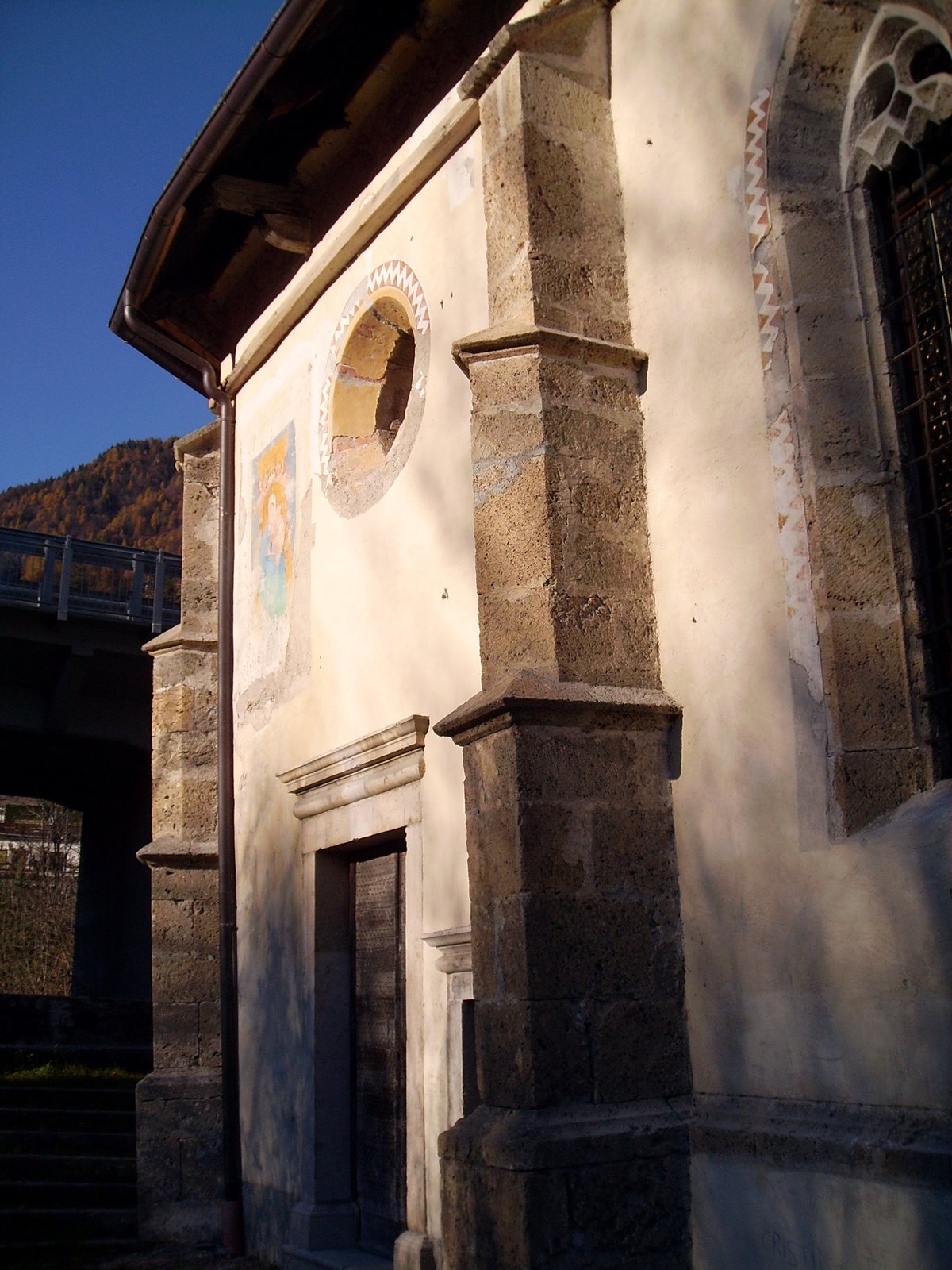
The church stands above the ravine cut by the Molinà, a tributary entering the Piave from its right bank. The rugged ravine and the church above it have been depicted by Italian and foreign landscape artists. The building has an asymmetrical, irregular polygon-shaped plan, with buttresses supporting the sides that face the ravine.
Interior and furnishings
Chapels and ceilings
Two chapels of equal size occupy the interior, divided by a square column. Two smaller columns connect to it, giving rise to projecting ribs that create a net-like pattern across the curved ceilings. The second chapel matches the first and stands on an isolated rocky pillar. A sacristy is attached to the church, with a room above it.
Altar painting
An altar associated with the second part of the church holds a copy of a painting of Saint Apollonia and the Virgin. The original, attributed to Venetian Renaissance painter Marco Vecellio, was moved to the parish church in Domegge in 1917 to protect it during the invasion.
Madonna fresco
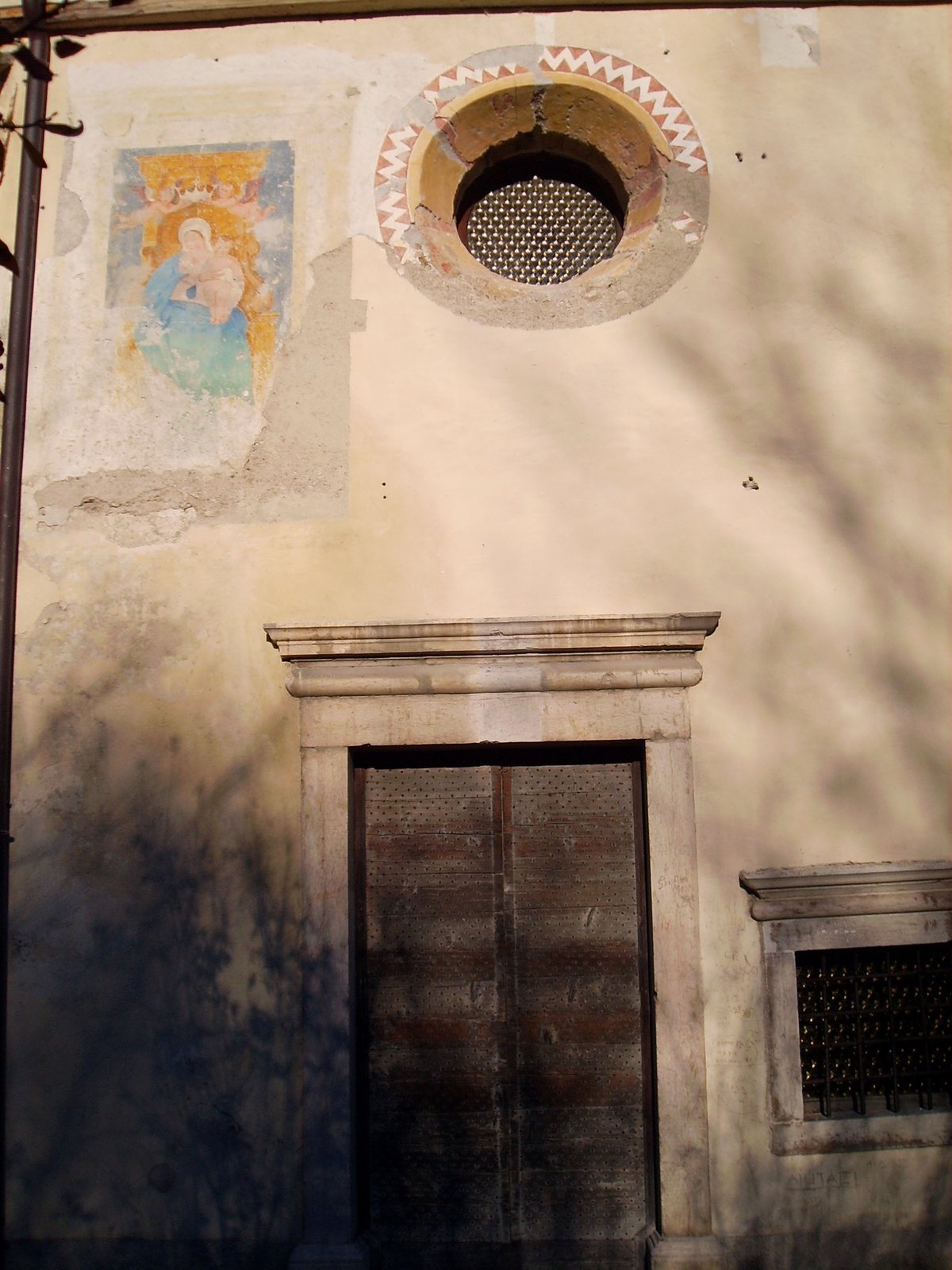
A fresco of an enthroned Madonna is thought to date to about 1350. Angels and childlike figures, known in art as putti, were added in the fifteenth century. The painting is in poor condition, and its figures are presented in a formal, simply rendered manner.
Crucifix and carved staircase
A wooden crucifix, probably associated with the Brustolon school, a woodcarving style linked to Belluno sculptor Andrea Brustolon, shows Christ with expressive realism in a non-symbolic pose. A small carved staircase completes the church’s ornamentation.