Santa Margherita in Salagona: A Medieval Chapel in Italy


Site at a Glance
- Rating
- 4.7
- Popularity
- Very Low
- Country
- Italy
- Primary era
- Medieval
- Eras represented
- Medieval
- Civilizations
- Unclassified
- Site type
- Religious
- Remains
- Chapel
On this page16 sections
History
Foundation and survival
Santa Margherita in Salagona is a Roman Catholic chapel in Laggio di Cadore, Italy, founded under the Caminesi, a medieval ruling family whose territories included parts of the Veneto, Trevisan, and Cadore regions. Construction began around 1250, and the earliest recorded evidence of the building dates to 1285, when it depended on the Patriarchate of Aquileia, a major medieval church jurisdiction in northeastern Italy and the eastern Alps.
Dedicated to Saint Margaret of Antioch, a Christian virgin martyr associated with the legend of a dragon, the chapel belongs to the Diocese of Belluno-Feltre. It is one of the oldest religious buildings in Cadore and the only surviving building of the village of Salagona. The village was destroyed by a major fire on 21 August 1705, leaving the chapel as a surviving link to the settlement’s medieval history.
Medieval painting
The chapel’s frescoes belong to a late phase of mainland Venetian painting influenced by Byzantine icons. They were probably created by two anonymous itinerant monks trained in the Trevisan area, active between the last quarter of the thirteenth century and the beginning of the fourteenth. Their work connects the building’s religious setting with the artistic traditions associated with the Caminesi period.
Remains
Building and interior
Chapel exterior
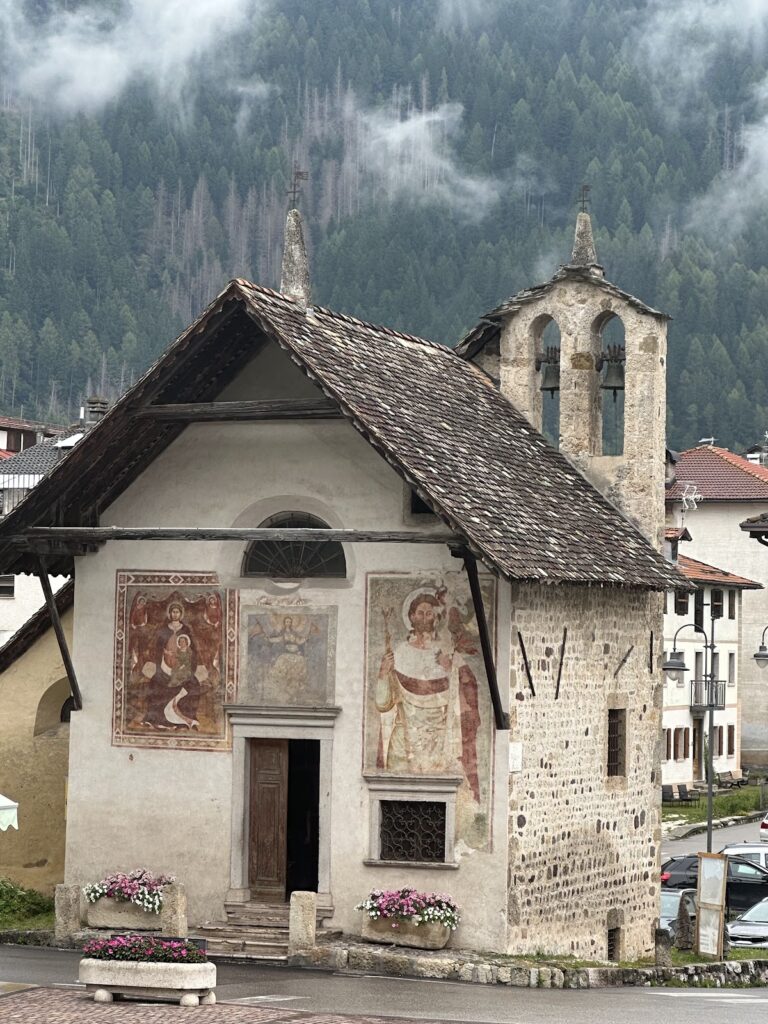
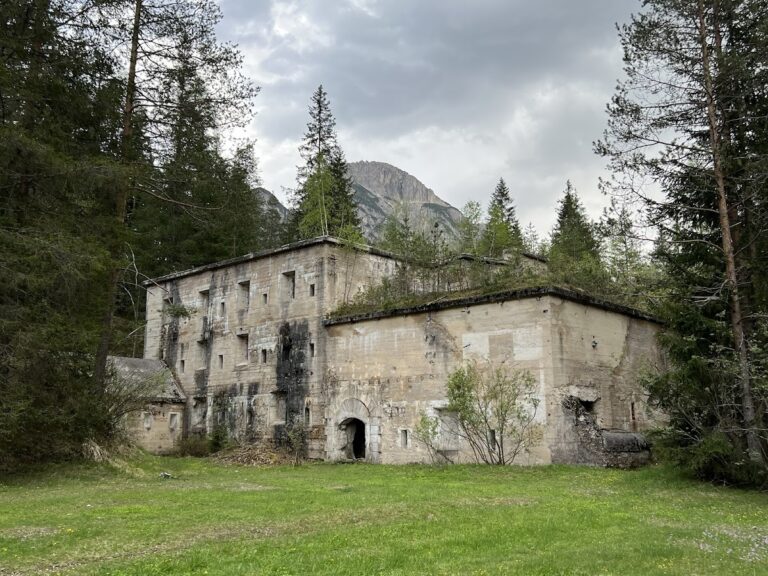
Santa Margherita in Salagona is a very small, simple building set in a broad meadow before the woods. A line of twentieth-century houses built along the road partly conceals it. The roof has two shingled slopes, and a small bell tower resembling a chimney rises from the ridge at the edge of the facade. A molded entablature emphasizes the portal, while two slightly misaligned windows are placed irregularly across the facade.
Frescoed room
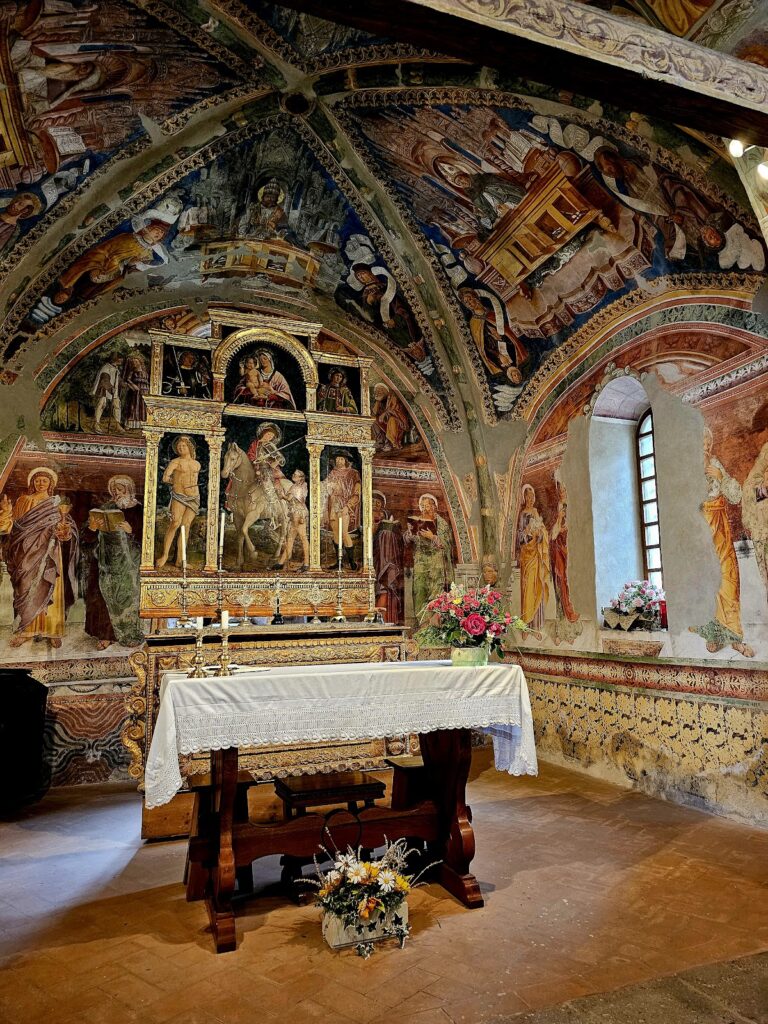
The interior is a single square room covered entirely with frescoes. The lower borders combine trellis patterns with lobed scales, finishes characteristic of buildings in the Trevisan area during the Caminesi period. The paintings follow the model of Greek icons, using frontal figures, symbolic settings, and formal arrangements associated with Byzantine-influenced Venetian art.
Apse and left wall paintings
Deesis and Saint Margaret
The apse wall contains a Deesis, a Christian composition in which Christ is shown as judge or ruler with Mary and John the Baptist interceding. Christ sits on a rainbow throne in a pose that combines an embracing gesture with the display of his wounds. Mary wears a large mantle known as a maphorion, while John holds a scroll with the words, “The voice of one crying in the wilderness: Prepare the way of the Lord.” Peter stands between Mary and Margaret.
The Deesis is flanked by two scenes from Margaret’s Passion. One shows her triumph over a dragon-shaped demon, from which she emerges, and the other depicts her beheading. The figures are framed against a background whose arrangement suggests spatial depth, although the scene itself has no landscape setting. The strong outlines defining the figures identify this painter with the artist responsible for the nearby Madonna and Child panel.
Madonna and Child panel
At the rear of the left wall, near the apse, the same painter created an enthroned Madonna and Child accompanied by Saints Susanna, Juliana, and Martin, bishop. The panel forms part of the chapel’s principal group of devotional images and shares the firm linear style visible in the Deesis.
Nativity
The Nativity occupies the rear part of the left wall and was painted by the second artist. His softer colors and more animated figures distinguish the scene from the paintings attributed to the first painter. The swaddled infant Jesus lies on a prophetic sarcophagus on a mountain slope, while a dark symbolic cave contains the ox and donkey. Mary caresses the child beneath a six-pointed star symbolizing his descent from David through his mother.
Two angels summon the shepherds, who approach from the right with their flock. Below them, two midwives wash the child. Anastasia, described in the tradition as the first believer, has a halo, while Sebel, the pagan and unbelieving midwife, does not. Their presence comes from an apocryphal episode, a religious narrative drawn from texts outside the canonical Bible.
Right wall and entrance wall
Daniel in the lions’ den
Near the entrance on the right wall, the story of Daniel in the lions’ den unfolds in four smaller vignettes. Daniel sits on a throne-like seat at the left, watched by two lions. One lion extends into the lower central scene, while the upper central vignette has been lost. In the right-hand vignette, an angel lifts Habakkuk by the hair and brings him a Eucharistic basket containing bread and fish. A small wineskin hangs from the angel’s shoulder.
Risen Christ and the Apostles
Beside the Daniel scenes, the risen Christ appears to the Apostles in an image based on the episode in John 20:19–31. The painter freely represented the Apostles’ agitation, showing them bowing in different directions, with astonished faces and hands extended toward Christ. The majestic figure of Christ blesses them at the center of the composition.
Missio Apostolorum
The Missio Apostolorum, representing the sending or mission of the Apostles, stretches across the inner entrance wall and turns onto the right side to complete the group of the Twelve. A separate panel adds Paul, holding the sword associated with his martyrdom, and Barnabas, dressed as the first legendary bishop of Milan.
Saint Christopher
A final fresco attributed to the second painter represents Saint Christopher on a gigantic scale, extending across the full height of the room. His figure divides the lower decorative borders into two sections. Christopher holds a finely worked, gilded staff topped by a large red drop rather than the customary knotted form with miraculous foliage.
Christopher wears a sumptuous robe associated with a high ecclesiastic. The garment is decorated with orbiculi, circular ornamental motifs used in late antique and medieval art and associated here with Constantinople and later Arab artistic traditions. The scroll held by the small Christ Child is now illegible.