Chiesa di Sant’Orsola: A Fourteenth-Century Catholic Church in Italy


Site at a Glance
- Rating
- 5
- Popularity
- Very Low
- Country
- Italy
- Primary era
- Medieval
- Eras represented
- Medieval, Early Modern
- Civilizations
- Holy Roman Empire, Venetian
- Site type
- Religious
- Remains
- Church
On this page11 sections
History
Chiesa di Sant’Orsola is a fourteenth-century Catholic church in Vigo di Cadore, Italy, built in the architectural tradition of medieval Cadore and dedicated to Saint Ursula. Construction was completed in 1345, and the church was consecrated in 1349–1350. Founded by Ainardo da Vigo, son of Odorico, the podesta, or senior civic and judicial official, of Cadore, it probably served as a family funerary chapel and lasting memorial to the founder’s household.
Foundation and family memorial
The foundation took place during a political change in Cadore. After Rizzardo III Camino died in 1335, the territory formally returned to the temporal authority of the Patriarchate of Aquileia, an ecclesiastical principality whose patriarch exercised both religious and political power in northeastern Italy. Ainardo remained an important official connected with the Caminesi, a medieval ruling family whose influence extended across parts of the Veneto and northeastern Italy.
Ainardo died at Serravalle in 1346 and was first buried in the Pieve di Bigonzo. His will requested the later transfer of his remains to Sant’Orsola, reinforcing the church’s role as a family memorial. Its endowment was enlarged by his widow, Margherita di Leisach, who died by 1350, and by her second husband, Federico Pandolfo di Lienz, who died in 1361.
The Saint Ursula fresco cycle
The principal fresco cycle was probably painted around 1353–1355, apparently through the impetus of Federico Pandolfo di Lienz. Its patron deliberately preserved the memory of the original founders by presenting Ainardo and Margherita as kneeling donors in the scene of the Glory of Saint Ursula.
The artists responsible for the cycle remain unidentified. Attributions to Vitulino da Serravalle or his son Bernardo, painters active in Cadore or Ampezzo during the period, have not been accepted as convincing. The paintings draw on post-Giottesque methods, the later development of Giotto’s innovations through more naturalistic figures, spatial arrangement, and narrative expression. They also reflect the work of Emilian painters active in the Veneto. The series may have been inspired iconographically by a polyptych, an altarpiece made from several panels, associated with Paolo Veneziano, a leading fourteenth-century Venetian painter.
Later additions and alterations
In 1541, the woodcarver Michael Parth of Brunico made the small high altar. The contract was concluded with a small group of lay parishioners, and the altar reflects northern sculptural and altar traditions valued in Cadore during the sixteenth century. Its style combines Renaissance features with elements associated with Austrian Gothic work, reflecting the region’s transalpine connections.
A seventeenth-century addition opened the Chapel of Saint Lazarus along the left side of the church. Its arch interrupted the earlier fresco cycle, and the chapel’s decoration was judged less successful than the older paintings. The Baroque crowning once made by the Cadoran brothers Giobatta and Giovanni de Chiantre was later removed. It had substantially concealed the Golgotha scene above the altar. The surviving parts are the vine-patterned columns beside the shrine and the short balustrades beside the altar frontal and table.
Remains
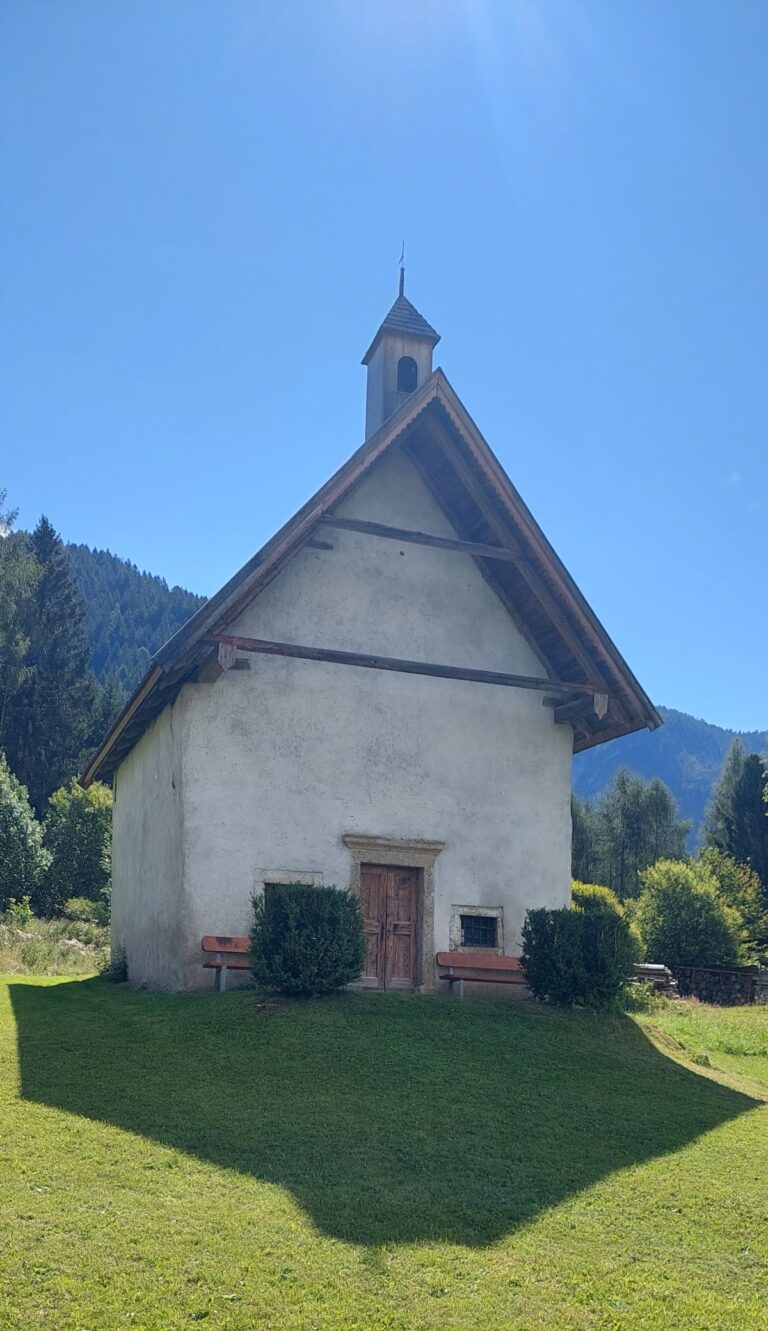
Chiesa di Sant’Orsola has the simple rectangular plan characteristic of fourteenth-century Cadoran churches. A set-back addition on the left belongs to the seventeenth century and contains the Chapel of Saint Lazarus and the sacristy. The broad overhang of the gabled roof protects the facade, where early wall paintings remain visible. Inside, painted decoration covers the walls, while the blue ceiling carries a central image of the Virgin and Child surrounded by roundels with the emblems of the Evangelists.
Facade and painted interior
Facade frescoes
Two fourteenth-century fresco panels survive on the facade. On the left, the Madonna and Child are shown enthroned and attended by angels. On the right, Saint Christopher carries the Christ Child. Both paintings are in fair condition. The Saint Christopher has losses in its upper-right section and was damaged when a seventeenth-century window was opened through its lower part. A much later fresco above the doorway depicts an unidentified female saint. It remains legible but is markedly faded.
Stories of Saint Ursula
The interior cycle devoted to the Stories of Saint Ursula unfolds from the left of the entrance in a clockwise direction. Its scenes present the Embassy to the King of Brittany, the Appearance of an Angel to Ursula, the Baptism of Etherius, the Arrival in Rome, the Voyage to Cologne, the Martyrdom of the Virgins, the Funeral Rites of the Martyrs, the Glory of Saint Ursula, and the Appearance of Saint Ursula to a Dying Monk. Saint Ursula is traditionally associated with a group of virgin companions and with a story of pilgrimage, martyrdom, and visions after death. Etherius is the male companion or betrothed linked with her traditional legend.
The cycle’s sequence is interrupted on the left by the arch of the Chapel of Saint Lazarus. In the Glory of Saint Ursula, the kneeling figures of Ainardo da Vigo and Margherita di Leisach identify the people who established and supported the chapel. The apse lunette, a curved field above an architectural opening, contains a large Golgotha scene, referring to the place traditionally identified as the site of Christ’s crucifixion.
The lunette on the counterfaçade contains a badly damaged Saint George and the Dragon. Beneath it, a painted zone imitating curtains shows three figures closing the curtains as a sign of mourning. These paintings form part of the church’s broader interior decoration, which continues across the walls and ceiling.
Altars and later chapel
The 1541 high altar
Michael Parth’s 1541 high altar has a Renaissance structure enriched with Austrian Gothic elements. Its central shrine compartment contains a three-dimensional Virgin and Child enthroned. Saint Ursula and Saint Mary Magdalene stand on either side at a slightly smaller scale. Four low-relief panels, each showing a pair of saints reduced to half height, occupy the side compartments. Four still smaller saints appear in the central compartments of the predella, the lower section of an altarpiece.
The altar frontal, the decorated panel at the front of the altar, carries vegetal motifs, scrollwork frames, cherubim, and putti. The surviving vine-patterned columns flank the shrine, while short balustrades stand beside the frontal and altar table. These elements are remnants of the altar ensemble after the removal of its Baroque crowning.
Chapel of Saint Lazarus
Above the simpler wooden altar in the Chapel of Saint Lazarus hangs a small painting by an unidentified Baroque tenebrist, a painter who uses strong contrasts between light and darkness. The work retains echoes of Tintoretto’s style and is enclosed in a gilded frame decorated with scrollwork and animated by two pinkish putti.
The chapel walls carry relatively unsophisticated fresco decoration above a base painted to resemble curtains. Vases of flowers, fruit, stars, and other vegetal motifs fill this painted scheme, which belongs to the later phase that altered the earlier arrangement of the church’s Saint Ursula cycle.