Baths of Agrippa: A Public Bathing Complex in Ancient Rome
Site at a Glance
- Popularity
- High
- Country
- Italy
- Primary era
- Classical
- Eras represented
- Classical
- Civilizations
- Roman
- Site type
- Sanitation
- Remains
- Baths
On this page13 sections
History
The Baths of Agrippa were a Roman public bathing complex in Rome, Italy, in the Campus Martius district. Their first phase, a heated sweating room associated with exercise facilities for young people, was completed by Marcus Vipsanius Agrippa in 25 BC. Agrippa, a Roman statesman and military commander closely associated with Augustus, later provided the baths with a direct water supply. The complex is described as Rome’s first public bathing establishment, and its example helped make public baths more acceptable as civic works. The next such complex in Rome followed under Nero in the 60s AD.
Foundation and water supply
Agrippa initially paid for the baths himself, but they were open to the public for a fee, usually one quadrans, a small Roman coin. In 19 BC, completion of the Aqua Virgo aqueduct enabled water to flow directly to the complex. Agrippa paid for the aqueduct. This arrangement differed from the earlier practice for private bath owners, who had to buy water collected from public troughs.
When Agrippa died in 12 BC, he left the baths for Roman citizens to use without charge. The bequest was linked to his transfer of various estates to Augustus. In 25 BC, Agrippa had also completed the original Pantheon and the Stoa of Neptune, a covered colonnade. Cassius Dio’s account of the projects has been understood as suggesting a connection among the three buildings.
Imperial rebuilding
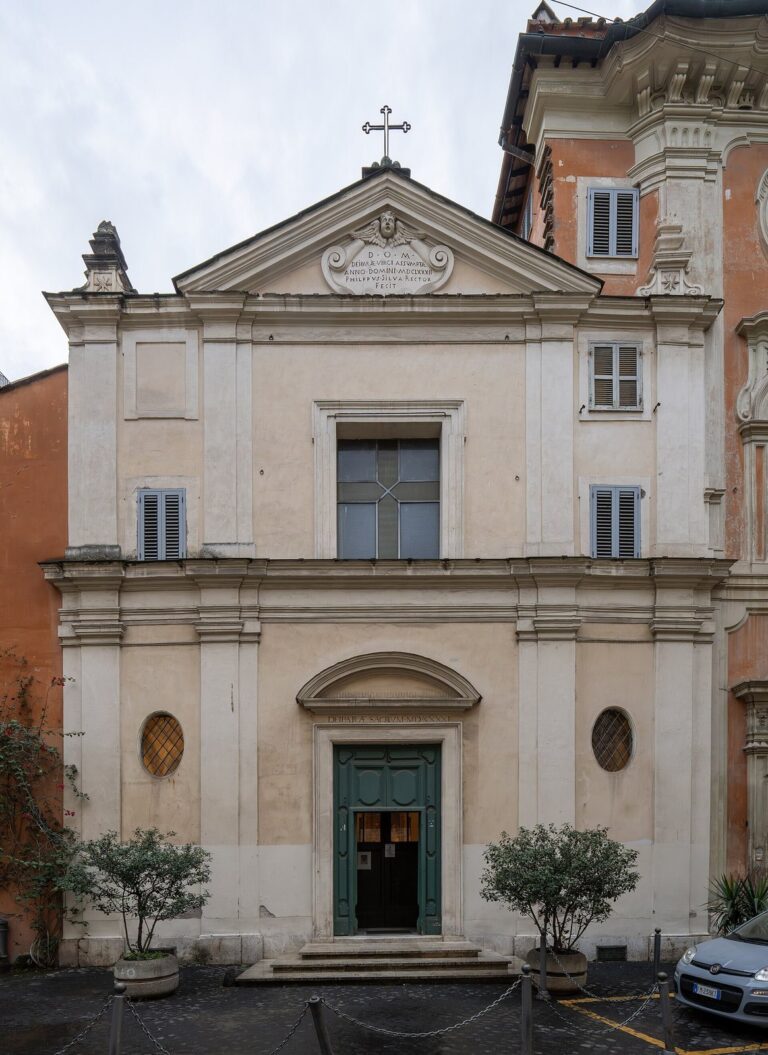
A major fire damaged the baths in AD 80, during the reign of Titus, and Domitian oversaw their restoration soon afterward. Hadrian enlarged the complex in the second century AD. Further repairs and rebuilding followed under the Antonine and Severan emperors, successive Roman imperial dynasties. An inscription found near Santa Maria in Monterone, west of the baths, records another reconstruction under Constantius II and Constans in AD 354–355.
Late Roman use and later history
The baths remained in use in the fifth century, when the writer Sidonius Apollinaris referred to them. They fell out of use after the Ostrogoths, a Germanic people who established a kingdom in Italy, cut Rome’s aqueducts in the 530s. In 599, Pope Gregory I converted the complex into a nunnery. By the seventh century, people were quarrying the structure for building materials.
Much of the building still stood in the sixteenth century. Renaissance architects Baldassare Peruzzi and Andrea Palladio made drawings of the ruins, preserving evidence of their appearance before further losses. A fragment of the Marble Plan of Rome, a marble map of the city discovered in 1900, also helps establish the baths’ plan and location.
Remains
The complex covered about 110 metres from north to south and 90 metres from east to west, an area of approximately 10,000 square metres. It stood among gardens in the Campus Martius. The surviving evidence includes part of a large circular hall, traces of heated rooms, and remains associated with the gardens and waterways.
Bathing buildings
The northern circular hall
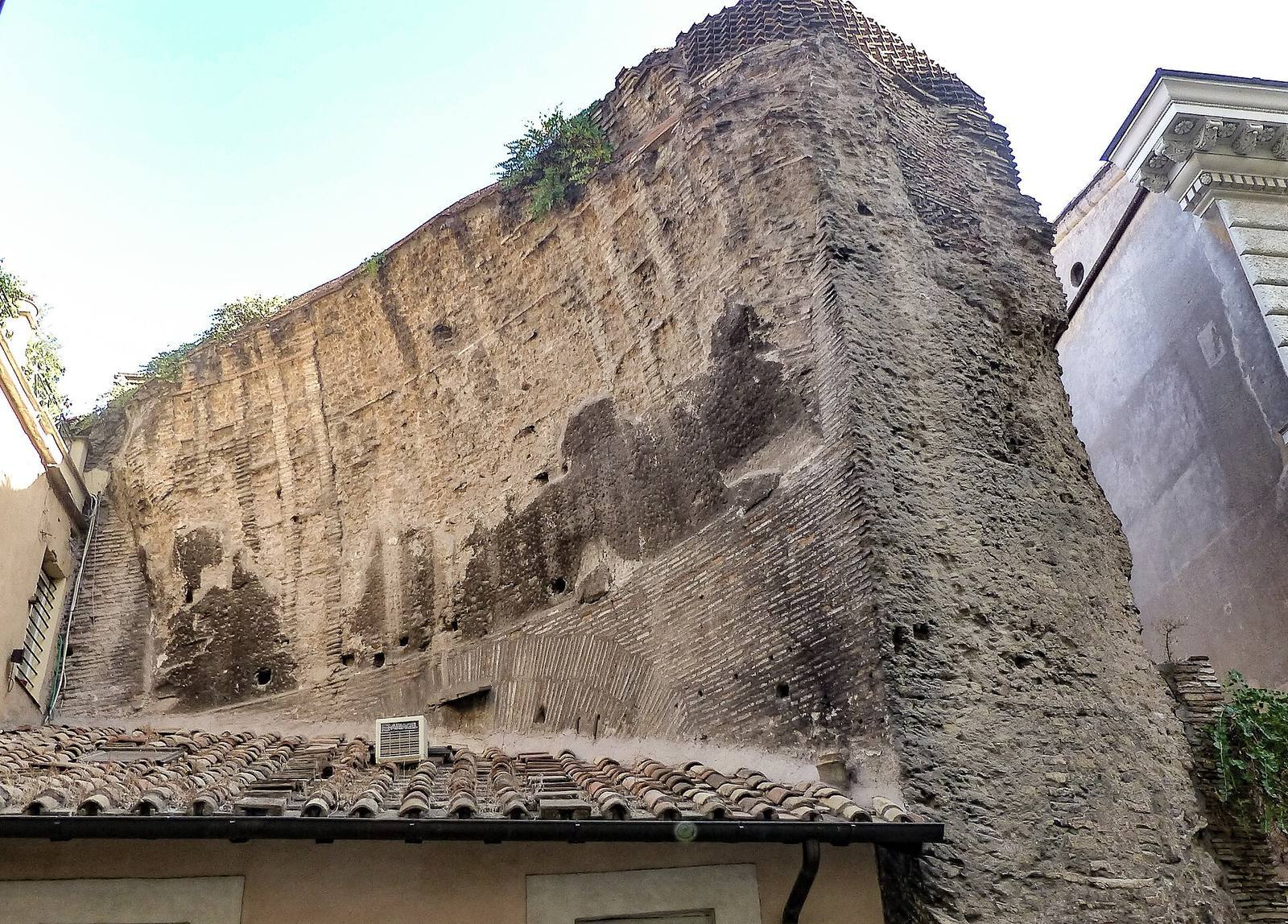
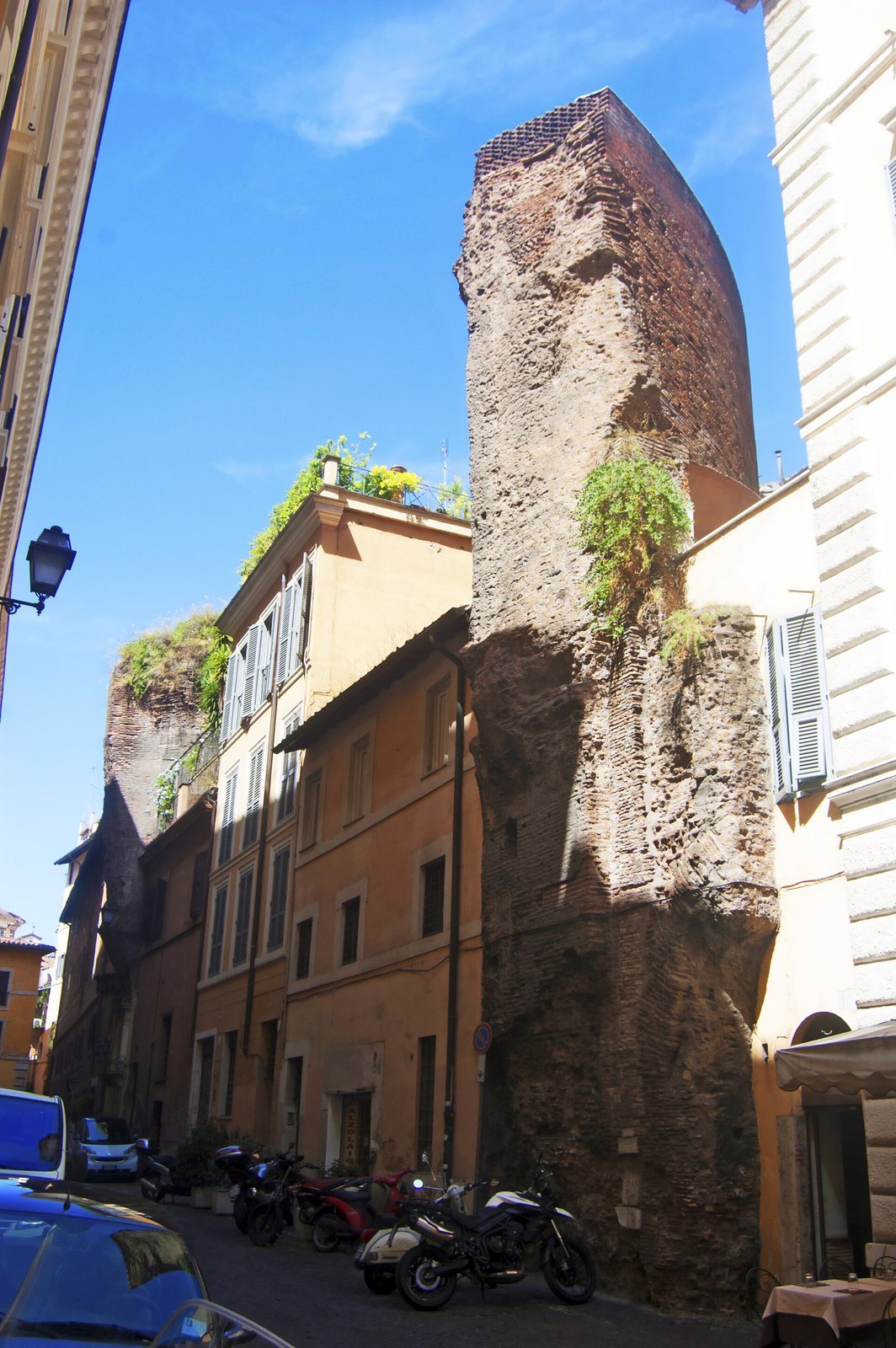
A large circular hall stood on the complex’s north side. Known as the Arco della Ciambella, it measured about 25 metres in diameter and had a dome that may have provided a gathering place for bathers. Part of its circular wall survives within later buildings, and one surviving section became part of a hall.
Heated and bathing rooms
West of the circular hall, an underfloor system for circulating hot air and hollow terracotta tiles indicate the presence of heated rooms. The baths are thought to have included a cold pool, a lukewarm room and pool, and a hot room and pool. Bathers may have used these spaces in a sequence from cold to hot, or in the reverse order. Fires beneath the hot-room pool heated the water, while sunlight also warmed the room. A bell may have signaled that the hot pools were open; another interpretation is that bells announced the approaching closure of the complex.
Decoration and sculpture
Glazed terracotta tiles and paintings decorated the baths. At the entrance stood Lysippus’s monumental Apoxyomenos, a sculpture of an athlete scraping oil from his body. The complex is described as the earliest known bathhouse to feature monumental sculpture. A marble head identified as Agrippa, found at the baths, is now in the Louvre.
Gardens and waterways
Gardens
The gardens included walking routes, colonnades, places to rest, and shelters from the sun. The grounds may also have contained facilities such as a restaurant and a reading room, suggesting that the complex served purposes beyond bathing.
The Stagnum
The Stagnum, a large artificial lake generally placed west of the baths, may have formed part of the pleasure gardens. Its water source is uncertain: it may have received runoff from the baths or water from the Aqua Virgo. Quays and boating have been proposed, while the lake may also have helped drain the low-lying, flood-prone Campus Martius. It was large enough for Nero to host a banquet on a raft towed by boats.
The Euripus
The Euripus was a canal running from the lake’s area toward the Tiber. It may have received cold water directly from the Aqua Virgo rather than carrying water out of the lake. Seneca described taking a New Year’s plunge in the canal for good luck; it may also have served bathers as a cold plunge or swimming area. Strabo placed a statue of a fallen lion by Lysippus in a grove between the lake and canal, a location used to support the interpretation that they were separate features.