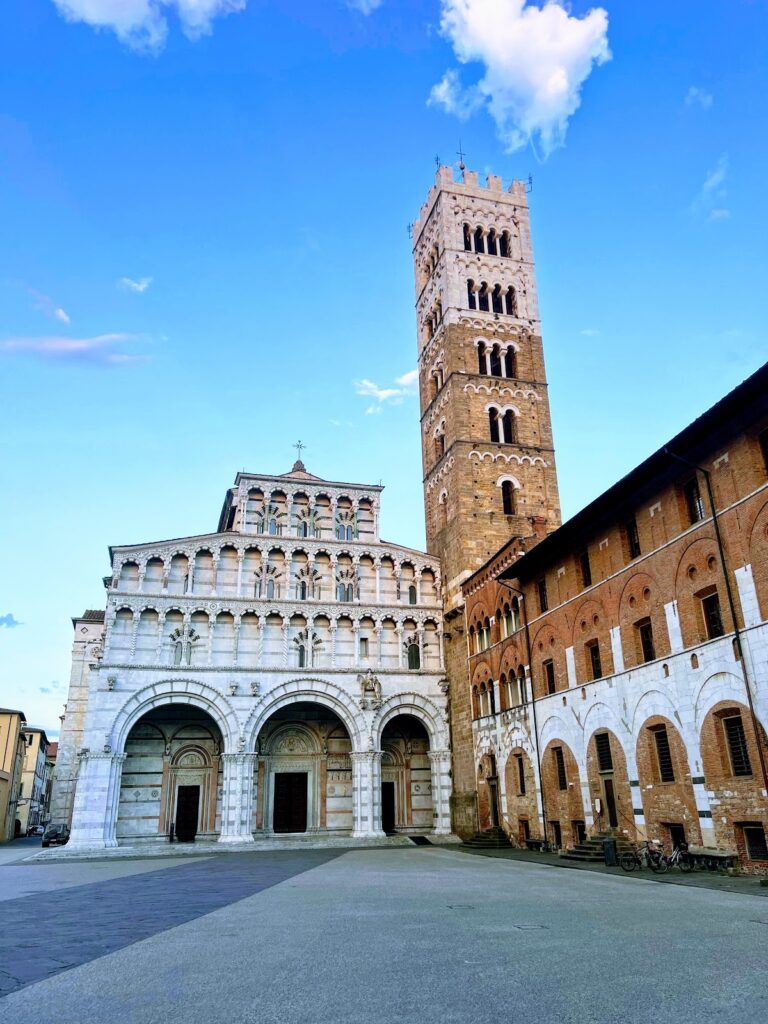
Basilica of San Frediano: A Romanesque Church in Lucca


Site at a Glance
- Rating
- 4.5
- Popularity
- Medium
- Country
- Italy
- Primary era
- Medieval
- External website
- Open
- Eras represented
- Medieval, Early Modern
- Civilizations
- Byzantine, Holy Roman Empire, Lombard, Republic of Lucca
- Site type
- Religious
- Remains
- Basilica
On this page29 sections
History
The Basilica of San Frediano is a Romanesque church in Lucca, Italy, rebuilt between the twelfth and thirteenth centuries on the site of a religious building founded in the sixth century. Its early construction is associated with Frediano, an Irish-born priest who served as bishop of Lucca between 560 and 588. The church later took his name after his burial there and became an important centre of worship dedicated to him.
Early Church and Canonical Community
Archaeological excavations beneath the present basilica confirmed the earlier sixth-century structure. It was associated with Saints Vincent, Stephen, and Lawrence before the cult of Saint Frediano became its defining religious identity. A community of canons formed around the church, and both the church and its canon house were enlarged during the Lombard period.
In 1104, Pope Paschal II confirmed the canons and placed them under the clergy of San Giovanni in Laterano. The prior of San Frediano later received a rank equal in dignity to that of a bishop, reflecting the standing that the institution had acquired within the religious life of Lucca.
The Twelfth- and Thirteenth-Century Rebuilding
Prior Rotone began rebuilding the church in 1112. Pope Eugenius III consecrated the new building in 1147. The project produced a three-aisled basilica with an east-facing facade and a westward apse. Its arrangement belonged to the architectural and institutional setting of the Gregorian Reform, an eleventh- and twelfth-century movement that sought to strengthen church administration, clerical discipline, and ecclesiastical independence.
The twelfth-century church stood lower than it does today. During the thirteenth century, the central nave was raised and received a timber trussed roof. The upper facade was then completed with a large mosaic, a project that continued into the fourteenth century. These changes established the medieval appearance that still defines the building.
Chapels and Renaissance Renewal
Between the fourteenth and sixteenth centuries, numerous side chapels were opened for private devotion and burial. Their construction extended the facade beyond the original lateral aisles. The additions, together with later decorative work, gave the interior a strongly Renaissance character while preserving the predominant appearance of the medieval basilica.
From the late fifteenth century into the early sixteenth century, Matteo Civitali and artists associated with him initiated a renewal of the interior. Painters from Emilia continued the work, particularly Amico Aspertini. After the Napoleonic suppressions, Mattia della Robbia’s large lunette and Giovanni Baratta’s marble altarpiece were brought into the church, adding further works to its changing artistic collection.
The Chapel of Saint Zita occupies the area of the cemetery where Zita was buried in 1278. It formerly belonged to the Fatinelli family, was renewed during the seventeenth century, and became a major focus of devotion to the thirteenth-century Luccan saint.
In 1412, Lorenzo Trenta received permission from the canons to establish a family chapel dedicated to Saint Richard. Jacopo della Quercia began the tombs of Lorenzo Trenta and his wife, Lisabetta degli Onesti, in 1413, and the inscriptions on the completed slabs bear the date 1416. Between 1419 and 1422, he created the chapel’s signed and dated marble polyptych.
Pasquino Cenami remodelled the Chapel of the Cross, also known as the Chapel of Saint Augustine, from 1505 and commissioned its decoration around 1506 to 1508. Amico Aspertini painted scenes from the Gospels, the life of Saint Augustine, and the history of the local church. These included Saint Frediano’s division of the Serchio, the transfer of the Volto Santo to Lucca, and the Deposition from the Cross.
Benedetto Buonvisi established the Buonvisi Chapel in 1510. He commissioned its wooden furnishings from Masseo Civitali and its altarpiece from Francesco Francia. The Chapel of Saint Anne was constructed during the sixteenth century, although most of its surviving paintings date from the nineteenth century. The Buonvisi Chapel was also redecorated during the eighteenth and nineteenth centuries.
Continuing Religious Role
The basilica remains a Roman Catholic church of the Roman rite dedicated to Saint Frediano and belongs to the Archdiocese of Lucca. Pope Pius XII raised it to the rank of minor basilica in November 1957. This is an honorary papal title for a church with particular historical, liturgical, or devotional importance.
The procession for the Feast of the Holy Cross traditionally begins at the basilica on the evening of 13 September. The church also retains devotional associations with Saints Frediano, Zita, and Richard the Pilgrim. Saint Richard’s tomb has remained an object of particular veneration in the English-speaking world.
Remains
The basilica presents a simple early-Christian plan expressed through Romanesque construction. A high central nave is flanked by two lateral aisles, and the nave ends in an apse while the aisles terminate in flat ends. The facade faces east, and the apse lies to the west. Smooth wall surfaces, rounded arches, and heavy masonry preserve the Romanesque character, while Roman and early-Christian design principles remain visible throughout the building.
Facade and Bell Tower
Romanesque Facade
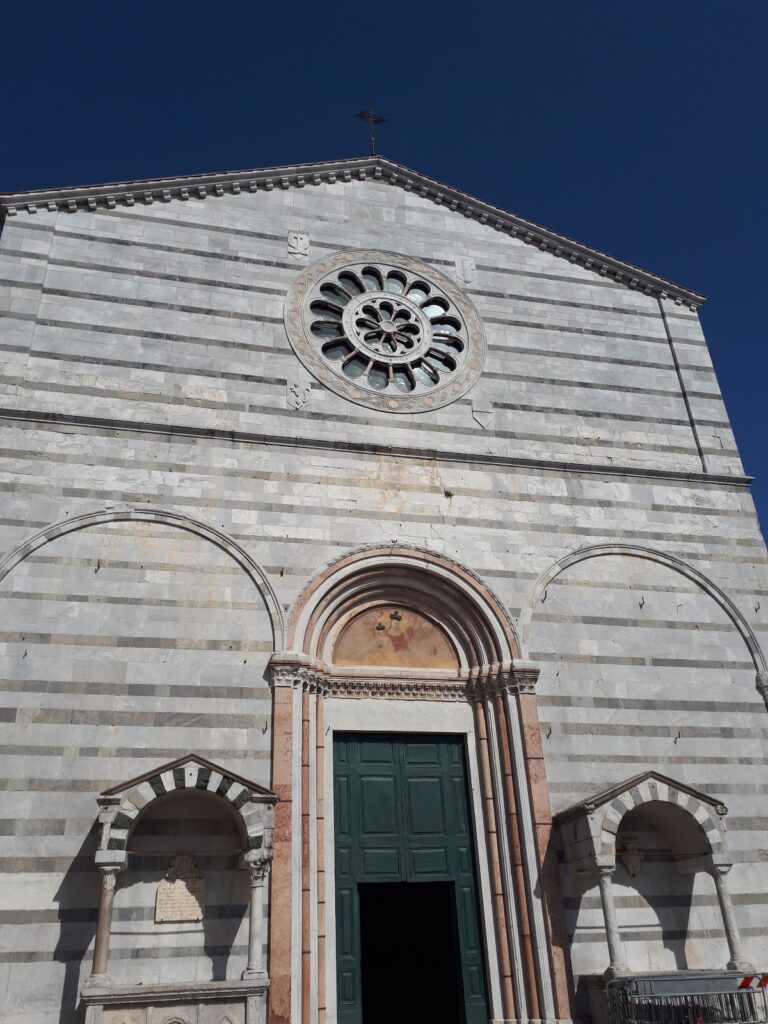
The facade is faced with polished stone and divided vertically into five sections corresponding to the nave, the two aisles, and the two lateral bands of chapels. Three portals are framed by piers, architraves, and blind arches. Vegetal ornament appears on the central architrave. Above them, a central loggia-like feature contains two single-light windows set among small columns with varied capitals, while four oculi occupy more lateral positions.
Facade Mosaic
The upper facade carries a mosaic of the Ascension of Christ, produced during the thirteenth and fourteenth centuries. Christ appears within a mandorla, an almond-shaped aureole, among angels and the Apostles. The original image of the Virgin was destroyed when the central window was opened. The upper zone is associated with a learned artist familiar with Byzantine developments in Rome, while the lower zone is attributed to a local artist connected with the Berlinghieri workshop. Relief figures of Saints Peter and Paul distinguish them from the other Apostles.
Campanile
The campanile stands near the apse and incorporates several building periods. Its dark-stone base predates the twelfth century, while the upper section, built in lighter stone, was reconstructed during the thirteenth century. Single-, double-, triple-, and quadruple-light windows divide its elevations, and blind-arch bands appear at two levels. Ghibelline crenellations crown the tower.
Six bells are housed in the tower, including one outside the regular peal. Two were cast by the Lorenzo Lera foundry at Lammari in 1804. The Mezzaterza bell was made by Giovanni Battista and Francesco Azzi in 1679, the Mezzana bell by Nicola and Luca di Bondi of Cortona in 1401, and the large bell by Vincenzo Giovardo of Genoa in 1605. A bell cast in 2020 copies an earlier bell made by Giovanni Pisano in 1223, which is preserved inside the basilica. A long restoration completed in 2020 restored the possibility of ringing the bells by hand after decades of electrical operation.
Nave, Entrance, and Baptismal Works
Interior Structure and Medieval Frescoes
Columns separate the aisles from the nave, and many are reused pieces brought from Rome. Their capitals also include Roman material. The columns support round arches, while architraved colonnades, niche windows, and specially carved composite capitals preserve features associated with Lucca’s Romanesque tradition before stronger Pisan and northern Italian influences developed.
The central nave is especially high because of its thirteenth-century raising and is covered by a timber trussed ceiling. On its upper right wall is a fresco of the Martyrdom of Saints Lawrence, Vincent, and Stephen, dating from the first half of the twelfth century. It is among the earliest surviving examples of medieval painting in Lucca. Two column frescoes showing Saint Helena and Saint Stephen date from the fourteenth century.
Counterfacade and Organ
The counterfacade contains a sixteenth-century organ beneath a richly carved and gilded seventeenth-century choir. Beside the main portal are two frescoes. One is a 1503 Visitation commissioned by the barber Bartolomeo da Sillico and attributed either to Ansano Ciampanti, Michelangelo di Pietro, or both. The other is a Madonna and Child with Saints John the Baptist, Agatha, Margaret, and Sebastian, probably an early Luccan work by Amico Aspertini commissioned by the blacksmith Salvatore di Tomeo.
Fonts and Terracotta Lunettes
Near the entrance stands a major twelfth-century Romanesque baptismal font. Its basin shows scenes from the Story of Moses and was carved by the artist known as the Master of the Stories of Moses. Master Roberto carved the other two basin panels. The central tempietto, a small architectural structure, depicts the months of the year and the Apostles and was made by the Florentine artist known as the Master of the Apostles and the Months. The ensemble rests within a circular basin supported on columns.
A second baptismal font remains in use. Matteo Civitali carved and adapted it in 1489 from the former Sacrament altar. In 1575, the surviving frame and predella of that altar were transferred to serve as the font’s frame. Bracket capitals and reliefs of Eucharistic chalices form part of the work. Nearby are glazed terracotta lunettes of the Annunciation and Saint Bartholomew, attributed to the della Robbia school and dated to the first half of the sixteenth century.
Chapels Along the Aisles
Chapel of the Soccorso
The Chapel of the Soccorso was assigned to Eufrosina Compagni in 1509. Giuliano da Pisa painted its principal altar fresco, the Madonna of Soccorso, between 1510 and 1513. The right altar contains the Madonna of Riposo, a thirteenth- or fourteenth-century fresco transferred from the nearby cloister. Other works include a panel of Saint Catherine attributed to Giuliano di Simone and perhaps dating from around 1385, an anonymous fifteenth-century panel of Saint Barbara, Romanesque columns and capitals, and thirteenth-century tombs of the Guidiccioni family.
Chapel of Saint Zita
The Chapel of Saint Zita contains the saint’s incorrupt body in a glass shrine, displayed on a bed covered with brocade. Paintings from the sixteenth and seventeenth centuries cover its walls. They include Paolo Guidotti’s Saint Zita and the Beggar, painted in 1611 and 1612, and five later canvases by Francesco del Tintore representing miracles associated with the saint.
Chapel of Saint Blaise
The Chapel of Saint Blaise, also dedicated to the Precious Blood, contains a marble altarpiece by Giovanni Baratta dating from the third or fourth decade of the eighteenth century. Transferred from the Sacrament altar of San Ponziano in 1837, it shows angels supporting a reliquary. The chapel also preserves the traditional relic of the Precious Blood, a pink breccia sarcophagus containing the remains of Bishop Corrado, Giovanni Domenico Ferrucci’s Miracle of Saint Blaise, Pietro Sorri’s Nativity, and Paolo Guidotti’s Deposition.
Sandei Chapel
The Sandei, or Annunciation, Chapel was created in the fourteenth century from a room belonging to the earlier monastery. Fragments of contemporary frescoes survive alongside Gaspare Mannucci’s seventeenth-century Annunciation, Camillo Ciai’s Saint Michael of 1665, and Girolamo Scaglia’s Saint Apollonia of 1646. An eighteenth-century Luccan wooden reliquary on the altar contains six bones of Saint Caesarius of Terracina and is displayed for veneration on 1 November.
Micheli and Stiatta Chapels
The Micheli, or Most Holy Sacrament, Chapel contains a painted wooden altarpiece of the Dormition and Assumption of the Virgin. Bonaventura Micheli commissioned it in accordance with the testamentary wishes of his father, Niccolao, who died in 1500. Masseo Civitali probably executed the work during the first decade of the sixteenth century, combining sculpture and painting. Michelangelo di Pietro Membrini is associated with its painted background and landscape.
The adjoining Stiatta Chapel originally held an altarpiece commissioned by Maddalena Stiatta from Francesco Francia in 1511. The resulting Immaculate Conception, completed by 1517, is now in Villa Guinigi. The chapel instead contains a late-thirteenth-century fresco of the Crucifixion, detached from the nearby cemetery and cloister.
Apse and High Altar
High Altar and Tomb of Saint Frediano
The sixteenth-century high altar contains the tomb of Saint Frediano. Around it survive sections of a twelfth-century Cosmatesque pavement, a medieval geometric floor made with patterned pieces of coloured stone and marble. The rear wall of the apse carries an Annunciation with a monstrance, a liturgical vessel for displaying the consecrated Eucharistic host, probably painted by Amico Aspertini.
Monolith and Traditional Tomb Slab
A massive monolith stands to the left of the high altar. Its origin remains uncertain. It may have been taken from Lucca’s Roman amphitheatre, while local tradition attributes its transport to Lucca and identifies it as the step of the first altar dedicated to Saint Frediano. A nearby tomb slab is traditionally said to have covered the saint’s grave.
At the ends of the aisles are later works that extend the basilica’s artistic history. Pietro Sorri’s Martyrdom of Saint Fausta, dating approximately from 1595, stands at the end of the right aisle beside a funerary monument to the poet, historian, and public official Lazzaro Papi by Luigi Pampaloni. The left aisle contains Aurelio Lomi’s Miracle of Saint Cassian, also dating approximately from 1595.
Trenta Chapel
Family Tombs and Marble Polyptych
The Trenta Chapel opens onto the left aisle through two large arches supported by a central pier. Its original double family coat of arms was later chiselled away. Jacopo della Quercia’s marble tomb slabs for Lorenzo Trenta and Lisabetta degli Onesti bear Gothic inscriptions dated 1416. His marble polyptych of the Madonna and Child with Saints Lawrence, Jerome, and Frediano is signed and dated 1422. Its sculptural treatment translates the traditional painted polyptych into three-dimensional form.
Relics and Later Decoration
Beneath the modern 1940 altar is a Roman funerary urn containing relics of Saint Richard. A polychrome wooden Annunciation by Matteo Civitali, probably from the late 1480s, stands on the opposite side of the chapel. Fragmentary quadratura decoration, painted architectural illusionism, survives on the walls and dates from 1756.
The same chapel contains a Roman sarcophagus identified with the body of Saint Richard the Pilgrim. Tradition describes him as a noble Saxon or English king of Wessex who died at Lucca in 722 while travelling on pilgrimage to Rome. His tomb, together with the chapel’s fifteenth-century sculpture, preserves the connection between the basilica’s medieval devotional life and its later artistic patronage.
Chapel of the Cross and Buonvisi Chapel
Chapel of the Cross
The Chapel of the Cross contains Amico Aspertini’s frescoes of 1508 and 1509. The cycle combines evangelical scenes with episodes from the life of Saint Augustine and local religious history, including Saint Frediano’s attempt to divert the Serchio to prevent flooding, the transfer of the Volto Santo from the port of Luni to Lucca by Blessed Giovanni, bishop of Lucca, the Deposition, and a Sacra Conversazione.
The blue vault shows God surrounded by angels, prophets, and sibyls. An anonymous seventeenth-century painting above the altar represents the Volto Santo, Saint Augustine, and Saint Ubaldo. The chapel also preserves the mortal remains of Bishop Giovanni. Beside the scene of Saint Frediano diverting the Serchio, a flat painted surface imitates a column through trompe-l’oeil, an illusionistic technique that makes a flat image appear three-dimensional.
Buonvisi Chapel
The Buonvisi Chapel retains wooden furnishings by Masseo Civitali. It originally housed Francesco Francia’s altarpiece, which is now in the National Gallery in London. Later decoration includes Stefano Tofanelli’s 1796 Saint Anne Adoring the Christ Child, A. Cecchi’s Nativity of Mary, and B. Rocchi’s Death of Saint Anne.