Santi Giovanni e Reparata: A Church and Former Episcopal Seat in Lucca
Site at a Glance
- Popularity
- Medium
- Country
- Italy
- Primary era
- Medieval
- Eras represented
- Classical, Medieval, Early Modern, Modern
- Civilizations
- Holy Roman Empire, Republic of Lucca, Roman
- Site type
- Religious
- Remains
- Cathedral
On this page18 sections
History
Santi Giovanni e Reparata is a Catholic church in Lucca, Italy, dedicated to John the Baptist and Saint Reparata. Established in the second half of the fourth century on a Roman settlement, it became the first seat of the bishops of the diocese of Lucca.
Early Christian and medieval development
In the early eighth century, the cathedral dignity passed to San Martino, but Santi Giovanni e Reparata retained the right to a baptismal font. This preserved a close institutional connection between the two churches. By around the sixth century, the complex had taken on a cemetery role, and the church was functioning again by the eighth century.
A crypt was opened in the ninth century to house the relics of Saint Pantaleon, a Christian martyr traditionally associated with healing. The relics were discovered in 1714. Further building work followed in the late tenth and early eleventh centuries. In the twelfth century, a new church replaced the earlier plan, and rebuilding in the latter half of that century established much of the arrangement that survives today.
Political upheaval and later changes
In 1522, Girolamo Vellutelli, a senior civic magistrate known as a gonfalonier, was killed during an uprising led by the Di Poggio family in an attempt to seize power. The revolt was suppressed, a development that effectively ushered in Lucca’s oligarchic government, in which political power was concentrated among a small group.
A major reordering of the church took place from the late sixteenth century through the first two decades of the seventeenth. A chapel dedicated to Saint Ignatius of Loyola, the Spanish priest who founded the Jesuits, was added on the church’s left side in the late seventeenth century.
In the early nineteenth century, the Napoleonic government confiscated the church and assigned it to house the archives of the former Republic of Lucca. Damp conditions made the building unsuitable for that use, and worship resumed in 1828, with new altars and paintings. The baptistery was then used as a memorial space for local figures.
Remains
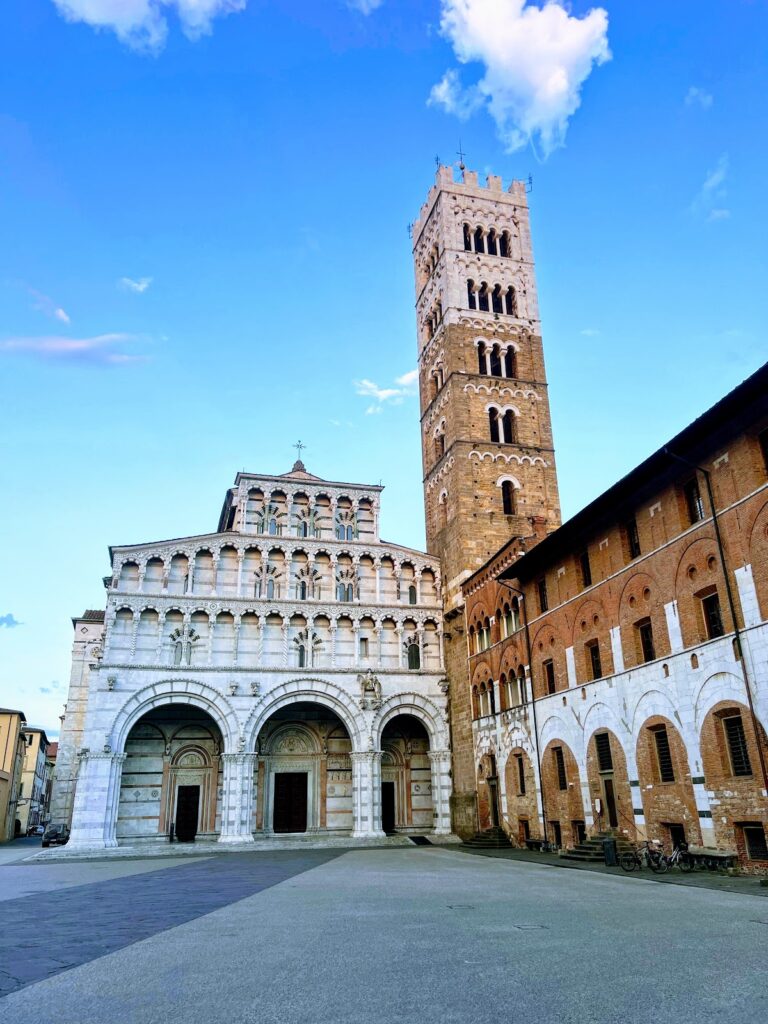
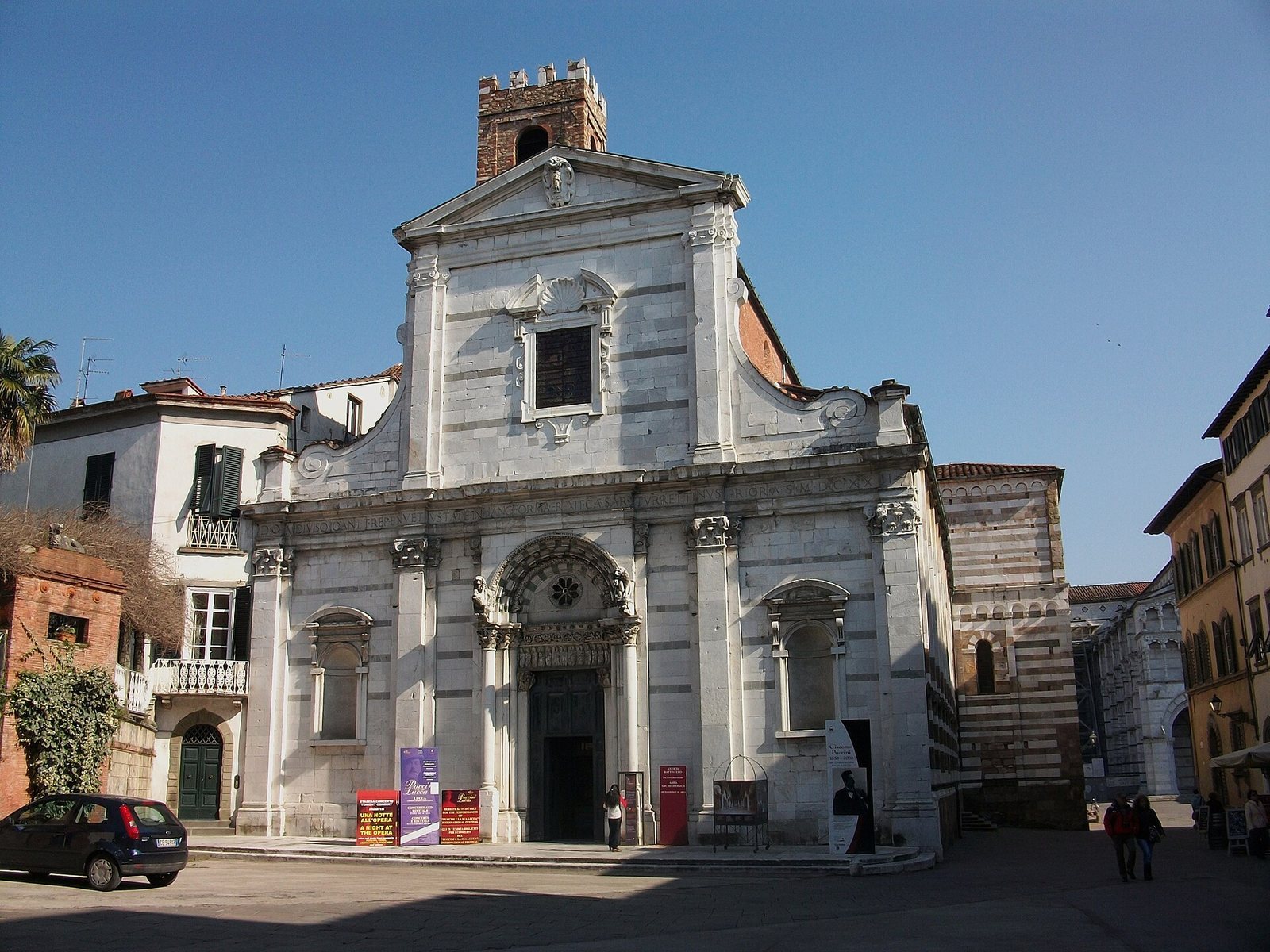
The complex combines the remains of earlier buildings with a church whose medieval plan has three aisles, a rounded apse at the east end, and a crosswise transept. Its design brings classical-revival forms together with features associated with medieval Lombard architecture.
Archaeological layers
Early basilica
Archaeologist Giulio Ciampoltrini has proposed that the earliest church was a three-aisled basilica with one apse, a mosaic floor, and a liturgical passage. He compares its design with church-building models used in Rome during the reign of Constantine I. An archaeological route beneath the present church preserves evidence of successive phases, including remains of Roman buildings and an early medieval baptismal basin.
Twelfth-century church
Plan and exterior
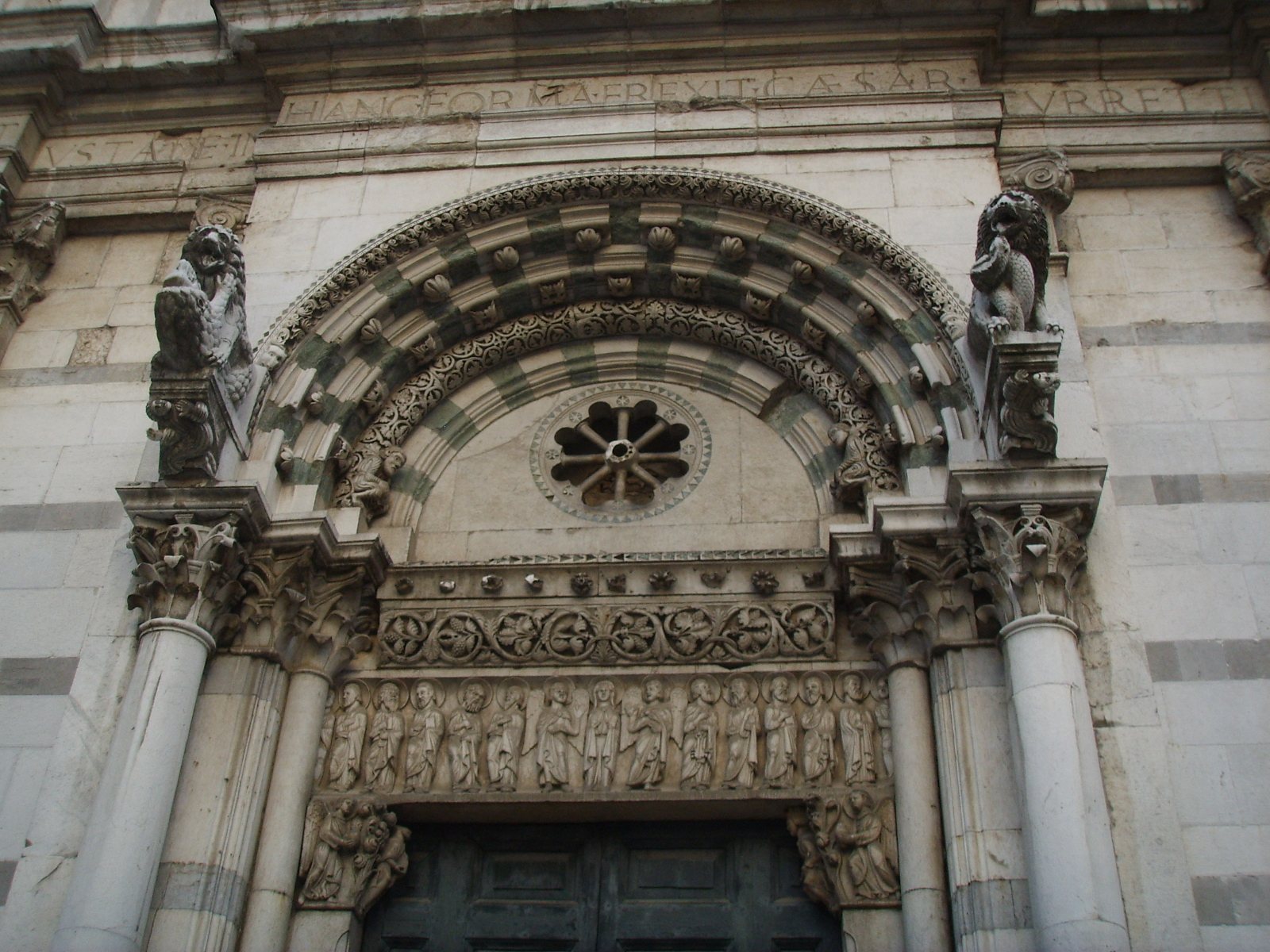
The twelfth-century church has three aisles divided by columns with composite capitals, which combine elements of classical column designs. Its overall dimensions were not greatly different from those of the early Christian building. Pilasters, shallow wall projections, divide parts of the exterior, while rows of molded arches in the apse and transept rest on projecting supports and are decorated with sculpted human and lion heads.
Capitals and central portal
Carvings on some interior capitals include intertwined figures, leafy masks, harpies, and dragons. Their style has been compared with the work of the medieval sculptor Guidetto. Related sculpture appears around the arch of the central portal and on its carved horizontal beam. The beam shows Mary in prayer between two angels and the Apostles. Villano, whose work is described as more traditional in style, completed his part in 1187 alongside a collaborator of Guidetto.
Later interiors and artworks
Facade and interior decoration
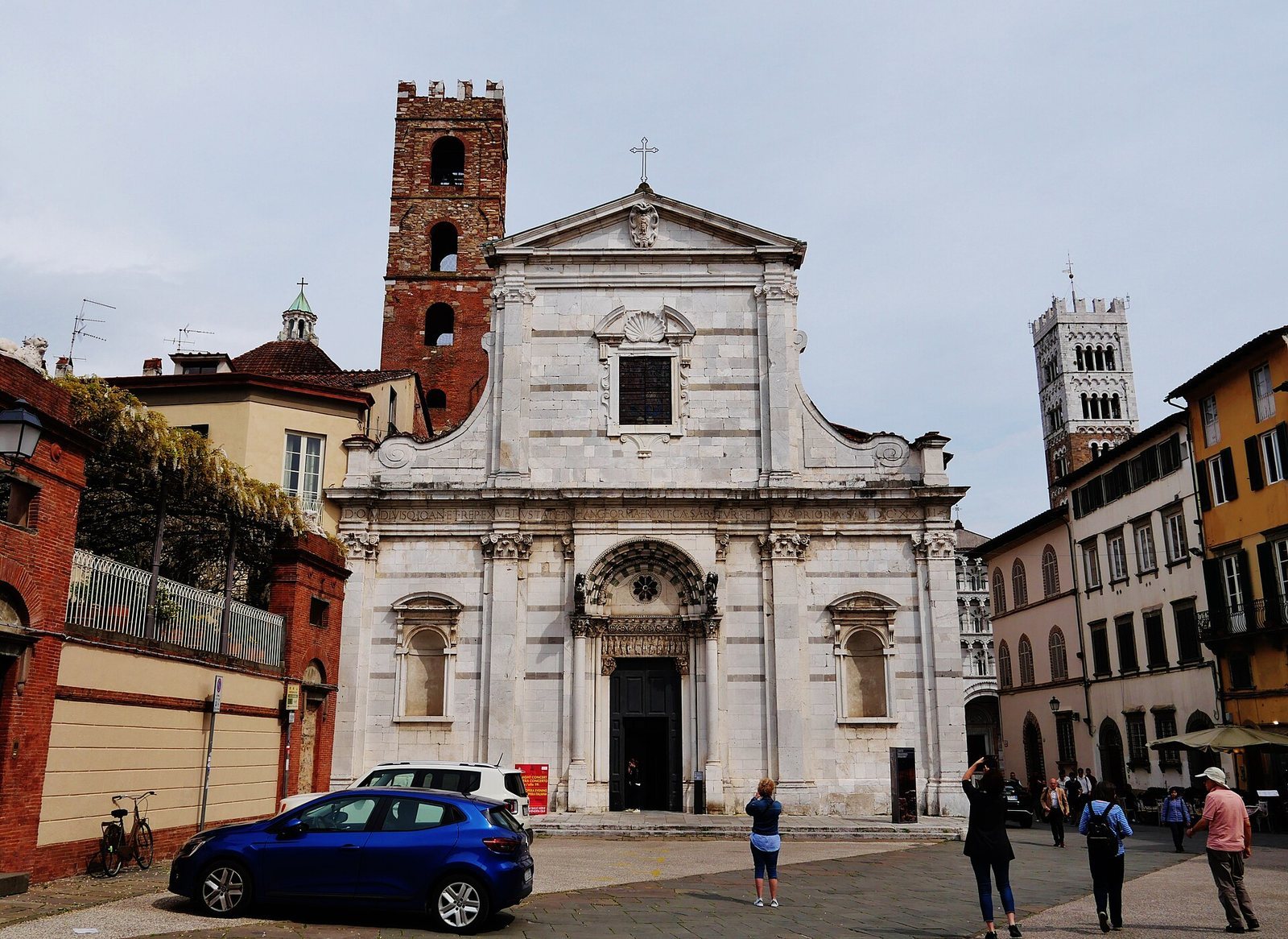
The major reordering that began in the late sixteenth century produced a new facade while retaining much of the medieval one. A ceiling divided into recessed panels and decoration on the semi-dome above the apse also belong to this phase. Paolo Guidotti painted an Annunciation with God the Father and angels on the apse semi-dome.
Chapel of Saint Ignatius
The chapel on the church’s left side is lined with colored marble. Its dome carries frescoes attributed to Ippolito Marracci depicting the Glory of Saint Ignatius.
Frescoes and memorial
Two large fresco panels survive on the left wall of the left transept, which opens toward the baptistery. One shows the Virgin Mary with Saints Nicholas and Catherine; the other depicts Saints Ginese, Sebastian, and Barbara. Both date to the late fourteenth century and are attributed to the same unidentified painter, whose style resembles that of Angelo Puccinelli. Their figures have strong outlines, marked contrasts of light and shadow, and a convincing sense of space. A Latin epitaph in the right aisle, near the door toward Piazza San Martino, preserves a memorial to Vellutelli.
Eucharistic tabernacle
The presbytery, the area around the altar, once held a tabernacle for the reserved Eucharist commissioned from Matteo Civitali in 1496. It may be the same work as a fragmentary piece signed by Civitali that is now in the Victoria and Albert Museum in London.
Baptistery
Font and dome
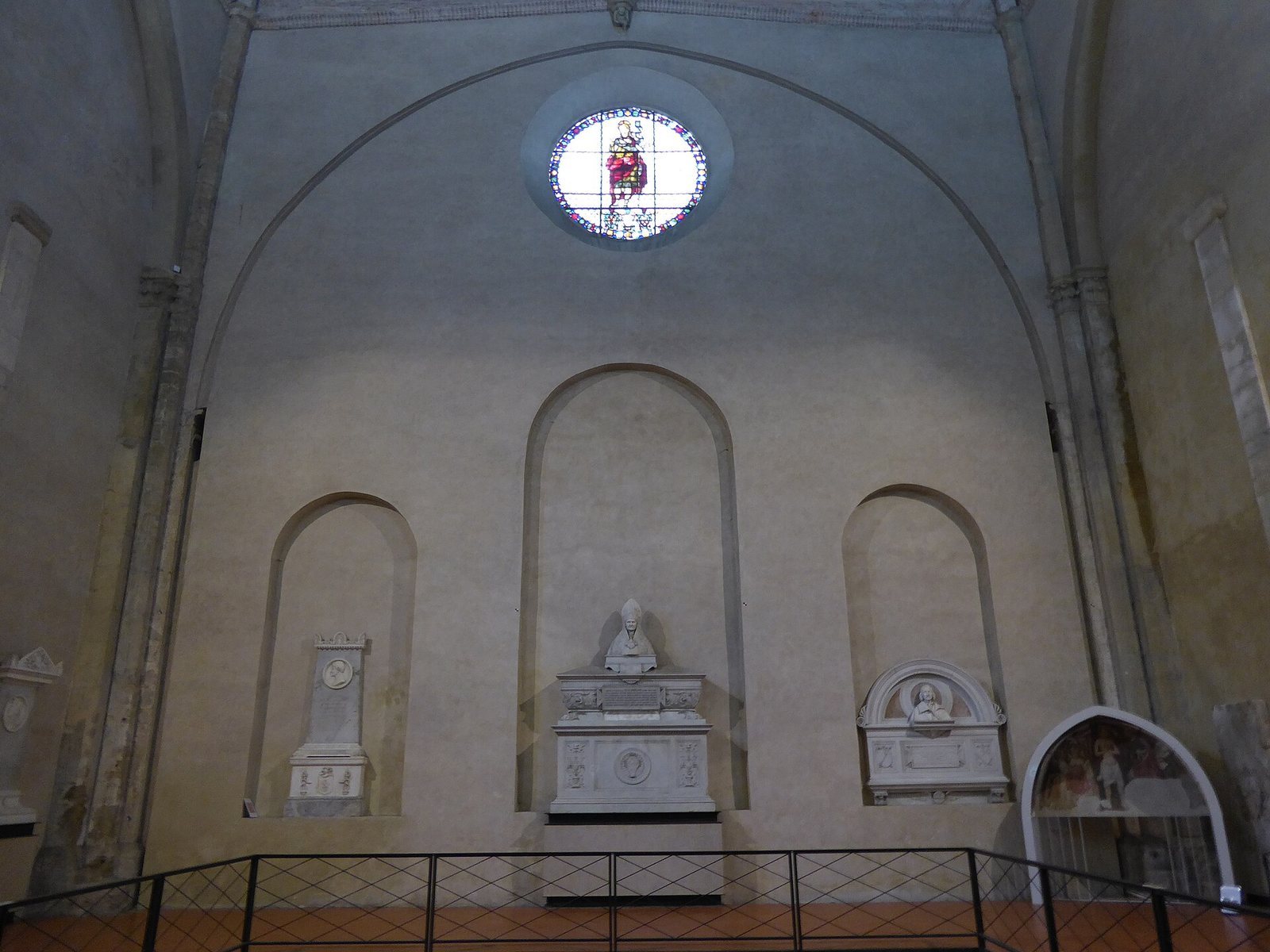
The baptistery was altered in the twelfth century, when a baptismal font and a floor of fitted stone pieces forming patterns were associated with the building. A comprehensive renovation followed in the fourteenth century. In 1393, a pointed dome supported on ribs was added.
Painted decoration
A damaged fresco of the Baptism of Christ, dated 1398, is positioned above a fifteenth-century baptismal font. It includes the donor Giovanna, daughter of the late Guido Sembrini, on the right. A curved wall panel from the late fifteenth century depicts the Virgin among saints and is attributed to the collaboration of Michele and Ansano Ciampanti.
Furnishings and archaeological work
Many of the church’s furnishings were removed when the building was assigned to archival use, and numerous works were dispersed. Recent efforts to bring the furnishings back together have included the return of artworks that originally came from the church.