Lobbes Abbey: A Benedictine Monastery in Belgium
Site at a Glance
- Rating
- 4.5
- Popularity
- Very Low
- Country
- Belgium
- Primary era
- Medieval
- External website
- Open
- Eras represented
- Medieval, Early Modern
- Civilizations
- Carolingian, Holy Roman Empire
- Site type
- Religious
- Remains
- Monastery
On this page18 sections
History
Lobbes Abbey is a Benedictine monastery in Belgium, founded on the Sambre in the mid-seventh century. Its community is documented from 654, and its traditional foundation is associated with Landelin, a converted brigand who became a hermit. At the confluence of the Laubacus and the Sambre, he established an oratory dedicated to Saint Peter and small cells for relics brought from Rome. Lobbes became an important medieval center of religious learning, although nearly all of the abbey was destroyed during the French revolutionary occupation in 1794.
Foundation and early development
Landelin’s disciples included Adelin and Domitian. After Landelin left Lobbes to establish Aulne Abbey farther downstream, the community declined. Hydulphe, lord of Lobbes, and Pepin of Herstal then called upon Ursmer, another disciple of Landelin, to lead the monastery. Ursmer became abbot about 680 and is regarded as Lobbes’s actual founder and first major organizer.
The community expanded as new members brought property to the monastery. Hydulphe donated his possessions when he retired there, while Pepin of Herstal assigned Lobbes the Forestaille wood and several dependencies, including Aulne and the priory of Wallers. On 26 August 697, the abbey church dedicated to Saints Peter and Paul was consecrated in Ursmer’s presence. Because the relics of Saint Peter prevented burials in that church, Ursmer established a separate burial church on a nearby hill. This building became the collegiate church of Saint-Ursmer.
Under Abbot Ermin, who governed from 711 to 737, the monastery’s intellectual activity began with the composition of the Life of Saint Ursmer. The library grew during later centuries. Abbot Theodulf established a monastic school, followed by another school founded in 797 under Abbot Anson. During the abbacy of Francon, from 888 to 901, the school developed into a major center for advanced ecclesiastical education and the training of church officials.
Liège administration and medieval renewal
Political intervention associated with Charles Martel led to Lobbes being assigned to the bishopric of Liège. In 728, Liège acquired the abbey’s temporal administration, meaning control of its worldly property and revenues. Lobbes consequently became closely connected with the ecclesiastical and political life of the Prince-Bishopric of Liège, the territory governed by the bishops of Liège, while it remained ecclesiastically associated with the bishopric of Cambrai.
During the ninth century, lay and commendatory abbots weakened the monastery’s administration and reduced its resources. A commendatory or lay abbot held an abbey’s title or revenues without necessarily belonging to its monastic community. In 882, monks and nearby inhabitants took refuge at Thuin Castle during a Danish incursion along the Sambre. Later in the century, Bishop Francon of Liège secured the annexation of Lobbes’s administration to the episcopal see, and the bishops of Liège held the abbacy until the tenth century.
Francon’s forces supported King Arnulf of Carinthia against the Normans at Leuven in September 891. The abbey’s dependencies at Aulne, Wallers, and Crespin were nevertheless plundered and damaged or destroyed to varying degrees. Francon also replaced the church consecrated in 697 with a larger building, consecrated in 903.
Lobbes recovered intellectual and institutional prominence during the tenth and early eleventh centuries under abbots including Folcuin, Heriger, Richard of Saint-Vanne, and Hugh III. Folcuin restored the monastery after the Hungarian attacks, promoted its library and manuscript workshop, and wrote a chronicle of the abbots. The school attracted students from areas extending from England to Poland. Hungarian raiders attacked the region on 2 April 955. After being denied refuge at Thuin Castle, the monks and local inhabitants fortified the upper church, the future Saint-Ursmer, and resisted the attackers. The abbey was nevertheless plundered and many people were killed.
In 961, Bishop Eracle relinquished the abbacy so that he could concentrate on Liège and restored the monks’ right to elect their abbot. More than half of the abbey’s possessions, including Aulne, remained property of the church of Liège. Abbot Aletran restored peace, order, discipline, and part of Lobbes’s lost independence between 961 and 965. Folcuin, abbot from 965 to 990, rebuilt the monastery after the Hungarian devastation and restored the abbey church. In 979, Pope Benedict VII confirmed the abbey’s privileges, including the prohibition on burying monks or other notable people in the abbey church.
Rebuilding, reform, and decline
A third abbey church was built during the abbacy of Ingobrand, from 1007 to 1020, completed in 1036, and consecrated again during the abbacy of Hugh III. It was completed under Adalard. The monastery was devastated in 1054 during warfare between forces associated with Hainaut and Emperor Henry III. In 1101, Abbot Fulcard sought the protection of Emperor Henry IV against wartime depredations, the misappropriation of property, and usurpation.
Under Wautier I, who was abbot from 1107 to 1131, the monks resisted the introduction of the Cluniac reform. This movement sought to strengthen monastic observance and extend the reforming influence associated with Cluny. His successor, Leonius of Furnes, introduced the reform gradually from 1131 to 1137 and allowed opponents to transfer to another monastery. A papal bull received in May 1131 confirmed Lobbes’s possessions, regulated the appointment of abbots, defined Liège’s rights at the monastery, allowed the monks to choose their lay advocates, prohibited burials in the abbey church, and placed Lobbes under papal protection.
During the twelfth and thirteenth centuries, successive abbots expanded or repaired the monastery, restored its finances, and rebuilt damaged buildings. The abbey nevertheless suffered from the burning of the Saintes grain estate, famine, warfare, and pillaging by the troops of Baldwin IV and Baldwin V of Hainaut. Cold weather in the 1230s caused repeated famines, while the bubonic plague around 1348 decimated the people who worked the abbey’s lands. Lobbes also participated in the persecution of the flagellants during the fourteenth century. From the thirteenth century onward, the rise of universities, urban autonomy, warfare, and the loss of political power gradually reduced the abbey’s intellectual and institutional importance.
Early modern rebuilding and destruction
Abbot William Cordier, who governed from 1495 to 1524, substantially embellished Lobbes. In June 1546, a fire that began in the kitchen destroyed the eleventh-century abbey church, all the cloister buildings, many works of art, and much of the library. Abbot William Caulier recovered much of the property alienated during earlier wars, rebuilt the cloister buildings, and laid the foundation stone of a new church on 2 May 1550.
The fourth abbey church was rebuilt under Caulier and Dominique Capron and consecrated on 27 May 1576 under Abbot Ermin François. In 1565, Capron applied the decrees of the Council of Trent at Lobbes. In 1569, the monastery joined the Benedictine Congregation of Exempt Monasteries of Flanders with Saint-Vaast Abbey and other regional monasteries.
During the Thirty Years’ War, mercenaries ravaged the abbey’s possessions and pillaged the monastery under Abbot Raphaël Baccart, who governed from 1628 to 1641. French troops severely plundered and damaged Lobbes during the Franco-Spanish War of 1650 to 1658. Abbot Pierre de La Hamaide restored the monastery, repaid its debts, and repelled a Dutch attempt to plunder it in 1675. Augustin Jonneaux continued the restoration.
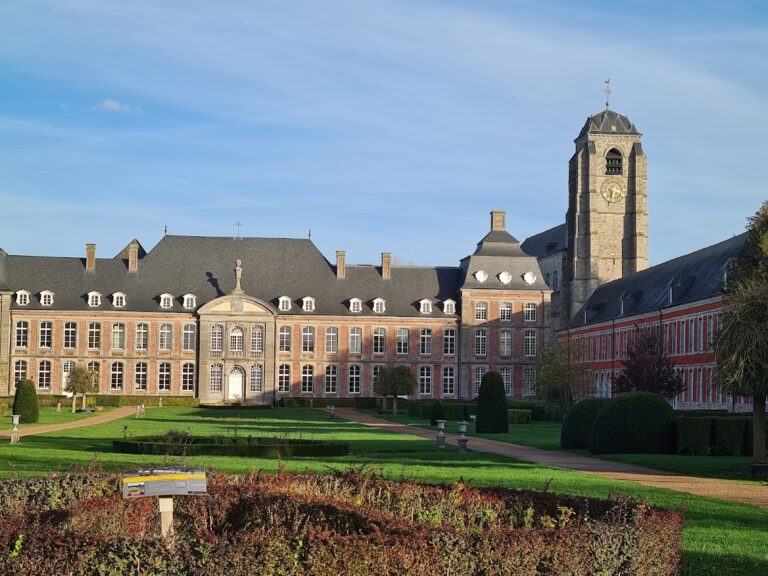
In the eighteenth century, Abbot Ursmer Rancelot strengthened the abbey church and built a library, infirmary, and guest quarter. Théodulphe II Barnabé added an abbatial quarter, a large dormitory, a brewery, and an extensive farm. Reforms under Joseph II, attacks by the Macas, local anti-clerical and anti-monastic agitators active around Thuin and Lobbes, the Liège Revolution, financial levies, and the arrival of French revolutionary forces progressively destabilized the monastery.
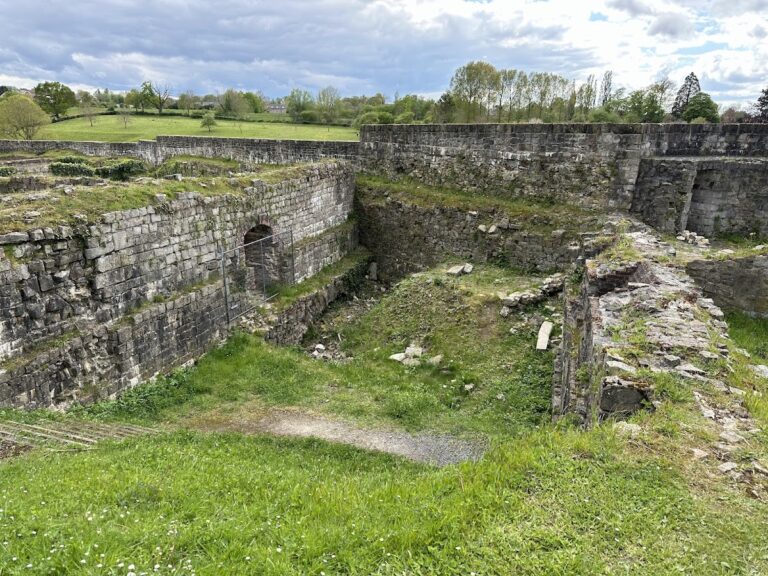
French revolutionary troops commanded by General Louis Charbonnier, assisted by the Macas, pillaged Lobbes for three days and burned it on 14 May 1794. The monastic buildings and abbey church were destroyed or severely damaged, while books were burned or left exposed to the weather. The 43 monks and the last abbot, Vulgise de Vignron, were dispersed, and many took refuge in Germany. The abbey was officially dissolved in 1796 under the decree of 20 August suppressing religious congregations. Its surviving property was sold as public property, and usable stone from the ruins was reused to strengthen the Dutch fortress of Charleroi in 1816 and 1817.
Learning and manuscript production
Lobbes’s library was recorded as containing 347 books. Its schools taught the trivium and quadrivium, the traditional curriculum of grammar, dialectic, rhetoric, arithmetic, geometry, astronomy, and music, to monastic pupils and external students. The internal school was suppressed in 1131, while the remaining external school was attached to the chapter of Saint-Ursmer.
The abbey’s intellectual and artistic work included manuscript copying and illumination, theology, music, history, sculpture, metalwork, and architecture. The Lobbes Bible was completed in 1084 and associated with the monk and calligrapher Goderan. It survived the later destruction and is now preserved in Tournai, with its Old Testament at the seminary there and its New Testament in England. Lobbes also produced a Bible completed in 1097, known as the Stavelot Bible, and a copy of works by Flavius Josephus now held by the Royal Library of Belgium.
Remains
Lobbes Abbey stood on the left bank of the Sambre. Around 1750, its enclosure had a perimeter described as almost that of a small town. The complex contained the abbey church, cloister, chapter house, summer and winter refectories, dormitory, infirmary, library, guest quarter, abbatial quarter, servants’ and gardeners’ accommodation, brewery, mill, granaries, stables, lower court, forge, dovecote, and fishpond. Access from the right bank was provided by a strong stone bridge with pointed arches. A gate near the crossing opened onto a terrace and lower court, while a decorated grille bearing the abbots’ coats of arms led toward the church.
Abbey churches and monastic buildings
Successive abbey churches
Four successive abbey churches were built at Lobbes. The first, begun under Landelin, was consecrated in 697. It was replaced by a larger church consecrated in 903, followed by a third church completed in 1036. The fourth church, begun in 1550, was a large Flamboyant Gothic building, a late Gothic style known for intricate ornament and flame-like tracery. It was consecrated in 1576 and destroyed in the fire of 1794.
The fourth church had three aisles of equal height and no transept. An iron screen separated the monastic choir from the area used by laypeople. The facade included a marble jubé, a screen or gallery separating the choir from the nave, and the walls carried wood panelling with finely carved low reliefs. The third church had been built of irregular rubble stone, often sandstone that was difficult to cut.
Cloister and chapter house
The cloister buildings had pointed-arch porticoes around a square courtyard containing a monumental fountain representing Moses and the serpent. Their high galleries resembled church naves. In the nearby chapter house, a vault rested on Tuscan-order columns. The summer refectory had two fountains and a ribbed vault supported by three carved marble columns.
Dormitory and infirmary
A seventeen-step stairway connected the cloister to the church, and twelve further steps led through long galleries above the cloisters to the dormitory. The dormitory had two large vaulted wings and a marble fountain that continually renewed the water in a marble basin. A bell tower with a clock and carillon rose above the buildings.
The adjacent infirmary pavilion contained four communicating rooms and the chapel of Guillaume Gilbart, dated 1617. Its arrangement allowed sick monks to attend services from their beds. A staircase above the infirmary led to the library.
Courts, residences, and gardens
Service courts and guest buildings
Service courts contained the brewery, bakery, and other utility buildings. Another large court was surrounded by eighteenth-century buildings, including guest accommodation. The abbey also had a mill on the Sambre, granaries, stables, a forge, a dovecote, and a fishpond.
Abbatial quarter and gardens
The abbatial palace had a large hall and chapel, an entrance pediment bearing the abbots’ arms, and a parterre with a fountain formed by four dolphins. Four extensive gardens and an amphitheatre with long walking avenues lay beyond it, while a Calvary stood on a small height.
Surviving structures and associated church
Surviving abbey remains
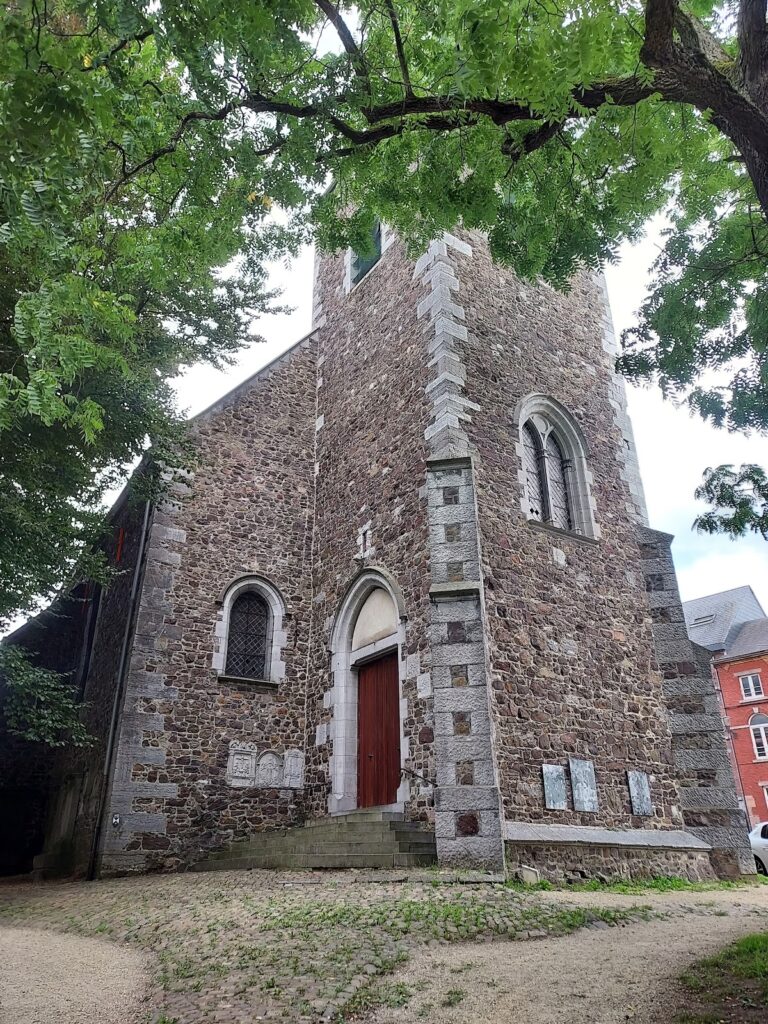
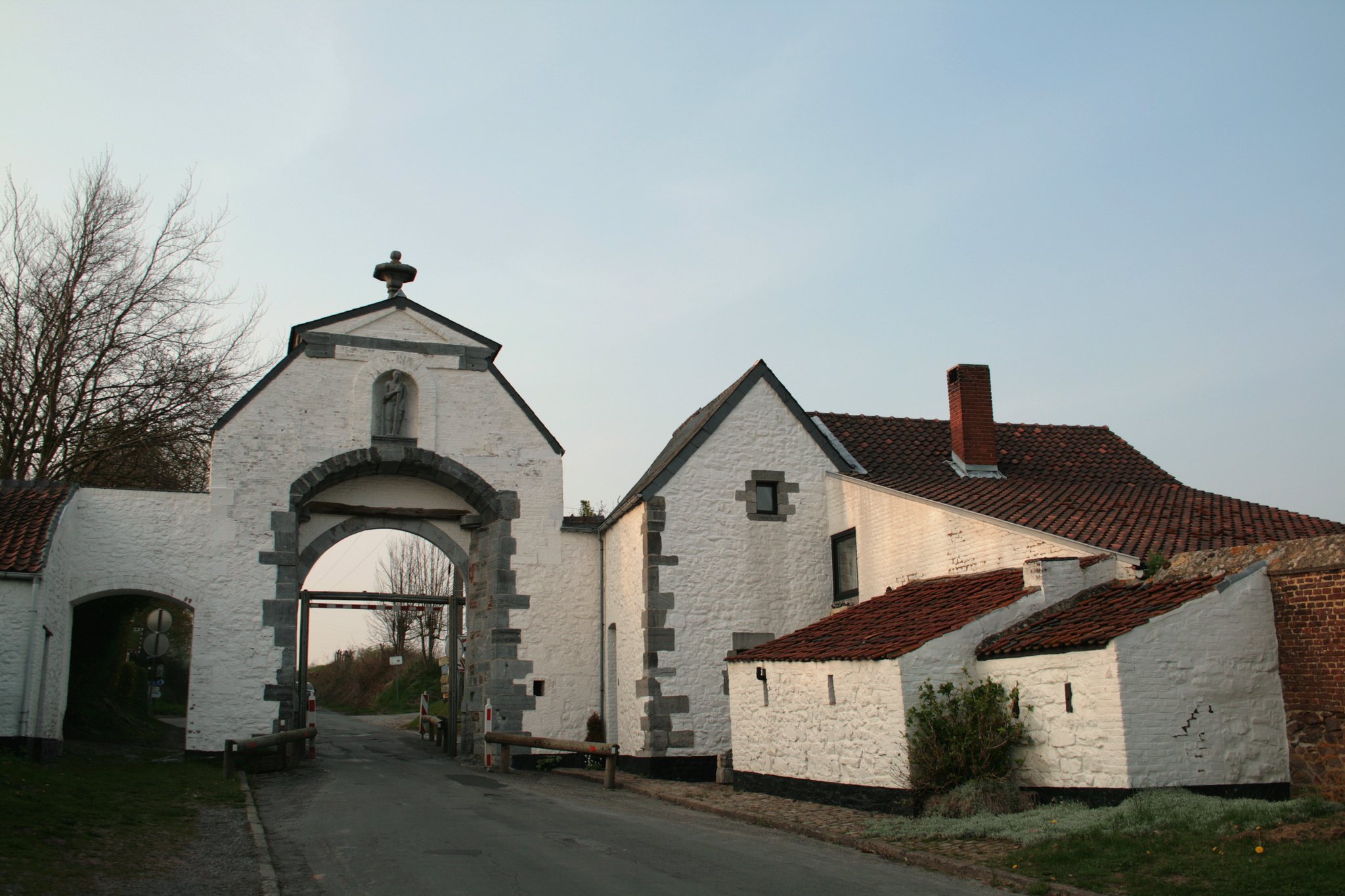
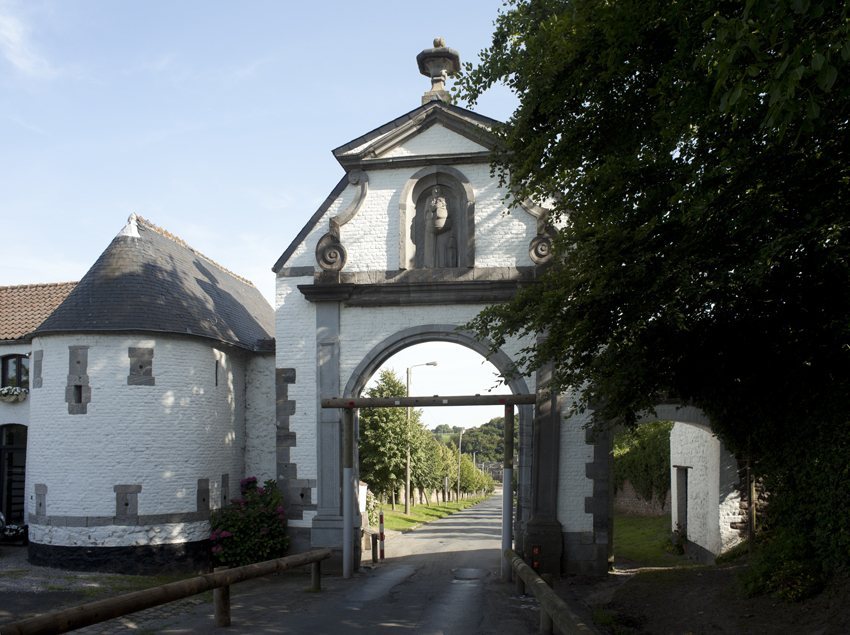
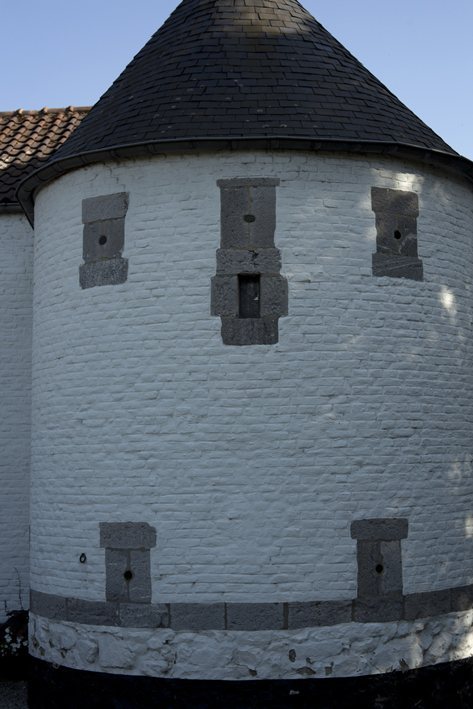
The surviving remains include the brewery built during the abbacy of Théodulphe II Barnabé, one wing of the former abbey farm, the enclosure wall, and a Renaissance entrance gate known as the Porte de Thudinie or La Portelette. Probably built during the major works undertaken by Abbot Ursmer Rancelot, the gate opened onto the road to Binche. Some smaller former abbey buildings were later incorporated into Lobbes railway station.
Collegiate church of Saint-Ursmer
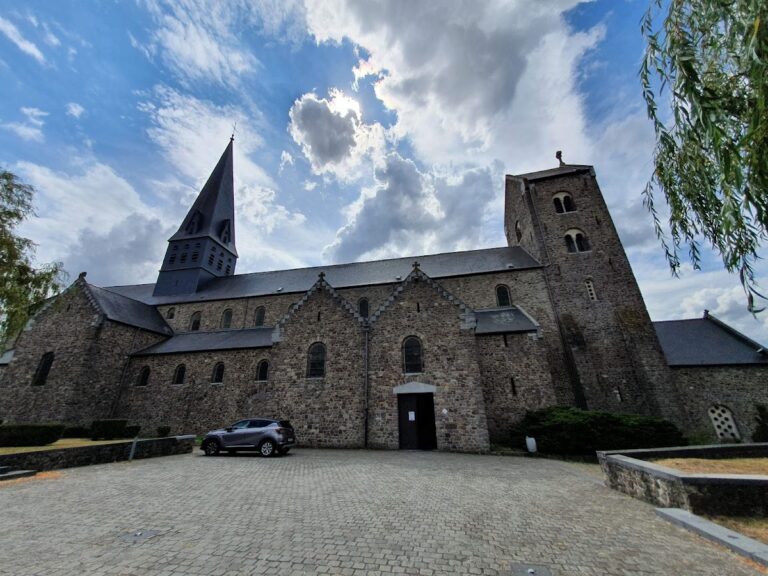
The collegiate church of Saint-Ursmer stands on a nearby height above the Sambre and is distinct from the abbey church. It originated as the Carolingian burial church established by Ursmer and survived the destruction of the monastery. The church is approximately 71 metres long and contains a well-known Carolingian crypt with the Merovingian sarcophagi of Ursmer, Ermin, and Abel. It survived as a parish church and is one of the oldest churches in Belgium.
Scriptorium and surviving Bible
The former scriptorium, the part of a monastery used by copyists, contained an atelier for manuscript production and painted decoration. The Lobbes Bible of 1084 is a surviving product of this activity. Its Old Testament is preserved at the seminary of Tournai, while its New Testament is in England.