Basavakalyana Fort: A Medieval Royal Citadel in India
Site at a Glance
- Rating
- 4.2
- Popularity
- Medium
- Country
- India
- Primary era
- Medieval
- Eras represented
- Medieval
- Civilizations
- Chalukya
- Site type
- Military
- Remains
- Castle
On this page15 sections
History
Basavakalyana Fort is a medieval Western Chalukya fort in Basavakalyan, India. Formerly known as Kalyana Fort, it was constructed in 973 during the reign of Tailapa II by Nalaraja, according to inscriptions at the fort. Kalyana had earlier become the capital of the Rashtrakutas after their capital moved from Manyakheta, and it later served as a principal capital of the Western Chalukyas, also called the Kalyani Chalukyas.
Western Chalukya capital
Someshvara I made Kalyana his capital, and the fort became the headquarters and royal capital of the Western Chalukyas from about 1050 to 1195. Rulers associated with Kalyana included Someshvara I, Someshvara II, Vikramaditya VI, Someshvara III, Jagadeka Malla III, and Tailapa III. The court of Vikramaditya II was associated with Someshvara, the Kashmiri poet Bilhana, and Vigyaneshwara, a medieval jurist and scholar known for his work on Hindu legal traditions.
Jainism also flourished under the Chalukyas, leaving a religious presence in Kalyana and around the fort. The site therefore belonged to a royal and intellectual center where several religious traditions were active.
Kalachuri rule and the Lingayatha movement
Bijjala Deva of the Kalachuri dynasty overthrew Tailapa III and moved his capital from Mangaliveda to Kalyani. He ruled there from 1163 to 1167 before abdicating in favor of his son Sovideva, and he was murdered in 1168. During Bijjala’s rule, Basaveshwara, also called Basavanna, served as Prime Minister and promoted Virashaivism, a Shaiva tradition centered on devotion to Shiva.
In the twelfth century, Kalyana and its fort became a center of social and religious activity and a seat of learning associated with Basaveshwara, Akka Mahadevi, Channabasavanna, Siddarama, and other Sharanas. Sharanas were saints or devotees linked with the Lingayatha movement. Basaveshwara is associated with opposition to casteism, untouchability, religious orthodoxy, and gender discrimination. Basavakalyana is regarded within the Lingayatha community as his Karmabhoomi, or a place associated with his important work.
Later powers and military conflict
After the Western Chalukyas, the fort was controlled and refurbished by the Kalachuris, Yadavas, the forces of Muhammad bin Tughlaq, the Bahmani and Bidar sultanates, the Bijapur and Ahmadnagar sultanates, the Vijayanagara Empire, the Mughals, and the Nizams. Malik Kafur attacked the fort in 1310 during his southern invasion.
Control of Kalyana became part of the sixteenth-century conflicts among the Deccan powers. Rama Raya of Vijayanagara claimed symbolic authority over the city through his asserted connection with the Chalukyan past. In 1543 he defeated the Sultan of Bidar and transferred the fort to the Sultan of Bijapur. With Ahmadnagar’s support, he captured it again in 1549 and transferred control to his ally. After Adil Shah I of Bijapur defeated the Sultan of Ahmadnagar in 1558, the key of Kalyana Fort was formally handed to Rama Raya, who passed it to Adil Shah I. Hussain of Ahmadnagar tried to recover the fort in 1561 but was defeated by Rama Raya and Adil Shah I. These Deccan conflicts contributed to the coalition that defeated Rama Raya at the Battle of Tallikota in 1565.
The Government of Karnataka has owned the fort since 1956. The fort is now in ruins, while its association with the Lingayatha community and its saints remains central to the historical identity of Basavakalyana.
Remains
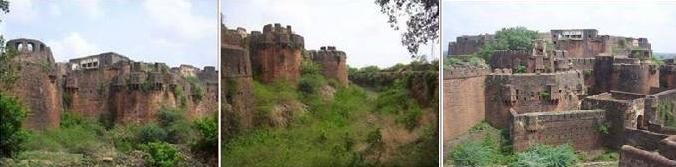
The fort is a concealed defensive complex spread across hills, where large scattered boulders are linked by strong walls. Three irregular concentric defensive walls enclose the site, with guard rooms, barbicans, numerous bastions, and a deep moat. The citadel, or central stronghold, occupies high ground. Seven gates are recorded, five of them remaining in good condition.
Defensive works
Walls and gateways
The main entrance has a solid arch with balconies on both sides and is reached by flights of steps. Openings above the gateways probably allowed defenders to pour boiling oil on attackers. Guard rooms are built into the walls around the central courtyard, while narrow secret passages lead to underground chambers intended to provide emergency escape during attacks.
Bastions and cannon
Bastions, projecting parts of a fortification used for observation and weapons, carry cannons, including ornamented examples. Cannons also stand along the approach to the citadel. A long cannon is placed on a circular battlement on the southern wall, and the cannon called Khadak Bijli Thopu is mounted on the second bastion. The walls bear engraved images of Yalis, stylized mythical animals commonly used as decorative motifs in South Indian architecture.
Citadel and palace precinct
Akhand Darwaza and Rajmahal
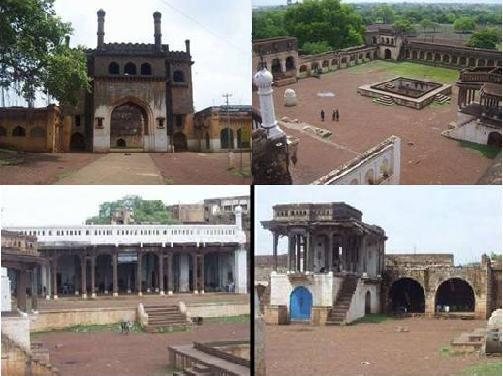
The citadel is entered through the Akhand Darwaza, built from four red-stone slabs. Steps lead from the doorway toward the Rajmahal palace, which is largely ruined. Its hall retains a ceiling with colorful designs, and patterns of vases and urns survive on the central wall.
Temple and Rani Mahal
A temple beside the palace has a square pond in front of it and an entrance framed by vertical stone columns with well-carved sculptures. The Rani Mahal, or Queen’s Palace, stands west of the temple and has a separate approach leading toward it.
Water, worship, and religious remains
Ponds and wells
The precincts contain a pond with a fountain pillar at its center and a platform used for Muharram prayers. Two deep wells lie on the northeastern and western sides of the fort. Inclined ramps beside the wells enabled oxen or horses to draw water.
Jain temple and images
A ruined Jain temple stands within the fort area, with Jain images engraved on its walls. A museum immediately adjoining the fort contains Jain idols dated to the tenth and eleventh centuries, preserving material connected with the Jain religious presence at Kalyana.
Talim Khana
The Talim Khana is a chamber used as a gymnasium, adding a training space to the fort’s palace, defensive, religious, and water-related structures.