Castle da Rocha Forte: A Medieval Fortress of the Compostela Archbishopric
Site at a Glance
- Rating
- 3.8
- Popularity
- Low
- Country
- Spain
- Primary era
- Medieval
- Eras represented
- Medieval
- Civilizations
- Crown of Castile
- Site type
- Military
- Remains
- Castle
On this page18 sections
History
Castle da Rocha Forte is a medieval fortress in Spain, near Santiago de Compostela, built for the Compostela archbishopric and occupied from approximately 1240 to 1467. It served as an archiepiscopal residence, a military stronghold, and a base for controlling roads and movement toward Santiago. The fortress became both a prominent expression of the archbishop’s territorial authority and a focus of opposition to the coercion associated with that rule.
Foundation and archiepiscopal control
Archbishop Juan Arias ordered the castle’s construction around 1240. Its first known documentary mention dates to 1255, in connection with Juan Arias’s constitutions for the cathedral chapter. The fortress provided a residence for the archbishop and the chapter while protecting them and controlling the passage of people and goods toward Santiago.
Its position beside the former roads to Noia and Padrón, close to the route used by pilgrims from southern Galicia, also gave it a military role. The castle formed a forward defensive post against possible approaches through the Arousa estuary and the Ulla River. The Compostela archbishopric, an ecclesiastical lordship ruled by the archbishops of Santiago, possessed territorial, judicial, military, and political powers as well as religious authority.
Revolt and reconstruction in the fourteenth century
In 1318, Archbishop Berenguel de Landoria arrived in Santiago while the city was in revolt against archiepiscopal authority. He took refuge at Castle da Rocha Forte and negotiated with the insurgent townsmen from the fortress. On 16 September 1320, soldiers closed its gates during a negotiating delegation’s visit and killed eleven representatives of Santiago. Those killed included Alfonso Suárez de Deza, the Andrade brothers, Martín Martínez, Juan Varela, Juan García de Mesía, and the notary Gonzalo Yáñez.
The killing formed part of the conflict led by Alfonso Suárez de Deza, a member of the Deza-Churruchao family and steward to Infante Felipe, son of Sancho IV of Castile. Peace was concluded on 27 September 1320. Berenguel then recovered control of the city and fortified Santiago Cathedral. Earlier that year, fighting between Compostela’s citizens and the bishopric had resulted in the castle being attacked and burned. Berenguel ordered its rebuilding, while Archbishop Lope de Mendoza later commissioned substantial modifications.
The Churruchaos and archiepiscopal conflict
The popular Churruchaos tradition connects the fortress with a captain’s revenge, the death of an archbishop, the destruction of the castle, and a supernatural golden hen. The historical episode behind part of this tradition took place in 1366, during the Castilian succession conflict between Henry II of Trastámara and Peter I, rival claimants to the throne. Archbishop Suero Gómez de Toledo, suspected of supporting Henry, was murdered in the Obradoiro by Fernán Pérez Churruchao and Alfonso Gómez Gallinato in the presence of the king.
The Churruchaos were opponents of archiepiscopal authority, not the owners of Castle da Rocha Forte and not the perpetrators of the abuses later attributed to its inhabitants. During the 1450s and 1460s, soldiers stationed at the Rocha faced accusations of stealing cattle, abducting peasants for ransom, and committing sexual violence. These charges contributed to the fortress’s reputation as an instrument of seigneurial oppression.
The siege of 1458–1459
In 1458, during Archbishop Rodrigo de Luna’s tenure, a brotherhood of nobles and officials from Santiago, Noia, and Muros besieged the castle in opposition to the archbishop’s authority. Its principal figures were Juana de Castro and her son Bernal Yáñez de Moscoso. Pedro Álvarez Osorio, Count of Trastámara, Suero Gómez de Soutomaior, Lope Pérez de Moscoso, and Fernando de Castro also joined the besieging forces.
The castle was defended by its lieutenant and castellan, Álvaro Sánchez de Ávila, who had held the post since 1456. The fortress resisted throughout the siege of 1458–1459. King Henry IV of Castile issued three orders requiring the besiegers to withdraw, including commands dated May 1458 and 12 June 1459. On 3 September 1459, at Mazarelos, the insurgents agreed with representatives of the archbishop to end the siege.
Destruction and later memory
The Great Irmandiño Revolt of 1466–1467 was a series of Galician uprisings against abuses by nobles and ecclesiastical lords. In 1467, the Irmandiños attacked Castle da Rocha Forte and demolished it to its foundations. It was among the first fortresses destroyed during the revolt and was never permanently rebuilt. The attack reflected the castle’s importance as a visible center of archiepiscopal authority and feudal power. Testimony connected with the later Tabera-Fonseca proceedings gives an attacking force of approximately 11,000 people.
Afterward, stone from the fortress was reused in other buildings, including a now-lost tower on Pico Sacro, constructions in Santiago, and parts of Santiago Cathedral. Forces under Lope Sánchez de Moscoso, Count of Altamira, later attempted to begin rebuilding the castle. The effort ended after Archbishop Alonso II de Fonseca intervened, in an agreement associated with the demolition of the castle of Alcobre and the abandonment of the Rocha Vella site.
The castle’s strategic role was discussed in the Tabera-Fonseca proceedings, a sixteenth-century arbitration concerning the properties, fortresses, and conflicts of the Santiago archbishopric. Because the testimony was collected after the castle had become a ruin, it required cautious interpretation, although archaeological work has supported parts of its description.
Archaeology and protection
Twentieth-century railway construction destroyed a substantial part of the archaeological site and concealed much of the fortress beneath or beside the railway corridor. Archaeological investigations began in 2001 through an agreement between Santiago de Compostela and the University of Santiago de Compostela. The work sought to study, recover, consolidate, and enhance the remains as an archaeological park. Iván Álvarez Merayo prepared the initial study, while excavation teams were directed by Raquel Casal García and Fernando Acuña Castroviejo.
In 2002, vegetation was cleared, intensive archaeological prospection and topographic surveying were carried out, and the surrounding land was examined. The 2003 campaign tested the northwest wall, cleared and recorded southern structures, investigated an underground feature, and gathered documentary references. Campaigns from 2004 to 2006 combined excavation, surveying, structural consolidation, and work on the main enclosure and barbican. The perimeter was assessed again in 2013. Castle da Rocha Forte is catalogued as a Cultural Interest Property, with medieval occupation generally assigned to the thirteenth through fifteenth centuries. The land belongs to the Archdiocese of Santiago, which granted its use to the municipality for fifty years.
Remains
Setting and fortress layout
The archaeological site occupies about 4,000 square metres at roughly 185 metres above sea level in Rocha Vella, in the parish of Conxo. It lies beside the railway and near the modern road toward Pontevedra, at the meeting point of the Vilar stream and the Sar River. The small promontory is bordered by the two watercourses to the east and north. Unlike castles placed on dominant heights, Castle da Rocha Forte was built in the bottom of a valley, where its position served the control of roads, traffic, and access to Santiago.
Concentric enclosures
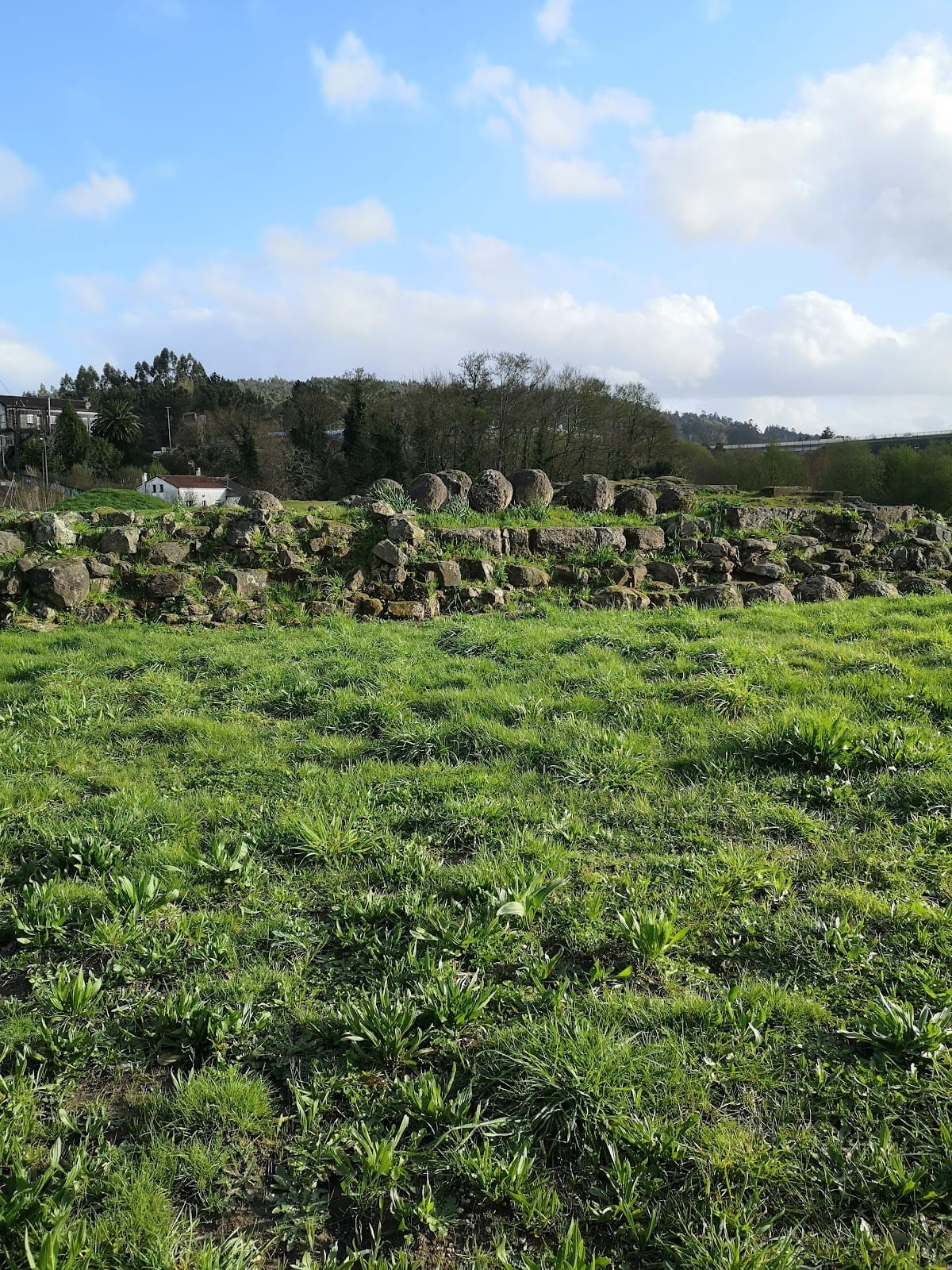
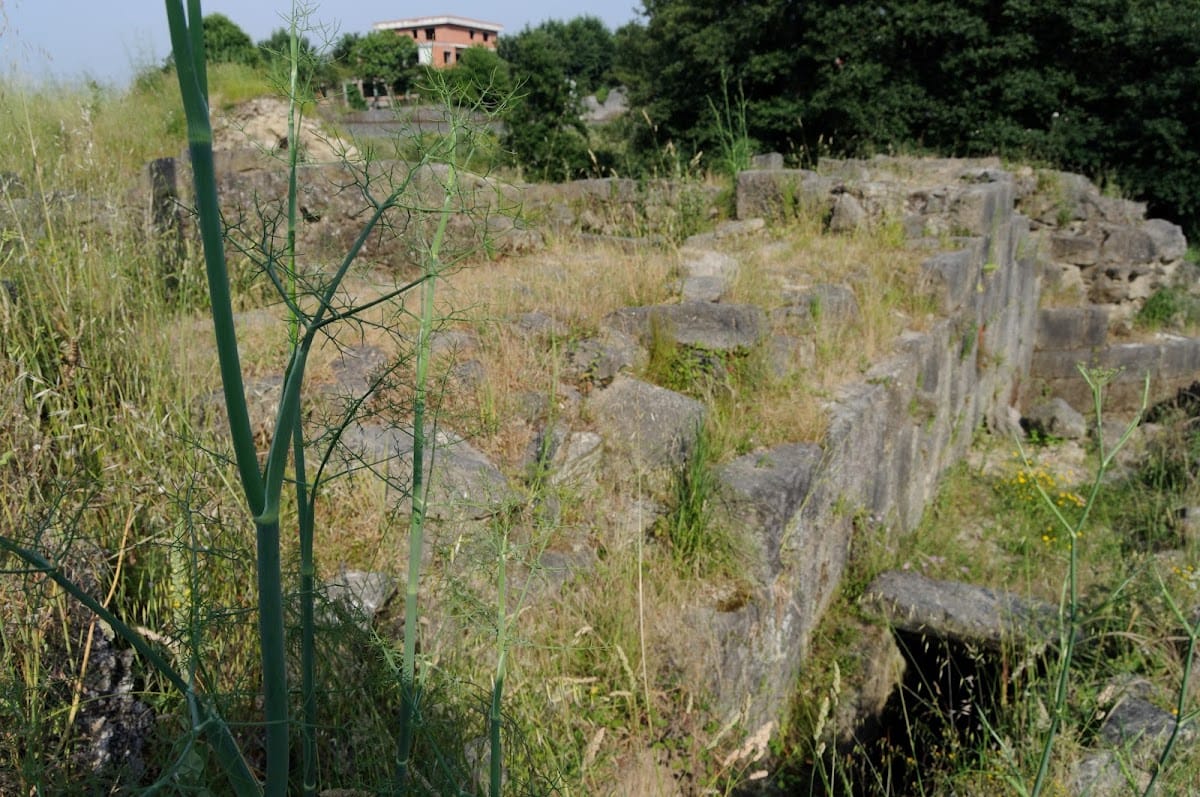
The ruined site preserves several defensive enclosures. Around 40 metres of the outer enclosure survive in the southeast, while the complete perimeter of the inner enclosure remains visible. Central structures may indicate the position of the main tower, and tower foundations survive at the corners and beside the principal entrance. Archaeological and documentary evidence points to a concentric fortress, meaning a strongpoint enclosed by successive defensive walls, with three walled circuits arranged around a central main tower.
Main tower and inner defenses
The main tower was described as four storeys high, with a vaulted chapel dedicated to Saint Euphemia beside it. The fortress was built from granite ashlar masonry bonded with lime and mortar and arranged on three levels. The innermost circuit was reportedly defended by nine circular towers with crenellated parapets, the notched wall tops used for defense. Four stood at the corners, three strengthened the middle sections of the southeast, northeast, and southwest walls, and two flanked the principal gate. One was called Santa Eufemia and another Torre Nova, while the names of the others are unknown.
Entrances, waterworks, and underground spaces
Moats and entrance defenses
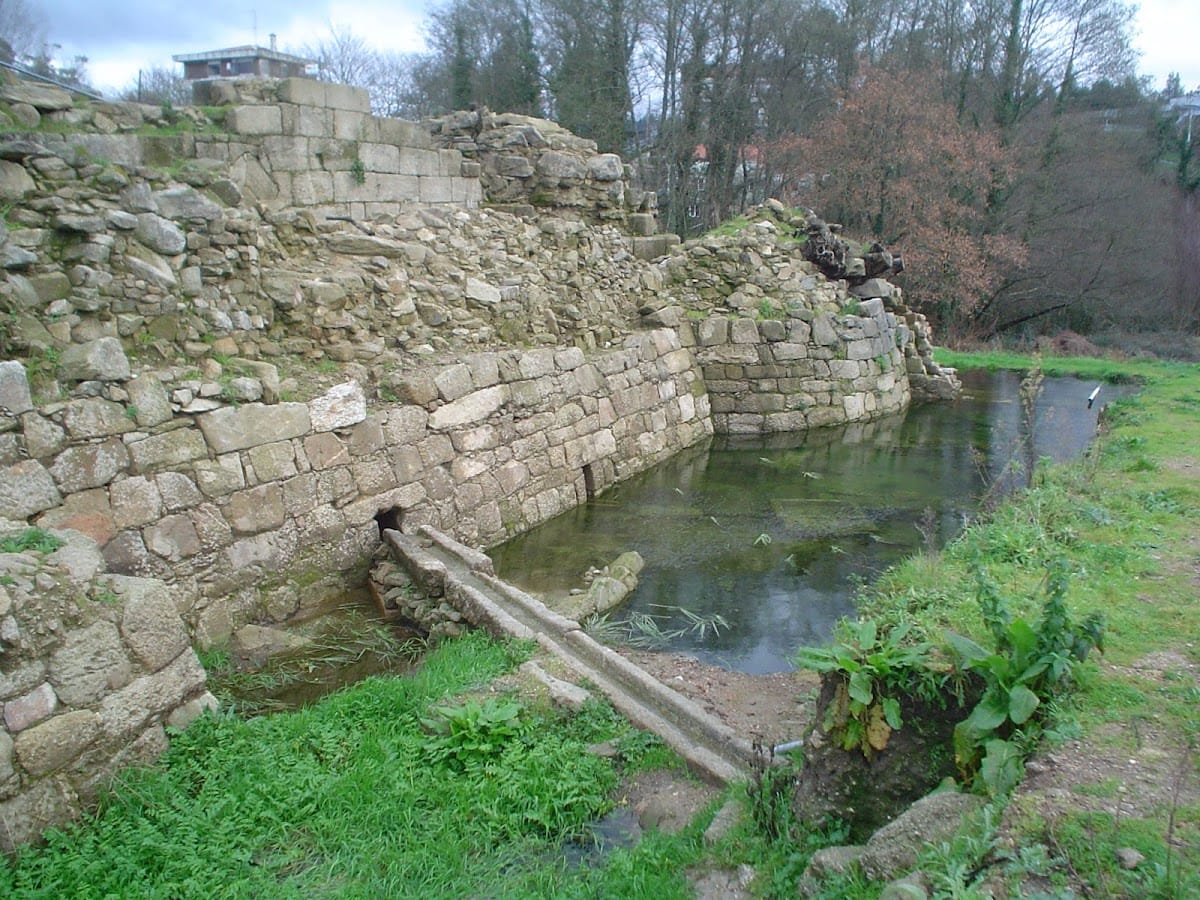
The defensive system included at least one or two moats, one of them permanently filled with water. Gates, smaller posterns, drawbridges, and barbicans formed part of the access system. A barbican was an outer defensive work protecting an entrance, while a postern was a smaller secondary gate. Documentary testimony compared the enclosed complex to a city.
Barbican and water supply
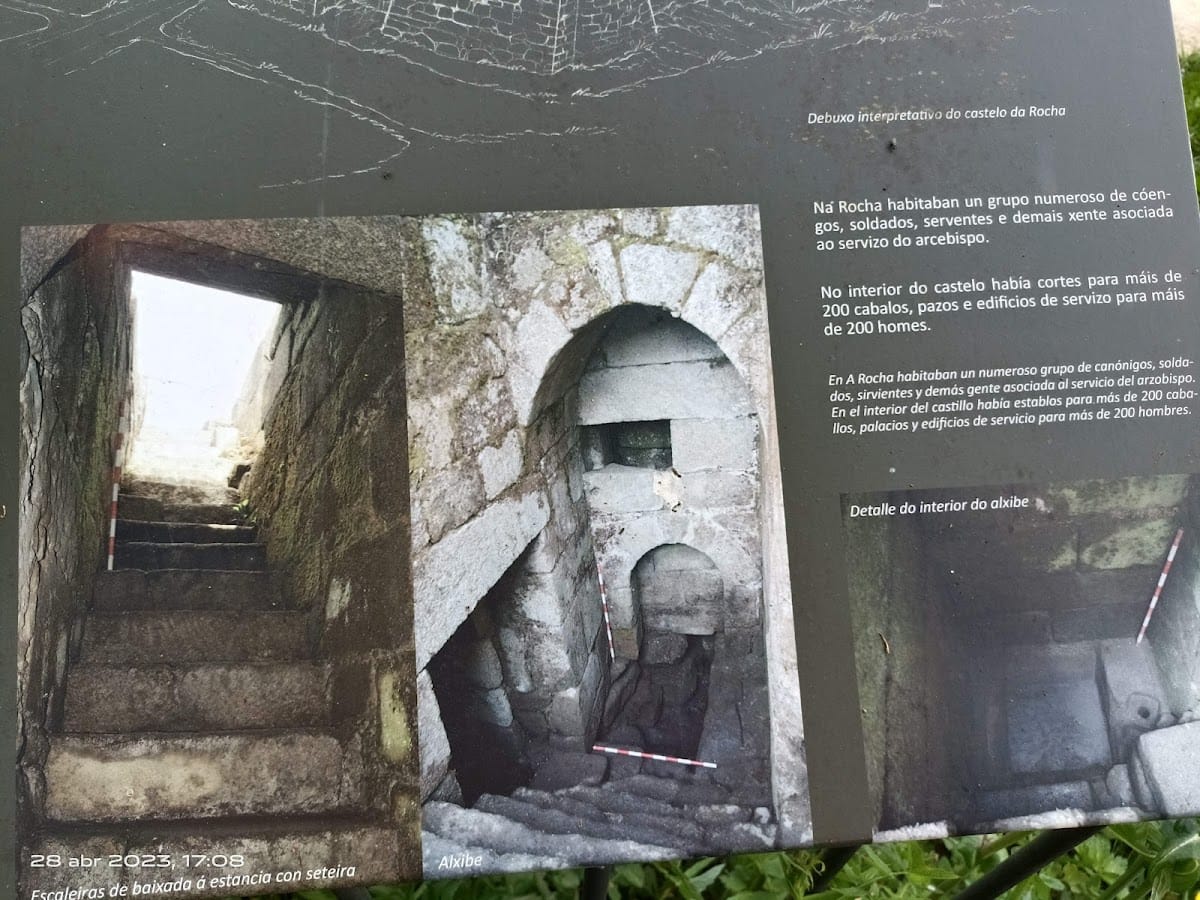
The exposed section of the barbican extends 35.95 metres from the southeastern corner tower to the railway embankment and stands approximately 3.5 to 4.5 metres high. In 2006, archaeologists excavated its eastern section and exposed a well-preserved trapezoidal bastion founded on bedrock. An external water-channel system and a masonry well 3.7 metres deep were uncovered in 2005; the well still contained water. Subterranean dependencies are also present, although their stepped entrances are the features identified so far. Interior accounts describe two vaulted chambers.
Archaeological finds
Weapons, projectiles, and coins
Excavations in 2003 recovered medieval ceramics from Seville and Manises, a blanca made of billon from the reign of Henry III of Castile, and worked stone fragments. The 2004 campaign produced numerous narrow Bodkin arrowheads, designed to pierce armor, including hollow-needle forms. Two possible swords remained under study, and 39 coins were recovered, 90 percent from one stratigraphic unit. The coins included thirteen issues of Henry III, two obols attributed to Alfonso XI and probably Alfonso X, two novenes of Henry III and probably Henry II, and six cornados of John I.
Numerous stone balls, measuring approximately 18 to 50 centimetres across and sometimes larger, were also found. Some had roughly bevelled surfaces and were suitable for trebuchets, counterweight siege engines used to throw heavy stones. Their presence provides evidence of a siege at the castle.
Architectural and domestic remains
Other finds from 2004 included chiselled and polished mouldings, a Gothic capital, tracery fragments, and column shafts. Excavation in 2005 revealed sections of the southern wall, one retaining traces of lime, together with ceramics, parts of a well curb, horseshoes, animal bones, and bronze fittings from clothing and furniture.
The 2006 campaign examined the western part of the main enclosure between the entrance and the southwestern corner tower and consolidated structures exposed earlier. It excavated 152.76 square metres and recovered 732 ceramic, stone, metal, and bone objects. The pottery consisted mainly of locally made domestic vessels, especially rounded cooking pots, but also included imported Levantine ware and a vessel-rim fragment in the Muslim tradition.
Metal objects from the same campaign included 74 nails of various types, spikes, hinges, links, a horseshoe, slag, casting waste, and bronze toilet implements. Two poorly preserved coins remained under study. Stone discoveries included decorated column shafts, column bases, Gothic capitals, tracery fragments, and several types of projectiles. Small glass pieces and samples of wall plaster were also recovered. By the end of the 2006 campaign, the castle plan had been defined on three sides, while the northern side remained unclear because of the railway.
Related archaeological landscape
The nearby Castriño de Conxo site contains unexcavated remains of a hillfort and rock carvings depicting swords or antenna daggers, halberds, and cup marks. Possible images of Castle da Rocha Forte also appear in the Tumbo B of the Santiago capitular archive, in a marginal note beside a papal bull confirming the privileges of the Compostela see, and in the Tumbillo de Concordias beside text confirming archiepiscopal privileges over fortresses. The Tumbo B image, made during Berenguel de Landoria’s period, shows Saint James on horseback with a drawn sword and a castle behind him. Some interpretations identify Castle da Rocha Forte as the model and connect the image with the justification of the events known as the Day of Wrath.
Archaeological work has also explored the possibility that the fortress followed an unusually early Gothic concentric design in the Iberian Peninsula. Portuguese specialists have supported this as a working hypothesis. Another proposal, still unconfirmed, is that Juan Arias employed a French military architect or engineer.