Bargello Palace: Florence’s Medieval Civic Palace and National Museum


Site at a Glance
- Rating
- 4.7
- Popularity
- Medium
- Country
- Italy
- Primary era
- Medieval
- External website
- Open
- Eras represented
- Medieval, Modern
- Civilizations
- Grand Duchy of Tuscany
- Site type
- Civic
- Remains
- Palace
On this page17 sections
History
Bargello Palace is a medieval civic palace in Florence, Italy, built by the Florentine commune from 1255 for the government of the Captain of the People. Its first construction phase ended in 1261, and the complex later became the seat of the podesta, a senior civic magistrate responsible chiefly for civil and criminal justice. Over the centuries, it served as a courthouse, prison, headquarters for the city guards, and museum.
Foundation and communal government
The palace arose after the Guelf victory over the Ghibellines at Figline in 1250. These were rival political factions in medieval Italian cities, with the Guelfs generally supporting the papacy and the Ghibellines generally supporting imperial authority. The commune acquired houses and land along the present Via del Proconsolo, including properties belonging to the Badia Fiorentina and the Boscoli and Riccomanni families.
An inscription still in place records that construction began in 1255. The earliest building was known as the Palazzo Pretorio, and Giorgio Vasari attributed its design to Lapo Tedesco, later assisted by the Dominican friars Fra Sisto da Firenze and Fra Ristoro da Campi. The palace was occupied while work continued in 1320. Its loggia was completed later, and the roof was finished in 1326, partly because the war with Pisa prolonged construction.
The podesta and his administration operated from the palace. From 1282, the podesta and his councillors held their meetings publicly in the loggia overlooking the courtyard. The building also contained cells and was used for interrogations, torture, and executions. Dante Alighieri was sentenced to exile there in 1298 before the podesta Cante de’ Gabrielli da Gubbio. Giotto and his workshop may also have worked at the palace for Cardinal Matteo d’Acquasparta around 1295 or between 1300 and 1304, although the date and attribution of the surviving Magdalene Chapel paintings remain uncertain.
Damage, expansion, and political conflict
The palace suffered serious damage during the disturbances surrounding the acquittal of Corso Donati in 1295. The municipality strengthened the building, added rooms, and made a new entrance toward Via della Vigna Nuova. In 1304, a crowd attacked the palace while attempting to free Talamo Adimari and drive out the podesta. In 1329, the podestas’ external coats of arms were removed, and their display was limited to the courtyard.
An attack in 1332 set the palace on fire, and a severe flood inundated the courtyard the following year. Between 1340 and 1345, Neri di Fioravante substantially enlarged and renovated the complex. He created the hall of the General Council, later called the Donatello Hall, and vaulted the principal rooms to reduce the risk of fire. The palace was plundered again in 1343 during the expulsion of Walter VI of Brienne.
After Walter’s expulsion, Giottino painted an infamizing image of the duke and his followers. Such images symbolically punished political enemies who were no longer present. The paintings were still noted during the siege of Florence in 1529. The palace was devastated during the Ciompi revolt on 21 July 1378. This major Florentine uprising involved wool workers and other lower-status groups. The tower bell was later recast and continued until 1848 to announce the evening curfew, executions, revolts, and street disturbances.
Judicial authority, imprisonment, and the Medici period
During the Medici ascendancy in the second half of the fifteenth century, the palace became the seat of the Council of Justice and, from 1502 to 1574, the Judges of the Wheel, a collegiate court of Florentine judicial magistrates. In 1574, under Cosimo I de’ Medici, it became the headquarters of the bargello, the chief of the city guards. The office was associated with arrests, interrogations, prison administration, and capital sentences, giving the building the name it retains.
For almost three centuries, the palace functioned principally as a prison. It held dangerous prisoners and people condemned to death. Arcades and galleries were converted into cells, while the great hall was divided into thirty-two cells and a chapel. The Magdalene Chapel was plastered over, divided between two floors, and partly adapted for prison use.
Girolamo Savonarola, the Dominican friar and religious reformer who influenced Florence during the 1490s, was brought to the Bargello after his arrest on 9 April 1498. He was interrogated and tortured there before being taken to the stake in Piazza della Signoria. Executions normally occurred outside the walls near the Torre della Zecca, although exceptional beheadings took place in the palace courtyard.
The building was also associated with politically directed painting. In 1434, Cosimo de’ Medici ordered Andrea del Castagno to paint nobles who had opposed him and had been hanged. In 1480, Sandro Botticelli painted participants in the Pazzi conspiracy for Lorenzo de’ Medici. During the siege of Florence, Andrea del Sarto painted three republican traitors on the palace. Ser Piero da Vinci, Leonardo da Vinci’s father, worked there around 1450.
Reform, restoration, and museum formation
In 1782, Leopold II, Holy Roman Emperor, abolished the death penalty and torture and ordered the instruments used for them to be burned in the courtyard. In 1799, the French installed two guillotines, one at the Bargello and one in Piazza Nuova before Santa Maria Novella, though neither was used.
Scholarly interest grew during the nineteenth-century revival of interest in Florence. In 1840 and 1841, Baron Seymour Kirkup and other donors financed investigations in the Magdalene Chapel. Antonio Marini uncovered a portrait of Dante attributed to Giotto within a larger painted cycle. The discovery attracted public and scholarly attention, although the restoration added substantial elements not present in Kirkup’s earliest drawings.
A revolt against the prison guards in 1847 demonstrated the need to relocate the inmates. In 1857, the grand duke ordered the prison transferred to the Murate and began restoring the palace. A decree of 22 November 1859 assigned the building to a museum intended to illustrate Tuscan institutions, customs, and arts. Restoration from 1859 to 1865 was directed by Francesco Mazzei in a neo-Gothic manner. The work recovered surviving fabric but also recreated architectural ornaments and painted decoration, with the latter entrusted to Gaetano Bianchi.
Parts of the building opened during the 1861 National Exhibition, and the National Museum was formally established in 1865, when Florence was the capital of Italy. Its first holdings included non-ancient sculpture from the Uffizi, arms from the Medici Armoury, statues from the Hall of the Five Hundred, Medici bronzes, and privately deposited objects. The collections later expanded to include majolica, wax, enamels, goldwork, ivory, amber, furniture, tapestries, medals, coins, plaques, seals, textiles, Della Robbia glazed terracottas, and sacred goldwork. Some collections moved to the Treasury of the Grand Dukes in 1928.
The 1887 Donatello celebrations produced a permanent installation for early fifteenth-century sculpture. A major donation from the Lyon antiquarian Louis Carrand in 1888 strengthened the European and non-European applied-arts collections, followed by additions from the Conti, Ressman, and Franceschi collections. The Florence flood of 1966 severely affected the palace. Later work restored the building, modernized its services, and reorganized the collections. Carlo Cresti designed the special installation of the Michelangelo Hall and sixteenth-century sculpture, which opened in 1975.
Restoration of the stone facing on the Via del Proconsolo front took place in 2010 and 2011. A further campaign begun in 2020 addressed the exterior facades, courtyard, and coats of arms. The tower had earlier undergone post-flood consolidation, including iron chains, strengthened masonry facing, and replacement of its roof covering. On 13 July 2006, three ancient jewels from the Islamic section were stolen during normal opening hours. Since 2014, the National Museum of the Bargello has held special status as an Italian museum and has administrative jurisdiction over Orsanmichele, the Medici Chapels, Palazzo Davanzati, and Palazzo Martelli. The palace appears in the 1901 inventory of monumental buildings as a monument of national artistic importance.
Remains
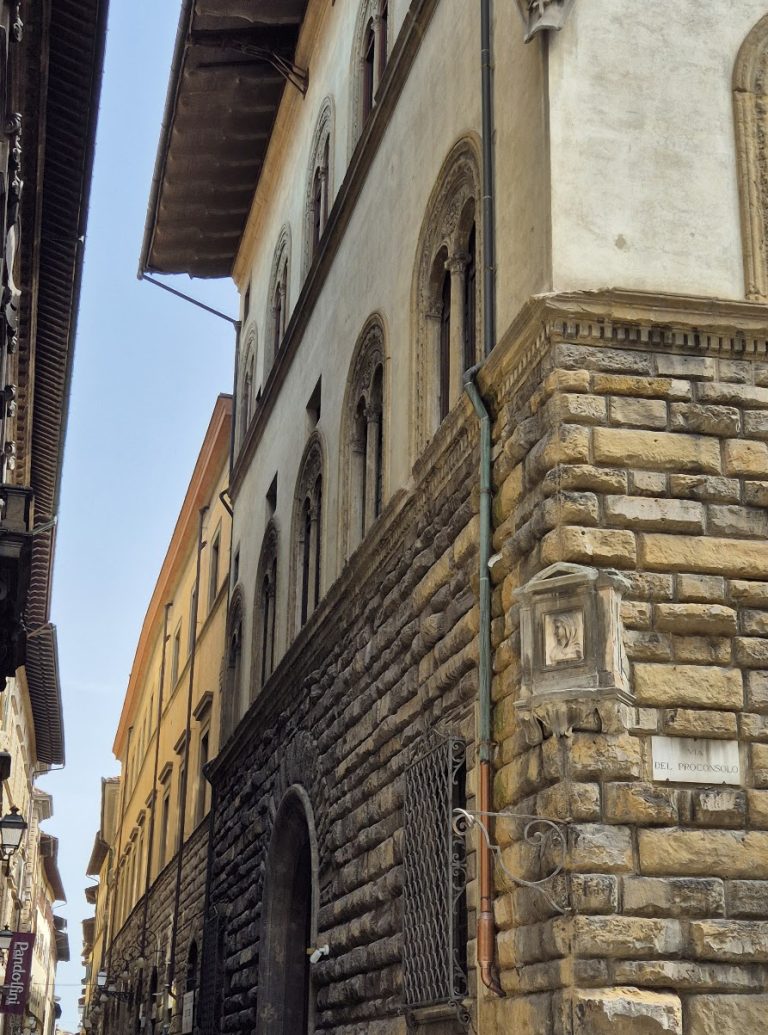
Bargello Palace occupies a complete city block bounded by Via del Proconsolo, Via Ghibellina, Via dell’Acqua, and Via della Vigna Vecchia. Its oldest section faces Via del Proconsolo and Piazza San Firenze. The complex began as a large rectangular block, expanded toward Via dell’Acqua between 1260 and 1280, and gained a porticoed courtyard around 1295. The sides along Via Ghibellina and Via dell’Acqua were raised between 1316 and 1320, while the side toward Via della Vigna Vecchia was raised in 1320. The rear section facing Via della Vigna Vecchia and Via dell’Acqua was built in stages between 1325 and 1346.
Exterior facades and tower
Medieval facades
The two oldest facades meet at a right angle and are divided horizontally by narrow cornices. At ground level, lintelled doors and windows have relieving arches. The middle levels combine smooth stone facing, lower mullioned windows divided by central stone members, and simpler upper windows. Rough masonry marks the uppermost level, which ends in a projecting crenellated parapet supported by corbels and pointed arches. A tall mullioned window toward Piazza San Firenze crosses the second cornice and lights the Council Hall. Benci di Cione designed this window, opened in 1345. The walls also retain signs of later raising, holes for timber galleries, and surviving stone corbels.
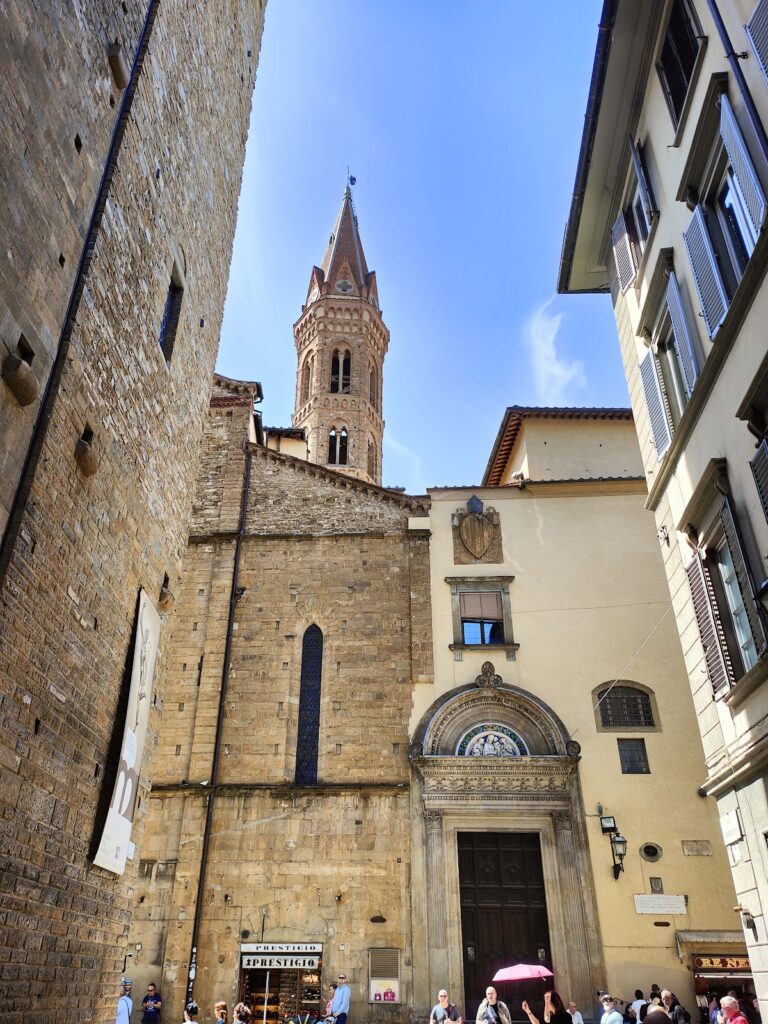
Volognana Tower
The Volognana Tower stands at the Canto del Bargello, where the palace meets Via Ghibellina. It rises 57 metres and forms part of the complex. The former private house-tower was sold to the commune in 1254 with surrounding Boscoli and Riccomanni properties, then incorporated into the new palace of the Captain of the People. Tradition connects the name Volognana with Geri da Volognano, said to have been its first prisoner.
The tower was adapted as a bell tower. Its upper chamber housed the Montanina, a bell taken from Montale Castle in 1302 and broken and recast in 1381. The bell summoned young men to arms and announced executions, revolts, and street disturbances. Guelf-type crenellation crowns the tower, while civic coats of arms beneath the corbels include the Florentine lily, the cross of the People, and the Angevin arms. Painted images of rebels and traitors once covered parts of the exterior. The paintings attributed to Giottino, showing Walter VI of Brienne and his followers, have almost entirely disappeared, leaving faint traces.
Courtyard and circulation spaces
Porticoes and gallery
The courtyard has porticoes on three sides, with round arches resting on octagonal piers. Built in the thirteenth century, it was enlarged in the following century with a Gothic gallery and staircase. Neri di Fioravante’s staircase was constructed along the side without a portico between 1345 and 1367. Its later roof was removed during the nineteenth-century restoration.
Restored prison spaces
During the building’s prison period, the arches of the loggia and gallery were blocked, and larger rooms were subdivided into cells. Mazzei’s restoration reopened the loggias and gallery, recovered surviving coats of arms belonging to podestas and Judges of the Wheel, and added Gaetano Bianchi’s frescoes of district standards and coats of arms beneath the loggia vaults.
Chapel, plaques, and sacred imagery
Magdalene Chapel
The Magdalene Chapel, also called the Chapel of the Podesta, contains a painted cycle with scenes of the Last Judgment and episodes from the lives of Mary of Egypt and Mary Magdalene. It also includes the portrait of Dante attributed to Giotto. The paintings were uncovered after later plaster was removed, but nineteenth-century restoration substantially altered them.
Saint Bonaventure tabernacle
At the corner of Via dell’Acqua and Via Ghibellina stands a neo-Gothic tabernacle frame from 1859. It preserves a detached fresco by Fabrizio Boschi showing Saint Bonaventure visiting prisoners. The Company of Saint Bonaventure of the Prisoners commissioned the image in 1589, and Daniela Dini restored it in 1996 under the direction of Silvestra Bargellini.
Inscriptions and plaques
A dated plaque from 1255 remains fixed on Via del Proconsolo near Piazza San Firenze. Its inscription commemorates the construction of the walls and names Bartolomeo Nuvoloni of Mantua, Captain of the Florentine People, and Alemanno della Torre of Milan, the Florentine governor. Near the Via Ghibellina entrance to the courtyard, another plaque prohibited disturbing condemned prisoners during their final hours, when members of the Croce al Tempio assisted them in the nearby Magdalene Chapel. The plaque has probably been removed, but its metal supports remain.
Another plaque near the tower warned against placing wood or other combustible material against the palace walls or lighting fires nearby, with penalties determined by the magistrates. A partly legible plaque dated 1708 apparently protected the vineyard and garden of the Theatine fathers of Sant’Apollinare. It probably preserves the memory of the former vineyard from which Via della Vigna Vecchia takes its name.
Museum collections and display spaces
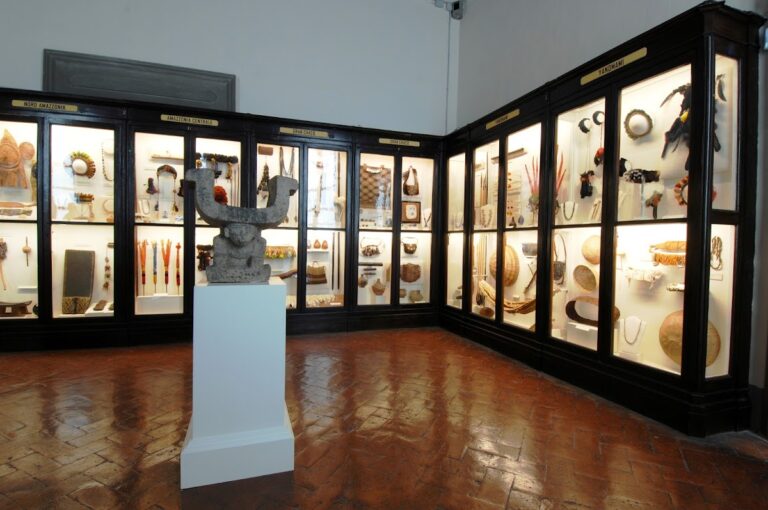
The museum is principally devoted to sculpture and applied arts. Early displays included two armour rooms on the ground floor, a room of fifteenth- and sixteenth-century sculpture, and large sculpture in the first-floor hall, including Michelangelo’s Genius of Victory. The collections include casts of works by Donatello, including the Gattamelata, as well as arms, bronzes, ceramics, wax, enamels, goldwork, ivory, amber, furniture, tapestries, medals, coins, plaques, seals, textiles, glazed terracottas, and sacred goldwork.