Palazzo Nonfinito: Florence’s Unfinished Mannerist Palace


Site at a Glance
- Rating
- 4.5
- Popularity
- Low
- Country
- Italy
- Primary era
- Early Modern
- External website
- Open
- Eras represented
- Early Modern, Modern
- Civilizations
- Grand Duchy of Tuscany, Italian
- Site type
- Domestic
- Remains
- Elite Residence
On this page14 sections
History
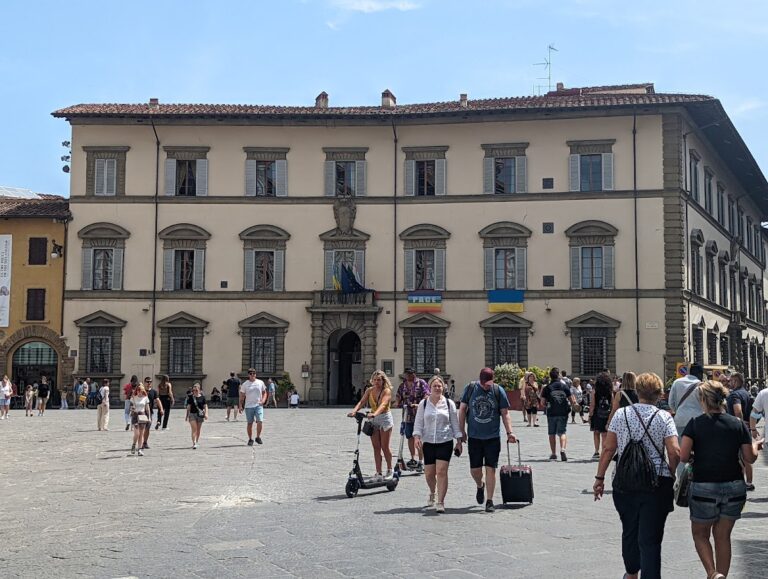
Palazzo Nonfinito is a historic palace in Florence, Italy, built for the Strozzi family in the late sixteenth and early seventeenth centuries in the Mannerist style, a late Renaissance mode known for elaborate ornament, unusual proportions, and imaginative details. Its main frontage faces Via del Proconsolo, while another substantial elevation extends along Borgo degli Albizi at the corner called Canto de’ Pazzi. The name, meaning “Unfinished Palace,” refers to the failure to complete the original project after several architects had worked on it.
Strozzi origins and the first building campaign
The palace replaced houses and towers that Alessandro Strozzi purchased from Camillo de’ Pazzi in November 1592. Properties belonging to the Niccolini and Perini families were also absorbed into the site, and a well-known apothecary’s shop was demolished before construction began in July 1593. Alessandro’s financial difficulties led him to sell the complex to his brother Roberto, transferring half in 1596 and the remainder in 1597.
Roberto Strozzi was often away in Venice on business, so his brother supervised the works without being required to share their expenses. Their brother Bernardo provided stone from his quarry at Le Campora, near the hill of Marignolle. A municipal application concerning the installation of windows names Bernardo Buontalenti, a Florentine architect, engineer, and artist associated with the Medici court. Buontalenti probably drew inspiration from Michelangelo’s architecture.
From 1593 to 1600, Buontalenti directed the initial construction with the assistance of Matteo Nigetti. This phase established the palace’s beginning, its ground floor, the portal on Borgo degli Albizi, and its distinctive kneeling windows, whose projecting sills and supports resemble a bent or kneeling form. Buontalenti left the site in 1600 after disagreements with the Strozzi family over the position of the principal staircase. Santi di Tito subsequently built the staircase to the right of the atrium.
Changing architects and the incomplete project
Between 1600 and 1612, Vincenzo Scamozzi was commissioned to complete the design, while Giovanni Battista Caccini directed its execution. Scamozzi was an architect from Vicenza who later claimed complete authorship in an architectural treatise. Later historians rejected that claim and established the participation of several designers. Scamozzi probably worked from Buontalenti’s drawings and encountered the palace already under construction.
The work attributed to this second phase included the monumental entrance on Via del Proconsolo and the first floor, articulated by giant-order Ionic pilasters. A giant order uses pilasters or columns that extend through more than one story. Caccini was also associated with the marble Strozzi coat of arms placed high on the corner. After Caccini died in 1612, Matteo Nigetti again directed the works.
Around 1604, Lodovico Cardi, known as the Cigoli, created the courtyard. Both Buontalenti’s and Scamozzi’s projects had envisaged two further floors, but the palace remained incomplete, and neither the interiors nor the principal facade reached the full form planned in the original designs. The reasons are uncertain. Luigi Biadi later connected the unfinished state with a traditionally reported rivalry among prominent families, although archival confirmation is lacking. A large dedication plaque dated 1607 invokes the munificence of Ferdinando I de’ Medici, suggesting that relations with the Medici were at least comparatively favorable. Alessandro Strozzi’s financial problems provide a separately documented difficulty.
A late nineteenth-century legend, later written down by Charles Godfrey Leland, claimed that Roberto Strozzi had made a pact with the Devil and that the palace was cursed to remain incomplete. The story drew on the sinister zoomorphic figures decorating the ground-floor window pediments. The palace’s name itself was first recorded in a Florence guide published in 1822.
Government offices and twentieth-century institutions
Strozzi ownership passed to Giovanni Guasti in 1802. Guasti sold the palace to the Tuscan government in 1814, after which Pasquale Poccianti adapted it for the Royal Customs service, the Community Chamber departments, the Superintendent’s office, and the Charity Deputation. In 1850, it housed the prefecture, the Foreigners’ Office, and the delegation of the San Giovanni district.
From 1865 to 1871, when Florence served as the capital of Italy, Palazzo Nonfinito housed the Council of State. The building underwent structural consolidation, restoration, and the decoration of several rooms under Francesco Mazzei, with the works directed by the engineer Nicola Nasi. The palace later accommodated the Posts and Telegraphs from 1901 to 1911, before the Central Post Office was built in Via Pellicceria. In 1917, alterations prepared it for barrack accommodation, and military offices occupied the building.
The palace was granted to the University of Florence in 1919 and chosen as the headquarters of the National Museum of Anthropology and Ethnology, founded by the physician and anthropologist Paolo Mantegazza. The museum moved there in 1924 and was officially inaugurated in 1932. Its collections were enlarged through the work and donations of Aldobrandino Mochi, Nello Puccioni, and others. Mantegazza’s heirs donated his books, papers, and letters to the museum in 1924.
Major facade restoration took place from 1938 to 1944 under Piero Sanpaolesi. War damage during the Second World War was repaired in 1948, and further restorations followed in 1956, 1967, and 1972. The palace was listed in 1901 by Italy’s General Directorate of Antiquities and Fine Arts among the country’s monumental buildings considered part of the national artistic heritage. It now accommodates the Anthropology and Ethnology section of the University of Florence’s Museum of Natural History, the anthropology service of the university’s Science Library, and university lecture rooms, laboratories, and offices.
Remains
Street elevations and entrances
Via del Proconsolo frontage
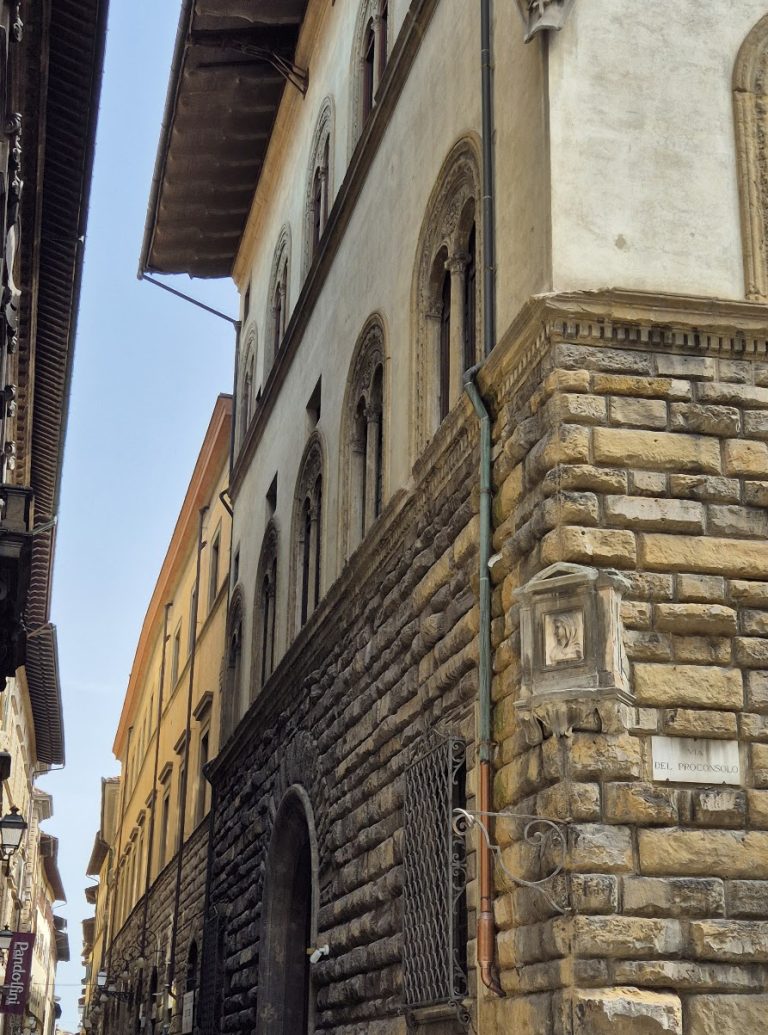
Palazzo Nonfinito stands at the angle of Via del Proconsolo and Borgo degli Albizi, with an alley separating it from the Renaissance Palazzo Pazzi. Its ground floor, constructed between 1593 and 1600 under Bernardo Buontalenti with Matteo Nigetti, is faced with flat rustication, masonry treated to emphasize the individual blocks or joints. Monumental corner pilasters frame large kneeling windows, which rest on substantial brackets, close with grilles, and carry a mixture of triangular and broken, scroll-shaped pediments.
Six kneeling windows are arranged symmetrically along Via del Proconsolo around a tall arched entrance attributed to Giovanni Battista Caccini. A balcony rises above the entrance, together with a Strozzi coat of arms bearing the date 1614. Another richly ornamented marble emblem is set high near the corner. Two female figures support its shield, and the work is attributed to Caccini. Further Strozzi emblems appear on the corner capital and in architectural details associated with Buontalenti.
Borgo degli Albizi frontage
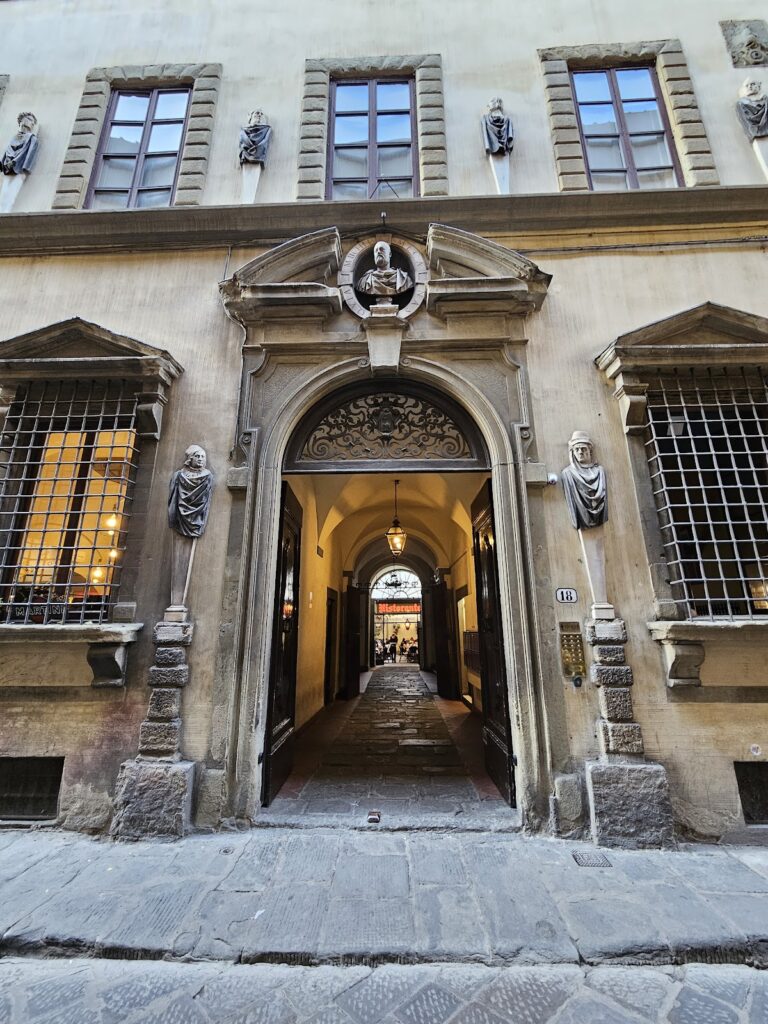
The elevation on Borgo degli Albizi is considered secondary to the Via del Proconsolo front, yet its individual details form a complete architectural composition. Four large ground-floor kneeling windows are arranged around a central axis marked by a broad portal. Above the portal are a small rectangular window and a Strozzi coat of arms held by a winged lion.
A balustrade and a large arched window rest above the portal. The window is carried on paired columns with figurative capitals. A dedication inscription dated 1607 refers to Roberto Strozzi and to the auspices of Ferdinando I de’ Medici, Grand Duke of Tuscany. On the left side, a small tabernacle set into the rustication formerly held a Crucifixion. A concealed door disguised by the masonry, corresponding to civic number 30, provided a secondary passage for informants heading to the Royal Customs offices.
Courtyard and circulation spaces
Courtyard loggia
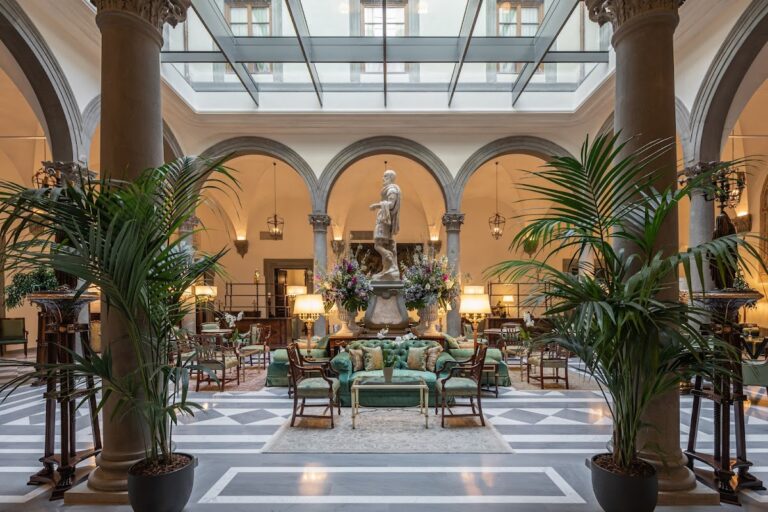
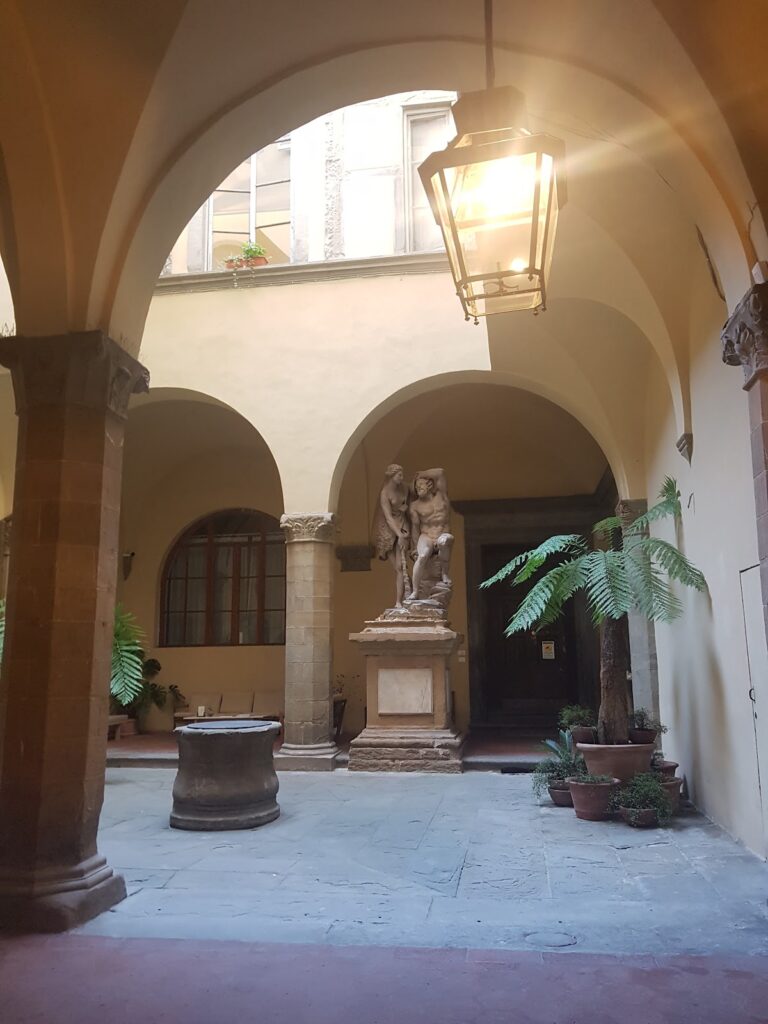
The courtyard combines Venetian influences, possibly associated with Scamozzi, with Florentine elements. Its ground-floor loggia uses serliana openings, each formed by a central arch flanked by two lower rectangular openings, carried on Tuscan columns. Two of the four sides, arranged at right angles, were executed in 1604 and are attributed to the Cigoli. The other two were completed in a matching style by Nicola Nasi in 1865 and 1866.
Opposite the principal entrance, a perspectively arranged niche contains Giovanni Battista Lorenzi’s sixteenth-century statue Perseus Killing the Dragon. The loggia also holds a bust of Paolo Mantegazza by Ettore Ximenes, a marble memorial to Nello Puccioni, and a medallion commemorating Aldobrandino Mochi. Puccioni and Mochi contributed to the museum’s collections through their donations.
Principal staircase and ground-floor hall
The principal staircase occupies a substantial area to the right of the atrium. It rises in three flights that turn at right angles beneath barrel vaults. Its original handrail is supported by rows of stone baluster forms. Nearby, the ground floor contains a large rectangular hall covered by a pavilion vault, with three doors leading to two other rooms.
Interior decoration and museum collections
Surviving rooms
Several rooms retain elements associated with Buontalenti’s design. A notable corner room has elaborately carved corbels bearing Strozzi emblems, including a falcon tearing out its feathers and a lamb. Another room contains a seventeenth-century ceiling painting depicting the court dwarf of the Cospi family. Rooms on the piano nobile, the principal upper floor, retain ceilings frescoed during Florence’s period as capital of Italy, with Savoy and Italian-city coats of arms accompanied by allegorical figures.
Anthropology and ethnology collections
The museum rooms contain anthropology and ethnology collections that include objects from Medici inventories, donations by explorers, Inca mummies from Peru, Japanese kimono, skull trophies from New Guinea, and objects from India collected by the orientalist Angelo De Gubernatis. The palace also houses the anthropology library fund begun by Mantegazza in 1871. Scientific donations and the participation of the Italian Society of Anthropology and Ethnology enlarged the library, while the later gift from Mantegazza’s heirs added his books, papers, and letters.
Nearby sites