Badia Fiorentina: A Benedictine Abbey and Church in Florence


Site at a Glance
- Rating
- 4.7
- Popularity
- Low
- Country
- Italy
- Primary era
- Early Modern
- External website
- Open
- Eras represented
- Medieval, Early Modern, Modern
- Civilizations
- Grand Duchy of Tuscany, Holy Roman Empire, Italian, Republic of Florence
- Site type
- Religious
- Remains
- Monastery
On this page16 sections
History
Badia Fiorentina is a Roman Catholic Benedictine abbey and church in Florence, Italy, founded around 978 on the site of an earlier church. Dedicated to the Assumption of the Virgin Mary, it developed from a Tuscan religious foundation into a major ecclesiastical and cultural complex whose buildings preserve successive medieval, Renaissance, Baroque, and later phases.
From Santo Stefano to the Benedictine Abbey
An earlier church dedicated to Saint Stephen, known as del popolo, stood on the site by 960. In that year, its private owner sold it to Willa of Tuscany, the mother of Hugh II, Margrave of Tuscany. Around 978, Willa founded the Benedictine abbey around the church, traditionally in memory of her deceased husband Hubert. The Benedictines are a Western Christian monastic order governed by the Rule of Saint Benedict.
After Hugh II became Margrave of Tuscany, he greatly increased his mother’s endowments to the abbey. Further donations and privileges from popes and emperors brought surrounding properties into its possession. These resources helped the area around the monastery develop into a neighborhood associated with stationers, illuminators, bookbinders, booksellers, and the production of parchment.
Boniface of Canossa appointed the Benedictine hermit monk Maurilius as abbot. Maurilius left the office in 1055 after being elected bishop of Rouen by William I of England. A hospital was attached to the monastery in 1071, while the monks also cultivated vines. The latter activity is remembered in the name of the nearby Via della Vigna Vecchia.
The Gothic Rebuilding and the Medieval Bell Tower
In 1285, Arnolfo di Cambio radically rebuilt the church in the Gothic style and changed its orientation. The apse was placed toward Via del Proconsolo, creating the arrangement associated with the medieval rebuilding. The campanile, or bell tower, was later reduced to less than half its height during a conflict over civic taxation.
In 1307, the monks refused to pay a tax on ecclesiastical property and barricaded themselves inside the abbey. They rang the bells to summon popular support, but Florence demolished part of the tower. A new campanile was built on the surviving base between 1310 and 1330, reportedly under the supervision of the chronicler Giovanni Villani and at the initiative of Cardinal Orsini.
The bell once marked the canonical hours, traditional Christian times of prayer, as well as the divisions of the working day. Dante referred to its sounding of terce and none, the third and ninth hours of the day in the traditional prayer cycle. The angel weather vane on the tower gave rise to the Florentine expression “to be changeable like the Angel of the Badia.”
The church also entered the literary traditions surrounding Dante Alighieri. According to the Vita Nuova and later tradition, Dante first saw Beatrice Portinari at the church during Mass. In 1373, Giovanni Boccaccio delivered his first lectures on Dante’s Divine Comedy in the adjoining chapel of Santo Stefano.
Humanist Culture and Renaissance Patronage
During the fifteenth century, the abbey became a center of humanist culture under the Portuguese Benedictine abbot Dom Gomes Eanes, also known as Blessed Gomezio. The period saw the construction and decoration of the Chiostro degli Aranci, or Cloister of the Oranges, together with the addition of numerous Renaissance works.
The Arte dei Giudici e Notai, the guild of judges and notaries whose headquarters stood nearby on Via del Proconsolo, sometimes used the church for meetings and public functions. It commissioned Masaccio to paint a fresco of Saint Ivo on one of the church piers, but the work is now lost.
Cosimo de’ Medici reportedly considered financing a renovation of the church. The Benedictine fathers rejected his condition that his coat of arms be installed, after which he supported San Marco instead. The coat of arms displayed at Badia Fiorentina remained that of Hugh II of Tuscany, whose patronage had substantially increased the abbey’s resources.
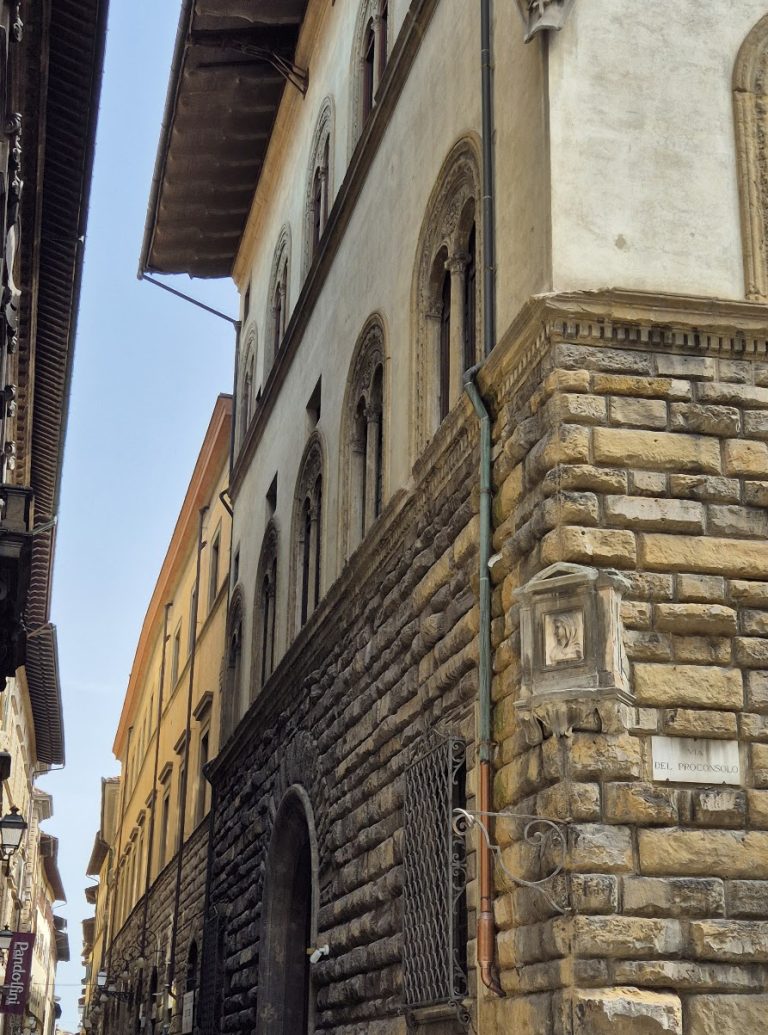
In the early sixteenth century, Giovan Battista Pandolfini commissioned Benedetto da Rovezzano to remodel the corner of the monastery between Via del Proconsolo and Via Dante Alighieri. The work incorporated the former Santo Stefano church, which became the Pandolfini Chapel, and created monumental entrances on both streets.
Seventeenth-Century Transformation and Later History
Abbot Serafino Casolani initiated a complete transformation of Arnolfo’s church. Between 1627 and 1631, Matteo Segaloni rotated the altar and changed the church into a Greek-cross plan, whose four arms are approximately equal in length. The altar then faced south toward the Arno. Further alterations followed in the eighteenth century, giving the interior much of its later character.
The Benedictine monastery was suppressed in 1810. Its buildings were subsequently divided and adapted for dwellings, shops, warehouses, and offices. In 1870, the entrance on Via del Proconsolo was reconfigured. Eroded elements were replaced, and a two-ramp staircase with a balustrade was replaced by steps. The earlier staircase had increasingly obstructed heavy street traffic, especially during the Carnival procession between Piazza Santa Croce and Piazza Santa Trinita. A glazed polychrome terracotta lunette attributed to Benedetto Buglioni was added at this time.
Modern investigations have altered the understanding of the medieval complex. Excavations and conservation revealed painted medieval decoration beneath the seventeenth-century white plaster. In 1940, Ugo Procacci identified the former location and altered setting of Giotto’s Badia Polyptych, leading to the discovery of surviving fresco fragments behind a later wall. The wall was removed over six months, revealing three scenes, although nearly all the heads had been removed except that of a shepherd.
The Chiostro degli Aranci was restored in 1921 by Giuseppe Castellucci. The organ built by Onofrio Zeffirini in 1558 was restored between 1979 and 1981 by Pier Paolo Donati, and the latest restoration of the campanile was completed in 2001. In the 1980s, an accidental inspection rediscovered the red-and-gold silk furnishing once used to cover the church interior during important ceremonies. The textile ensemble had been stored in a depot after being cut to fit Arnolfo’s church and could no longer be used there. Since 1998, part of the complex has been occupied by the Monastic Communities of Jerusalem, a Catholic monastic community of men and women devoted to urban contemplative life and communal prayer.
The abbey and its annexes also hosted several confraternities, including the Company of Sant’Omobono of the Tailors and the Congregation of the Buonomini of San Martino.
Remains
Medieval Church and Bell Tower
Gothic Church Fabric
The complex is entered from Via del Proconsolo and also retains historic entrances on Via Dante Alighieri. The sixteenth-century entrances lead through a vestibule with a loggia to the campanile or cemetery courtyard, from which the Pandolfini Chapel and the church can be reached.
Along Via del Proconsolo, the Arnolfian presbytery wall survives with four large lancet windows. They no longer correspond to the windows of the present interior. The old apse wall stands immediately behind the later church structure, separated from it by a narrow interspace. The original Gothic facade can be seen from the former court of the tribunal offices on Via dei Magazzini. Its surviving upper portion has a gabled form, a blocked oculus, and inserted ceramic decoration.
Arnolfo di Cambio’s Gothic church had three naves, a strongly colored appearance, a decorated ceramic floor, ornamented timber roof trusses, and walls where fresco decoration had begun. Excavations have found traces of the earlier colored floor. The medieval roof trusses remain above the present coffered ceiling, a ceiling divided into recessed panels.
Campanile
The campanile rises approximately 70 meters and carries the ancient angel weather vane associated with the Florentine expression about the changeable Angel of the Badia. Its lower base is square, while the upper structure has a hexagonal plan. The lower portion is Romanesque and the upper stages are Gothic. The tower stands between the towers of the Palazzo Vecchio and the Bargello.
Seventeenth-Century Church Interior
Greek-Cross Interior and Presbytery
The present church combines Gothic, Renaissance, Baroque, and later structures. Its Greek-cross plan results from the seventeenth-century reorientation of the altar and church axis. The interior is dominated by a richly carved wooden coffered ceiling made by Felice Gamberai by 1631. It conceals the earlier Gothic roof trusses, which survive above it.
The presbytery contains a sixteenth-century choir by Francesco and Marco Del Tasso. Giovanni Domenico Ferretti painted frescoes there in 1734, while Pietro Anderlini supplied architectural illusionistic painting. Ferretti also painted the apse decoration in 1733 and 1734.
Paintings and Chapels
Filippino Lippi’s large altarpiece, Apparition of the Virgin to Saint Bernard, was painted between 1482 and 1486. Piero del Pugliese commissioned it for the church of Santa Maria del Santo Sepolcro at the Campora monastery. It was transferred to Badia Fiorentina in 1530 to protect it from the siege of Florence. The scene shows Saint Bernard in ecstasy before the Virgin, with a furry, fanged demon concealed in the rock beneath him.
The Chapel of San Bernardo contains traces of a fourteenth-century fresco cycle depicting scenes from the life of Christ, attributed to Nardo di Cione. Other medieval frescoes survive on the present counterfacade and in the interspace between the former presbytery wall and the seventeenth-century structure.
The former Chapel of San Bernardo, once at the head of the left nave, and the interspace behind the later wall contained sections of a painted Thebaid, a Christian cycle depicting hermits and ascetics living in the Egyptian desert. The interspace frescoes are attributed to Giotto and his workshop. Fragments, including a Shepherd’s Head, are divided between the Pandolfini Chapel and the Galleria dell’Accademia.
The Baroque Chapel of San Mauro, formerly the second bay of the nave, was completely frescoed by Vincenzo Meucci in 1717. Its altar painting by Onorio Marinari shows Saint Maurus healing a crippled man. Above the chapel is a large carved and gilded wooden organ dated 1717.
The chapels beside the altar contain Mirabello Cavalori’s Pentecost on the right and Giovan Battista Naldini’s Ascent to Calvary on the left. Naldini’s painting dates from about 1570. Above Hugh II’s monument, on the left choir loft, is Giorgio Vasari’s Assumption and Saints, painted in 1568.
Monuments and Organ
The church contains the marble Neroni dossal by Mino da Fiesole, a decorative panel showing the Madonna and Child with Saints Leonard and Lawrence. Its funerary monuments include the tomb of Giannozzo Pandolfini from the workshop of Bernardo Rossellino, Bernardo Giugni’s tomb by Mino da Fiesole, and Mino’s monument to Hugh II of Tuscany.
The marble and porphyry monument to Hugh II was made between 1466 and 1481. It reworked the burial of the benefactor who died in 1001 and is surmounted by a personification of Charity. Bernardo Giugni’s tomb, placed near the entrance, includes an allegory of Justice rising above the sarcophagus. Giugni was a lawyer and diplomat who died in 1456, and his brother Ugolino Giugni, bishop of Volterra, commissioned the monument from Mino.
The right transept choir loft contains the pipe organ built by Onofrio Zeffirini in 1558. It has mechanical action, a richly decorated wooden case, a window console, one keyboard, a 20-note lectern pedalboard, and six stops.
Pandolfini Chapel and Recovered Medieval Paintings
The former Santo Stefano church was incorporated into the sixteenth-century remodeling commissioned by Giovan Battista Pandolfini and became the Pandolfini Chapel. It is reached from the cemetery courtyard and forms part of the group of structures connected with the historic entrances on Via del Proconsolo and Via Dante Alighieri.
Giotto’s Badia Polyptych, made around 1300 in tempera on wood, was formerly installed on the high altar and is now in the Uffizi Gallery. The altar’s position changed during the 1628 renovation, when two and a half walls were demolished. The surviving left half of the rear wall was covered by a later wall, behind which an Annunciation, the Presentation of Jesus at the Temple, and Joachim among the Shepherds were revealed.
The later wall also concealed surviving medieval fresco fragments. Nearly all the heads in the three revealed scenes had been removed, while the head of a shepherd remained. The recovered fragments, including the Shepherd’s Head, are divided between the Pandolfini Chapel and the Galleria dell’Accademia.
Chiostro degli Aranci
The Chiostro degli Aranci is a two-level cloister built between 1432 and 1438 by Bernardo Rossellino, with construction also associated with Antonio di Domenico della Parte and Giovanni d’Antonio da Maiano. Its upper gallery contains eleven frescoes depicting episodes from the life of Saint Benedict. They were painted between 1436 and 1439 and are attributed to the Portuguese painter Giovanni Consalvo, although another attribution associates them with Zanobi di Benedetto Strozzi under the guidance of Fra Angelico.
One lunette was replaced in the sixteenth century by the young Agnolo Bronzino with Saint Benedict Penitent in Ecstasy. The painting was transferred to canvas in the nineteenth century. Two other lunettes in the southeast corner have a later Gothic character and may predate the principal fresco cycle.
The cloister frescoes were detached in the twentieth century, while their sinopie, the preparatory drawings made beneath frescoes, remain visible in situ. The cloister therefore preserves both the painted cycle’s historical association and the underdrawings connected with its preparation.
Works Formerly Associated with the Abbey
Several important works once connected with Badia Fiorentina are now held elsewhere. Giotto’s Badia Polyptych is in the Uffizi Gallery, as is Fra Bartolomeo’s Apparition of the Virgin to Saint Bernard. Andrea Orcagna’s Pentecost is in the Galleria dell’Accademia, while Masaccio’s fresco of Saint Ivo, commissioned for a church pier by the Arte dei Giudici e Notai, is lost.
Nearby sites