Novospassky Monastery: A Romanov Monastic and Burial Complex in Moscow


Site at a Glance
- Rating
- 4.9
- Popularity
- Medium
- Country
- Russia
- Primary era
- Early Modern
- External website
- Open
- Eras represented
- Early Modern, Modern
- Civilizations
- Russian
- Site type
- Religious
- Remains
- Fortified Monastery
On this page20 sections
History
Novospassky Monastery is a Russian Orthodox monastery in Moscow, Russia, whose present architectural ensemble developed chiefly during the seventeenth and eighteenth centuries. Its history reaches back to a monastic community established around 1330 under Grand Prince Ivan I, also known as Ivan Kalita, and it became closely connected with the Romanov dynasty as a family burial place and religious foundation.
Foundation and the New Savior
The original community was associated with the Kremlin monastery of the Savior. In 1490, Grand Prince Ivan III, the ruler who consolidated Moscow’s authority over much of the Russian lands, transferred the community beyond Taganka to Krutitsy Hill beside the Moskva River. The new foundation received the name Monastery of the New Savior. Its first stone Cathedral of the Transfiguration was built in 1494.
Novospassky served a defensive purpose as well as a religious one. Its wooden fortifications withstood attacks by Crimean Tatar forces in 1571 and 1591. During the early seventeenth century, the monastery also endured a siege by Polish troops. In 1612, Russian militia preparing for the final liberation of Moscow from Polish-Lithuanian forces gathered near its walls.
Romanov patronage and the seventeenth-century rebuilding
The monastery had long been a burial place for members of the Romanov family and related boyar houses. After the Romanovs came to the Russian throne in 1613, royal patronage increased greatly, and building activity gave the monastery much of the form associated with it today.
Patriarch Filaret, father of the first Romanov tsar, Mikhail Fedorovich, built a stone bell tower with a church dedicated to Saint Sabbas the Sanctified in the 1620s. By order of Tsar Mikhail Fedorovich, the wooden defensive walls began to be replaced with stone in 1640. The present Cathedral of the Transfiguration was begun in 1645, completed under Tsar Alexei Mikhailovich, and consecrated in September 1647.
Nikon, who later became Patriarch of Moscow and All Rus, was the monastery’s archimandrite from 1646 to 1649. An archimandrite is the senior head of a major Orthodox monastery. Royal gifts and privileges helped make Novospassky one of the wealthiest monasteries by the end of the seventeenth century. In 1689, Tsar Peter I ordered the Transfiguration Cathedral to receive painted murals, and in 1717 he ordered a new cathedral bell weighing 1,100 poods, a historical Russian unit of weight.
Reform, war, and nineteenth-century renewal
Catherine II’s secularization reforms of 1764 removed the monastery’s landed estates and much of its income. The resident community subsequently declined considerably. The architectural complex nevertheless continued to develop, including the construction of the Church of the Sign of the Virgin between 1791 and 1795.
The monastery suffered extensive damage during the Napoleonic invasion of 1812, including damage caused by fire. In March of that year, Ambrose Ornatsky became its superior and chairman of the Committee of Spiritual Censorship. In 1813, the Synod assigned him responsibility for restoring Moscow monasteries damaged by the French. By 1820, the damaged buildings had been repaired, a new two-storey building had been erected along the western defensive wall, and a replacement bell had been cast from the remains of Peter I’s bell. The monastery churches were renewed during the 1830s and 1840s.
Archimandrite Jonathan administered Novospassky from 1853 to 1859. During his tenure, the Church of the Resurrection was completed and consecrated. The monastery also retained its role as an aristocratic necropolis during the eighteenth and nineteenth centuries. Among those buried there were the painter Fyodor Rokotov, Moscow mayor Nikolai Alexeyev, historian Platon Beketov, theater figure Ivan Gagarin, and Decembrist Pyotr Titov. Decembrists were participants in the failed December 1825 uprising by Russian military officers and reformers against autocratic rule.
The Romanov memorial association
After Emperor Nicholas II visited the monastery in 1900, a church dedicated to Saint Romanos the Melodist was planned within the Romanov burial vault. The church was consecrated in 1902 in the presence of Grand Duke Sergei Alexandrovich Romanov. Nicholas II visited Novospassky again during the tercentenary of the Romanov dynasty, which ruled Russia from 1613 until the monarchy was overthrown in 1917.
The priest Pyotr Venyaminov was also buried at Novospassky. French forces killed him during the 1812 invasion after he refused to reveal the monastery’s treasures. In 1810, the nun Dosifeya was buried at the monastery. She was traditionally, though controversially, identified as Princess Tarakanova, and that identification remains uncertain.
Closure, Soviet use, and return to the Church
Novospassky Monastery was closed in 1918 after the fall of the monarchy. A concentration camp was established on its territory, while monuments considered to have museum value were assigned to the museum of Simonov Monastery. In 1925, the site housed the Second Women’s Correctional Facility.
Architect Sergei Rodionov carried out restoration work during the 1920s, but the monastery’s cemetery was demolished between 1927 and 1930. The cemetery had occupied as much as two-thirds of the grounds. The monastery itself was threatened with demolition for a residential complex designed by Arkady Mordvinov, although only three buildings from that project were constructed.
From 1935, the NKVD economic administration controlled the territory. The NKVD, the Soviet People’s Commissariat for Internal Affairs, was responsible for internal security, policing, and related state administration. Monastic buildings were converted for administrative and domestic purposes or into housing. The Transfiguration Cathedral housed the Moscow regional NKVD archive, while the Church of Saint Nicholas was used to store confiscated furniture and potatoes. The territory was also used successively as a prison, a police drunk tank, housing, and an art institute or restoration facility.
Residents began to be removed in 1960. In 1968, the authorities decided to establish a museum devoted to the history and contemporary practice of restoration in the Soviet Union, with a restoration-history museum planned for the cathedral. A restoration centre operated on the territory from 1985 until the end of 1990. The monastery was then returned to the Moscow Patriarchate.
Monastic life was revived in April 1991, and the monastery was formally returned to the Russian Orthodox Church that year. A male monastery choir was founded in July 1991, followed later by a Sunday school and a boys’ choral school. The Romanov burial vault was restored in the late 1990s, and the reconstructed Church of Saint Romanos the Melodist was consecrated on 10 March 2002.
In 1995, the remains of Grand Duke Sergei Alexandrovich, who had been assassinated in 1905 by the Socialist-Revolutionary terrorist Ivan Kalyayev, were transferred to Novospassky. A memorial cross based on a surviving design by Viktor Vasnetsov was erected there and reconstructed in 2017. A monastery history museum opened in 2011. In 2012, the so-called Italian Courtyard, where executions took place in the 1920s, was opened for public veneration and visitation.
In February 2014, Patriarch Kirill consecrated a 16-ton Romanov bell cast as a replacement for a historic bell destroyed in the twentieth century. In February 2015, the monastery received from Greece an incorrupt right-hand relic of Saint Demetrius of Thessaloniki. The transfer commemorated the seventieth anniversary of victory over fascism and reflected the saint’s longstanding association in Russia with military valor, patriotism, and the defense of the homeland. Novospassky is a stauropegial monastery, meaning that it is placed directly under the authority of a patriarch or another senior church authority rather than the ordinary administration of a local bishop. It belongs to the Moscow Diocese and is a federally protected Russian cultural-heritage monument.
Remains
Novospassky is organized as a fortified monastic enclosure on Krutitsy Hill near the Moskva River. Stone and brick are the principal building materials. Within the enclosure are the Cathedral of the Transfiguration, several churches, defensive walls and towers, monastic residences, service buildings, burial spaces, and surviving gravestones from the former cemetery.
Fortifications and monastic buildings
Defensive walls and towers
The stone defensive wall built from 1640 onward measures approximately 650 metres in length, reaches up to 7.5 metres in height, and is up to 2 metres thick. Three gates and five corner towers formed the enclosure. Loopholes and positions for cannon and muskets show how the walls supported the monastery’s defensive role.
Residential and service buildings
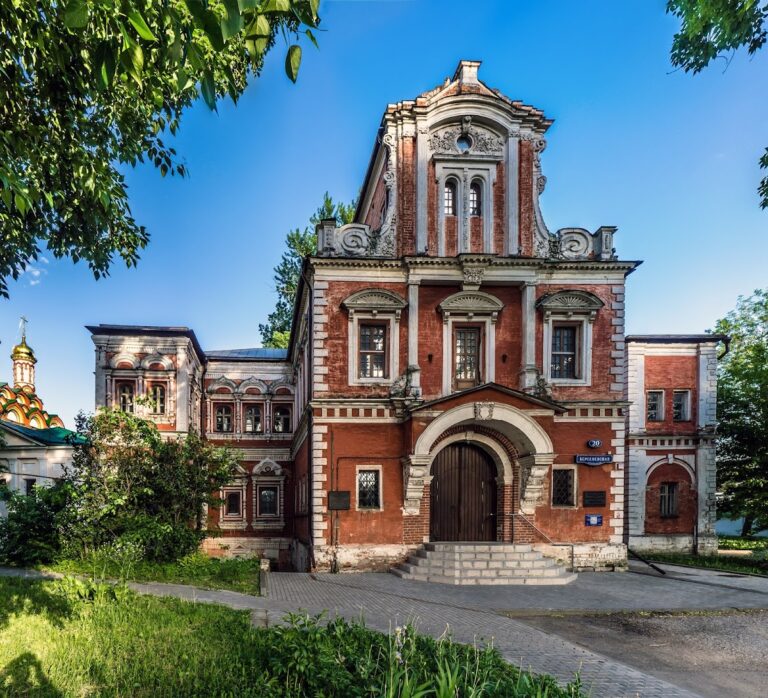
The complex includes monks’ cells adjoining the Church of Saint Nicholas, a superior’s residence dating from the seventeenth or eighteenth century, the house of Patriarch Filaret, the Bread-Giving Chamber, and other residential and service buildings. After the repairs following the 1812 fire, a new two-storey building along the western wall provided cells, a kitchen, and related facilities.
Churches and bell tower
Cathedral of the Transfiguration
The Cathedral of the Transfiguration was built between 1645 and 1649 as a large five-domed church replacing the fifteenth-century cathedral. Its interior contains frescoes by seventeenth-century Muscovite painters. The murals depict saints alongside Homer, Orpheus, Plato, and other ancient philosophers and writers. Their arrangement below the saints expressed the intended superiority of Christianity over pagan civilization.
Church of the Intercession
The Church of the Intercession of the Virgin was built with its refectory, a communal dining building, in the 1670s, more specifically between 1673 and 1675.
Church of the Sign
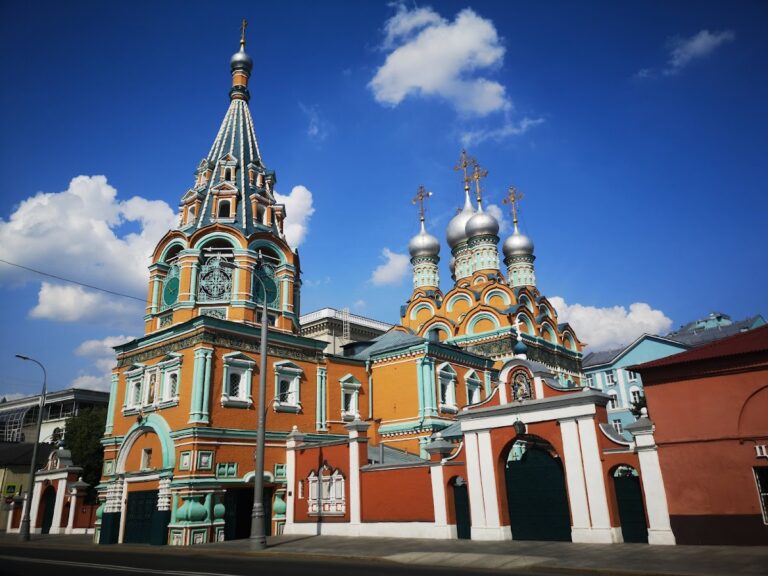
The Church of the Sign of the Virgin was built between 1791 and 1795 at the northwestern corner of the defensive walls, replacing an older church on the site. Designed by Yelizar Nazarov, it served as the burial church of the Sheremetev family and also contained burials of the Kurakins and Lobanov-Rostovskys.
Bell tower
The present bell tower stands on the site of the earlier tower erected by Patriarch Filaret in 1622. Built between 1759 and 1785, it rises 78 metres and was among the tallest bell towers in pre-revolutionary Moscow. Its design imitated the bell tower of the Trinity-Sergius Lavra. The 16-ton Romanov bell, consecrated in 2014, replaced a historic bell destroyed during the twentieth century.
Romanov burial vault and memorials
Romanov burial vault
The Romanov burial vault occupies the basement of the Transfiguration Cathedral. It contains graves of the Zakharin-Koshkin and Zakharin-Romanov families, ancestors and relatives of the Romanov dynasty. Those buried there include Vasily Yuryevich Zakharin, buried in 1497 or 1498; Roman Yuryevich Zakharin, who died in 1543 and gave his name to the Romanov family; Vasily Yuryevich Zakharin, a cousin of Anastasia Romanova; Nikita Romanovich Yuryev-Zakharin, later the monk Nifont and father of Patriarch Filaret; and the nun Martha, mother of the first Romanov tsar, who died in 1631.
In 1607, the remains of three brothers of Patriarch Filaret, who had died in exile during the reign of Boris Godunov, were transferred to the vault. The vault was plundered after the monastery closed in 1918. Tombstones were destroyed and some graves were lost. Some remains were transferred to an underground chamber in the southern annex of Moscow’s Cathedral of the Archangel before the Romanov vault was reconstructed. Architect Sergei Solovyov rebuilt the vault in 1902, and its reconstructed Church of Saint Romanos the Melodist was consecrated in 2002.
Other noble burials
The basement of the Transfiguration Cathedral also contains burials of the Sitsskys, Cherkasskys, Yaroslavskys, Obolenskys, Troekurovs, Trubetskoys, and Naryshkins, among other prominent pre-Petrine noble families. A memorial monument over Vladimir Novosiltsev’s grave was regarded as a masterpiece of memorial sculpture and was made to a design by Vasily Demut-Malinovsky.
The Church of the Sign contains family burial places of the Sheremetevs, Kurakins, and Lobanov-Rostovskys. State Chancellor Alexei Cherkassky was buried in 1742 in the basement of the earlier church on the same site, in the presence of Empress Elizabeth. The surviving gravestones in the monastery courtyard are remnants of the former aristocratic cemetery. The monument to Pyotr Venyaminov bore an epitaph commemorating his death for faith and tsar.
Sergei Alexandrovich memorial
The remains of Grand Duke Sergei Alexandrovich were transferred to the monastery in 1995. A memorial cross based on Viktor Vasnetsov’s surviving design stands at the burial site and was reconstructed in 2017.
Archaeological and historical collections
Archaeological excavations within the monastery produced objects that form the basis of the monastery museum’s collection. Together with material associated with the Romanov vault, the historic and reconstructed bells, the memorial cross, and the surviving gravestones, these remains illustrate successive phases of burial, destruction, and restoration at Novospassky.
Nearby sites