Saikoku-ji Temple: A Historic Shingon Buddhist Temple in Onomichi


Site at a Glance
- Rating
- 4.3
- Popularity
- Low
- Country
- Japan
- Primary era
- Medieval
- External website
- Open
- Eras represented
- Medieval, Early Modern
- Civilizations
- Ashikaga shogunate, Tokugawa
- Site type
- Religious
- Remains
- Monastery
On this page10 sections
History
Saikoku-ji Temple is a major Shingon Buddhist temple in Onomichi, Japan, founded according to tradition during the Tenpyo era, around 729–749. Shingon is an esoteric Buddhist tradition in Japan, and Saikoku-ji belongs to its Daigo branch. Its formal name is Mani-san Soji-in Saikoku-ji, combining the mountain name Mani-san, the institutional name Soji-in, and its status as a principal temple, a high-ranking center within the branch.
Foundation and imperial patronage
Temple tradition attributes the foundation to Gyoki, a prominent Nara-period Buddhist monk associated with religious instruction, temple founding, and public works. While travelling through the country, Gyoki is said to have experienced a spiritual dream of Kamo Myojin, a Shinto deity associated with the Kamo shrines and their worship tradition. The tradition holds that he established Saikoku-ji after this experience.
Fire destroyed most of the temple buildings in 1066. On the command of Emperor Shirakawa, the abbot Keiban rebuilt the temple, and a large complex extending from the foot to the middle slopes of Atago Mountain was completed in 1081. Saikoku-ji became Shirakawa’s prayer temple in 1082. After he became a retired emperor, he made it an imperial prayer temple in 1108. The temple then functioned as an official institution with more than 100 branch temples and was regarded as the leading temple complex along the Sanyo Road.
Medieval reconstruction and institutional change
In 1312, Emperor Hanazono issued an imperial order under which the temple adopted the name Saikoku-ji. It remains the largest-scale temple among the many temples of Onomichi. During the Eiwa era, around 1375–1378, another fire destroyed the complex. The Yamana clan, a military-governor family of Bingo Province, undertook its restoration. The Main Hall was rebuilt in 1386.
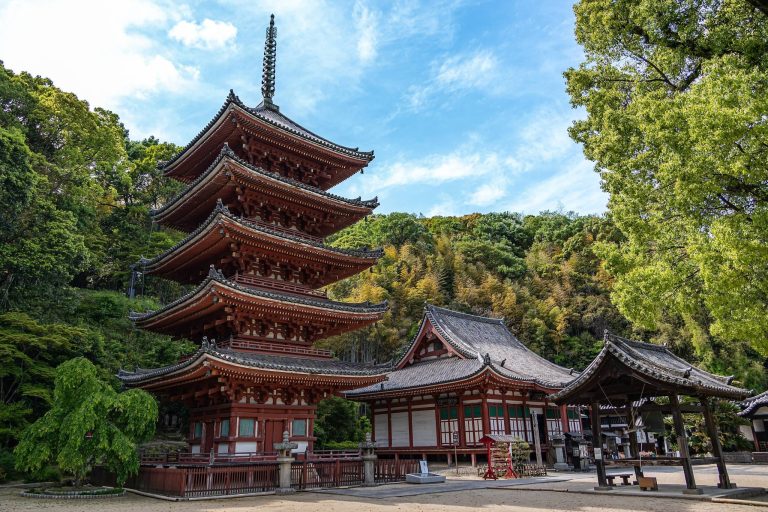
The Three-Story Pagoda was erected in 1429 through a donation from Ashikaga Yoshinori, the sixth shogun of the Muromachi shogunate. The Muromachi period was the era of the Ashikaga shogunate. For a time, Saikoku-ji separated from the Daigo branch and served as the head temple of the Saikoku-ji branch of Shingon Buddhism. It later returned to the Daigo branch.
Religious role and heritage status
Saikoku-ji’s principal image is a concealed Buddhist image of Yakushi Ruriko Nyorai, the Buddha associated with healing and medicine. The temple forms part of several pilgrimage networks. It is the sixteenth station of the Chugoku Forty-Nine Yakushi pilgrimage, the nineteenth station of the Sanyo Flower Temples pilgrimage, the sixth station of the Bingo Thirty-Three Kannon pilgrimage, and one of the temples associated with the Chugoku Thirty-Three Kannon pilgrimage. Kannon is a bodhisattva associated with compassion.
The Main Hall and Three-Story Pagoda became Important Cultural Properties of Japan on April 14, 1913. The Nio Gate received designation as an Important Cultural Property of Hiroshima Prefecture on April 28, 1969. The three buildings are also components of the Japan Heritage designation.
Saikoku-ji formerly held a ten-volume copy of the Konkomyo Saishoo Sutra, written in gold on purple paper. The text had originally been deposited at the provincial temple of Bingo during the reign of Emperor Shomu. After the Second World War, it became state property and is now held by the National Institutes for Cultural Heritage at the Nara National Museum.
Remains
Saikoku-ji occupies the foot and middle slopes of Atago Mountain in Onomichi. Its surviving complex includes the Main Hall, Three-Story Pagoda, and Nio Gate, with the buildings representing different phases of reconstruction from the Muromachi period to the early Edo period.
Temple buildings
Main Hall
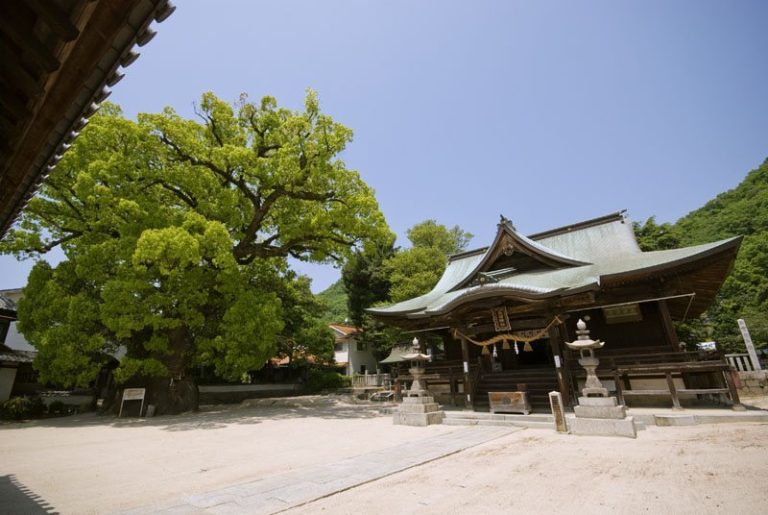
The Main Hall was rebuilt in 1386 by the Yamana clan and is a surviving example of the temple’s Muromachi-period reconstruction. Its inner sanctuary contains the temple’s principal image, a 91-centimetre-high wooden seated statue of Yakushi Nyorai. The image is enshrined on a Sumeru pedestal, an altar supporting a principal Buddhist image and symbolically corresponding to Mount Sumeru in Buddhist cosmology. It is concealed from ordinary view and is traditionally said to have been brought from Zentsu-ji in Sanuki Province.
Three-Story Pagoda
The Three-Story Pagoda dates from 1429 and was erected through the donation of Ashikaga Yoshinori. It forms part of the surviving medieval architectural group at Saikoku-ji and stands alongside the Main Hall as one of the temple’s nationally designated Important Cultural Properties.
Nio Gate
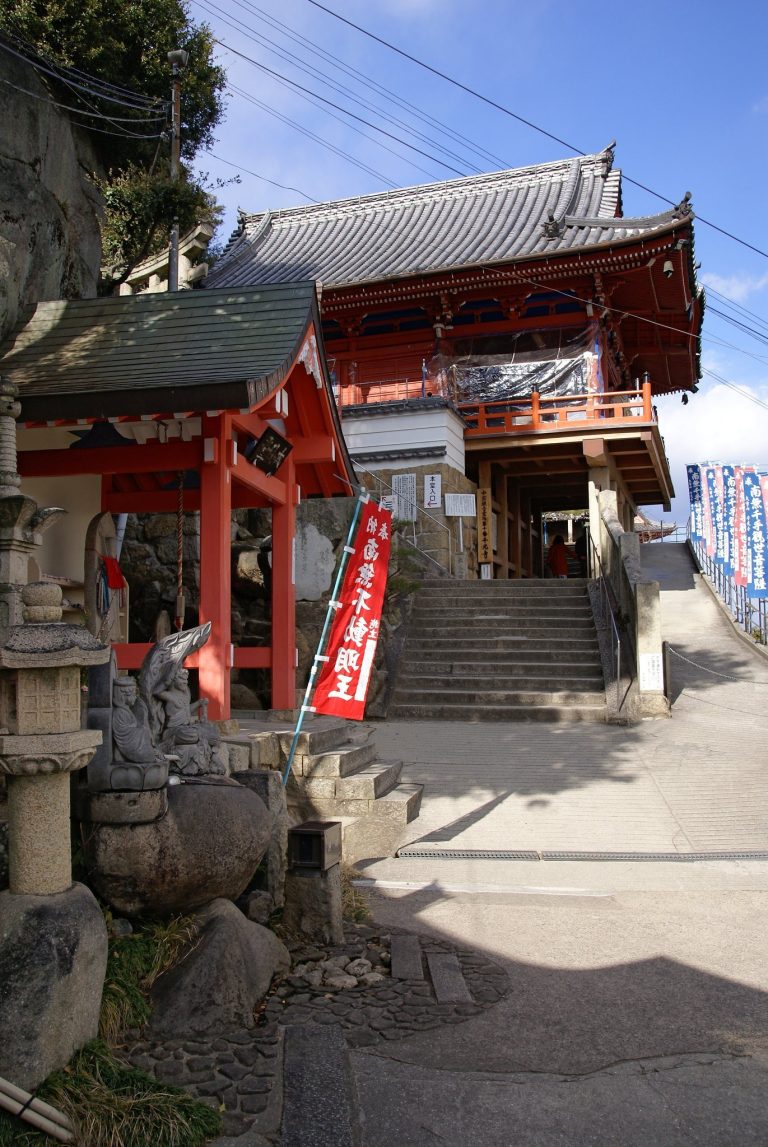
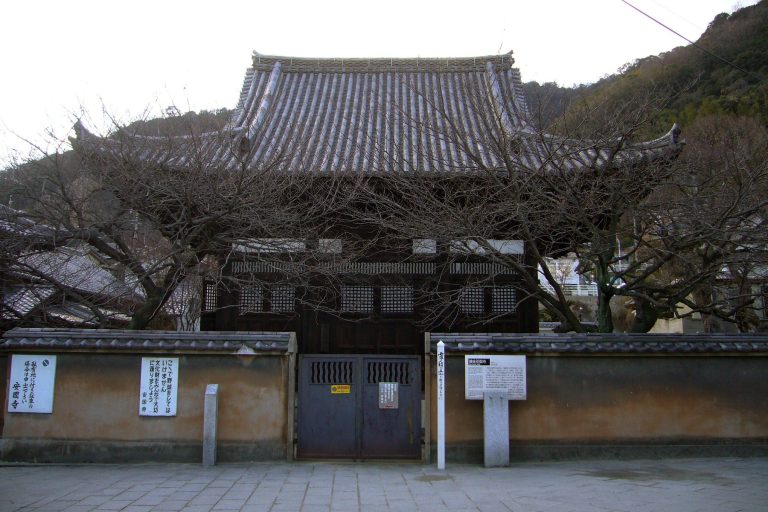
The Nio Gate was built in 1648, during the early Edo period. A Nio Gate is a Buddhist temple entrance traditionally guarded by two powerful guardian figures. Saikoku-ji’s gate carries a giant pair of straw sandals, each approximately 2 metres in size, identified as a symbol of the temple.
Buddhist sculpture
A wooden standing statue of Shaka Nyorai is installed in a side room beside the guest hall. The statue dates from the Kamakura period, an era associated with the rise of warrior government and major developments in Japanese Buddhist sculpture. Tradition attributes the work to the sculptor Kaikei, although its actual maker is unknown.