Ballycowan Castle: A Sixteenth-Century Fortified House in Ireland


Site at a Glance
- Rating
- 4.2
- Popularity
- Very Low
- Country
- Ireland
- Primary era
- Early Modern
- Eras represented
- Early Modern
- Civilizations
- English
- Site type
- Military
- Remains
- Castle
On this page8 sections
History
Earlier Gaelic origins
Ballycowan Castle is a ruined fortified house in Ireland, located about 4 kilometres west of Tullamore in County Offaly. Thomas Morres built it in 1589 as a residence designed to combine domestic life with defensive features. The new building replaced an earlier O’Molloy castle or tower house called Baile Mhic Abhainn, which had been destroyed by fire in 1557. The O’Molloys were an Irish Gaelic ruling family associated with the territory around present-day County Offaly.
The site is mentioned in the Annals of the Four Masters, a major compilation of medieval and early-modern Irish historical records. It also appears in volume 5 of Michael O’Clery’s Annals of the Kingdom of Ireland, published in 1856, and in a poem by Ferganainm Mac Keogh about the victories of Hugh O’Byrne of Glenmalure.
The Herbert enlargement
In 1626, Sir Jasper Herbert and his wife, Lady Jane Finglas, added an adjoining tower. Their land had been granted during the plantations in Ireland, English colonization schemes that transferred land to settlers and supporters of English rule. Herbert was related to Queen Elizabeth I.
Herbert later lost both his lands and Ballycowan Castle during confiscations. He was Catholic and supported Catholic rebels seeking Irish independence. During the Cromwellian period, when Oliver Cromwell’s forces conquered much of Ireland, the southern end of the castle was blown up from a hill roughly 90 metres away. After the rebellion was suppressed, the castle lands and property were confiscated and transferred to the Earl of Mountrath in 1666. Ballycowan is now a ruin. Its Irish names include Baile Mhic Abhainn and Caisleán Bhaile Mhic Comhainn.
Remains
Castle complex
Fortified house
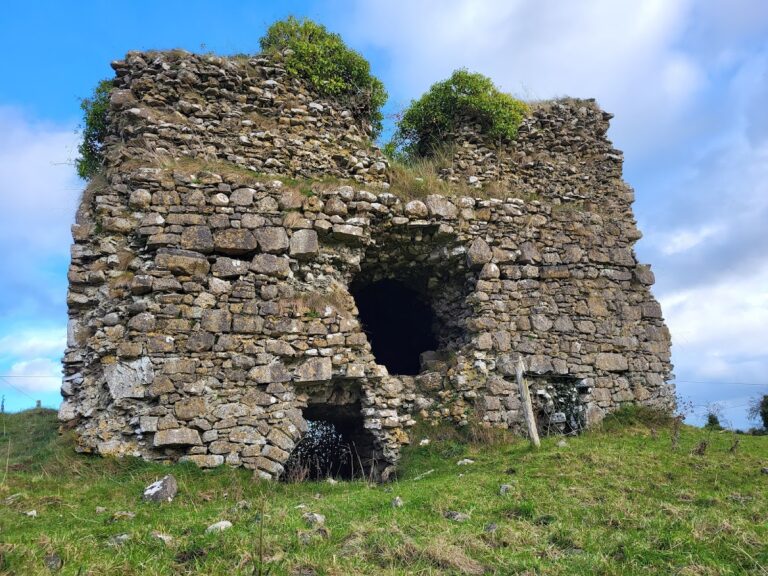
Ballycowan Castle is a lowland fortified house built from rubble stone and arranged on an L-shaped plan. A defensive wall once enclosed the complex, while surviving ruins include residential buildings, service structures, and chimney stacks. The remains preserve the domestic and defensive character of the building erected by Thomas Morres in the late sixteenth century.
Herbert tower
The adjoining tower forms part of the surviving castle complex. Built in 1626, it is associated with Sir Jasper Herbert and Lady Jane Finglas. An inscription on the ruins identifies the builders and gives the construction date, while a coat of arms connected with Herbert remains on a gable. These features preserve evidence of the enlargement carried out during the period of the plantations.
Ancient church
Ruins of an ancient church stand near the castle, adding a separate ecclesiastical feature to the surviving remains around Ballycowan.
Nearby sites