Meyendorff Castle: A Neo-Gothic Estate and Russian State Residence


Site at a Glance
- Rating
- 4.1
- Popularity
- Very Low
- Country
- Russia
- Primary era
- Modern
- Eras represented
- Modern
- Civilizations
- Russian
- Site type
- Domestic
- Remains
- Castle
On this page8 sections
History
Meyendorff Castle is a nineteenth-century Neo-Gothic residence in Russia, located at Barvikha in Moscow Oblast. Built between 1874 and 1885 as a private home for the Swedish-Baltic German Meyendorff family, it later passed through aristocratic, Soviet medical, and modern state uses.
Construction and the Meyendorff family
Construction was initiated by Nadezhda Kazakova, the daughter of General A. B. Kazakov. The residence was completed in 1885, and Kazakova married General Staff Colonel E. A. Verigin in 1886. After Verigin’s death in 1891, she married Baron Michael Felixovich Meyendorff in 1904, bringing the estate into the Meyendorff family.
The Meyendorffs belonged to a cadet line, or junior branch, of the Baltic German noble House of Uexküll. The castle was designed in the Châteauesque manner, which imitates the elaborate forms of French châteaux, with Neo-Gothic features that revived elements of medieval Gothic architecture.
Revolution and Soviet transformation
The Meyendorffs went abroad for medical treatment in 1914 and remained outside Russia during the First World War. The Revolution of 1917 and the Civil War that followed prevented their return to the estate.
After the October Revolution, Vladimir Lenin, the Bolshevik revolutionary and founding leader of the Soviet state, lived and worked at the castle for a time. Until 1935, the property served as a colony for Red Army orphans. In that year, the former aristocratic estate became the Barvikha Sanatorium of the Council of Ministers of the Soviet Union. A Soviet sanatorium was a state institution for medical treatment, convalescence, and organized rest. Mikhail Bulgakov, Sergei Korolev, and Yuri Gagarin stayed there for treatment or rest.
During the Second World War, known in Soviet and Russian usage as the Great Patriotic War, the castle housed a military hospital. A soldiers’ cemetery was established in the surrounding park during the same period.
Restoration and state use
A major restoration took place in 2003 and 2004. The building was substantially remodeled and adapted for state use. Since November 2008, the official presidential website has referred to the property as State Residence Barvikha.
The castle is owned by the Presidential Administration of the Russian Federation. It is used for official meetings with foreign heads of state and government, leaders of State Duma factions, and other officials. The State Duma is the lower house of Russia’s federal parliament. The property also serves as a residence for the Russian president and is made available to visiting foreign heads of state. While Gorky-9 was being renovated, President Dmitry Medvedev primarily resided at Barvikha until that work was completed.
On 2 November 2008, the presidents of Azerbaijan, Armenia, and Russia signed the Meyendorff Declaration at the castle. The declaration addressed the Nagorno-Karabakh conflict, a long-running dispute involving Armenia and Azerbaijan over the Nagorno-Karabakh region, and was intended to support efforts toward its resolution. The estate is a regionally significant cultural-heritage property of the Russian Federation.
Remains
Castle and park
The castle
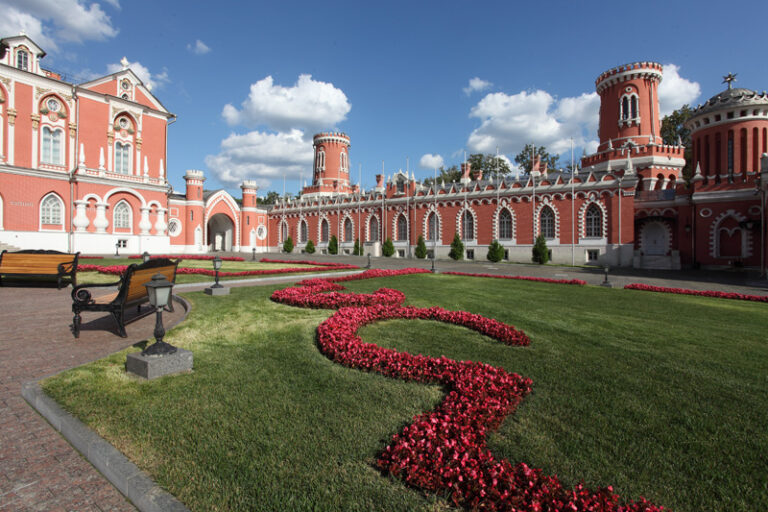
The approximately 1,300-square-metre castle stands near Podushkino and Odintsovo along Podushkinskoye Highway, west of Moscow. It is a Châteauesque building in the Neo-Gothic style, shaped after French châteaux of the early sixteenth century. The original residence was constructed between 1874 and 1885, then later substantially remodeled. Its restoration and adaptation for state use preserved the building as the central architectural feature of the estate.
The military cemetery
The estate includes a park with a military cemetery established during the Second World War. The cemetery contains Evgeny Vuchetich’s sculpture Grieving Mother, a replica by the artist of his sculpture at the Stalingrad Battle memorial on Mamayev Hill. Vuchetich was a major Soviet monumental sculptor known for large memorial works commemorating the Second World War.
Since 2009, a metal fence has separated the castle grounds from the adjoining sanatorium area of the park. The physical division forms part of the estate’s present arrangement, alongside the restored castle and the wartime cemetery.
Nearby sites