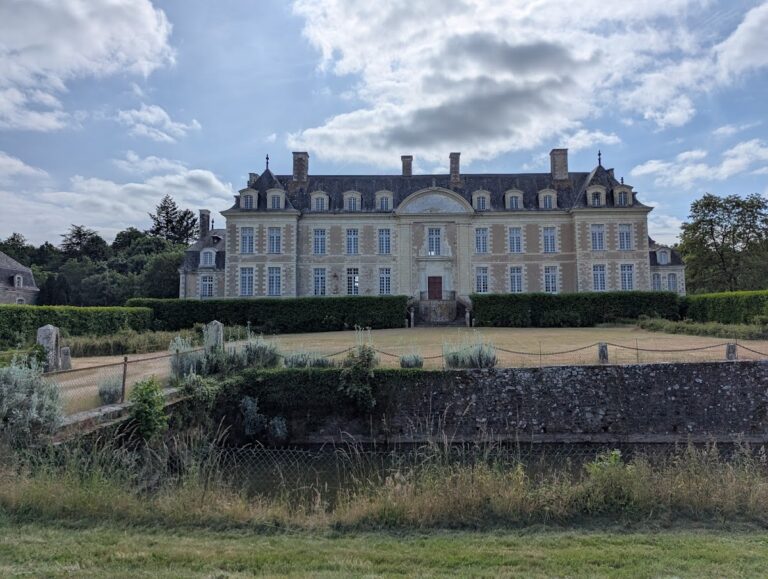
Château de la Rongère: A Historic Noble Estate in France


Site at a Glance
- Rating
- 4.4
- Popularity
- Very Low
- Country
- France
- Primary era
- Early Modern
- External website
- Open
- Eras represented
- Medieval, Early Modern
- Civilizations
- French
- Site type
- Domestic
- Remains
- Elite Residence
On this page9 sections
History
Medieval lordship and feudal obligations
Château de la Rongère is an eighteenth-century château in France, near Saint-Sulpice in La Roche-Neuville, whose estate developed from a medieval fief and lordship associated with Château-Gontier. The site appears in records as “H. de Rongeria” in 1239, as the lodging of La Rongère in 1414, and later as the high-justice domain, land, fief, and lordship of La Rongère. A fief was a landed holding granted within a feudal relationship in return for defined obligations.
In 1239, the lord of Laval granted the feudal rights of La Rongère to Jacques de Château-Gontier as part of his marriage to Avoise de Laval. Because the fief depended on Château-Gontier, its holder owed forty days of guard duty there and had to summon the men responsible for protecting La Rongère when their service was required. High justice, meaning the authority to hear serious criminal cases and impose the highest judicial penalties, was recognized at La Rongère in 1404 and 1431. The estate was not, however, granted the territorial title of a châtellenie, a jurisdiction linked to a castle and its lord.
The Quatrebarbes family became associated with La Rongère at an early date. Macé Quatrebarbes acquired the estate in 1293 for 12,000 livres. Members of the family occasionally used the title “marquis of La Rongère,” but this was a personal designation rather than the official title of a territorial jurisdiction.
From the medieval lodging to the château
The fifteenth-century lodging was replaced by a castle between 1545 and 1571. During the religious conflicts of the sixteenth century, the site was visited by the Duke of Rohan, a leader of a Protestant faction. Local Huguenots, French Protestants chiefly associated with the Reformed tradition, had turned him against Gilles de Quatrebarbes. Rohan entered La Rongère without resistance, was received respectfully, and realized that he had been misled. He left without hostile action and later maintained friendly relations with the lord of La Rongère.
The complex continued to expand during the seventeenth century. A further residential building had been completed by 1675, when an inventory listed extensive tapestries, paintings, and silverware. The present château belongs to a later eighteenth-century phase. During this period, La Rongère became the habitual residence of the marquises of Montecler, while the estate included the pond, high-forest woods, and the parish lordship.
The Montecler and Chavagnac families
Ownership and lordship passed through the Quatrebarbes, Menon, Montecler, and Chavagnac families. In 1705, François Henri de Menon de Turbilly received the château, the high-forest woods, the La Rongère pond, and the parish lordship. Joseph-François, marquis of Montecler, married Jeanne Hyacinthe de Menon de Turbilly, lady of La Rongère, in 1716. Their son, Hyacinthe-François-Georges, count of Montecler, retired to La Rongère in 1759 and died there in 1764.
His daughter Hyacinthe-Jeanne later married René-Georges-Marie de Montecler. He emigrated in 1791 during the French Revolution, while she was imprisoned during the Terror, the period of intensified revolutionary repression, and died in 1805. The Chavagnac succession began through the marriages of Henriette-Françoise and Agathe-Françoise de Montecler to the marquis Henri-Frédéric de Chavagnac and the count Louis-Vigile de Chavagnac. The château and its estate subsequently passed to the Chavagnac family.
Revolutionary conflict and later protection
La Rongère was involved in the military unrest of western France during the Revolution. A republican post at the La Rongère causeway was attacked by Chouans during the night of 18–19 May 1794. The Chouans were royalist insurgents who fought the French Revolutionary government. Two men were killed and a third was wounded.
Jean Bezier first lived at the La Rongère mill in 1797 and then at the château in 1800, where he was received by Henriette-Françoise de Montecler, marquise Henri-Frédéric de Chavagnac and lady of La Rongère. In 1814, the Count of Artois, the future King Charles X, made Bezier a knight of the Order of Saint-Louis, a royal military order awarded for military service. Bezier was later appointed colonel of the Legion of the Royal Army of Maine.
The château’s façades and roofs were listed as historic monuments on 16 May 1991, and the park received classification as a historic monument on 10 October of the same year. These protections recognize both the surviving buildings and the designed landscape. The property remains privately owned by Jacques and Véronique de Chavagnac.
Remains
The château and eighteenth-century landscape
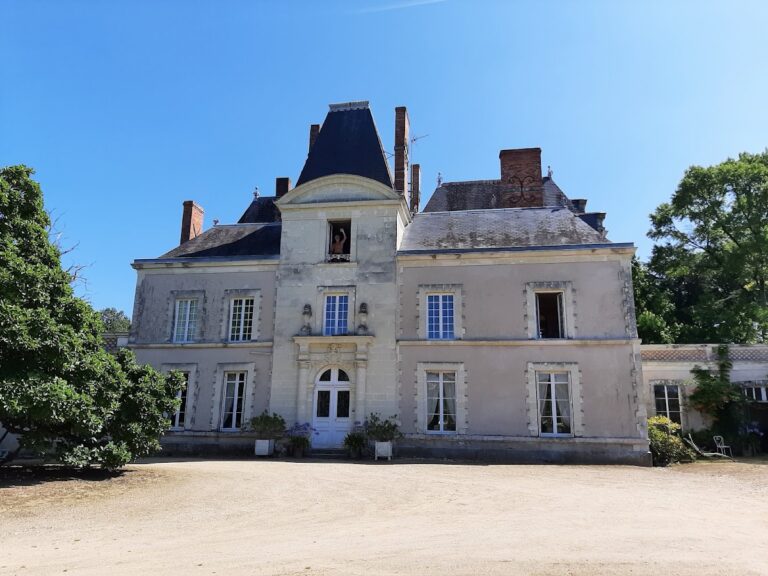
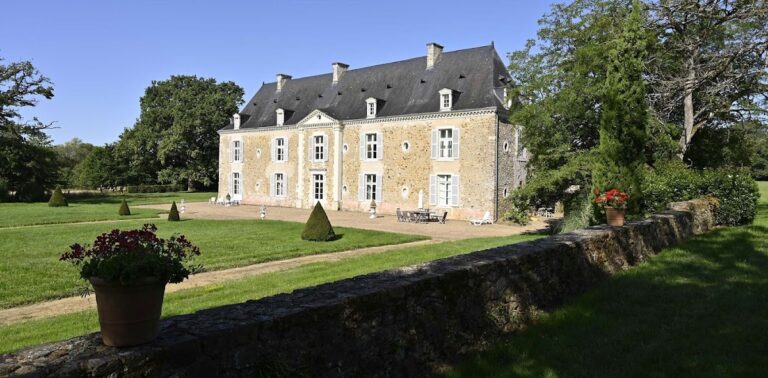
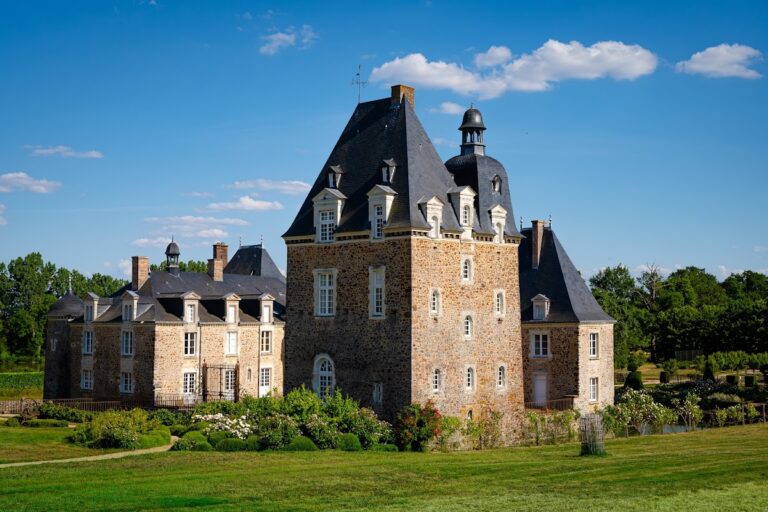
Château de la Rongère stands near Saint-Sulpice, about one kilometre from the village. A stream rises on the estate and runs for approximately 1,000 metres before joining the Mayenne as a tributary. The eighteenth-century château has simple, carefully proportioned architecture. Its terraces and gardens overlook the Mayenne, while avenues, lawns, groves, mature trees, and planted areas extend through the estate.
The present building forms part of a longer architectural sequence. The medieval lodging gave way to the sixteenth-century castle, an additional residential building had been added by 1675, and the eighteenth-century château represents the later residential phase of the complex. An art gallery contains a series of portraits of the Froulay family.
Religious buildings and ceremonies
A chapel dedicated to Saint James stood within the La Rongère estate near the church of Saint-Sulpice. It was endowed in 1365 with an obligation to celebrate three Masses. Its chapelains included members of the Quatrebarbes family, Robert Rolland, François de la Lande, parish priest of Saint-Sulpice, and Joseph-François de Montecler. The chapel served religious and matrimonial purposes, including the marriage of Gaspard L’Enfant, lord of Saint-Gilles, and Suzanne-Thérèse de la Matraye in 1738. Its preservation was requested in Year XIII, the thirteenth year of the French Revolutionary calendar, which was used in France from 1793 to 1805.
River crossing and water-powered features
The estate’s historic transport facilities were connected with the Mayenne. The La Rongère ferry provided a frequently used crossing and was accompanied by a boat port. In 1669, a parish procession crossed the river by barge to reach Villiers. Financial assistance was granted in 1774 for a road linking the ferry with the boat. Boats stopping at the port paid a toll, while boats merely passing through were exempted, under a provision attributed to Francis I, from the claims of the lord of La Rongère.
The La Rongère causeway contained two mills, and a separate windmill stood at La Petite-Rongère. One of the causeway mills belonged to Jean du Coudray in 1460, when he sold it to Pierre Quatrebarbes in return for an annual rent of four setiers of rye. A setier was a historical French measure of grain capacity whose quantity varied according to place and period. A windmill at La Petite-Rongère is mentioned in 1355.