Ballone Castle: A Scottish Z-Plan Fortified Residence


Site at a Glance
- Rating
- 4.3
- Popularity
- Very Low
- Country
- United Kingdom
- Primary era
- Early Modern
- Eras represented
- Early Modern
- Civilizations
- Kingdom of Scotland
- Site type
- Military
- Remains
- Castle
On this page8 sections
History
Ballone Castle is a sixteenth-century fortified residence in Scotland, United Kingdom, on the east coast of the Tarbat Peninsula near Portmahomack. Probably built during the second half of the sixteenth century, it follows the Scottish Z-plan arrangement, with towers set at diagonally opposite corners of a central block. Its early builders remain uncertain. They may have been members of Clan Dunbar, who had held land in the area since 1507, or one of the Earls of Ross.
Early records and Dunbar ownership
The castle appeared on Timothy Pont’s map of Tarbat Ness and Easter Ross, made between 1583 and 1596, under the name “Cast: Terbart.” Timothy Pont was a Scottish mapmaker and surveyor of the late sixteenth century. In the early seventeenth century, the building was described as the fortified residence of Easter Tarbat while in Dunbar possession. It later became known as Tarbat Castle and, in older publications, as Balone Castle.
The Mackenzie seat
Clan Mackenzie acquired the castle in 1623. During their ownership, the residence was enlarged with a bakehouse and brewery and became the seat of a separate Mackenzie family line. Sir John Mackenzie, who had been made the first Baronet of Tarbat in 1628, died there on 10 September 1654.
In 1656, Sir George Mackenzie, the second Baronet of Tarbat and later the first Earl of Cromartie, acquired the Miltown Castle estate from a branch of Clan Munro. That estate lay about 20 kilometres southwest and was better connected, so Sir George developed it as the family’s principal seat. The name Tarbat then moved to the new residence, which was first called New Tarbat. Its successor, built in 1787, is now Tarbat House.
Decline and restoration
Sir George’s son, John Mackenzie, the second Earl of Cromartie, married Elizabeth Gordon, only daughter of Charles, the first Earl of Aboyne, in 1685. The couple lived at Ballone Castle for at least part of their marriage, although their relationship broke down during a European journey in 1693. The castle was probably last occupied in 1691 and no later than 1693.
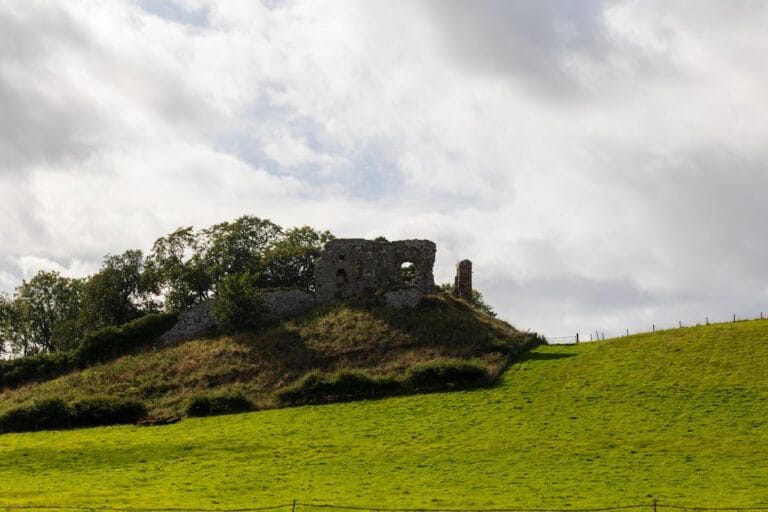
From the beginning of the eighteenth century, Ballone was no longer maintained and gradually decayed. By 1845 it was described as a ruin that had not housed a respectable family for two centuries. The condition of the estate may also have been viewed in light of the loss of George Mackenzie, the third Earl of Cromartie, whose title was forfeited after his involvement in the second Jacobite rising of 1746.
Lachlan and Annie Stewart purchased the ruin in 1990 after it had stood empty and deteriorating for roughly three centuries. Lachlan Stewart was an architect specializing in the restoration of historic buildings and historically styled new construction, while Annie Stewart worked in Scottish crafts. The restoration took nearly ten years, including about three years spent securing planning permissions, and the family moved into the castle in 1998. The work reconstructed the exterior and internal arrangement as far as surviving evidence allowed while adding modern building services. Ballone had been entered as a Category A Listed Building in March 1971, a Scottish designation for buildings of national or exceptional architectural or historic importance, and it remains protected under that status. Stewart received the Scottish Castles Association’s Nigel Tranter Memorial Award in 2006. A further restoration phase in 2009 largely rebuilt the mostly vanished seventeenth-century wing.
Names associated with the castle
Ballone has also been linked with the names Castlehaven and Castle Tarbat. Sir George Mackenzie received the title Lord Castlehaven in February 1685. The title referred to Castlehaven on the north coast of Tarbat, while the same name was used for Portmahomack after its renaming in 1678 and was also applied to Ballone Castle. This usage did not endure. From the second half of the eighteenth century, Ballone Castle became the established local name. The Castlehaven connected with the title is now understood as the remains of an Iron Age dun, a fortified prehistoric settlement or enclosure, rather than a medieval castle or fortress.
Remains
Ballone Castle stands a few metres from cliffs that rise about 20 metres above the Moray Firth, north of Rockfield and near Portmahomack. Its principal form is a Z-plan building, a Scottish arrangement with a rectangular central structure and towers at diagonally opposite corners. The central block has three storeys and a finished attic. One projecting tower is circular and lies to the north or northeast, while the other is square and lies to the south or southwest. Both towers extend only slightly beyond the main block.
Central block and defensive features
Two tourelles, each containing a staircase, give access to the upper floors. Several corbel-supported sentry turrets reinforce the building’s defensive character. These small turrets have stone roofs and gun loops. Before restoration, the castle was largely roofless and in very poor condition. The surviving fabric had lost the caphouse, the vaults over the first floor, part of the south end, and much of the later wing.
Courtyard and garden
An adjoining courtyard extends eastward from the castle and is enclosed by lower ancillary buildings, including the bakehouse added during the Mackenzie period. The castle also possessed a brewery from that phase of its history. Southwest of the building, a small garden is enclosed by a semicircular boundary wall.
The restoration reinstated the castle’s exterior and internal arrangement as far as they could be established. The mostly vanished seventeenth-century wing was largely rebuilt in 2009, and part of the seaward barmkin wall was reconstructed. A barmkin is an enclosing defensive or courtyard wall associated with a Scottish fortified residence.