Fearn Abbey: A Former Premonstratensian Monastery in Scotland


Site at a Glance
- Rating
- 4.6
- Popularity
- Very Low
- Country
- United Kingdom
- Primary era
- Early Modern
- Eras represented
- Medieval, Early Modern
- Civilizations
- British, Kingdom of Scotland
- Site type
- Religious
- Remains
- Church
On this page10 sections
History
Fearn Abbey is a former Premonstratensian monastery near Tain in the United Kingdom, established at its present site in 1238. The Premonstratians were members of a religious order whose white habits gave them the name white canons in Britain. The abbey was associated with Whithorn Priory and the Diocese of Ross, and controlled the churches of Kilchrist and Tarbat.
Foundation and relocation
Fearchar, 1st Earl of Ross, founded the original monastery during the 1220s, with the foundation dated variously to 1221–22 or 1227. Canons from Whithorn Priory provided its first abbot and community. The first monastery stood near Fearn Burn at Edderton on the Dornoch Firth, within the territories of the Earls of Ross, who maintained and protected the institution.
In 1238, during the abbacy of Malcolm of Nigg, the second abbot, the monastery moved about 10 miles, or approximately 14–16 kilometres, southeast to its present location. Turbulence caused by northern clans was associated with the move, while the new site also provided richer agricultural soil. The relocated house was initially called New Fearn, or Nova Ferna, before the name Fearn was restored. Its size at foundation is unknown, although it had at least eight canons and an abbot during one period.
Medieval rebuilding and prosperity
In 1321, Mark, a canon of Whithorn, was presented to the abbacy by the prior of Whithorn rather than elected by the canons. At the direction of William III, Earl of Ross, rebuilding began during Mark’s tenure in 1338. The work was completed in 1372 under Abbot Donald Pupill.
The abbey underwent substantial improvement during the forty-four-year abbacy of Finlay McFaed, from 1442 to 1485. A cloister was added, and the community acquired an organ, tabernacles, chalices, vestments, and other embellishments from Flanders. During this period Fearn became known as “The Lamp of the North.”
Reformation and changing administration
Patrick Hamilton served as commendator from 1517 to 1528. A commendator was a lay or clerical administrator who held an abbey or church, often without acting as its monastic superior. Hamilton was an early adherent of Reformation principles and was burned for heresy at St Andrews in 1528, aged twenty-six.
In 1539, James V recommended Robert Cairncross, Bishop of Ross, for the abbacy, partly because his wealth was considered useful for restoring buildings that had fallen into disrepair. After Cairncross died in 1545, Nicholas Ross, provost of the collegiate church of Tain, held the abbacy. He appears to have treated it as a secular charge, sitting in Parliament in 1560 and voting for the abolition of Catholicism in Scotland.
Following the Scottish Reformation, the abbey ceased to function as a monastic institution, while its church continued as a parish church of the Church of Scotland, Scotland’s Presbyterian national church. From 1560 it served that church, and in 1609 it came under the jurisdiction of the Diocese of Ross. The abbey lands were resumed by the Crown in 1587 during the commendatorship of Walter Ross of Morangy, the son of Abbot Thomas Ross. They were granted to Patrick Gordon of Letterfourie in 1591 and made the Barony of Geanies for Sir Patrick Murray by James VI in 1598. In 1609 they were annexed to the see of Ross for Bishop David Lindsay. The arrangement was extended to Bishop Patrick Lindsay in 1616, confirmed by Parliament on 28 June 1617, and confirmed again by Charles I for Bishop John Maxwell in 1633.
Parish church and modern conservation
In 1742, the church’s flagstone roof collapsed during a Sunday service, killing dozens of members of the congregation. A new church was built beside the ruined abbey church, but it had become ruinous by the early 1770s. Part of the medieval church was rebuilt in 1772 after the efforts of John Lockhart-Ross, 6th Baronet. The rebuilding, also attributed to the eighteenth-century builder James Rich, incorporated surviving medieval fabric and late-medieval fragments, and the building again served as a parish church.
The church was restored by Ian G. Lindsay & Partners in 1971, with further restoration under Historic Scotland in the early 2000s. It was placed in Scotland’s highest listed-building category, Category A, in 1971. Fearn Abbey remained a Church of Scotland parish church until services ceased in the historic building in 2023. In 2024, the parish united with the former parishes of Tarbat at Portmahomack and Tain to form Easter Ross Peninsula Church of Scotland. The abbey is managed by the Church of Scotland.
Burials and memorial associations
The church has associated burials of Fearchar, 1st Earl of Ross, who died in 1251; Sir Mark Ross, Abbot of Fearn, who died about 1350; Thomas Ross of Culnahal, provost of Tain’s collegiate church and vicar of Alness, who died in 1591; General Charles Ross of Balnagown, who died in 1732; and Sir John Lockhart-Ross, 6th Baronet and a Royal Navy admiral, who died in 1790.
Remains
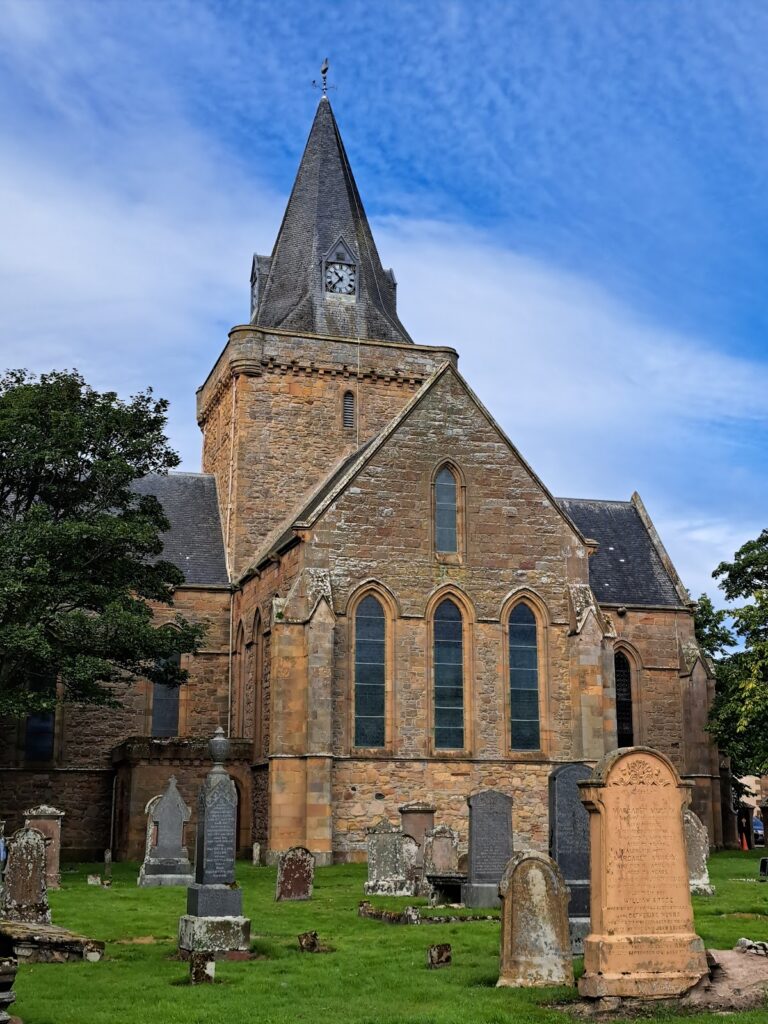
Fearn Abbey’s surviving church is an elongated, relatively plain building on a rectangular east–west plan, with the choir at the eastern end. Its internal length is 96 feet and its internal width is 26 feet. The walls are formed from roughly dressed rubble laid in coursed masonry, with natural-stone dressings. The main church is accompanied by ruined aisles, chapels, and a family mausoleum that preserve later additions and memorial use around the medieval fabric.
The surviving church
The gable ends contain lancet windows, with four openings of equal height in the east gable and three in the west. Similar pairs of openings occur between the buttresses along the walls. The church has six windows on each side wall, three at the west end, and four at the east end. Two Venetian windows, large round-arched openings divided into sections, were later blocked with masonry. A small bell turret with an open belfry rises from the roof, and the bell rope has worn a deep groove into the masonry beneath the bell structure.
The south wall preserves the medieval sedilia, built-in seats for the monks, at the eastern end. Two large tracery openings, with ornamental stone framework, are set into the south facade. The eastern end was partitioned as a burial vault for the Ross family of Balnagown, connecting the church’s surviving fabric with the later memorial history of the family.
South and eastern additions
The south wing known as St Michael’s Aisle is probably an addition by Abbot Finlay McFaed. It measures 32 feet by 23 feet and connects with the main church through a 14-foot-wide archway. A doorway stands on its west side and an ambry, a wall recess for sacred objects, on its east side. Its south side carries a canopied monument to Finlay, bearing his shield and the inscription, “Hic jacet Finlaius McFaed abbas de Fern qui obit anno MCCCCLXXXV.” The aisle survives as a ruin. In 1790, a new outer wall was built against its original wall, probably to protect it from deterioration.
A small monumental chapel was probably built against the church’s southeast corner during the sixteenth century, blocking two windows. Another structure was built against the north wall, while a further addition stands east of St Michael’s Aisle. This eastern structure has a Gothic window and entrance on its east side and another window on its west side. The two southern additions and the northern mausoleum survive in ruinous condition, with their roofs largely missing.
Ross family mausoleum
The post-Reformation mausoleum associated with the Earls of Ross stands externally beside the north side of the church’s eastern end. It has an eastern entrance and a Gothic window on its north side, surmounted by the family arms. Its largely missing roof contributes to its ruinous condition and distinguishes it from the enclosed church building.