Dornoch Cathedral: A Medieval Cathedral and Parish Church in Scotland


Site at a Glance
- Rating
- 4.6
- Popularity
- Low
- Country
- United Kingdom
- Primary era
- Medieval
- External website
- Open
- Eras represented
- Medieval, Modern
- Civilizations
- Kingdom of Scotland
- Site type
- Religious
- Remains
- Cathedral
On this page7 sections
History
Dornoch Cathedral is a medieval church in Dornoch, United Kingdom, founded and built in 1224 under King Alexander II of Scotland and Gilbert de Moravia, Bishop of Caithness. Dedicated to Saint Mary and Saint Gilbert, it served as the cathedral of the Diocese of Caithness after the bishop’s seat was transferred from Halkirk to Dornoch.
Medieval cathedral of Caithness
A cathedral traditionally contains a bishop’s seat. Dornoch retained that name because it was historically the seat of the Bishop of Caithness, although the Church of Scotland later abolished its episcopal system and the building became a parish church. Gilbert de Moravia was later canonized as Saint Gilbert of Dornoch. The church’s medieval associations also include Adam of Melrose, whose body was transferred from the church of Skinnet in 1239, and members of the Moravia family. William de Moravia, who became the first Earl of Sutherland, was buried there in 1248, while Richard de Moravia was killed at the Battle of Embo in 1245.
In the seventeenth century, Dornoch ceased to be the bishops’ seat after the episcopate was abolished in the Church of Scotland. The cathedral was burned in 1570 by the Mackays of Strathnaver during local feuding, an event that profoundly affected the medieval building.
Rebuilding and later use
Full renovation took place between 1835 and 1837 under the architect William Burn, with financial support from Elizabeth, Countess of Sutherland. The medieval nave had remained largely intact before this work, but it was demolished and replaced on the same site by a narrower nave without pillars. The building’s later history remained closely connected with the Sutherland family. George Leveson-Gower, 1st Duke of Sutherland, and Elizabeth Leveson-Gower, Duchess of Sutherland, were among those associated with burials in the cathedral.
Between 1924 and 1926, the Reverend Charles Donald Bentinck reordered the interior. Victorian plasterwork was removed, exposing the stonework, and the medieval high-altar site was raised and converted into a Sutherland family burial area. Large marble memorials were installed there. On 30 September 1866, before this interior reordering, the Duke and Duchess of Sutherland welcomed the Prince and Princess of Wales and the Duke of Edinburgh to the cathedral, where they attended the morning service.
Dornoch Cathedral has been a Category A listed building since 18 March 1971. In Scotland, this designation identifies buildings of national architectural or historic importance.
Remains
Church and churchyard
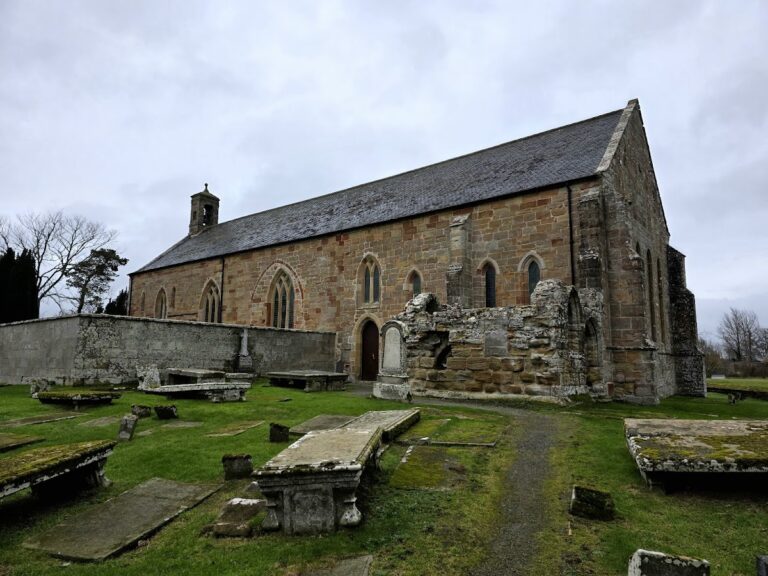
The cathedral stands in Dornoch, in the Scottish Highlands, within a churchyard adjoining Dornoch Castle, the partly reconstructed remains of the medieval palace of the Bishops of Caithness. The medieval church had an aisled nave, meaning that its central space was flanked by narrower passageways. That nave was demolished during the nineteenth-century renovation and replaced by a narrower, pillar-free nave on the same site.
The 1924–1926 interior work revealed the building’s stonework by stripping away Victorian plaster. The medieval church would originally have been plastered throughout, so the exposed masonry reflects a later presentation of the fabric rather than the original interior finish.
Burial area and memorials
The raised site of the medieval high altar now forms a burial area for the Sutherland family. Large marble memorials occupy this part of the cathedral, linking the surviving interior with the family burials associated with the building.
Organ
The cathedral’s first organ was built by Eustace Ingram, donated by Andrew Carnegie, and installed in 1893. It opened in January 1894 as the first organ installed in Sutherland. In 1909, the instrument was enlarged and fitted with hydraulic power, with a further £200 provided by Carnegie for that work.