Avraamiev Monastery: An Orthodox Monastic Complex in Rostov Veliky


Site at a Glance
- Rating
- 4.8
- Popularity
- Low
- Country
- Russia
- Primary era
- Early Modern
- Eras represented
- Early Modern
- Civilizations
- Russian
- Site type
- Religious
- Remains
- Monastery
On this page13 sections
History
Avraamiev Monastery in Rostov Veliky, Russia, is an Orthodox monastery traditionally regarded as the city’s oldest. Historically a men’s monastery, it is now a women’s monastery belonging to the Yaroslavl Diocese. Its foundation tradition connects the site with Abraham of Rostov, a Russian Orthodox ascetic and saint, while its surviving buildings reflect major phases of Russian religious architecture from the sixteenth and seventeenth centuries.
Foundation tradition and medieval origins
The monastery’s foundation story is preserved in the Life of Abraham of Rostov. According to this tradition, a stone idol of Veles, a pre-Christian Slavic deity associated with the underworld, cattle, wealth, and magic, stood at the site. After Abraham prayed, the Apostle John the Theologian appeared to him in a vision and gave him a staff. Abraham used it to destroy the idol, then built a church and founded a monastery at the former pagan sanctuary.
The historical date and circumstances of the foundation remain disputed. The Laurentian Chronicle first mentions the monastery under 1261, while historical interpretations place Abraham of Rostov in the fourteenth century. The earliest version of his Life is dated to the fifteenth century. The staff associated with Abraham was preserved at the monastery for a long period, strengthening the connection between the foundation tradition and the institution’s later history.
Ivan the Terrible and the sixteenth-century rebuilding
Before his campaign against Kazan, Ivan IV, known as Ivan the Terrible, made a pilgrimage to the monastery and took Abraham’s staff with him. Ivan IV was grand prince of Moscow and the first tsar of Russia, ruling from 1547 to 1584. After the capture of Kazan in 1552, he fulfilled a vow by sponsoring the construction of the Epiphany Cathedral in 1553-1555.
The cathedral was among the earliest building projects undertaken by Ivan IV in fulfillment of a vow after the conquest. It was also among the first mid-sixteenth-century multi-altar churches whose dedication program was expressed through subsidiary chapels, smaller worship spaces attached to or incorporated into the main church. This rebuilding gave the monastery a prominent architectural expression during a period of expanding royal patronage.
Destruction and reconstruction
In 1608, during the Time of Troubles, the monastery was plundered by the voivode Pleshcheyev, who had gone over to the Polish side. The Time of Troubles was a period of dynastic uncertainty, political crisis, foreign intervention, and warfare in the Russian state from the late sixteenth to the early seventeenth century. The damage left Avraamiev Monastery unable to recover for a long period.
Its later rebuilding gathered pace in the mid-seventeenth century under Archimandrite Jonah, a senior Orthodox monastic title traditionally associated with the leadership of an important monastery. The stone Church of the Presentation was built in 1650, and the gate Church of Saint Nicholas followed later in the seventeenth century.
Changing prominence and modern religious history
After the canonization of Demetrius of Rostov in the mid-eighteenth century, the nearby Spaso-Yakovlevsky Monastery became more prominent and Avraamiev Monastery moved into a secondary position. Demetrius was an eighteenth-century Russian Orthodox bishop, theologian, and saint. Members of the imperial family nevertheless visited Avraamiev Monastery, as did John of Kronstadt, a prominent Orthodox priest and spiritual figure, and Patriarch Tikhon, who was later recognized as a saint.
In 1860, Fyodor Verkhovtsev made a new reliquary, a container for holding and honoring relics, for the relics of Abraham of Rostov. In 1914, the Euphrosyne of Polotsk Women’s Monastery and the Vitebsk Diocesan School were temporarily transferred to the monastery grounds, while the monastery’s residents moved to Rostov’s Spaso-Yakovlevsky Monastery.
Local believers organized a religious community at Avraamiev Monastery in 1923. Its first superior was Archimandrite Neophyte Korobov. The monastery buildings were formally transferred to the Rostov Museum of Antiquities on 3 March 1926, but the community continued until its dissolution on 16 July 1929. The clergy who had served it subsequently moved to Rostov’s Dormition Cathedral.
The monastery was abolished in 1929. From 1930, its fortification walls were dismantled, while the buildings were assigned secular and military uses. The Epiphany Cathedral became a grain storehouse, the Saint Nicholas Church housed a military unit and residential quarters, and the Presentation Church was successively used as a kindergarten, a sanatorium, and a Soviet sobering-up station, where intoxicated people were temporarily detained and cared for.
By the end of the twentieth century, the buildings required urgent repairs, with the Epiphany Cathedral in particularly dangerous condition. The monastery was revived in the 1990s. In 1993, a metochion, or dependent religious establishment, of the Church of the Savior Not Made by Hands at Moscow’s Andronikov Monastery was established there. It became a patriarchal metochion in 1994 and was served by Archpriest Vyacheslav Savinykh as rector.
In 2004, with the blessing of the Holy Synod of the Russian Orthodox Church, the patriarchal metochion became the Avraamiev Epiphany Women’s Monastery of the Yaroslavl Diocese. Abbess Miropia Yurchenkova led the women’s monastery from 2004 until her death on 11 February 2022. Abbess Avraamiya Sorokina has served as abbess since 16 May 2023. The monastery is a federally significant cultural-heritage site of the peoples of the Russian Federation.
Remains
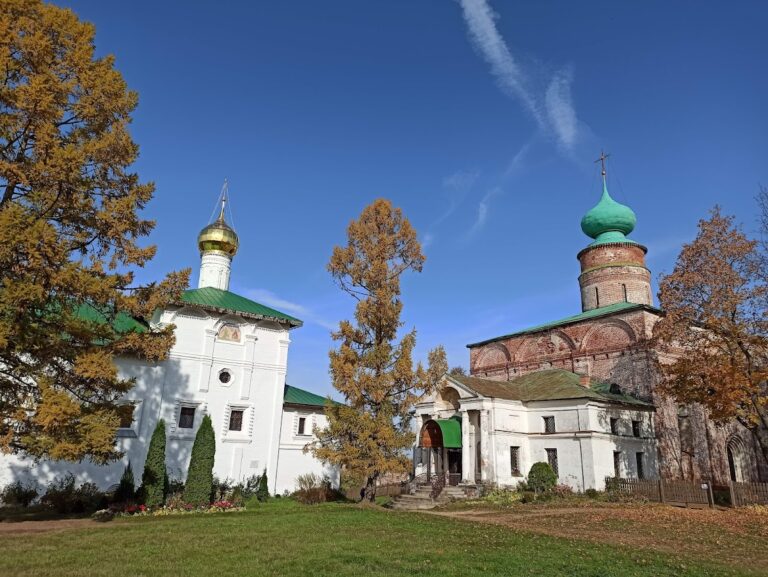
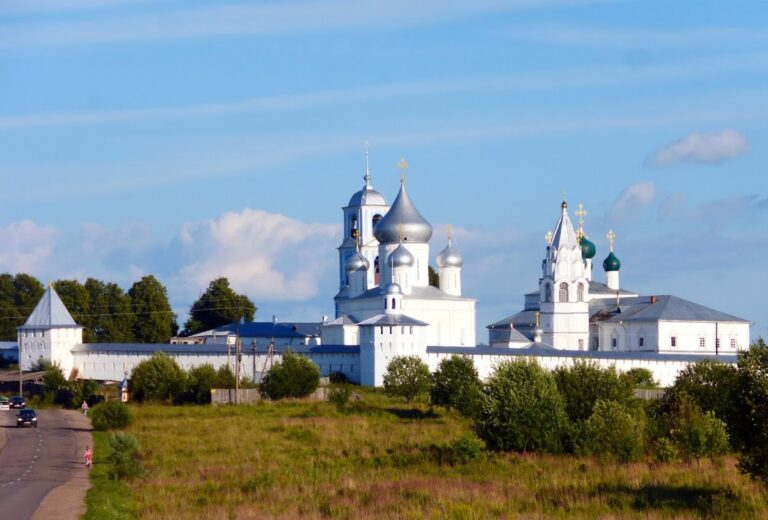
The monastery historically formed a fortified religious complex enclosed by defensive walls. The walls were dismantled during the 1930s and are no longer preserved. The surviving buildings include the Epiphany Cathedral, the Church of the Presentation, and the gate Church of Saint Nicholas. Together they preserve the principal architectural phases associated with the monastery’s royal patronage and seventeenth-century reconstruction.
Sixteenth-century cathedral
Epiphany Cathedral
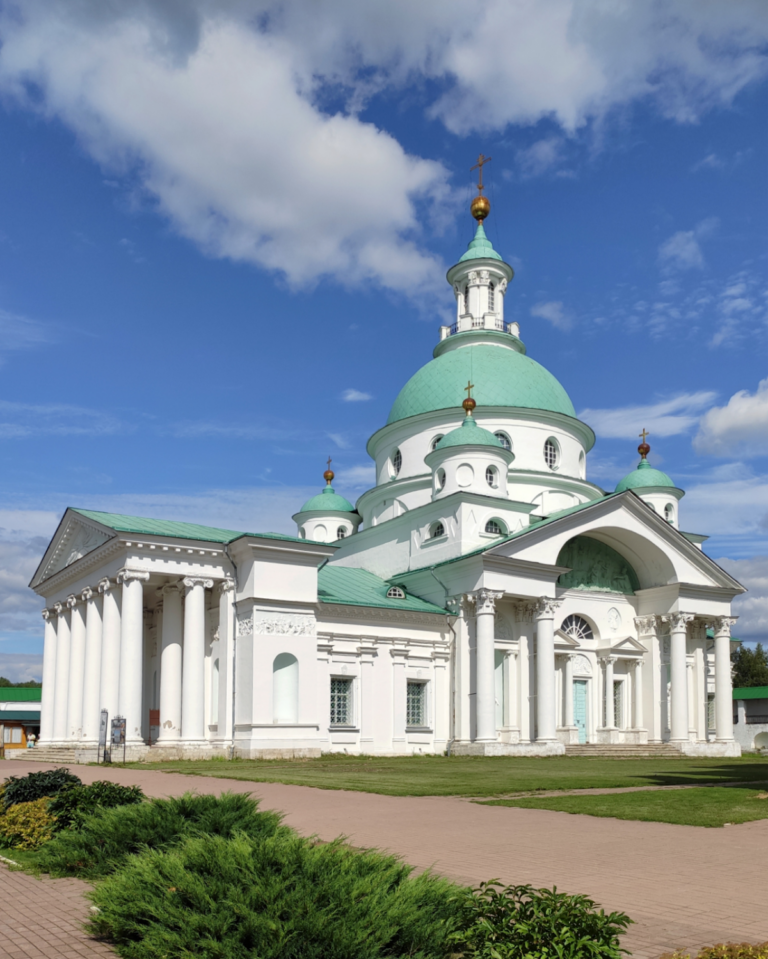
Built in 1553-1555, the Epiphany Cathedral is one of the monastery’s surviving buildings. Its multi-altar arrangement incorporates subsidiary chapels into the larger church, reflecting the dedication program established during its construction under Ivan IV. The cathedral is currently in an emergency condition.
Restoration work has drawn criticism from architectural-conservation advocates and heritage-protection authorities because replacement elements and structures do not correspond to the cathedral’s historical appearance. In 2015, the vaults of its entrance porch collapsed during the works, adding to the building’s physical vulnerability.
Seventeenth-century churches
Church of the Presentation
The stone Church of the Presentation was built in 1650 under Archimandrite Jonah. Later alterations changed the building after its seventeenth-century construction. During the Soviet period, it was used successively as a kindergarten, a sanatorium, and a sobering-up station before the monastery’s religious revival.
Gate Church of Saint Nicholas
The gate Church of Saint Nicholas dates from the late seventeenth century. It has two towers and was heightened during the Classical period. During the Soviet period, the church housed a military unit and residential quarters, uses that formed part of the wider secular reassignment of the monastery buildings.
Memorial object
Reliquary of Abraham of Rostov
A new reliquary for the relics of Abraham of Rostov was made by Fyodor Verkhovtsev in 1860. The object belongs to the monastery’s continuing veneration of its traditionally associated founder and preserves a material link with Abraham’s religious legacy.
Nearby sites