Badia di Sant’Andrea: A Cistercian Abbey in Genoa
Site at a Glance
- Popularity
- Medium
- Country
- Italy
- Primary era
- Medieval
- Eras represented
- Medieval, Modern
- Civilizations
- Genoese
- Site type
- Religious
- Remains
- Monastery
On this page9 sections
History
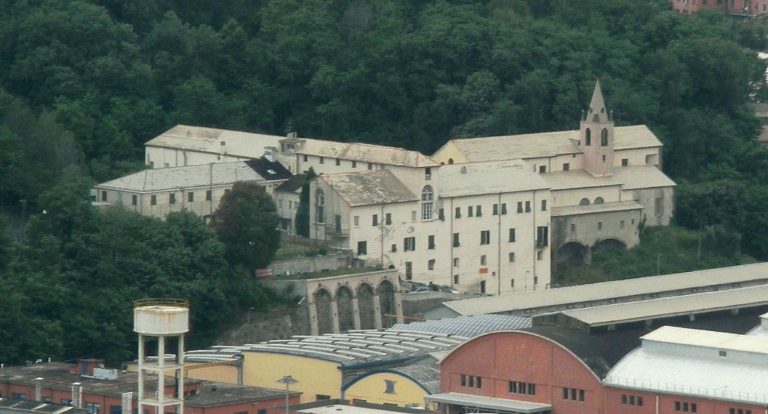
Badia di Sant’Andrea is a former abbey between the Cornigliano and Sestri Ponente districts of Genoa, Italy. Founded as a Benedictine monastery in the seventh century, it later became one of Italy’s earliest Cistercian houses. Its church preserves medieval Gothic forms.
From Benedictine monastery to Cistercian abbey
The first monastery stood on Gabbaia, a small offshore islet. After a year, the community moved to higher ground at Colombara. In the twelfth century, a disputed papal succession between Pope Innocent II and rival claimant Anacletus II brought Bernard of Clairvaux to Genoa as a mediator. Bernard declined an offer to become archbishop but promised the Genoese a Cistercian abbey. On 5 November 1131, Cistercian monks took over the earlier monastery on the islet. The expanding community required a larger complex, built on the nearby hillside.
The new foundation belonged to Cîteaux, the Cistercian order’s principal monastery and institutional center. The Cistercians were a reform movement within Western monasticism. Peter led the founding community as its first abbot, while the new complex is also associated with Stephen Harding, the third abbot of Cîteaux. The abbey was among the earliest Cistercian communities in Italy, following Santa Maria alla Croce at Tiglieto. Its related daughter houses, monasteries established within an abbey’s institutional family, included Saint Albert of Sestri Ponente, Rivalta di Torino, and Santa Maria di Coronata. Sant’Andrea took over Rivalta in 1254.
The monk Albert lived at the abbey in the first half of the twelfth century, then became a hermit above Sestri Ponente. He died on 8 July 1180, and Pope Innocent IV canonized him on 7 July 1244. The following year, Innocent stayed at the abbey after falling ill on his journey to the Council of Lyon. For centuries, the community also maintained a hospice for pilgrims travelling to the Holy Land.
Hospice and changing religious control
In 1478, Pope Sixtus IV placed the abbey under a commendam, an arrangement giving an outside holder its revenues or administration. The Genoese Fregoso and Fieschi families held this role, and monastic life declined afterward. The Cistercians eventually left. Dominican friars, members of the Catholic Order of Preachers, took over in 1569 and remained until Napoleonic troops arrived in 1797.
Villa, damage, and renewed use
After the Inquisition, a church tribunal that investigated heresy, was abolished in 1798, Duke Pietro Vivaldi Pasqua acquired the abbey and converted it into an aristocratic villa. In 1879, entrepreneur Edilio Raggio bought the wider estate and built Castello Raggio nearby, on the site of the earlier Benedictine monastery. The sea-facing residence was later demolished.
A Benedictine community returned in 1938 but left in 1962 because of noise from the A10 motorway and Genoa airport. The abbey suffered severe damage during the Second World War and was later renovated. It housed companies and research organizations until the mid-1990s, then remained unused for several years. Further renovation began in 2008, after which the complex again accommodated company offices.
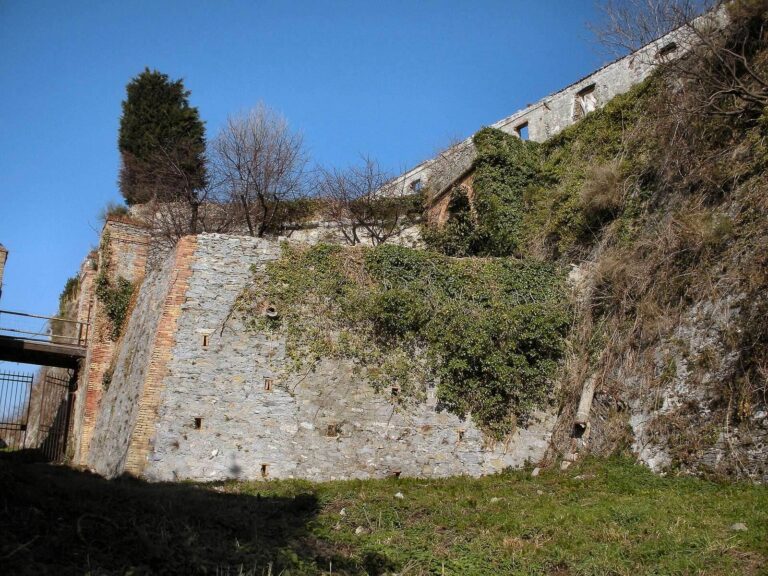
The abbey is the last surviving testimony to historic Colombara. After the war, industrial development, the airport, motorway interchanges, and the demolition of Castello Raggio transformed the area; the beach below the hill was covered over. Later redevelopment of the wider district followed the closure of ILVA’s hot-production area and a related redevelopment agreement. In 2022, 777 Partners, then the owner of Genoa Football Club, acquired the former abbey. It was inaugurated in August 2025 for offices and accommodation for the club’s football academy.
Remains
The abbey church
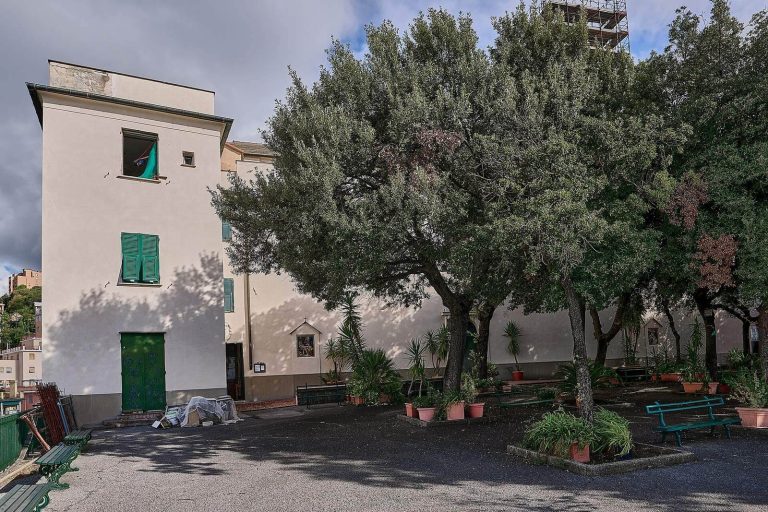
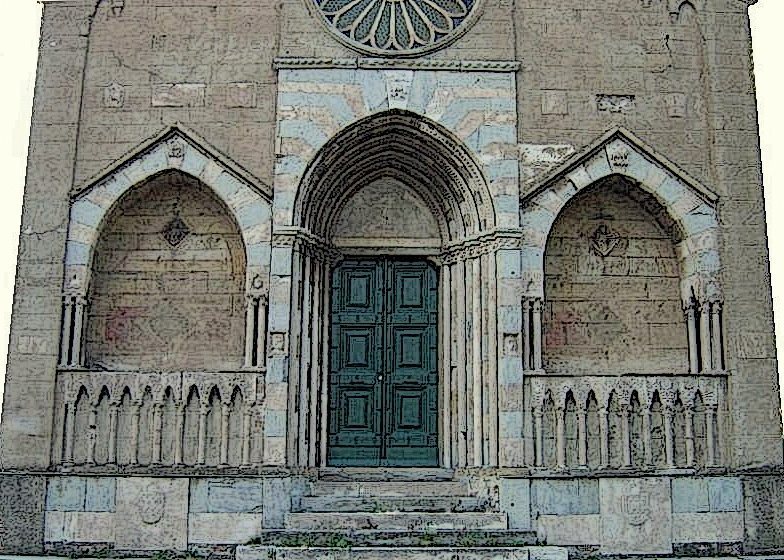
The complex stands at the foot of Erzelli Hill, between Cornigliano and Sestri Ponente and near the former beach known as “the Desert.” The church’s façade combines a formal entrance, funerary monuments, and an upper section shaped by later renovation.
Entrance and tombs
The main doorway has a pointed arch and sides that flare outward. Alternating white and grey bands decorate its surface. Two funerary tombs stand beside the entrance beneath pointed arches, while further tombs occupy positions along the church’s sides.
Upper façade and rose window
The upper façade, including its rose window, reflects a neo-medieval intervention carried out during the nineteenth or twentieth century. Renovation work from this period also affected much of the building.
Works by Bertel Thorvaldsen
Works by Bertel Thorvaldsen, a Danish sculptor associated with Neoclassical art, were identified inside the church in 2026 after having been forgotten there.