San Francesco da Paola: A Minor Basilica and Sanctuary of Sailors in Genoa
Site at a Glance
- Rating
- 4.7
- Popularity
- Very Low
- Country
- Italy
- Primary era
- Early Modern
- External website
- Open
- Eras represented
- Early Modern, Modern
- Civilizations
- Genoese
- Site type
- Religious
- Remains
- Sanctuary
On this page15 sections
History
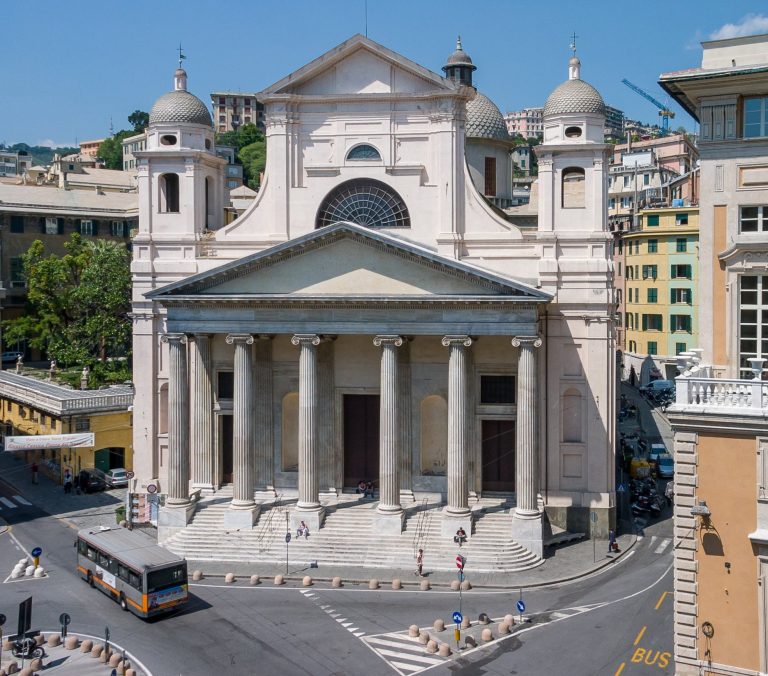
San Francesco da Paola is a Roman Catholic sanctuary in Genoa, Italy, dedicated to Saint Francis of Paola, Jesus, and Mary. Associated with the Order of Minims, the Catholic order founded by the fifteenth-century religious leader Saint Francis, it became known as the “Sanctuary of the Sailors” because of his patronage of seafarers. The complex acquired its present form through a complete rebuilding and enlargement in the seventeenth century.
Foundation and the Order of Minims
Tradition holds that Saint Francis of Paola identified the hill of Caldetto as the site for a church during a visit to Genoa in 1483. The proposed dedication was to Jesus and Mary. In the late fifteenth century, the nobleman Ludovico Centurione acquired the property and transferred it to the Minims so that they could establish a convent and church there.
The original church was later replaced. The complex was substantially rebuilt and enlarged in the seventeenth century through the initiative of Veronica Spinola, Princess of Molfetta. Genoese noble families, including the Doria, Balbi, and Spinola families, contributed to the church’s furnishings, linking the sanctuary’s development with the city’s aristocratic patronage.
Changes from the nineteenth century onward
During the nineteenth century, the Savoy government expropriated the convent. It was subsequently returned to the religious order, after which the convent became a public school offering a philosophical, theological, and literary curriculum.
Pope Pius XI raised the sanctuary to the rank of minor basilica in 1930. This is a special papal title, distinct from the architectural use of the word “basilica.” On 14 May 1930, he granted the church the title, and on 25 May the Sea Bell was installed on the bell tower in connection with the elevation.
Bombing during the Second World War severely damaged the church. Restoration continued for many years and was completed in 1970. On 27 March 1943, Pope Pius XII proclaimed Saint Francis of Paola patron of seafarers. A memorial room was later arranged in the entrance atrium, displaying votive offerings given to the saint by the faithful and by sailors over the centuries.
Genoa celebrates Saint Francis of Paola each year on 7 May with a solemn Mass followed by the blessing of the sea. This observance continues the sanctuary’s long association with maritime life.
Remains
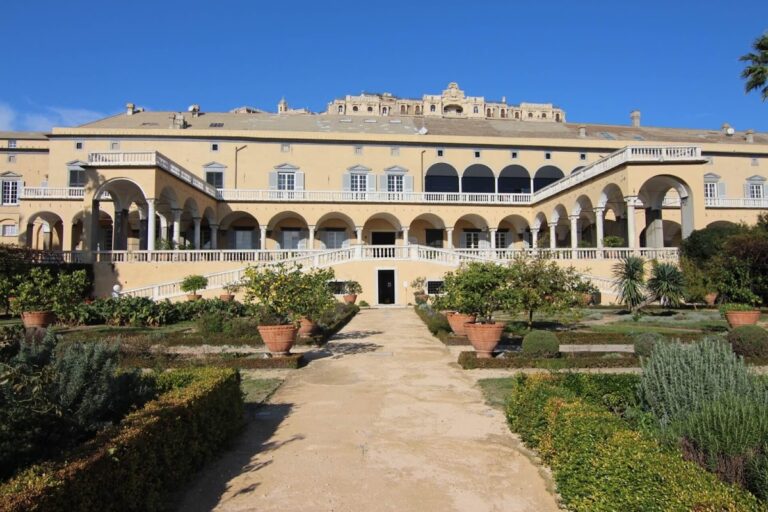
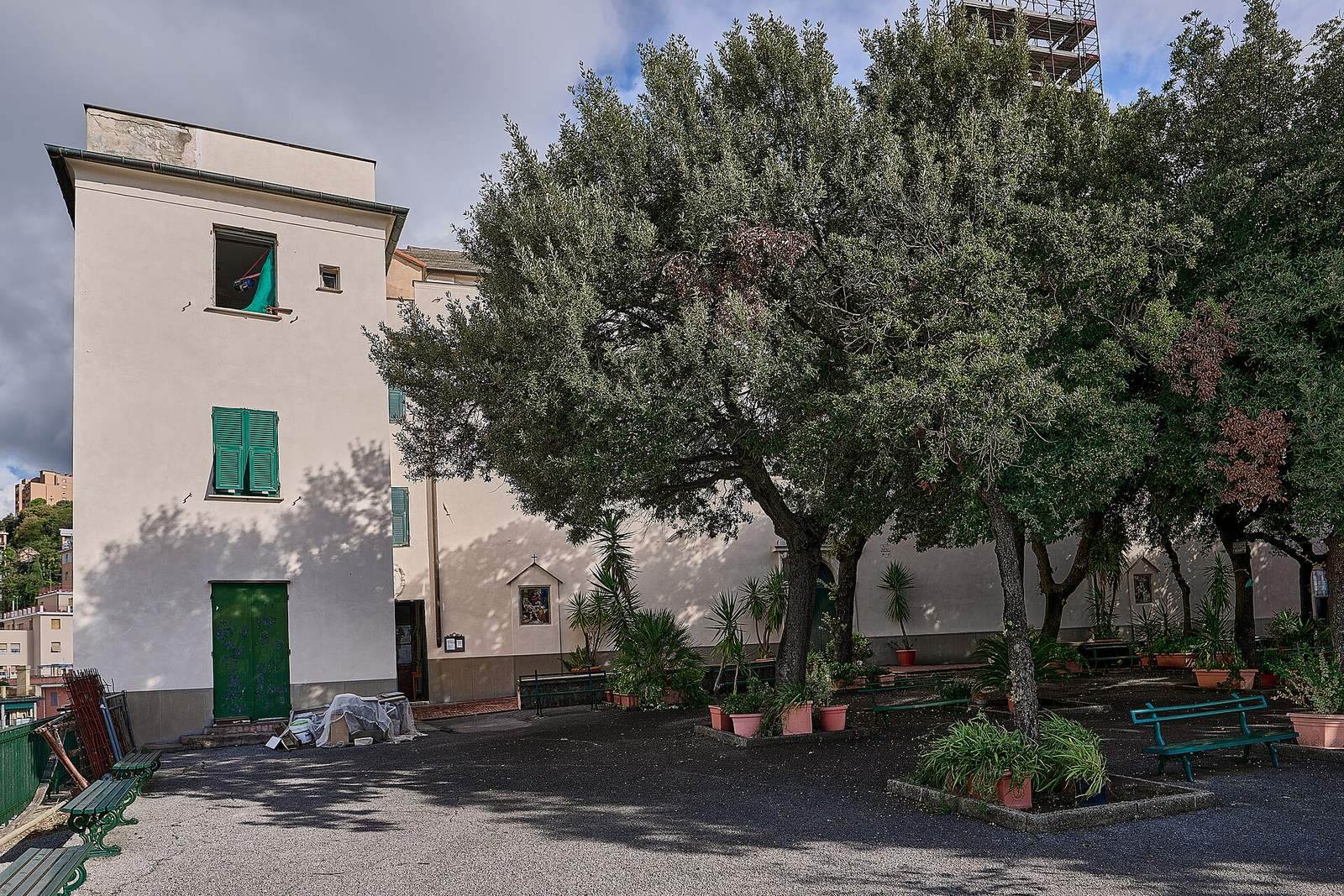
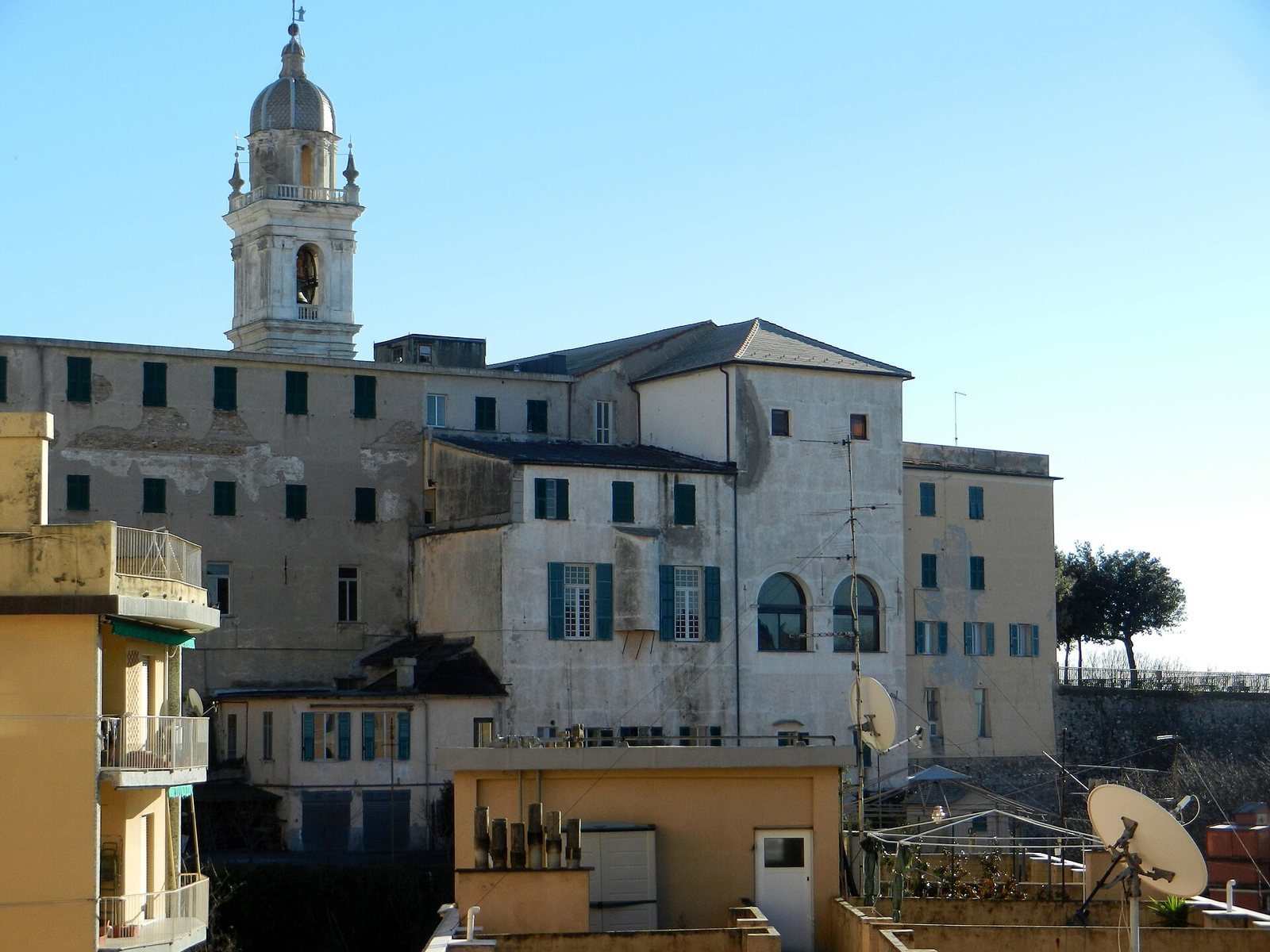
The complex stands on the hill of Caldetto in the San Teodoro district, at approximately 132 metres above sea level. It includes the church and the Minims’ convent, with views over Genoa, the historic centre, and the basin of the old port. A broad, tree-lined forecourt precedes the buildings.
Approach and entrance
The characteristic approach is Salita San Francesco da Paola, a broad brick-paved lane opened in the nineteenth century. Stations of the Cross line the route, which replaced an earlier steep and narrow approach that partly followed the course of the present Salita del Passero.
The church has no visible façade, and its external perimeter walls are undecorated. From the forecourt, entry is through a short corridor leading to a bright glazed atrium. The atrium contains numerous sailors’ votive offerings, a statue of Saint Francis of Paola, and a large anchor donated in 2002 by the National Association of Italian Sailors.
Bell tower and cloister
Sea Bell
A square-plan bell tower rises between the church and the cloister and is crowned by a dome. Its Sea Bell is rung slowly each evening at dusk in memory of sailors who died at sea. The bell therefore forms both a physical part of the complex and a continuing memorial to the sanctuary’s maritime dedication.
Cloister frescoes
The adjoining cloister, a covered walkway arranged around an open courtyard, contains seventeenth-century frescoes by Ventura Salimbeni, Lazzaro Tavarone, and the Calvi brothers. Their scenes represent miracles of Saint Francis of Paola.
Church interior
Naves and chapels
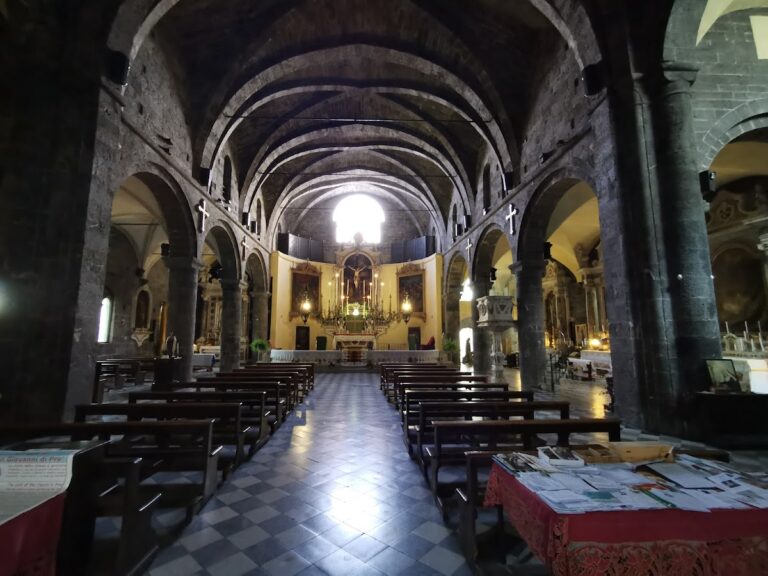
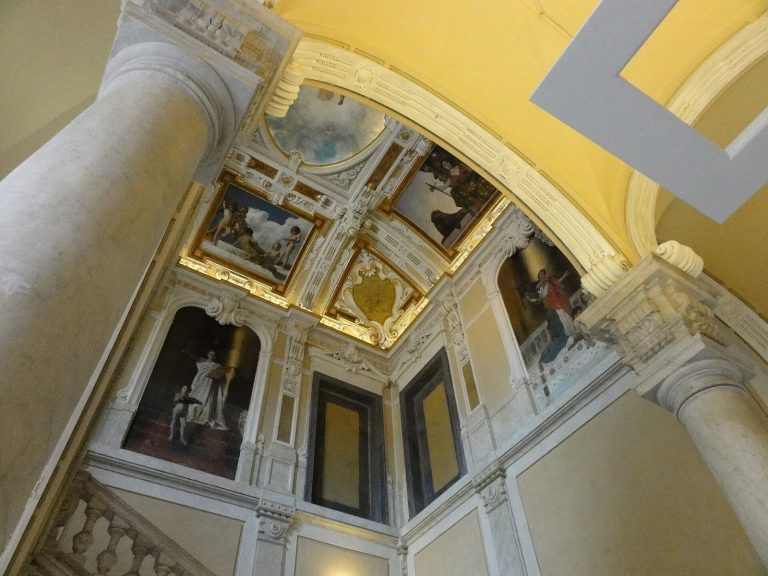
The interior is divided into three naves by fourteen columns. Ten side altars occupy the aisles, whose floors are largely covered by tomb slabs belonging to Genoese figures from different periods. The interior decoration combines stucco, paintings, frescoes, and details in polychrome marble.
The chapel dedicated to Saint Francis contains an eighteenth-century altar in the Genoese baroque style, made with inlaid polychrome marble by Francesco Schiaffino. Schiaffino also created the crucifix on the high altar. Giuseppe Palmieri painted the chapel fresco Glory of Saint Francis of Paola, while the main nave contains paintings of Saint Francis healing lepers.
Memorial tombs
The tomb slabs commemorate figures including Veronica Spinola, who promoted the sanctuary’s enlargement; Archbishop Nicolò Spinola; the architect Ippolito Cremona; Marchioness Luigia Pallavicini, who died in 1841; Marquis G. B. Lomellini; and Admiral Luigi Serra. Pallavicini is also associated with the famous ode dedicated to her by the Italian poet and writer Ugo Foscolo.
Paintings and frescoes
Painted works
The church contains an oil painting of Saint John the Baptist by Angela Airola and a panel of Saint Augustine attributed to Ottavio Semino. Giovanni Battista Paggi painted Saint Jerome’s Viaticum in 1620. Luca Cambiaso is represented by the Nativity, dated about 1565, and Prayer in the Garden, dated about 1570.
Other works include Saint Francis de Sales by Francesco Campora, Christ’s Ascension by Giovanni Cambiaso, and a sixteenth-century painting of Saint Francis of Paola attributed to Lazzaro Calvi. The collection also includes The Washing of the Feet by Orazio De Ferrari and the sixteenth-century All Saints by Cesare Corte. Two doors from a reliquary, made by Valerio Castello, depict the Madonna and Child with Saints Anthony of Padua and Martin.
Nineteenth-century fresco cycle
Giuseppe Isola painted the nineteenth-century frescoes The Coronation of the Virgin, Saint John in the Desert, and Dispute in the Temple. These works date to about 1845, as do the episodes from the life of Saint Francis of Paola painted by Giacomo Borzino.
Works removed during the Napoleonic occupation
During the Napoleonic occupation in 1811, several paintings were removed from the sanctuary and taken to the Louvre with other Italian works. They included Giovanni Cambiaso’s Christ’s Ascension and the Nativity, together with Paggi’s Saint Jerome’s Viaticum. The French government returned the paintings after Napoleon’s fall.