Aueršperk: A Ruined Early Gothic Noble Castle in Czechia


Site at a Glance
- Rating
- 4.3
- Popularity
- Very Low
- Country
- Czechia
- Primary era
- Medieval
- Eras represented
- Medieval
- Civilizations
- Holy Roman Empire, Margraviate of Moravia
- Site type
- Military
- Remains
- Castle
On this page7 sections
History
Aueršperk is a ruined early Gothic noble castle in Czechia, near Bystřice nad Pernštejnem, probably founded after 1250 in the second half of the thirteenth century. Its exact foundation date is uncertain. The castle was probably established by the Lords of Medlov, a family associated with the Lords of Pernstein, and its design followed the Central European bergfried type, centred on a strong defensive tower used mainly for lookout and protection rather than as the lord’s ordinary residence.
Foundation and the Lords of Pernstein
The name Aueršperk derives from the aurochs and is unrelated to the Austrian noble family Auersperg. The castle may initially have been called Bystřice. Its later name appears in written records in 1325, when Jimram of Pernstein was also described as being of Aueršperk. The Lords of Pernstein temporarily adopted forms of the castle’s name in their own designation and used the aurochs in their coat of arms.
Between 1325 and 1335, Aueršperk was held by Geruše, the daughter of Jimram of Aueršperk. After this period, the castle soon ceased to be regularly mentioned as an actively used residence. Its large outer bailey, the part of a castle beyond the main fortified core, could accommodate a substantial military force. An enclosed area in the forefield, the ground immediately in front of a fortified site, may have been connected with military retinues during the pre-Hussite period, the decades before the religious and political upheavals that began in Bohemia in the early fifteenth century.
Abandonment and archaeological dating
A traditional claim places the castle’s abandonment in 1406, but this arose from a misinterpretation of a document referring only to land near Ušperk. Aueršperk was described as deserted in 1403, while archaeological evidence indicates that it continued to be used during the first quarter of the fifteenth century. Investigations, including work carried out in the first half of the twentieth century, revealed castle cellars. A richly worked Gothic lock found through later archaeological investigation has extended the known period of use into the early fifteenth century.
Aueršperk is protected as a cultural monument of the Czech Republic. This status reflects the surviving remains and the site’s role in understanding the medieval network of noble castles associated with the Pernstein family.
Remains
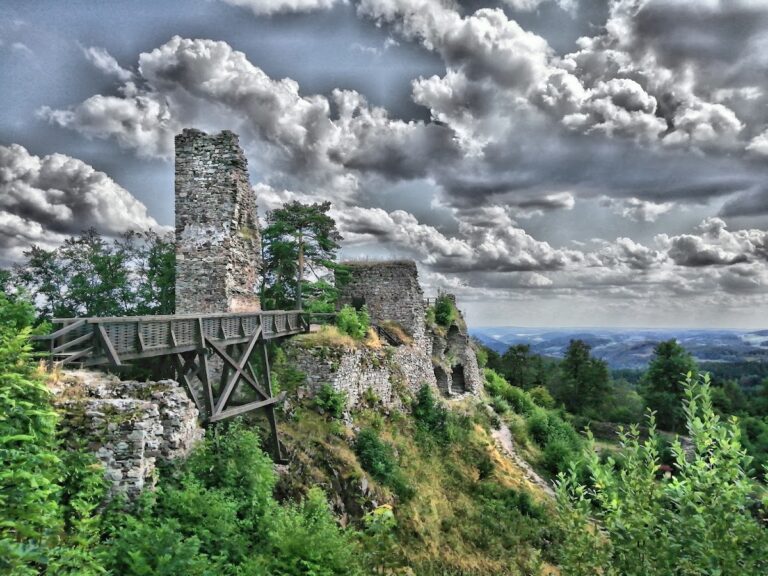
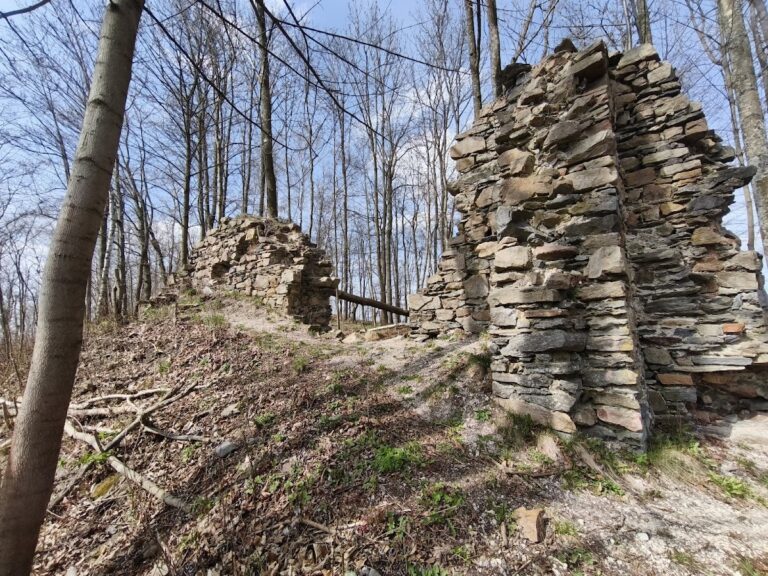
Aueršperk occupies a wooded rocky spur in a bend of the Bystřice River, which surrounds the site on three sides. The castle lies between Vír and Dvořiště, in the cadastral territory of Dvořiště near Bystřice nad Pernštejnem, at approximately 501 metres above sea level. A long ridge extends from the plateau between Dvořiště and Hrdá Ves, and a deep dry ditch cut across the ridge to curve around the castle complex. The earth removed from the ditch formed a substantial rampart, creating a strongly defended position.
Fortifications and entrance
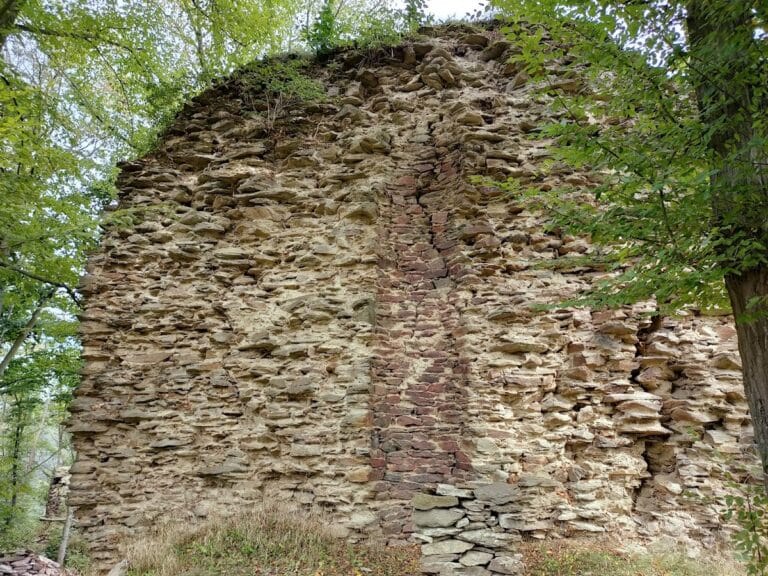
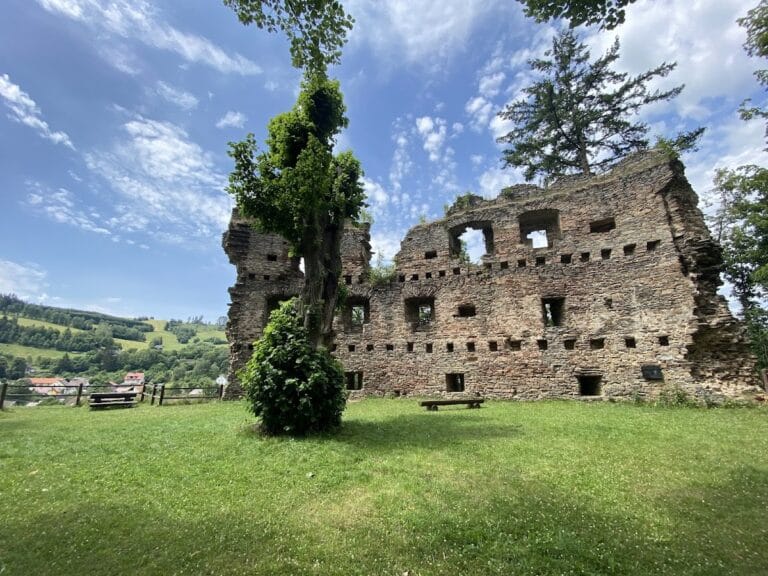
The approach from the plateau led through a gate protected by a high tower. A circular defensive tower, or bergfried, stood within the main castle complex and measured about 9 to 10 metres in diameter. The surrounding ditch reached approximately 13 metres in depth. Surviving fabric includes part of the circular tower, sections of the curtain wall, the defensive wall enclosing the castle, and portions of the surrounding ditches. North of the main castle core, the foundations of an outlying turret remain visible. A shallow ditch separated this turret from the principal complex.
Residential and supporting buildings
A rectangular residential building adjoined the gate tower, while further buildings occupied the castle complex. Foundation walls of the residential palace survive east of the tower. A farmstead may also have belonged to Aueršperk on land later occupied by the village of Dvořiště. The present remains consist chiefly of the tower fragment, wall remnants, foundations, and ditch sections. Castle cellars were still visible within the ruin during the first half of the twentieth century.
Archaeological evidence
Archaeological investigation has supplied evidence for the castle’s later use. The richly worked Gothic lock is especially important because it places activity at Aueršperk in the first quarter of the fifteenth century. Together with the surviving masonry and foundations, the find helps connect the fragmentary remains with a castle that continued to function beyond the date traditionally assigned to its abandonment.
Nearby sites