Suquet Castle: A Fortified Monastery and Castle in Cannes, France


Site at a Glance
- Rating
- 4.8
- Popularity
- Low
- Country
- France
- Primary era
- Medieval
- Eras represented
- Medieval, Early Modern
- Civilizations
- County of Provence, French
- Site type
- Military
- Remains
- Castle
On this page10 sections
History
Suquet Castle, also known as the Château de la Castre, is a medieval fortified monastery and feudal castle in Cannes, France. Its construction began in the eleventh century and continued through the sixteenth century under the influence of the Abbey of Lérins, a monastic institution established on the Lérins Islands off the coast of Cannes.
Roman and early medieval foundations
The castle occupied the site of the Roman Castellum Marcellini, near the Via Julia Augusta, a Roman coastal road linking settlements in southern Gaul and northern Italy. In 960, the Provençal counts and marquises Guillaume I and Rotboald I entrusted the castellum to their vassal Rodoard, lord of Grasse and Antibes, along with the fief of Antibes, which included Cannes.
Around 1030, Rodoard’s younger son, Guillaume-Gruette, entered religious orders and gave part of his lands to the Abbey of Lérins. This donation and its later foundation became associated with the formation of the commune of Cannes.
The fortified monastery
Around 1080, Aldebert II, abbot of Lérins, began building a fortified enclosure and the Tour du Suquet. The works supported surveillance and defence, allowing the site to monitor the Bay of Cannes and help protect the settlement from corsairs and attacks by Saracen forces.
In 1178, the abbots of Lérins renamed the site Castellum Francum, meaning “Frank Castle,” and developed it as a fortified feudal monastery. The complex grew around the earlier tower and included defensive walls, residential buildings, a fortified church, a hospital, a medieval monastic garden, and a fortified medieval borough. In 1327, a fire-signalling system connected the Tour du Suquet with the fortified monastery of the Abbey of Lérins.
Alteration, decline, and civic reuse
The castle underwent repeated changes and periods of abandonment. Among its restorations was work carried out in 1512 by Augustin Grimaldi, abbot of Lérins. The Church of Notre-Dame-d’Espérance was founded and incorporated into the fortified enclosure in 1521.
The castle suffered damage at the end of the sixteenth century and was partly demolished in the eighteenth century on the orders of the Bishop of Grasse. Eighteenth- and nineteenth-century sanitation and roadworks further destroyed sections of the defensive walls. During the French Revolution, the partially demolished castle was sold as a national asset, property confiscated and offered for sale by the revolutionary state, in 1791 to Jean-Charles Hibert, who later became mayor of Cannes.
In 1878, the site was converted into the La Faïencerie d’art Léon Castel du Mont-Chevalier ceramics manufactory. The Municipality of Cannes purchased the property from the Hibert family’s heirs in 1919 to establish the Musée de la Castre, which had previously been associated with Cannes town hall. The former castle complex now houses the Museum of World Explorations. The château, the Tour du Suquet, the Sainte-Anne Chapel, and the Church of Notre-Dame-d’Espérance were designated together as a protected historic-monument ensemble on 28 July 1937. The municipality of Cannes remains the owner.
Remains
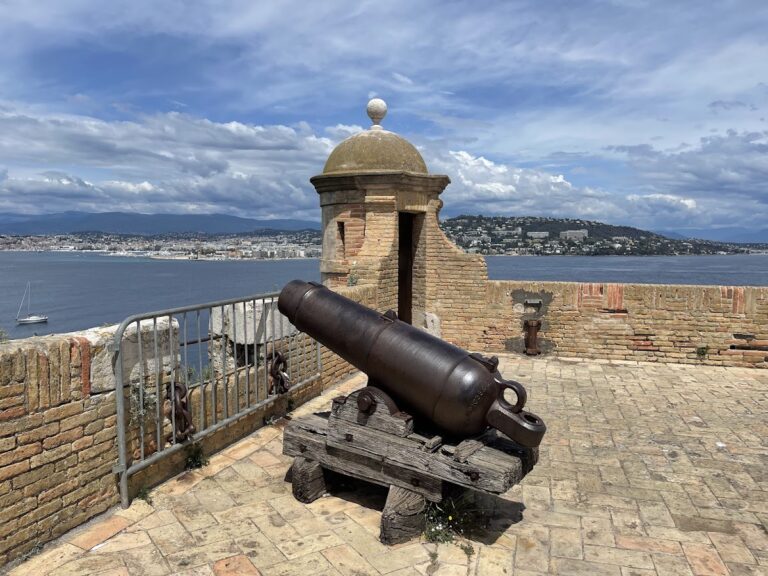
Suquet Castle stands on the summit of the historic Suquet hill, also called Mont-Chevalier, in Cannes’s old quarter. The complex developed around the present Place de la Castre on a broadly square plan enclosed by defences. From this elevated position, the site overlooks Cannes, the Old Port, the Bay of Cannes, and the Lérins Islands. The surviving remains form part of the former castle complex, whose present museum use occupies the historic buildings.
Defensive structures and religious buildings
Tour du Suquet
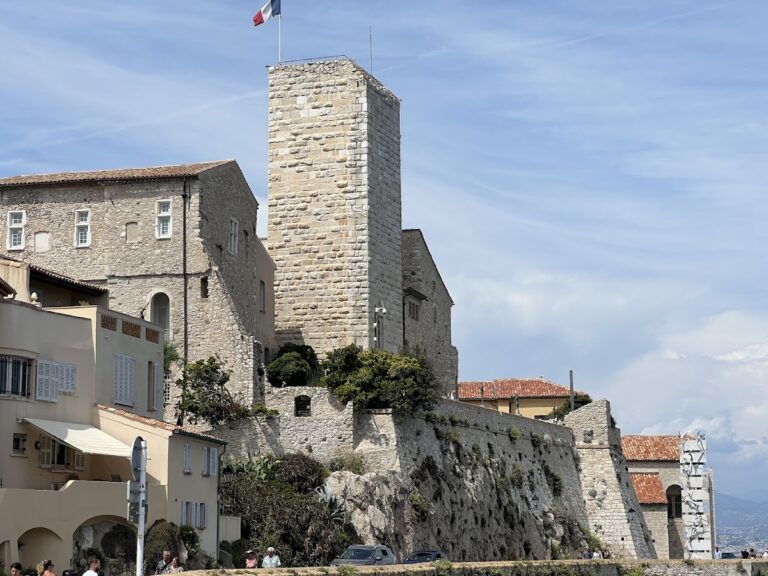
The Tour du Suquet is an eleventh-century watchtower and keep, the principal fortified tower of a castle, used for defence, observation, and sometimes residence. It rises 22 metres and served as a lookout structure with a 360-degree view of the surrounding area. The tower formed the central point around which the fortified complex developed.
Fortified enclosure
The enclosure contained residential buildings, a hospital, and a medieval monastic garden, as well as the fortified Church of Notre-Dame-du-Puy. The church was partly Romanesque, a medieval style known for massive construction, rounded arches, and thick walls, and is now identified as the Sainte-Anne Chapel. The chapel is associated with the Tour du Suquet and includes an interior courtyard.
Church of Notre-Dame-d’Espérance
The Church of Notre-Dame-d’Espérance was built in the sixteenth century and integrated into the defensive enclosure in 1521. It remains one of the religious buildings associated with the former fortified complex.
Surviving fabric and later use
The castle is partially destroyed, and sections of the original defensive walls were lost through eighteenth- and nineteenth-century sanitation and roadworks. Vestiges of the former enclosure and its associated buildings remain around Place de la Castre. The surviving complex is used by the Museum of World Explorations, formerly the Musée de la Castre, preserving the site’s later civic and cultural function within its historic fabric.
Nearby sites