Ascoli Satriano Cathedral: A Roman Catholic Co-Cathedral


Site at a Glance
- Rating
- 4.7
- Popularity
- Very Low
- Country
- Italy
- Primary era
- Medieval
- External website
- Open
- Eras represented
- Medieval, Early Modern, Modern
- Civilizations
- Italian, Kingdom of Naples, Kingdom of Sicily
- Site type
- Religious
- Remains
- Cathedral
On this page13 sections
History
Ascoli Satriano Cathedral is a Roman Catholic cathedral in Ascoli Satriano, Italy, built in the Romanesque tradition during the second half of the thirteenth century by the Conventual Friars Minor, a branch of the Franciscan order. Dedicated originally to Saint Francis, the church formed part of a complex with an adjoining monastery. It is dedicated today to the Nativity of the Blessed Virgin Mary and has served as an active co-cathedral of the Diocese of Cerignola–Ascoli Satriano since 1986.
From Franciscan church to cathedral
On 24 September 1455, Pope Callixtus III elevated the Franciscan church to cathedral status through a papal bull, a formal legal act of the Catholic Church. It replaced the earlier cathedral of Santa Maria del Principio, which had been destroyed by an earthquake. The elevation gave the Franciscan foundation a new diocesan role in Ascoli Satriano.
Seventeenth- and eighteenth-century changes
The building was enlarged and restored during the seventeenth century, and it was reconsecrated on 3 June 1709. Further work and decoration followed in the eighteenth century. The Chapel of Saint Joseph and the baptistery belong to this period, reflecting the continued development of the cathedral after its earlier enlargement.
Earthquake and rebuilding
An earthquake in 1871 reduced the church to ruins. The cathedral was then completely rebuilt, creating the structure that later received further additions, including the bell tower erected beside it in 1950. The building is recognized as an Italian national monument.
Remains
Facade and exterior
Romanesque facade
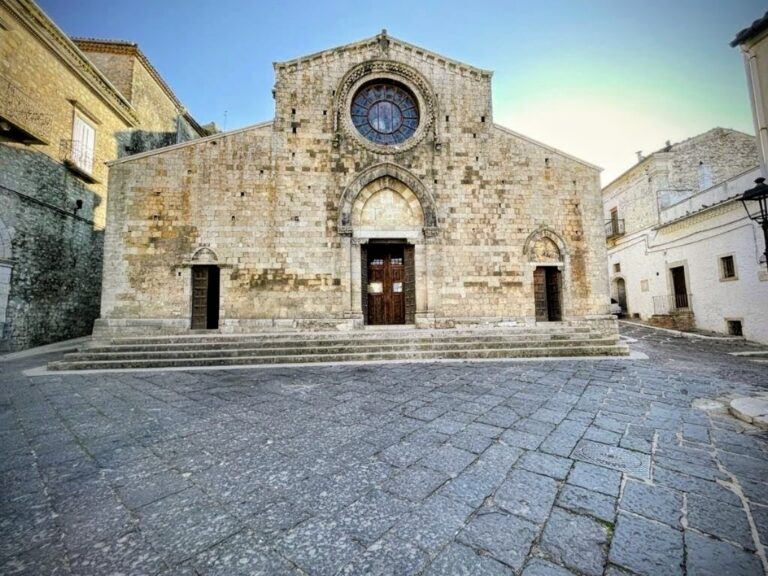
The facade has a late-Romanesque structure divided into three sections by pilasters. Three entrance portals organize its lower level, each surmounted by a marble baldachin, or canopy, and a pointed lunette, the curved area above the doorway. The central portal has a bronze door installed during the 2000 Jubilee, whose panels portray episodes from the lives of Jesus and Mary.
Bell tower
A bell tower dating from 1950 stands beside the co-cathedral and forms part of the building’s present exterior ensemble.
Interior arrangement and decoration
Nave and side aisles
The interior is arranged in three aisles, each ending in an apse, with a transept and a barrel vault. The side aisles contain seven lateral altars with inlaid marble, four on the right and three on the left. Their eighteenth-century paintings and sculptures add to the interior decoration, while a baptismal font closes the aisle. The central nave vault carries eighteenth-century frescoes showing the Stoning of Stephen, the Nativity of Mary, and Bishops Blaise and Leo.
Presbytery
Steps lead up to the presbytery, where an eighteenth-century altar in polychrome marble stands with an early nineteenth-century wooden choir. The vault and apse retain eighteenth-century decoration. Above the presbytery, an unknown artist painted the Choir of Angels and figures of four Doctors of the Church, Saint Jerome, Saint Ambrose, Saint Leo the Great, and Saint Augustine. The title refers to authoritative Christian theologians and teachers in Catholic tradition.
Apsidal chapels
Two apsidal chapels terminate the side aisles. The Chapel of the Immaculate Conception occupies the right side, while the Chapel of the Sacred Heart of Jesus is on the left. The first is dedicated to the Catholic teaching concerning Mary’s conception, and the second to a devotional representation of Christ’s love.
Transept chapels
Further chapels open onto the transept. The Chapel of Saint Potitus is on the right, and the Chapel of Saint Joseph is on the left. Saint Potitus was an early Christian martyr venerated as a saint, while the Chapel of Saint Joseph belongs to the cathedral’s eighteenth-century phase of embellishment.
Nearby sites