Ardfinnan Castle: An Anglo-Norman Hill Castle in Ireland
Site at a Glance
- Rating
- 4.3
- Popularity
- Very Low
- Country
- Ireland
- Primary era
- Medieval
- Eras represented
- Medieval, Modern
- Civilizations
- Crusader, English, Knights Templar
- Site type
- Domestic
- Remains
- Castle
On this page15 sections
History
Ardfinnan Castle is an Anglo-Norman hill castle in Ardfinnan, Ireland, built around 1185 during Prince John of England’s first expedition to the country. It occupied the site of an earlier Christian abbey and formed part of a strategic castle scheme promoted by Henry II, John’s father and the reigning English king. Along with Lismore Castle, it appears to have been among the earliest castles in Ireland built and occupied by a member of the English Crown.
An early royal stronghold
Henry II identified Ardfinnan and nearby Tybroughney on the River Suir, together with Lismore on the River Blackwater, as positions of strategic value. Ardfinnan guarded the northern frontier of Waterford, secured a river crossing and the route from the Anglo-Norman-controlled south toward central Ireland, and controlled the pass between the ecclesiastical centres of Cashel and Lismore.
The castle replaced Ardfinnan Abbey, an early Christian monastic site on Saint Declan’s fifth-century pilgrimage route. By about 632, the religious foundation had developed into an important abbey. When John arrived at Waterford in April 1185, he issued royal charters during a brief stay at Ardfinnan. Maurice de Prendergast protected the royal castle, which was also known as Castrum de Harfinan. Hugh de Lacy witnessed at least one charter in which John styled himself “King of Limerick”, possibly the earliest use of a territorial royal title in Ireland by a member of the English Crown.
The castle was soon captured by Irish forces. A feigned retreat drew its small garrison into the open, allowing Donal O’Brien, Rory O’Connor and Dermod MacCarthy to defeat the exposed knights and take Ardfinnan. John’s original force of 300 men was severely reduced after further defeats. He was recalled to England in December 1185, leaving Hugh de Lacy at Ardfinnan.
Crown administration and religious orders
Ardfinnan later served as the centre of an administrative cantred, an Anglo-Norman territorial division. Philip of Worcester was associated with its administration and was later granted the barony of Kiltenenan, whose chief seat became Cahir Castle. Royal enquiries and grants in 1206, 1215, 1218 and 1225 show that the castle and cantred repeatedly remained in, or returned to, English Crown control.
The site was associated first with the Knights Templar and later with the Knights Hospitaller. These military-religious orders combined religious duties with the administration and defence of estates, while a preceptory was an order’s administrative house or commandery. The Hospitallers later attributed the origin of their Ardfinnan estate to Philip of Worcester and the king after its transfer from the Templars.
After the Templars were dissolved in 1312, their estates passed to the Hospitallers. Between 1326 and 1339, the Hospitallers held burgages in Ardfinnan, along with the church, its tithes and associated rights. They supported a free church where a chaplain celebrated daily services. An Irish parliamentary act of 1449 exempted Ardfinnan from customs and sanctions.
The Irish Hospitallers were dissolved in 1540. Oswald Massingberd attempted to restore their presence around 1557 and 1558, but Elizabeth I transferred ownership of Ardfinnan land to Lord Cahir. The Bishop of Waterford and Lismore challenged the transfer in 1558. An inquisition in 1588 recorded the Manor of Ardfinnan, including 80 acres and a mill, as having passed to Elizabeth I after the bishop’s death.
The Cromwellian assault
During the Cromwellian conquest of Ireland, Captain David FitzGibbon, known as the “White Knight”, defended Ardfinnan for the royalist cause with a small force. On 2 February 1650, Major General Henry Ireton approached the castle after failing to cross the Suir elsewhere because he lacked boats and suitable weather. Ireton was a Parliamentarian general involved in Oliver Cromwell’s conquest of Ireland, and his forces belonged to the New Model Army, the Parliamentarian army formed during the English Civil Wars.
Ireton bombarded the castle from a hill on the opposite bank of the river. Once a breach had been made, the garrison surrendered to the New Model Army. The precise losses are uncertain. Estimates include about thirteen defenders killed, two attackers killed and approximately ten attackers wounded, while another version states that FitzGibbon lost no men before the walls were breached.
The New Model Army used Ardfinnan as a garrison and as part of a supply route carrying weapons, ammunition and other provisions from Youghal through Cappoquin and Ardfinnan toward the army in Tipperary. Parliamentarian troops slighted the castle when they withdrew after the campaign, leaving it partly ruined. FitzGibbon’s life was spared after his honourable defence and surrender, but he lost his Ardfinnan lands and was transplanted westward in 1653. The Civil Survey of 1654 to 1656 recorded the manor, castle, mill and weir as belonging to the Bishops of Lismore and Waterford and leased to Richard Butler.
Military reuse and later ownership
During the French Revolutionary Wars, the ruined castle was reoccupied in 1795 by British Army fencible units. A fencible was a locally recruited military unit intended chiefly for the defence of Britain or Ireland. Ardfinnan commanded an important crossing of the Suir, and the surrounding Ardfinnan and Neddans area became a summer training camp with reserves prepared against French invasion.
In March 1796, John Pratt, 1st Marquess Camden, ordered the camp’s conversion into a permanent base for 2,740 mainly Protestant soldiers. The camp was disbanded in 1802. In the eighteenth or early nineteenth century, land including the castle was restored to descendants of Maurice de Prendergast, in the Protestant Ascendancy branch associated with Newcastle. The castle remained with the Prendergast family until Admiral Sir Robert Prendergast settled in England after retiring in 1920.
John Mulcahy, a Catholic owner of the local Ardfinnan Woollen Mills, bought the castle in 1921. Further restoration took place by 1929, and the latest addition was probably made during the 1930s. The castle, bridge and adjoining watermill are protected structures, and the castle and grounds remain a private residence.
Religious and industrial associations
Ardfinnan’s religious and industrial history continued earlier monastic functions. The Templars are traditionally credited with establishing woollen and fulling mills at Ardfinnan, while corn milling took place at older monastic mills. A skilled dyer named William le Teynturer was recorded in Ardfinnan in 1295. These activities formed part of the region’s medieval wool trade, which included the export of Irish woollen cloaks through Waterford.
Remains
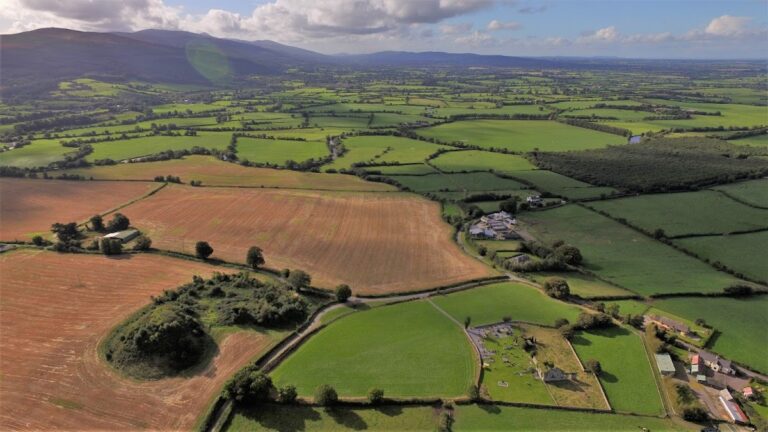
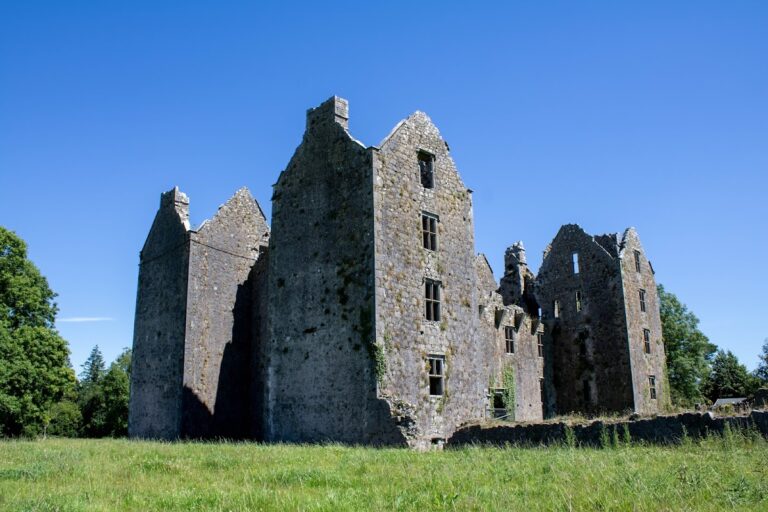
Ardfinnan Castle occupies a large rocky incline above a ford and bridge on the River Suir. The hill overlooks the Suir valley, with the Knockmealdown Mountains to the south and the Galtee Mountains to the northwest. Its layout is described as a parallelogram, with a fortified entrance gateway, a keep, and circular corner towers or a preceptory at the eastern corners. The western side contains the ruins of two towers and a great hall. Square corner crenellations are also associated with the castle. Trees in Castle Wood obscure the full extent of the complex.
Castle buildings
Eastern round tower
The surviving round tower at the eastern side of the castle is traditionally identified as a Templar preceptory, an administrative house of a military-religious order. It was probably built in the late twelfth or early thirteenth century. McCurtin’s Annals identify it as a chief preceptory during the order’s early presence in Ireland. The tower forms part of the castle’s surviving eastern group and retains its association with the Templars.
Western towers and great hall
The western side contains the ruins of two towers and a great hall. Together with the entrance gateway, keep and eastern tower, these remains express the castle’s fortified plan around the rocky site. The complex was partly ruined after the seventeenth-century slighting, and later work changed its character from a military stronghold into a country house.
Country-house restoration
Around 1846, the tower-house received a Victorian-style restoration, with adjoining buildings added during the conversion into a private residence. The property is built of rubble stone, with some sections rendered or plastered. A three-storey, gable-ended wing was probably added during the 1930s, extending the later domestic phase of the building.
Bridge, mill and associated remains
Watermill and river works
The castle’s watermill stood on the bridge and survived the Cromwellian destruction. The former monastic mill complex included a mill race and weir, features that may have been reused for later milling and cloth-finishing activities. The riverbank, bridge and road boundaries are associated with the old watermill, linking the castle remains with the crossing and industrial landscape around the Suir.
Spanish helmet
During restoration work in 1929, mill workers recovered a Spanish helmet from the castle grounds. The helmet was dated to the Siege of Kinsale in 1601, connecting a movable find from the property with the military history of early modern Ireland.
Nearby convent church
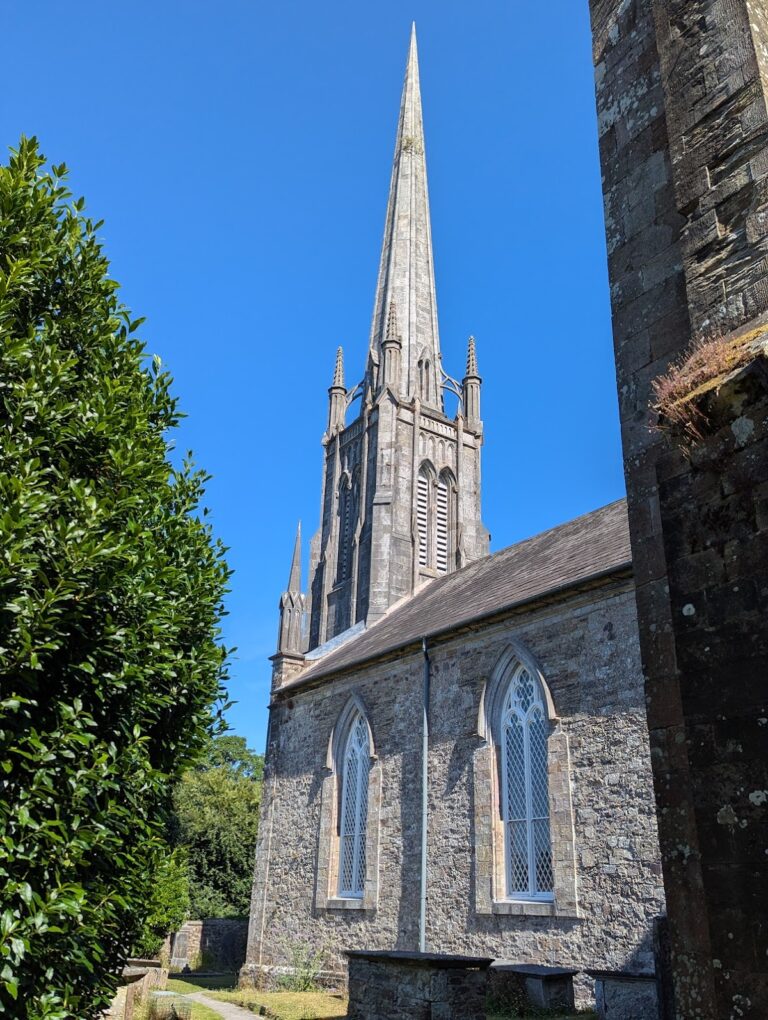
A fourteenth-century church associated with a nearby Carmelite convent survives in ruins near the castle. Stone sculptures and reliefs remain at the church, including a complex figure with intertwined beard and hair and another figure with a melancholy expression. One sculpture has been tentatively interpreted as a Tudor rose. The church forms part of the wider religious landscape connected with Ardfinnan’s former monastic and ecclesiastical uses.
Nearby sites